Can "elderly toys" make money from the silver-haired group, but not much?
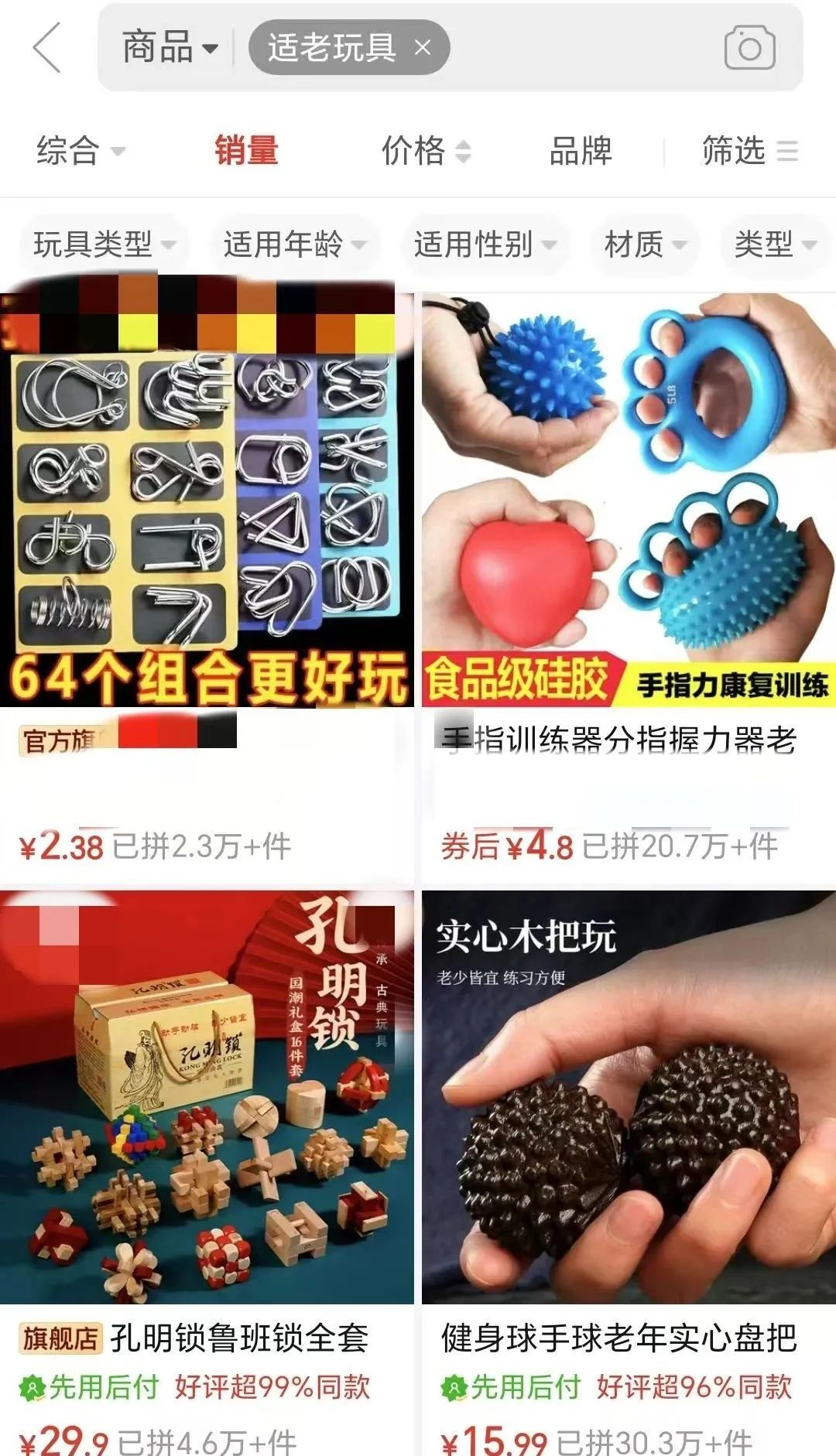
Recently, reporters have found that "toys for the elderly" have become a significant trend on e-commerce platforms. Searching for keywords like "toys for the elderly" yields dozens of relevant stores. Merchants also prominently label their product pages with slogans such as "brain - training gadgets for the elderly", "preventing Alzheimer's", "enhancing memory", and "preventing brain degeneration".
Intelligent Gomoku, colorful Kongming locks, mini bowling, magnetic collision chess, and the nine - ring puzzle... This isn't the first time toys for the elderly have sparked controversy. In 2025, media reported that in the past year, the search volume for "elderly - friendly toys" on a certain e - commerce platform increased by 124% year - on - year, and the transaction volume increased by over 70% year - on - year.
Looking at the consumer group, the proportion of consumers over 55 years old is gradually increasing, and the transaction speed is also accelerating.
However, upon closer inspection, the so - called "elderly toys" seem more like inventory promotions of children's toys. Once labeled for the elderly, the price can skyrocket tenfold. For example, a 12 - hole "puzzle ball" is priced at 156 yuan. But if you search in the children's toy category, the same product costs only about ten yuan.
The large silver - haired population has once again encountered a "scythe" tailored for them, but this business isn't that simple.
Can't Compete with Short Videos?
In June this year, the consumption power of the silver - haired population once again astonished the entire consumer market.
Data shows that in the first half of the year, the sales revenue of elderly nutritional health products and walking and hearing aids increased by 30.1% and 32.2% year - on - year respectively. The sales of smart wearable devices soared by 32.6%. During JD's "618", the sales of medical devices such as automatic ventilators and blood glucose meters increased by over 100%, and the order volume of in - home nursing services for the disabled increased by over 4 times year - on - year.
Tmall also performed well. Data shows that the transaction proportion of health supplements, clothing, and beauty products for the middle - aged and elderly continued to expand. The consumption of the new silver - haired population aged 55 - 65 increased by over 60% year - on - year. In the beauty category, the transaction volume of skin - care products with anti - aging, repair, and anti - sensitivity effects doubled year - on - year.
Amid the increasing consumption demands of the silver - haired population, the market potential of "toys" has also exploded.
According to statistics from multiple media outlets, toys for the elderly are booming both online and offline. The specific sales volume on several major online e - commerce platforms often exceeds ten thousand.
The sales volume of a finger trainer from a certain merchant even exceeded 200,000 pieces, and the sales volume of another fitness ball reached 300,000. The sales volume of traditional toys like Luban locks and Kongming locks also reached tens of thousands of pieces.
Offline, physical stores selling "toys for the elderly" attracted attention a few years ago. For example, the "Toys for the Elderly" store, which was featured in newspapers like Worker's Daily and Beijing Daily, now has over 700 types of toys suitable for the elderly, up from the initial 300 - 400. It has also developed hundreds of multi - player puzzle board games to meet the needs of the elderly to socialize through play.
Globally, the market size and demand for toys for the elderly are increasing year by year. According to IMARC Group statistics, the global toy market size reached $183 billion in 2023 and is expected to exceed $326 billion by 2032. Among all age groups, the consumption of toys by the middle - aged and elderly is on the rise.
A survey shows that 20% of respondents will buy toys for the elderly. If labeled with "anti - aging" or "anti - dementia", the traffic will further increase. A report released by the China Research and Development Institute of Industry and Commerce shows that products such as memory training blocks and voice - interactive chess designed for Alzheimer's patients have a significantly higher repurchase rate than the industry average.
It seems that toys have become a major niche in the silver - haired market.
However, while the popularity is rising year - on - year, this business may not be easy to do. According to data from the National Bureau of Statistics, as early as the end of 2024, the average annual cultural and entertainment consumption expenditure of urban elderly families in China exceeded 5,000 yuan. In contrast, Xinhua Pension Weekly reported that the annual sales of the "toys for the elderly" category on e - commerce platforms were only 320 million yuan, with a supply - demand gap of over 80%.
Do the elderly really need an "elderly - friendly" toy?
Actually, in a life where mobile phones are all - important, there is a big question mark over this business. In the past two years, short videos and short dramas have been frantically vying for the attention of the elderly. The Internet Life Report of the Elderly shows that 0.19% of the elderly spend over 10 hours a day on short - video platforms, and there may be over 100,000 elderly people in the country who are addicted to their mobile phones all day long.
Compared with the annual sales of 320 million yuan for elderly toys, the middle - aged and elderly have supported a 5 - billion - yuan short - drama market and a 1.4 - trillion - yuan cultural and tourism market.
The owners of some elderly toy stores can better illustrate the profitability of this niche.
Wang Hong (pseudonym), the owner of an elderly toy store on Taobao, once told Guangming Daily that after operating the online store for more than five years, it has one or two thousand purchases per month, but the profit is not high. Beijing Business Today reported that low profit and difficulty in control are the key reasons why many stores are reluctant to introduce and invest in elderly toys.
The situation of offline stores is even more embarrassing. Song Delong (pseudonym), the founder of "Toys for the Elderly", said that his store was once in a state of "losing money every day". Especially since the store is located in Tongzhou District, Beijing, with an annual rent of nearly 300,000 yuan. Coupled with water, electricity, and labor costs, the monthly turnover of 10,000 - 20,000 yuan can't even cover the cost.
To relieve the operating pressure of the store, Song Delong launched a membership card model, with a monthly card costing 100 yuan and an annual card costing 500 yuan. However, the elderly are naturally resistant to the membership card model, and the store's business is even worse than before. Currently, Song Delong mainly focuses on group - purchase orders from institutions such as banks, property management companies, welfare homes, and senior apartments, as well as program sponsorships and community activities.
The sales of some overseas vertical brands in China are also mediocre. It is reported that Japan's Morian Yoshi Co., Ltd., which has been focusing on toys for the elderly for 35 years, entered the Chinese market with 200 products in 2021 and suffered a loss of over 10 million yuan in the first year. Kobayashi Kenji, the president of the Chinese region, reflected to the media: "We underestimated the cultural differences."
What are the differences in consumption between the elderly at home and abroad? The developed short - video culture may be the best answer.
With mobile phones, why buy toys? Where does the short - video win? It is free, can provide instant gratification, requires no learning cost, and even offers a false sense of social interaction... In the battle for the attention of the elderly, the carefully crafted physical toys have revealed the cruelest truth of the silver - haired economy from the very beginning.
Children's Demand is Decreasing, but Toy Manufacturers Don't Want to Do Business with the Elderly?
Interestingly, compared with the operating difficulties, the difficulty in finding suppliers for elderly toys is the real bottleneck of this business.
Before opening "Toys for the Elderly", Song Delong visited toy stores of all sizes in Beijing but couldn't find toys specifically designed for the elderly or relevant manufacturers. Helplessly, he had to screen and contact more than 3,000 relevant manufacturers one by one, trying out and selecting the products for the store one by one.
In June this year, Beijing Daily also reported that most toys for the elderly are just children's toys with a changed label, and then the price skyrockets. According to data from Zhiyan Consulting, 87% of the so - called "elderly toys" on the market are modified children's toys, and products with truly elderly - friendly designs account for less than 5%.
Logically, as the growth of the children's consumer market slows down, the silver - haired population is likely to become the next major consumer group in the toy market. Toy manufacturers should be more eager to seize the "elderly - friendly" trend. However, the opposite is true. Beijing Business Today reported that there are almost no enterprises specializing in toys for the elderly on the market. Many manufacturers have abandoned this field after evaluating the market for elderly toys.
Why is this the case?
First of all, although the consumption of toys for the elderly has become popular on e - commerce platforms, its scale is not large enough to attract upstream manufacturers. Xinhua Pension Weekly reported a toy company. Its product director said: "Last year, we tried the elderly jigsaw puzzle market. The first batch of 5,000 sets of products were overstocked for 9 months. Finally, we had to change them into toys for grandchildren to clear the inventory."
It was thought that the growing elderly population would replace children and "save" the sluggish toy market, but the result was the opposite.
Secondly, the design and R & D of toys for the elderly require a large investment. Some products also need to have rehabilitation functions, and the material requirements are high. Before the consumer demand is fully unleashed, manufacturers are reluctant to enter the market easily. Many manufacturers that Song Delong negotiated with said, "Enterprises simply have no motivation to invest manpower and material resources in the R & D of toys for the elderly."
Of course, things may change in the future. After all, the contrast between the children's consumer market and the silver - haired consumer market is becoming more and more obvious.
In fact, in some overseas markets where the silver - haired economy is booming, there are many examples of children's toy manufacturers "transforming" toys for the elderly. A typical region is Japan. It is reported that many Japanese toy companies have shifted their focus from the children's market to the elderly market.
For example, Trendmaster shifted its production focus to communication - type toys for the elderly as early as 2011 and also launched companion toys such as pet cats and pet dogs; 20% of the toy products of Japan's Bandai Company are targeted at the elderly market; the mechanical doll PARO developed by Japan's Daiwa House Industry Group can interact with the elderly.
The market for toys for the elderly in the United States is also quite developed. A professor at California State University said that about 40% of toys in the United States are specially developed for the elderly. On overseas online shopping platforms such as Amazon and Rakuten, the "toys for the elderly" category has been established. Last year, Global Times reported that toys for the elderly have become a new favorite in the European and American markets.
It is worth noting that the turning point of China's "toys for the elderly" market may occur in the AI era.
While many toy manufacturers are still hesitant about the growth of the silver - haired market, e - commerce platforms and AI companies have taken the lead. Xinhua Pension Weekly reported that as early as 2023, Pinduoduo launched the "Silver - Haired Laboratory", adopting the "elderly evaluation group" model to customize products in reverse. For example, it turned traditional chess into voice - controlled chess; Taobao also plans to establish an "elderly - friendly toy" category, covering at least 20,000 products.
In January 2026, the second batch of self - developed AI toys of JD Jingzao was launched, and new AI toys for the elderly were developed.
There are an endless stream of "tech - savvy" toys for the elderly, such as the intelligent Huarong Dao with built - in pressure sensors and AI chips; various AI plush toys that can talk and be called; the Shenzhen Toy Industry Association predicts that the scale of China's AI toy market will exceed 10 billion yuan around 2030, with an annual compound growth rate of over 70%.
However, can the entry of AI and the promotion of e - commerce platforms really break the ice in the market for toys for the elderly?
The collective wait - and - see attitude of upstream manufacturers may not be easily changed.
Why is it Getting Harder to Do Business with the Elderly?
To date, the number of people wanting to enter the silver - haired consumer market has increased significantly.
The latest data from the State Taxation Administration shows that in the first half of 2025, the number of entities engaged in the production and manufacturing of silver - haired products nationwide increased by 14.1% year - on - year; the sales revenue of the manufacturing of elderly - friendly fitness equipment, rehabilitation aids, and nutritional health products increased by 14.7%, 12.1%, and 6.9% year - on - year respectively, which were 9.5, 6.9, and 1.7 percentage points higher than the average growth rate of the national manufacturing industry respectively.
But is it really easy to do business with the silver - haired population?
For a long time in the past, the middle - aged and elderly were the most stable foundation for the consumer market, once establishing a unique and efficient commercial conversion system. This business logic contributed to the golden age of certain industries, with typical examples being the health - product market, the live - streaming e - commerce market, and the convalescence market.
However, after the glorious days, when the consumption power of the silver - haired population is further increasing, these industries that used to "make easy money" are actually getting worse. Especially in the health - product industry, in the past two years, the consumption of health products has cooled down significantly. The revenue of the leading enterprise, BY - HEALTH, decreased from 9.4 billion yuan in 2023 to 6.2 billion yuan in 2025.
Donkey - hide gelatin producer Dong'e Ejiao has even targeted young people. Brands such as Zuleijian, Health and Happiness Group, and Shouxian Valley... are all having a harder time. The data of the convalescence industry is even more dismal. A research report from the Bank of China shows that from 2018 to 2022, for five consecutive years, the average profit margin of national commercial elderly - care service institutions has been negative, with a fixed - asset profit margin of - 2.97% and an operating profit margin of - 13.71%.
Seeing that the consumption level of the silver - haired population is likely to dominate the consumer market, why is it even harder to do relevant business?
On the one hand, among the large silver - haired population in the country, the proportion of real "high - net - worth" individuals is not high. Xinhua Pension Weekly gives a figure of 10%. This 10% needs to support the partial prosperity of high - end elderly - care communities, sojourn - style convalescence, and luxury consumption. Up to 90% of the middle - aged and elderly can only afford basic living expenses.
This results in high - quality and high - end consumption not being the mainstream in the silver - haired market. Instead, low price, affordability, and cost - effectiveness are the common criteria.