With an annual revenue of 1 billion yuan and a staggering 1700% surge over five years, the post-80s entrepreneur in Zhejiang who develops street-sweeping robots is heading for an IPO.
According to reports from multiple media outlets, Coowa is preparing for a Hong Kong IPO and plans to officially submit its IPO application within the next two to three months.
Previously, Coowa secretly completed a new round of financing exceeding $600 million, with a post - investment valuation of over $3 billion (approximately RMB 20.3 billion).
Coowa focuses on sanitation robots. In 2025, its revenue exceeded RMB 1 billion, and the pending orders were worth over RMB 5 billion. More interestingly, Coowa's sales team has always been around 20 people, yet it has increased its business volume by 17 times in five years.
Coowa aims to prove in urban service scenarios that embodied intelligence can first become a profitable business in dirty, tiring, repetitive, and labor - scarce areas.
01
From Suitcases to Sanitation Vehicles
Coowa was founded in 2015. Its founder, He Tao, is from Yiwu, Zhejiang. He is an 80s generation and graduated from Shanghai Jiao Tong University's School of Electronic Information and Electrical Engineering in 2008. He once conducted research on autonomous driving at the Tokyo Institute of Technology, studying under the world - renowned robot expert Shigeo Hirose (who has developed snake - shaped robots, pipeline inspection robots, mine - clearing robots, etc.).
At the end of 2012, He Tao returned to Shanghai Jiao Tong University as a faculty member. In 2015, he founded Coowa.
Coowa's earliest direction was to develop an intelligent suitcase that could follow people. Due to low user acceptance, this product was abandoned. The company also tried to apply autonomous mobile technology to shopping carts in large shopping malls.
From 2017 to 2018, Coowa explored indoor scenarios (food - delivery robots), closed scenarios (ports, airports, mining areas, etc.), semi - closed highway scenarios (trunk logistics), and urban open - road scenarios. Based on the transferability of data and technology and the scalability of scenarios, it finally focused on three sub - fields in urban scenarios: municipal sanitation, urban distribution logistics, and urban transportation.
He Tao believes that instead of directly challenging the most complex open - road Robotaxi, it is better to start from more controllable and essential low - speed scenarios.
He compares the commercialization of L4 autonomous driving to "three circles".
The first circle is sanitation. Sanitation vehicles mostly operate within a fixed area with a diameter of about 10 kilometers, with relatively stable routes, low speeds, and clear operation targets. The second circle is urban distribution logistics, with an activity radius that may expand to 100 kilometers. The third circle is Robotaxi, with dense point - to - point routes, a larger scope, and the most long - tail scenarios.
Coowa chose the first circle.
A small vehicle driving on the road by itself, identifying road garbage, automatically cleaning, and avoiding pedestrians and vehicles. This may not sound high - tech, but it was the most realistic unmanned driving implementation scenario in the world at that time: fixed operation areas, low speeds (generally not exceeding 30 km/h), low regulatory risks, and real customers (government sanitation departments and property management companies) willing to pay.
Around 2018, Coowa's autonomous sanitation vehicles started operating on the streets of Shenzhen, Changsha, and Hefei. If it continued like this, Coowa would be an autonomous driving company with a very vertical scenario and have nothing to do with embodied intelligence.
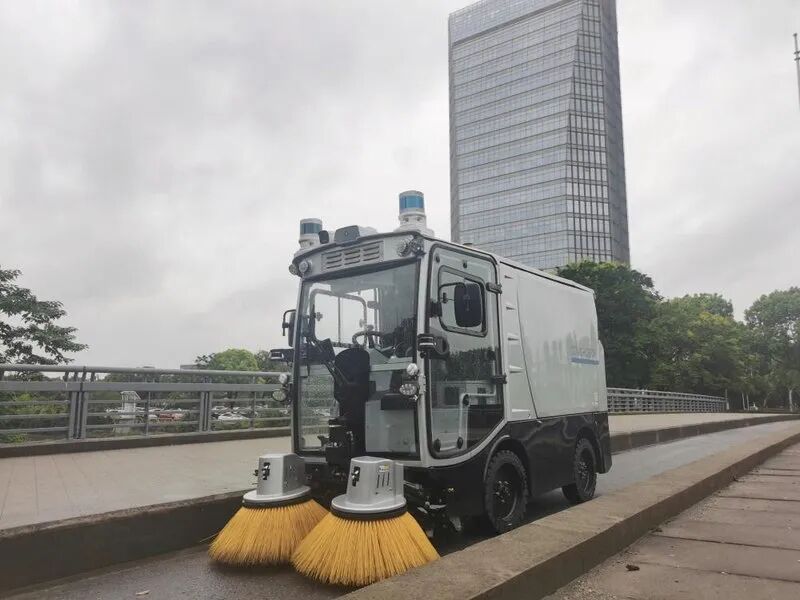
Coowa's sanitation robots operating on urban streets. Source: Public information
The turning point occurred in 2021. With the rise of the Transformer architecture and end - to - end AI, embodied intelligence became possible.
In November 2022, OpenAI released ChatGPT - for the first time, AI had general language understanding and reasoning abilities.
Liao Wenlong, Coowa's CTO, believes that "after the emergence of ChatGPT and end - to - end AI, we saw the possibility of creating general and productive robots - both mobility and operation capabilities can be solved by large models."
In the past, for autonomous driving, engineers had to write rules line by line ("stop at a red light", "slow down when seeing a pedestrian"); now, with large models, AI can "learn after one look" like a human. This paradigm shift gives a company like Coowa, which has "operated on real streets for several years and accumulated a large amount of real data", the potential to be "general".
Therefore, Coowa made a key strategic decision: to upgrade from "autonomous sanitation driving" to a "full - stack provider of urban embodied intelligence".
To make this path successful, Coowa took several steps.
First, it invested heavily in building a data lake. By 2026, Coowa had accumulated over 50 PB of high - quality data. What does 50 PB mean? It is approximately equivalent to 500 million high - definition movies. It contains "robot - perspective" videos from more than 50 cities and 45 million kilometers of real operation mileage. Every frame is the world seen by robots on real streets. This is more valuable than any company that "does demos in the laboratory".
Second, it built a dark factory. In Yongkang, Zhejiang, Coowa built an AI robot dark factory covering an area of over 100,000 square meters (a "dark factory" is a fully automated factory where even lights don't need to be turned on). It handles everything from hardware design to large - scale mass production by itself. Self - developed and controllable core components are the key for Coowa to control costs.
Third, it focused on the world model. In May 2026, Coowa released the industry's first interactive world action model - CooWAIM 2.0.
02
The Strongest "Sweeping Monk"
Today, Coowa has three major business segments:
Smart City Steward: This is the core and most profitable business. The main products are the "Kylin" X3, "Unicorn" X1 and other series of urban sanitation robots, and the main customers are government sanitation departments and property management companies. In large - scale orders worth over ten million yuan (at least 10 vehicles per project), Coowa's market share is about 80%. With 80% of the share in a sub - field, Coowa has almost monopolized this "most down - to - earth business".
According to a report from Titanium Media, the national demand for smart sanitation exceeded RMB 7.4 billion per year in 2025, about four times that of 2023.
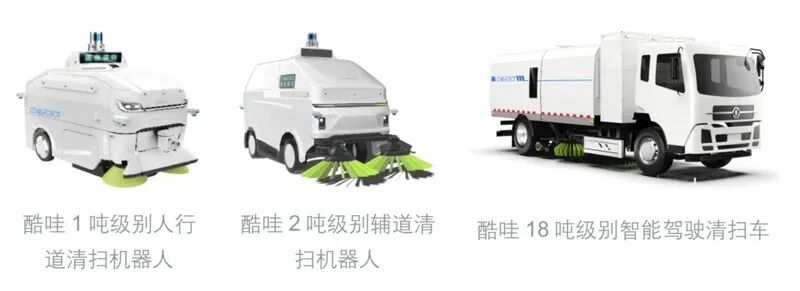
Coowa's 1 - ton, 2 - ton, and 18 - ton cleaning robots. Source: Public information
Smart Mobility: It self - develops the L4 - level autonomous minibus CooBus to solve the "last three - kilometer" travel problem. The cumulative safe operation mileage has exceeded 5 million kilometers. This business line is in line with the earliest autonomous driving and is Coowa's "foundation".
Smart Property Management: For high - end office buildings and closed - off industrial parks, Coowa has launched a "product combination" consisting of the wheel - legged robot R0 and the quadruped robot D0, targeting scenarios such as building delivery and security patrol. This business line is currently small in scale but growing rapidly.
You can see that Coowa's product matrix has one thing in common: all are services in the "urban capillaries" - sweeping, patrolling, shuttling, and delivering.
The advantages of this approach are obvious: clear payers (government/property management/industrial park management), standardizable scenarios (low cost to replicate to the next city after succeeding in one), and high data value (video data from real operation scenarios is the best material for training the world model).
Li Kehong, Coowa's COO, revealed to the industry media RoboX that Coowa's order backlog has exceeded RMB 5 billion. Moreover, Coowa's sales team has always been around 20 people, yet it has increased its business volume by 17 times in five years.
The national demand for sanitation workers is 7 - 8 million. Now, the average age of sanitation workers is close to the retirement age, and the shortage is up to half of the demand. One intelligent robot can replace the workload of about five people.
It should also be noted that this model has a limited ceiling. A city's annual sanitation budget ranges from several billion to over ten billion yuan, and the total across the country is a relatively stable amount.
03
Three Major Challenges
In 2026, Coowa's total product shipments are expected to exceed 10,000 units. As it officially embarks on the IPO journey, Coowa still faces several challenges to be examined by the capital market.
The first problem is whether it can maintain the delivery quality after deploying tens of thousands of units.
For a robot company, making dozens or hundreds of prototypes in the early stage is completely different from large - scale operation. Urban service robots have to face a large number of complex scenarios such as rain, snow, high temperatures, dust, muddy water, damaged roads, pedestrians crossing, non - motorized vehicles going in the wrong direction, pets suddenly running out, and the approach of the elderly and children. The road conditions, management rules, and customer standards in each city are also different.
The larger the scale, the more long - tail problems there are.
Coowa now emphasizes real - world physical data and the world model, and the logic is valid. The more robots are deployed, the more data there is, the faster the model is iterated, and the more stable the system is. However, whether this flywheel can keep running depends on data quality, automatic annotation ability, simulation verification ability, remote operation and maintenance ability, and safety backup mechanisms.
The second problem is whether Coowa is a high - margin AI company or a heavy - asset equipment and operation company.
Coowa uses "full - stack self - development" and the "MaaS model" to enhance its barriers. On the one hand, self - developing the chassis, domain controllers, models, operating systems, and some core components helps control costs and performance; on the other hand, MaaS can turn one - time equipment sales into continuous service revenue and increase customer stickiness.
Under the MaaS model, Coowa needs to continuously participate in subsequent operations: whether the equipment is online, whether the tasks are completed, whether the routes are reasonable, whether faults are promptly handled, whether the operation quality meets the standards, and whether customers renew their contracts. This places higher requirements on the company but also brings stronger customer stickiness.
In the future, we need to pay attention to the proportion of hardware, software, and services in the revenue and the degree of dependence on large customers.
The third problem is that although urban service scenarios are essential, expansion may not be easy.
In the domestic market, sanitation and urban services have strong local characteristics. The financial capabilities, outsourcing mechanisms, operating entities, and bidding processes of each city are different. For a robot company to grow, it not only needs reliable technology but also needs to enter complex government - enterprise and industrial customer systems.
What really deserves attention when Coowa rushes for a Hong Kong IPO is not just how much money it raises and its high valuation, but that it may provide a new valuation reference for the commercial embodied intelligence track.
In the past two years, the hottest narrative in embodied intelligence has focused on humanoid robots. Capital is willing to pay for the "future": future use in factories, future entry into families, and future replacement of manual labor. However, the problem is that many companies are still at the prototype, demo, and pilot stages and are still far from stable revenue, large - scale delivery, and continuous profitability.
Coowa presents a different logic: it promotes embodied intelligence from "whether it can be made" to "whether it can operate, be sold, and be continuously operated".
The capital market will for the first time see relatively comprehensively how a commercial embodied intelligence company enters essential scenarios such as urban sanitation, property management, and unmanned shuttles, exchanges real deployments for orders, accumulates data through real operations, and then uses the data to feed back the model and products.
This is what makes Coowa more charming than Unitree, but it also means greater challenges.
This article is from the WeChat official account "Pencil News" (ID: pencilnews), written by Huang Xiaogui and edited by Zhu Zhishan. It is published by 36Kr with permission.