Behind the 380 Million-View Hit: AI Drama Industry Undergoes Reshuffle, Workflow Outperforms Luck as Mid-Tier Players Overtake on the Curve
The AI short drama track has recently witnessed multiple changes, with continuous reshuffling in the industry. The extensive model of blindly following trends by luck and accidentally creating a hit is no longer sustainable. However, a group of mid - tier and small - to - medium - sized manufacturers have managed to break through against the odds during this period, achieving a "corner overtaking."
Recently, Beijing Shusheng Wanjuan, which stood out in the May DataEye AI Drama/Anime Drama Top 100 list, is a typical representative of this trend. Its production, "Reborn in the 1980s: A Warm Family Life," has exceeded 380 million views, ranking among the top in the May DataEye AI Drama/Anime Drama Top 100 list.
In this article, the DataEye Research Institute will take Shusheng Wanjuan as a case study to analyze how mid - tier and small - to - medium - sized manufacturers can achieve a counter - attack from "accidental popularity" to "replicating hits" in the ever - changing landscape of AI short dramas.
Analysis of the Ideas Behind the 380 - Million - View AI Drama Hit
(1) Data Verification: Small and Medium - Sized Factories Can Also Produce Hits
"Reborn in the 1980s: A Warm Family Life" by Shusheng Wanjuan has exceeded 380 million views on the Douyin platform (as of June 16) and has accumulated 830,000 collections on the Hongguo platform, ranking among the top in the May DataEye AI Drama/Anime Drama Top 100 list.
Notably, Shusheng Wanjuan did not invest a large amount in buying traffic, nor did it have the support of top - tier IPs. Its market performance is mainly driven by the content itself and the production system.
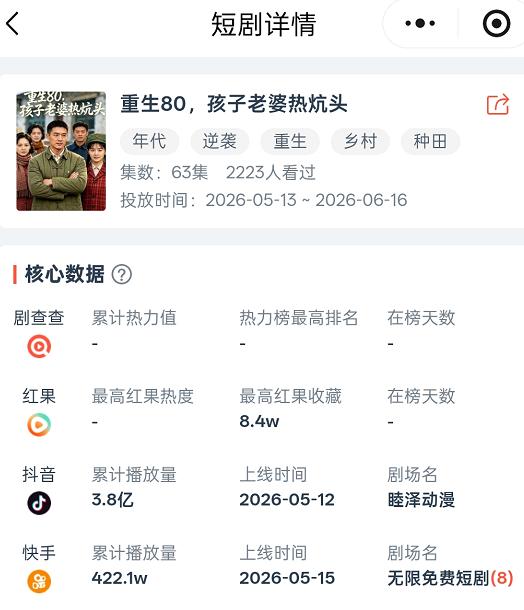
This reflects an important change in the industry's competition logic: the focus of competition in AI short dramas has shifted from capital and traffic investment to the combination of content screening ability and industrial production ability.
For small and medium - sized manufacturers, this is actually an opportunity - hit dramas are starting to rely more on the company's system and content judgment ability rather than initial capital.
(2) Content Structure: Precisely Match the Creation Rules of AI Short Dramas
Analyzing the content structure of "Reborn in the 1980s," we can find that its success is not accidental but in line with the rules of creating hit short dramas.
Currently, the mainstream AI short dramas are mainly in the vertical - screen format with an episode length of 1 - 3 minutes and generally adopt the business model of "free in the early episodes and paid later." This means that the drama must build conflicts and capture users in a very short time, with high requirements for rhythm control, character shaping, and plot density.
"Reborn in the 1980s" does the following: it quickly introduces conflicts at the beginning. After the protagonist travels back to the 1980s, he immediately gets involved in contradictions, quickly establishing a plot hook; it completes the image shaping of the main characters within two episodes, clarifying the protagonist's growth line; the whole drama is densely packed with exciting moments, reversals, and suspense, perfectly fitting the core of short dramas with "fast - paced and strong emotions."
After the popularity of "Reborn in the 1980s," Shusheng Wanjuan launched a new work, "Starting with a Demotion, I Ascend to Become a Land Immortal." The drama's popularity on the Hongguo platform has exceeded 50 million, further verifying the universality and replicability of its production system.

From the perspective of industry evolution, the value of this case lies in: the competition threshold for AI short dramas has been upgraded from the early stage of "whether you can produce it" to "whether you can stably produce content that meets market demand and is suitable for the AI production process."
This means that mid - tier and small - to - medium - sized manufacturers have found space for differentiated development.
The Underlying Architecture for Stable Production of Hits: A Three - Layer Business System
Shusheng Wanjuan's ability to continuously produce works with good market performance is not due to luck but a complete business system: its own online literature IP library, standardized production process, and self - developed AI middle platform. The three cooperate with each other to form a complete closed - loop from content screening, mass production to efficiency optimization.
(1) Own IP Library: Pre - screening to Reduce Trial - and - Error Costs
Adapting an AI drama is not simply generating a video from an online novel. The theme, character settings, narrative rhythm, and compatibility with AI production of the IP will directly affect the project's implementation cost and market performance. Therefore, content screening is the most preliminary and crucial step in the production process.
Shusheng Wanjuan has its own online literature IP reserves, with a total of more than 10,000 books, including more than 4,000 exclusive/signed IPs, with an average annual increase of more than 2,000 books. More than 100 IPs have been adapted into short dramas. This provides sufficient options for its content screening and industrial adaptation.
This kind of reserve is not just about quantity. You know, the premise of IP adaptation is clear copyright ownership. For the platform and partners, any unclear copyright issues will directly affect the launch rhythm and commercial recovery. Having more than 4,000 exclusive/signed IPs means that a large amount of copyright confirmation, authorization negotiation, and ownership risks can be reduced during project implementation.
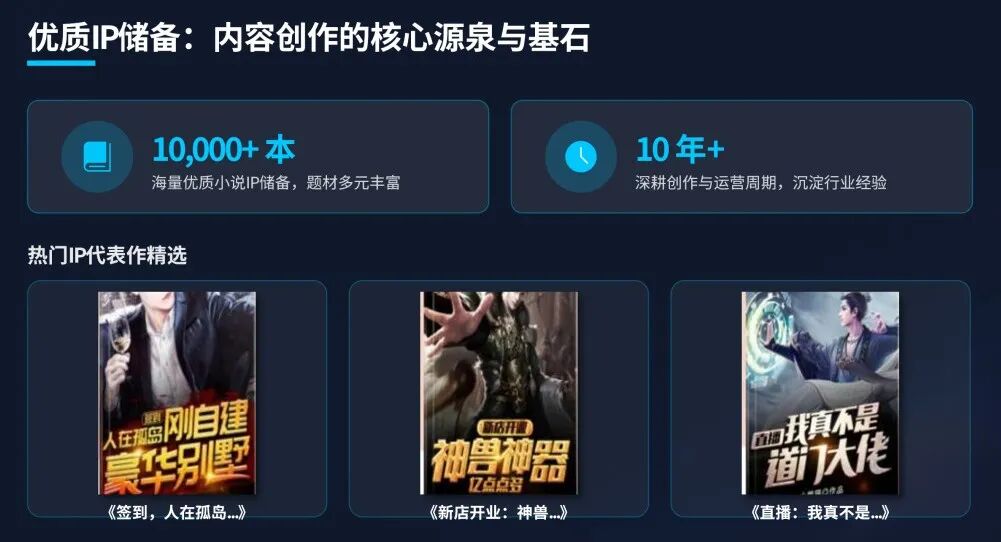
Moreover, compared with the traditional "script - collection form," the advantage of IP screening is more obvious. Most traditional short - drama manufacturers adopt the model of purchasing finished scripts. Usually, they can only evaluate the theme, rhythm, cost, and market adaptability of the script after it is completed. Once the content does not meet the requirements, the previous investments in communication, creation, modification, and procurement will become sunk costs.
Companies with their own IP libraries, such as Shusheng Wanjuan, can optimize from the source: relying on the IP library for batch screening, classification, and adaptation evaluation, and giving priority to content that is suitable for AI production and has market potential, thus reducing the ineffective early - stage investment and improving the overall operation efficiency.
In addition, most of the online literature IPs used for adaptation have been tested in the reader market. The story framework is relatively mature, and they have a certain audience base. This makes the content of the adapted drama more stable, and the certainty of market performance is relatively higher.
(2) Self - built Standardized Workflow: Hits Are No Longer "Random"
There is a common pain point in the AI short - drama industry: it is difficult to ensure the consistency of characters and pictures before and after the drama, which ultimately leads to fluctuations in production capacity, unstable quality, and out - of - control costs.
In response to these problems, Shusheng Wanjuan has built a standardized production system covering the whole process internally. The job responsibilities, delivery timeliness, output standards, and collaboration rules of each link from topic selection confirmation to post - launch review are clearly defined. This system effectively improves the problems of chaotic production processes, unclear responsibilities, and difficult - to - control project schedules in the traditional small - workshop model.
The design of the whole process has several key features:
· First, pre - confirmation for quick decision - making. Topic selection and script review are completed within a few hours to quickly determine whether the content is suitable for AI drama production, avoiding rework in subsequent links and increasing cost consumption;
· Second, parallel production to compress the project schedule. The production of art assets and storyboard work are carried out simultaneously, and video generation and rough cutting also adopt a multi - task parallel mode, turning the originally linearly - advanced work into multiple lines running simultaneously, significantly shortening the production cycle;
· Third, early intervention of fine - cutting to reduce rework. The editing team gets involved in the middle of the card - drawing stage instead of waiting until all the materials are generated, so that problems can be found and corrected in time, avoiding large - scale rework in the later stage.
· Fourth, data review to form a closed - loop. After each drama is launched, the operation team monitors the data synchronously. After the project is completed, experience is reviewed and precipitated to feed back the next round of topic selection and production.
Under such a process, a standard - sized drama of about 70 episodes and 80 minutes in length can be launched within a month from preparation. According to Shusheng Wanjuan, the team can simultaneously promote 3 - 4 projects per month and deliver 3 - 4 complete dramas on average per month. The production process is highly controllable and efficient.
According to Shusheng Wanjuan, after introducing AI tools, the efficiency of the standardized process can be further improved: AI automatically disassembles the script and generates an asset list, increasing the efficiency of pre - production script preparation by about 10 times; AI generates character materials in batches, increasing the output efficiency of character assets by 5 times; automated storyboarding increases the efficiency of video generation and trial - and - error by 5 times, and the overall rework rate of the project is reduced by 50%. In long - term operation, materials such as characters, scenes, shot templates, and prompts can be precipitated and reused, and the material reuse rate of similar projects is increased by 2 - 4 times, forming a positive cycle of production efficiency.
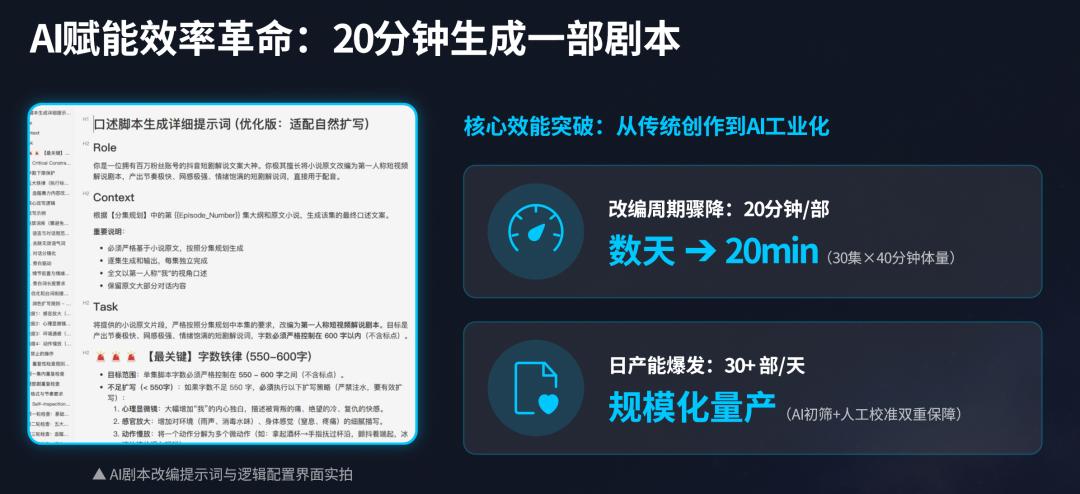
(3) Self - developed AI Middle Platform "Lumet": Technological Foundation Empowers High - Quality Works
If the standardized workflow is the "skeleton" of production, then the self - developed AI middle platform is the "core engine" that drives the skeleton to operate. Shusheng Wanjuan's self - developed AI middle platform, "Lumet," is a full - process anime drama production platform covering the whole chain of script adaptation, asset management, storyboard production, and video generation. This platform can compress the production cycle of a single project to the weekly level, with an overall efficiency improvement of 60% compared with the traditional manual process.
The core role of this AI middle platform is reflected in three aspects:
First, full - process automation to improve efficiency. The platform embeds AI capabilities into each production link. Script disassembly, art asset generation, shot rendering, video synthesis, etc. can all be completed automatically, replacing a large amount of repetitive manual labor and significantly shortening the production cycle. For example, in the pre - production script preparation stage, Shusheng Wanjuan uses "Lumet" to automatically disassemble script assets and generate a reusable asset list, which is 10 times more efficient than traditional manual asset statistics.
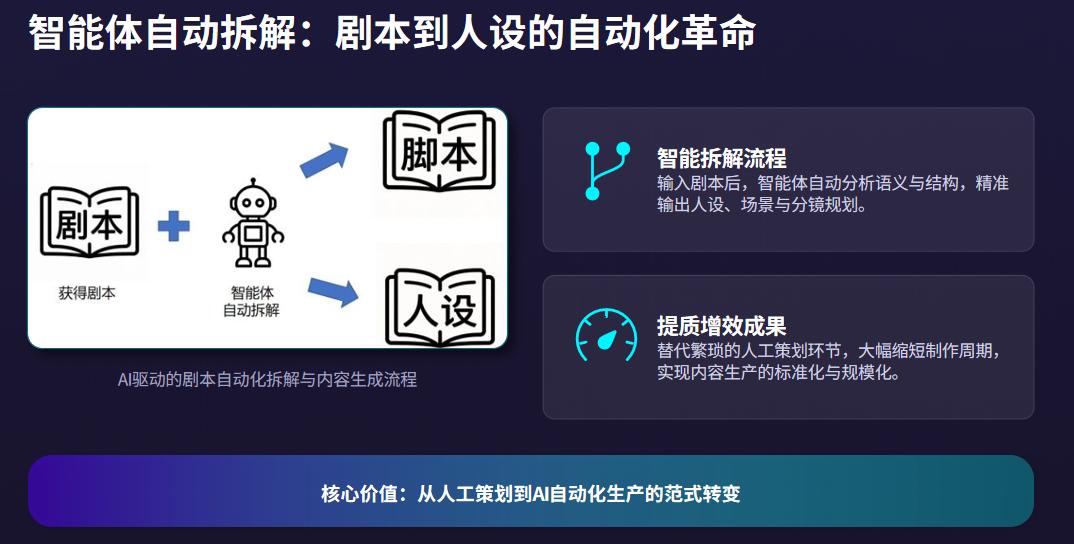
Second, multi - model adaptation to reduce production fluctuations. The platform supports seamless switching between multiple video models and can automatically adapt prompts, shot parameters, and picture constraints according to the rules of different models. When the effect of a certain model is not good, the scheme can be quickly switched and the existing materials can be reused, reducing the risk of project stagnation; at the same time, it can automatically classify problem shots for targeted optimization, reducing ineffective rework.
Third, unified asset management to improve reuse efficiency. The platform centrally stores resources such as character images, scene materials, shot templates, prompts, and model parameters of all projects, forming an enterprise - level digital asset library. New projects can directly reuse mature materials and templates without starting from scratch, which helps to reduce production costs and ensure the stability of the finished product's style and quality.
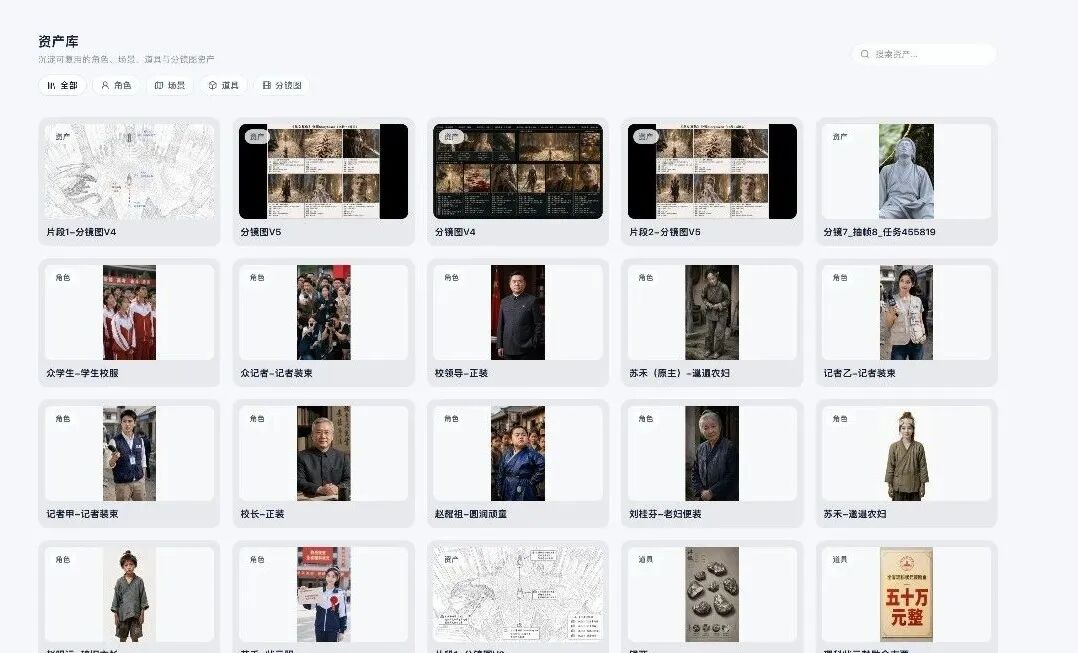
The deep integration of the IP library, standardized workflow, and AI middle platform constitutes Shusheng Wanjuan's closed - loop system of "content selection + industrial production + technological empowerment," which is also the confidence for it to continuously produce hits.
(4) Business Expansion: From Self - Production to Empowering the Industry
Notably, Shusheng Wanjuan is not satisfied with only developing in the AI drama field and is constantly expanding its business boundaries, extending from simple content production to industry services. Relying on its talent matrix, AI production middle platform, script adaptation ability, and full - process production and distribution resources, it opens up cooperation channels: on the one hand, it provides services such as AI production tools, script customization, and drama production for small and medium - sized manufacturers and creators; on the other hand, it outputs its standardized production process and IP screening methodology externally.
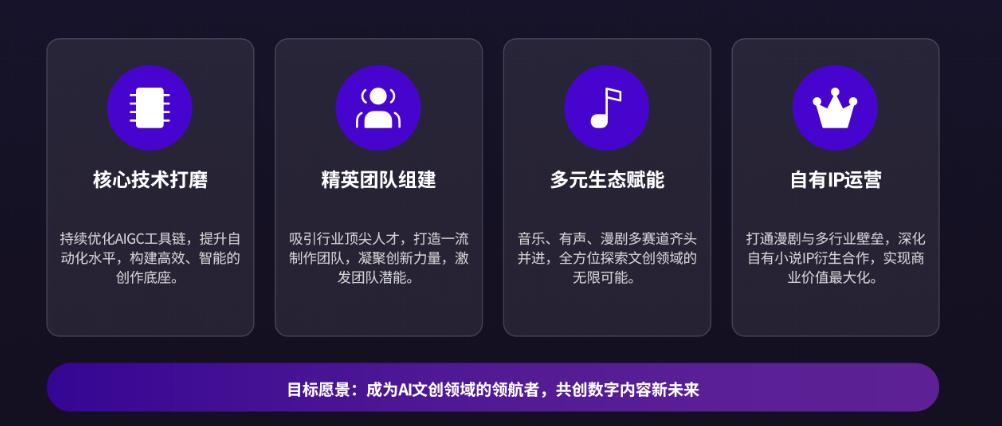
This layout not only broadens its own business scope and improves its risk - resistance ability but also provides a reference for the business expansion of small and medium - sized manufacturers in the industry.
Industry Reshuffling: Three Types of Enterprises May Stand Out
Currently, the dividend of the AI short - drama industry is fading, and it has entered a deep adjustment stage. The competition logic has undergone fundamental changes. The model of simply relying on following hotspots, low - quality mass production, and traffic speculation is becoming increasingly unsustainable. The industry is evolving towards high - quality, industrialized, and data - driven development as a whole. Based on the practice of Shusheng Wanjuan, the DataEye Research Institute believes that three types of enterprises may remain competitive or even rise in this round of reshuffling.
(1) Enterprises with All - Staff Creation Ability
The core asset of this type of enterprise is not technology or traffic but a mature content judgment system - knowing what kind of stories can touch people, what