Humanoid robots are still learning to work, but dexterous hands have already become a hot business
The dexterous hand is the most expensive component of humanoid robots. Although it accounts for 17% of the BOM, it is trapped in the "performance-cost-reliability" impossible triangle. Capital has soared to 8.7 billion, but no company in the entire industry has truly made a profit.
One is a startup that has been established for less than 3 years, and the other is a star enterprise active on the Spring Festival Gala stage. Surprisingly, their valuations are in the same echelon.
The above is not science fiction but the current situation of the humanoid robot track.
The first one is Lingxin Qiaoshou. Media reports say that Lingxin Qiaoshou plans to seek a valuation of $6 billion (equivalent to about 41 billion yuan) in the next round of financing, doubling its previous-round valuation.
The second one is Yushu Technology, which is going public on the Science and Technology Innovation Board. Based on the planned fundraising of 4.202 billion yuan and a rough estimate that the public offering ratio is not less than 10%, the initial issuance market value is about 42 billion yuan.
Why can the "unknown" Lingxin Qiaoshou match Yushu in terms of valuation? The reason can be traced back to Morgan Stanley's disassembly of Tesla's Optimus - the dexterous hand accounts for 17.2% of the total cost of the humanoid robot and is the most expensive single component.
According to the statistics of Gaogong Humanoid Robots, in the first quarter of 2026 alone, the financing in the domestic dexterous hand industry approached 5 billion yuan, 70% higher than the whole year of 2025. Even though the sales volume of the Chinese dexterous hand market was only about 19,200 in 2025 (data from GGII) and it was still a "small pond", capital has already been valuing it as a "big ocean".
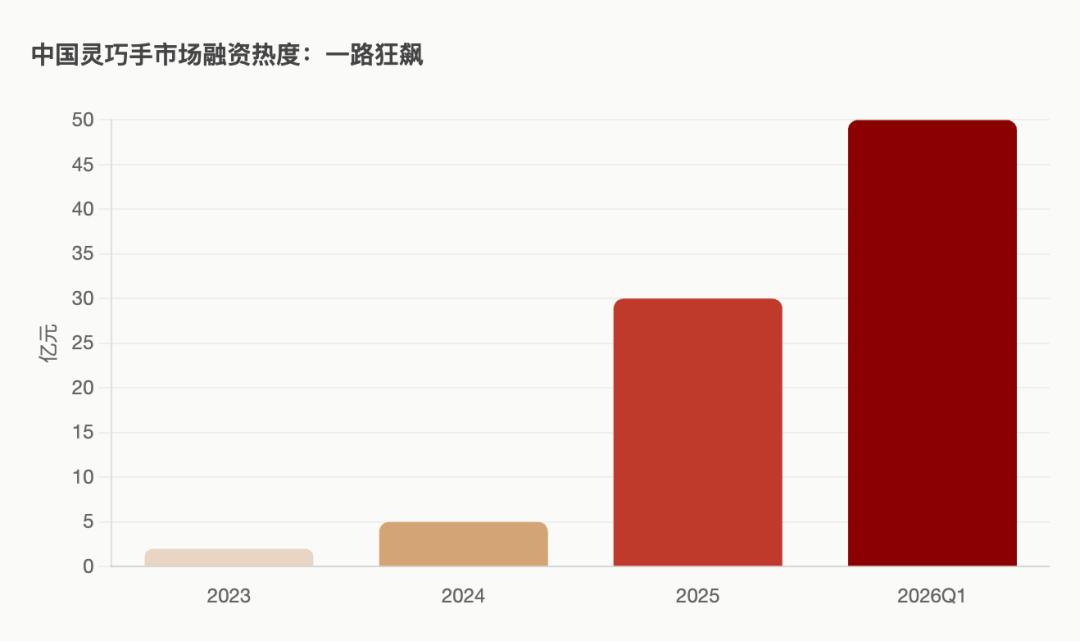
The dexterous hand may be the most charming capital story in China's hard technology industry in 2026, but it may also be the most dangerous bubble.
The "hand" that Tesla can't handle exposes the industry's Achilles' heel
Back in October 2025, Elon Musk said bluntly in Tesla's Q3 earnings conference call: "The manufacturing difficulty of the forearm and hand is even greater than that of all other parts of the robot."
Optimus' mass production plan was held back by a pair of hands.
It's not that Musk was "backing out". Instead, the hand design of Optimus Gen3 is too complex: each hand has 22 degrees of freedom, only a little less than the 27 of a human hand.
The price is to fit all 25 linear actuators into the forearm and pull the fingers through tendon ropes - very similar to the tendon structure of the human body. However, tendon ropes have elastic deformation, friction, and there will be coupling interference between multiple ropes. The control complexity increases exponentially, and it also needs to be non-shaking and non-lagging.
In addition to the delay in mass production time, Musk also wants to reduce the price of Optimus from $40,000 to $20,000. However, a field research report on China written by relevant people from Physical Intelligence and B Capital poured cold water on Musk's ideal: "The key to cost reduction lies not in large-scale mass production but in simplifying or improving the design."
Why can't large-scale production reduce costs? Because the dexterous hand is stuffed with too many things.
The minimum diameter of the micro-transmission system is only 3.4 millimeters, and the sensors are thinner than a ballpoint pen refill. Hollow cup motors, micro lead screws, tendon ropes, precision bearings... all have to be compressed into a space the size of a human hand. Challenges such as assembly man-hours and yield rate will not automatically disappear due to large-scale production.
Corresponding to this is an industry term, the "impossible triangle" of the dexterous hand: If the performance is high, the cost can't come down; if the cost is low, even basic grasping is difficult; if the reliability is improved, the design has to be simplified, and the performance will be compromised.
Want all three? Sorry, the laws of physics don't allow it.
Researchers from Physical Intelligence believe that the problems of precision assembly man-hours and yield rate of the dexterous hand may be a rare category in the manufacturing industry where "large-scale production cannot spread the cost", completely different from the curve of "the larger the scale, the lower the cost" in the photovoltaic and power battery industries.
But in the eyes of Chinese entrepreneurs, challenges and opportunities are equal.
Since most of the parts of Tesla's dexterous hand come from Chinese suppliers, sensitive capital quickly turned its attention and rushed to find "upstream shovel sellers".
The logic is simple: the overall solution of humanoid robots is still in rapid iteration, and no one dares to say that they have found the ultimate form. However, the dexterous hand is almost a necessity for humanoid robots - without a dexterous hand, it's just a "walking torso". Moreover, the dexterous hand can be sold independently from the main body and serve multiple scenarios such as scientific research, industry, and medical care.
The problem is, when everyone rushes in to be a "shovel seller", will the shovels themselves become inventory?
The hidden battle in the supply chain: Dissecting the value of a "hand"
To understand why the cost of the dexterous hand is high, we must dissect it layer by layer along the supply chain.
Based on third-party reports, the cost structure of the dexterous hand is roughly as follows: the drive system accounts for 50% (hollow cup motors are the major part), the sensing system accounts for 30% (tactile sensors + torque sensors + encoders), the transmission system accounts for 12% (harmonic reducers + micro lead screws + tendon ropes), structural parts account for 5%, and the control circuit accounts for 3%.
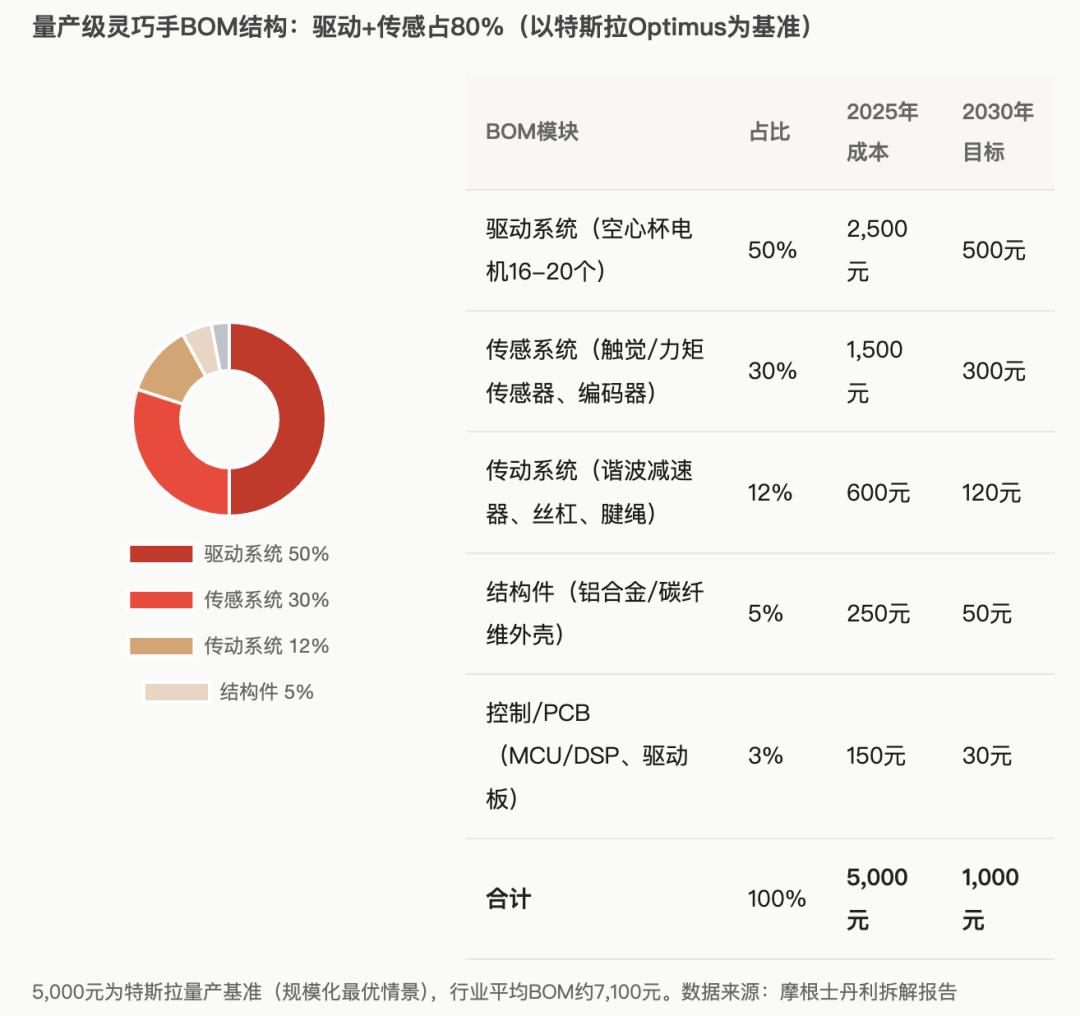
The drive and sensing systems account for 80% of the cost, and the core components of these two modules are precisely the weakest links in the current Chinese supply chain.
Hollow cup motors: A 22 DoF dexterous hand requires 16 to 20 hollow cup motors, each with a diameter of only 6 - 8 millimeters. The market is dominated by Swiss Maxon and German Faulhaber, and the imported unit price is $50 to $80. Domestic companies such as Mingzhi Electric and Tuobang Co., Ltd. have reduced the price to 30% - 40% of the imported price, but there is still a gap between high-end products with a diameter of less than 8 millimeters and foreign products. The domestic substitution rate was only 30% - 40% in 2025.
Micro harmonic reducers: Japanese Harmonic Drive takes 58% of the global market share. Domestic companies such as Green Harmonic and Laifu Harmonic are catching up rapidly, and the domestic substitution rate has exceeded 60%.
Tactile sensors: The price of domestic Hall tactile sensors has been reduced to 199 yuan each, while the price of Tekscan and SynTouch sensors is over a thousand yuan. However, domestic sensors have insufficient durability and will age after 1 million touches, still a long way from the mass production requirement of 5 million touches.
High-precision encoders: Medium-precision encoders can be domestically substituted, but ultra-high-precision ones still rely on Heidenhain and Renishaw.
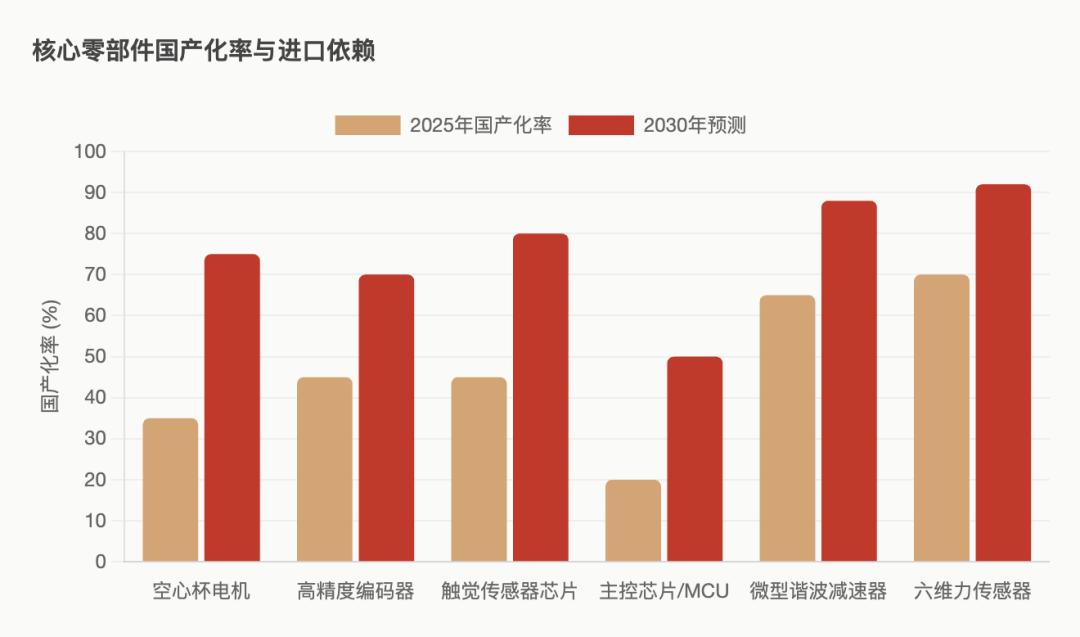
The cost reduction curve of the dexterous hand does not depend on which company works harder but on the speed of domestic substitution of upstream core components. If the domestic substitution rate can be increased from an average of 40% in 2025 to 80% in 2030, the BOM can be reduced by 50% - 60%. However, it will take at least 3 - 5 years for the domestic substitution of high-end hollow cup motors and main control chips.
But the judgment of researchers from Physical Intelligence is: Without simplifying the design, it is not easy to further reduce the BOM to below $500 only by large-scale production and domestic substitution; the problems of precision assembly man-hours and yield rate may become a hard constraint in the cost reduction curve.
That is to say, the fate of the dexterous hand industry is largely in the hands of Maxon and STMicroelectronics, which is the same as when the photovoltaic industry was constrained by the price of silicon materials and the power battery industry was constrained by lithium ore - the real industrial bottleneck is always upstream.
The technical route is undetermined, and the dexterous hand is still looking for the "optimal solution"
Focusing on the competition landscape of the dexterous hand, GGII released a list of the top 5 in terms of shipment volume:
Yinshi Robotics ranks first, Qiangnao Technology and Lingxin Qiaoshou are tied for second, and Aoyi Technology, Leisai Intelligence, and Dahan Robotics follow closely.
It seems that the pattern is clear, but in fact, it is in a complete mess. The six companies are taking almost completely different routes, and the camps behind them are also different.
The entire track can be divided into three major camps:
The first type is independent integrators, including Lingxin Qiaoshou, Yinshi Robotics, Pasini, Qiangnao Technology, etc. They focus on making dexterous hands, with strong technical depth but no support from the whole machine.
The second type is self-developed by whole-machine manufacturers, such as Tesla, Yushu, Zhiyuan, and Galaxy General. They optimize software and hardware in a coordinated manner, but the dexterous hand is not the core investment.
The third type is component extension, such as Zhaowei Machinery & Electronics, Leisai Intelligence, and Dahan Robotics. They start from precision components and have mature mass production capabilities and supply chains.
Different camps mean different contradictions.
Independent integrators are "squeezed from both sides". Above, whole-machine manufacturers' self-developed products erode the high-end market, and below, component manufacturers seize the mid - and low - end markets with cost advantages. The biggest risk for whole-machine manufacturers' self - development is insufficient investment, after all, the dexterous hand is not their core business. The challenge for component extension companies lies in the large gap between making parts and making the whole hand.
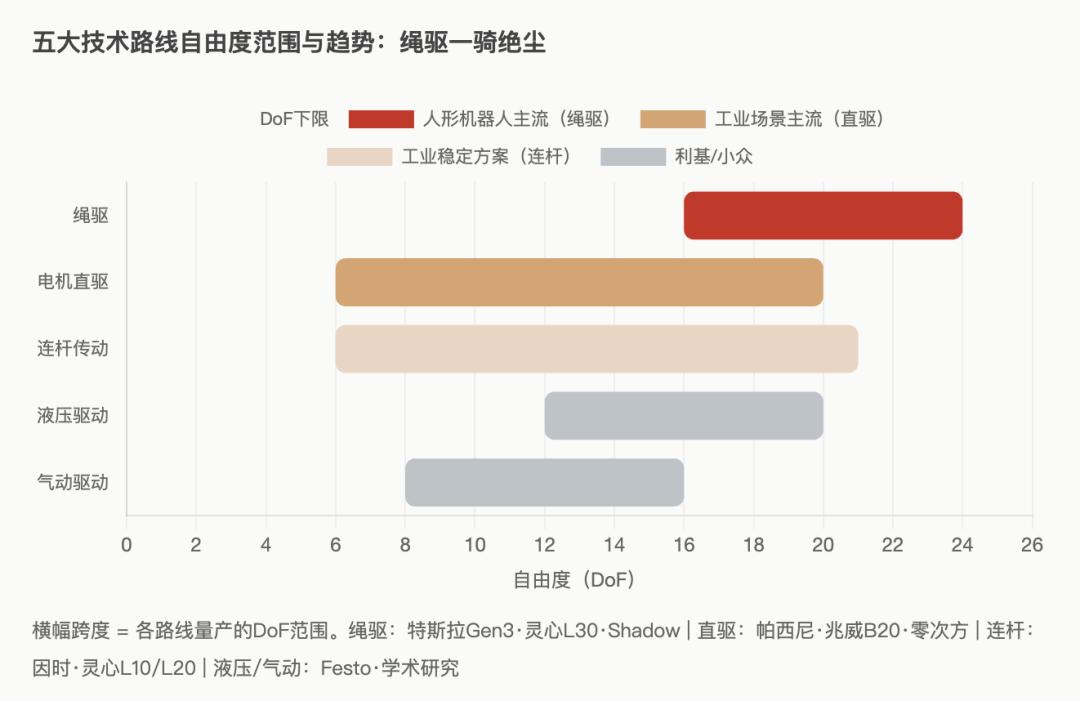
In addition to the three major camps, the technical routes can also be divided into different schools.
The direct - drive school pursues fine control. The motor directly drives the joints without transmission errors and has a fast response. Representative enterprises are Qiangnao Technology and Dahan Robotics. Qiangnao's bionic hand was once selected as one of the top 100 inventions by Time magazine and started with brain - computer interfaces. Dahan's main business is electric grippers, and direct - drive force feedback is its specialty. However, the weakness of direct - drive is obvious - the motor has to be stuffed into the finger, with a small volume and poor impact resistance. It is delicate but not durable.
The linkage school relies on stiffness and bearing capacity. Representative enterprises are Yinshi Robotics and Aoyi Technology. Yinshi was established in 2016 and started with micro servo cylinders, having a good understanding of precision transmission. Aoyi has experience in medical rehabilitation - level bionic hands and has a deeper understanding of mechanical logic. The linkage solution has first - class load and accuracy and is suitable for industrial scenarios, but it lacks flexibility - there are places where the fingers can't bend.
The rope - drive school is the most similar to a human hand, being flexible and having a high degree of freedom. To some extent, it has become the current mainstream. Tesla Gen3, Lingxin Qiaoshou L30, and Shadow can all be regarded as the rope - drive school, with an obvious technology convergence effect. The disadvantage is that the tendon ropes are prone to creep and break, and the maintenance is complex.
Behind these are two completely different industrial philosophies.
The linkage school and the direct - drive school follow the "engineering optimization" route - making incremental improvements on existing technologies and first solving the yield rate and cost problems. The rope - drive school follows the "bionic leap" route - benchmarking against the human hand structure and directly increasing the degree of freedom, but the engineering complexity and cost soar simultaneously.
Valuation bubble: A collective illusion of the entire industry?
The most heart - wrenching question: Why is the capital so "crazy"?
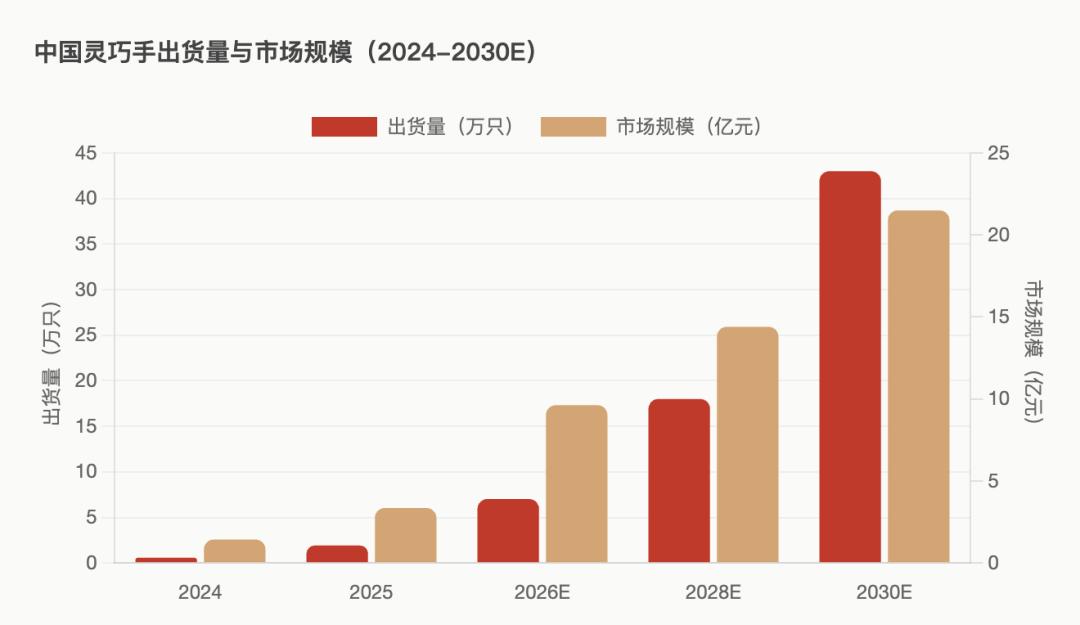
The dexterous hand is the "last mile" of humanoid robots, accounting for 15% - 25% of the BOM. If high - degree - of - freedom models become popular, it is expected to exceed 30%. GGII predicts that the sales volume of Chinese dexterous hands will increase from about 19,200 in 2025 to about 70,200 in 2026 and is expected to exceed 430,000 by 2030.
Each number points to a trillion - level market.
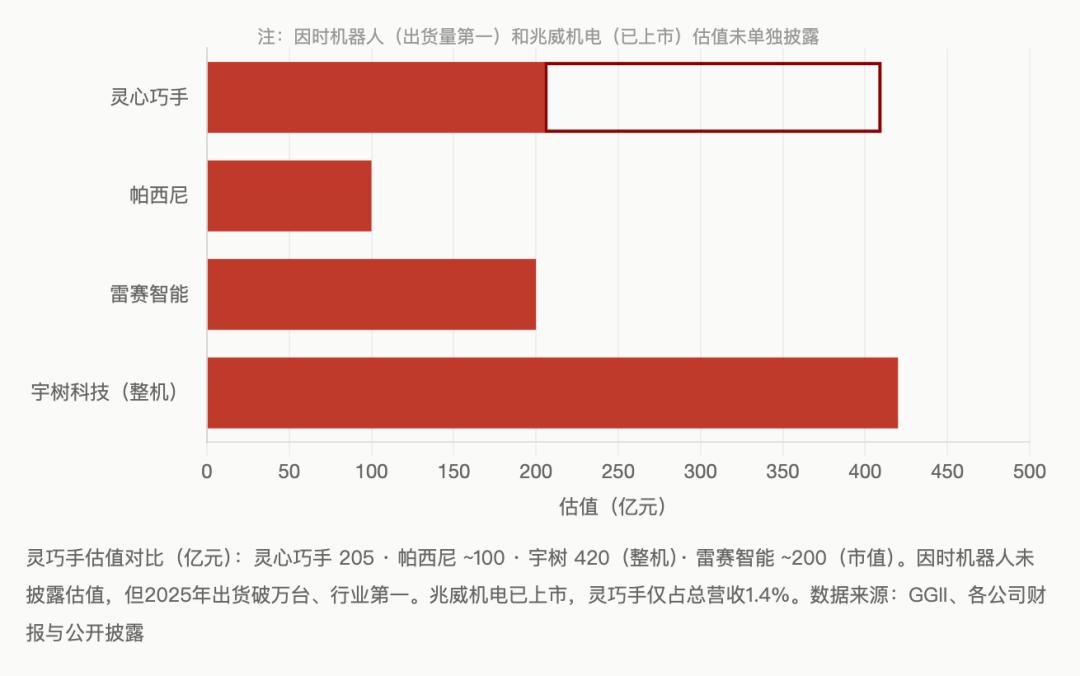
Comparing the valuation and shipment volume, an anti - common - sense fact emerges: The company with the largest shipment volume does not have the highest valuation; the company with the highest valuation does not have the largest shipment volume.
For example, Yinshi Robotics has shipped over 10,000 units and has achieved break - even, but its valuation is far lower than that of Lingxin Qiaoshou. Because the premium that capital gives to Lingxin Qiaoshou comes from the "hardware + data + model" flywheel narrative: hardware generates installation volume, installation volume generates data, data trains the model