Tencent backed "China's AMD" with 5.1 billion yuan, and it is set to list on the A-share market to challenge Cambricon.
"China's AMD" is ready to list on the A-share market.
Recently, the IPO application of Enflame Technology on the Science and Technology Innovation Board has passed the review of the exchange's listing review committee.
This company has many labels: one of the "Four Little Dragons" of domestic GPUs, a startup project by former AMD executives, and an AI chip company heavily invested in by Tencent.
The founders, Zhao Lidong and Zhang Yalin, both come from AMD, and the core team also has a large number of talents with AMD backgrounds. In terms of the commercialization path, Enflame has many similarities with Cambricon: neither has chosen the typical GPGPU route, both have benefited from the replacement of domestic AI computing power and the construction of local intelligent computing centers, and both have entered the supply chains of Internet giants first.
However, compared with the title of "China's AMD", Enflame's more important identity may be a "Tencent-affiliated chip company".
Tencent is not only an important shareholder but also the most core customer. From 2023 to 2025, the proportion of Enflame's revenue from Tencent increased from 33.4% to 83.8%. At the same time, Tencent also provided Enflame with a valuable cash - flow buffer through a more favorable payment cycle and large - scale prepayments.
However, although the advantage of relying on Tencent is significant, the capital market will not unconditionally support a company just because of Tencent.
According to IDC's calculations, Enflame currently only holds about 1.7% of the market share in China's AI accelerator card market. There are still obvious gaps in both the overall gross profit margin and the gross profit margin of the core AI accelerator card business compared with comparable companies such as Cambricon and Moore Threads.
Therefore, the real question that Enflame needs to answer after listing is not whether Tencent can continue to support it, but whether it can go further on its own.
Comparing with Cambricon
The story of Enflame Technology began with two AMD engineers.
Zhao Lidong graduated from Tsinghua University and Utah State University in the United States. He worked at AMD for 7 years, participating in the R & D of CPUs, GPUs, APUs, and multiple core IPs. Zhang Yalin graduated from the Department of Electronic Engineering of Fudan University and also worked in AMD's global R & D system for a long time.
In 2018, the two founded Enflame Technology in Lingang, Shanghai. According to Caixin's report, there are at least more than twenty supervisors within the company with AMD backgrounds.
If Moore Threads is called "China's NVIDIA" by the market because its founder comes from NVIDIA, then by the same logic, Enflame Technology is more like "China's AMD".
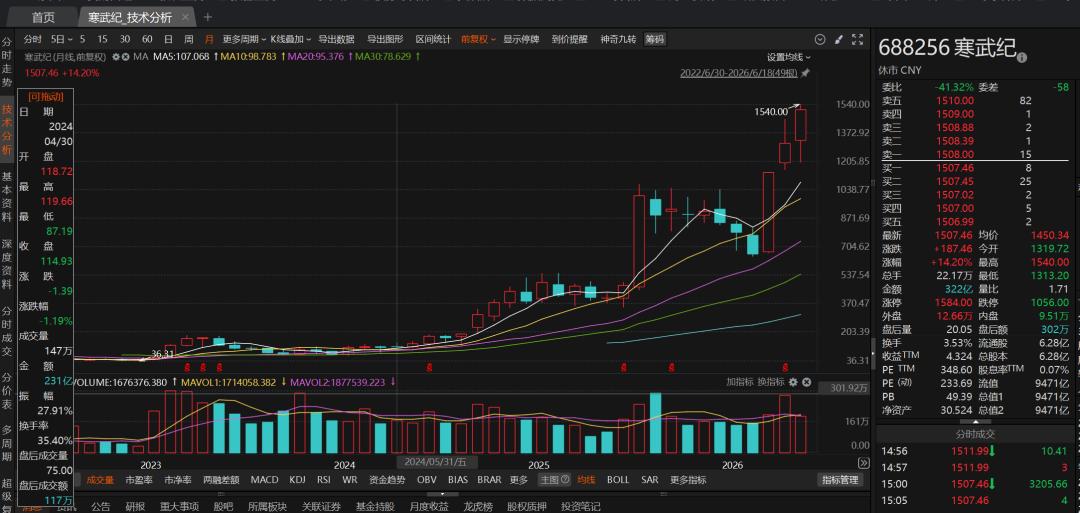
This attempt to go public also coincides with the high - light moment of the domestic AI chip sector. Since the end of March, the concept of AI chips has continued to heat up. As of June 18, Cambricon's stock price rose from 659.2 yuan to 1507.46 yuan, an increase of more than 130% in two and a half months. During the same period, Moore Threads rose about 20%, and Muxi Co., Ltd. rose about 28%.
It is worth noting that Enflame Technology has many similarities with Cambricon, the leader in this round of the Chinese technology stock market.
For example, in terms of the technical route, companies such as NVIDIA, Moore Threads, Muxi Co., Ltd., Dayu Zhixin, and Biren Technology mostly follow the GPGPU, that is, the general - purpose graphics processing unit route.
However, Enflame Technology did not choose the typical GPGPU architecture but a non - GPGPU route closer to Cambricon. It retains the GPU's ability to perform multi - core parallel computing but cuts out the less necessary parts such as graphics rendering, and allocates more chip resources to general - purpose computing, tensor computing, and matrix computing.
In addition, both have benefited from local intelligent computing projects.
Cambricon once expanded its revenue with large orders for the construction of intelligent computing clusters in Zhuhai Hengqin New Area and Shaanxi Xixian New Area. Enflame Technology signed the "Strategic Cooperation Framework Agreement for the Co - construction of the East - to - West Computing Power Network and System" with the People's Government of Qingyang City, Gansu Province, Meitu Inc., China Telecom Gansu Company, Zhongdian Wanwei, China Mobile Gansu Company, etc. in September 2023.
In November 2023, a cluster of more than 3,000 second - generation computing power cards was launched in Yichang, Hubei. In 2024, the Qingyang Ten - Thousand - Card Cluster was put into use. In January 2025, the Taihu Yixin (Wuxi) Intelligent Computing Center based on Enflame's S60 computing power cluster was put into operation.
But more importantly than local intelligent computing projects, both companies have successfully entered the supply chains of Internet giants.
The importance of this is rising rapidly. In the past few years, government intelligent computing centers and the operator's Xinchuang market have indeed provided growth space for domestic chip companies. However, the real source of future incremental demand may still be Internet giants such as ByteDance, Alibaba, and Tencent.
The Wall Street research institution Bernstein predicts that by 2028, the AI capital expenditures of ByteDance, Alibaba, and Tencent will account for nearly 50% of the domestic AI capital expenditures.
Whoever can enter the supply chains of these giants will have a better chance of completing commercialization verification first.
Public information shows that currently, Cambricon and Enflame Technology are among the few domestic AI chip companies that have deeply bound with leading Internet customers and demonstrated large - scale commercialization in terms of revenue or orders. According to Caixin's report, Cambricon's largest customer is ByteDance, with a pre - purchase order volume of 200,000 units.
And standing behind Enflame is Tencent.
The Buffer Zone Provided by Tencent
According to Caixin's report, Tencent has participated in five rounds of financing of Enflame successively, with a cumulative investment of 5.14 billion yuan. Including related parties, the total shareholding ratio of the Tencent - affiliated entities in Enflame reaches 20.26%, making Tencent the most important external shareholder of Enflame.
More importantly, Tencent is not only an investor but also a buyer. From 2023 to 2025, the proportion of Enflame's sales revenue from Tencent to its operating income was 33.4%, 37.8%, and 83.8% respectively.
According to the self - media "Alpha", Enflame's support for Tencent's business scenarios probably started with its second - generation products. Many ordinary users may have indirectly experienced Enflame's computing power, such as WeChat voice - to - text conversion. In addition, Enflame's second - generation products also support Tencent's capabilities in dozens of traditional AI business scenarios such as content understanding and Tencent Meeting minutes.
The relationship between the two parties is not only important for Enflame but also for Tencent.
According to the Bernstein report, Tencent's direct and indirect AI - related capital expenditures from 2026 to 2028 are expected to reach 11 billion US dollars, 13 billion US dollars, and 14 billion US dollars respectively.
The greater the computing power demand, the more important the security of the underlying supply chain becomes. Especially since Tencent holds a national - level platform like WeChat, which involves a large amount of user and enterprise data. For it, deeply binding with a domestic AI chip company is not only a gesture of domestic substitution but also a strategic move to ensure data security, supply - chain security, and long - term cost control.
This also explains why Tencent both invests and continuously purchases products, but that's not all. Looking through the prospectus, you will find that after relying on Tencent, Enflame has also obtained a "loss buffer zone" that is quite rare among domestic chip companies.
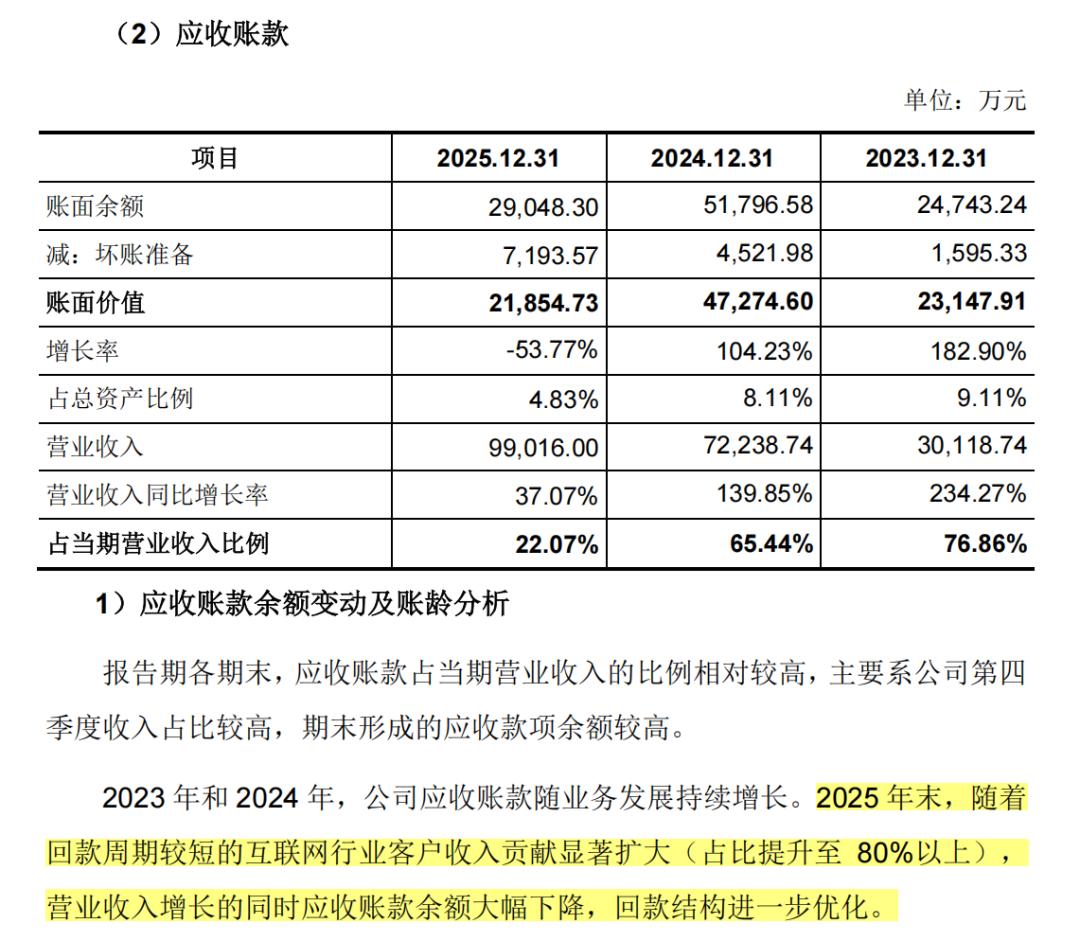
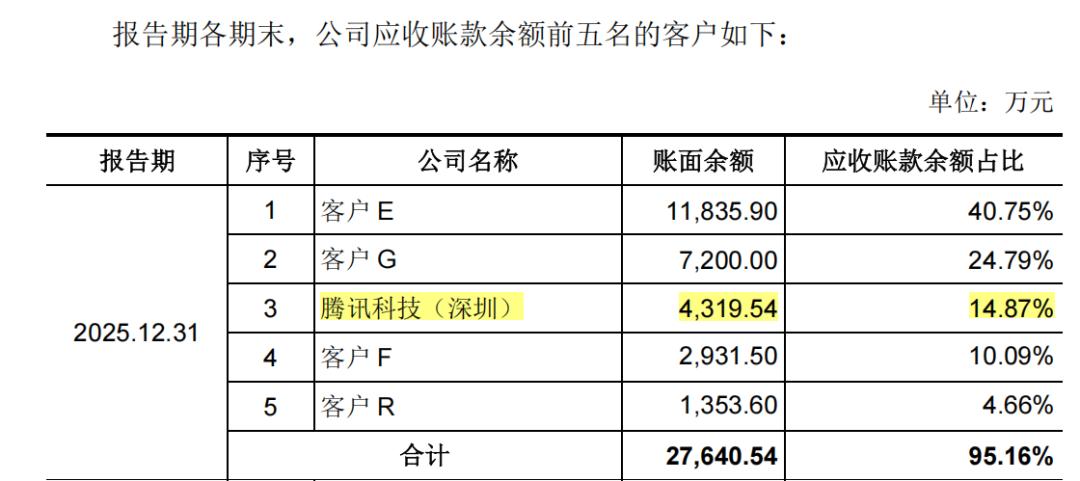
In 2025, Enflame's operating revenue increased from 720 million yuan to 990 million yuan, but the balance of accounts receivable decreased from 518 million yuan to 290 million yuan. The reason given in the prospectus is that "at the end of 2025, the revenue contribution from customers in the Internet industry with a shorter payment cycle increased significantly." In addition, although Tencent plays a crucial role in Enflame's business, Tencent only accounts for 14.87% of Enflame's accounts receivable, ranking third.
In addition, in 2025, Enflame's advance receipts reached 346 million yuan, almost tripling compared with 2024. The prospectus also clearly states that the contract liabilities are mainly advance receipts from Tencent - affiliated entities.
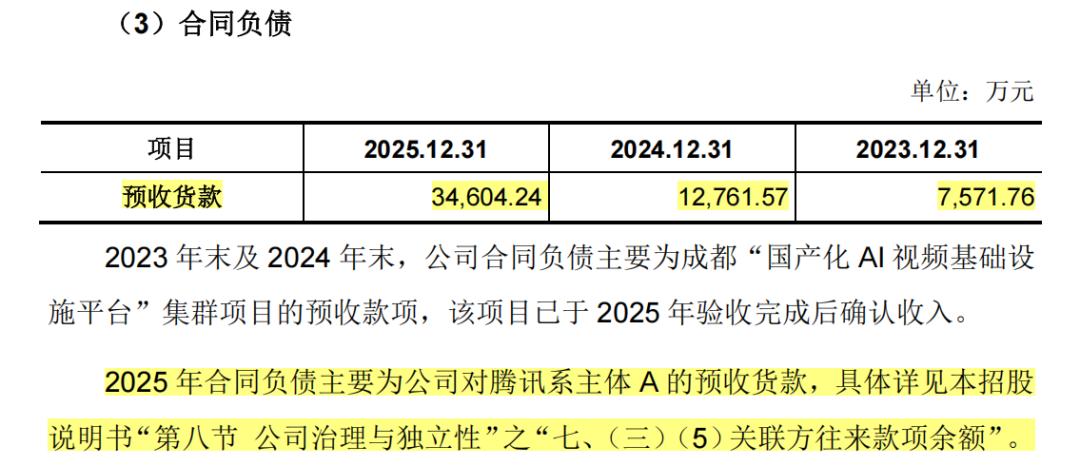
That is to say, while Tencent places orders to boost Enflame's performance, it helps the latter reduce a lot of cash - flow pressure at the operational level through favorable payment methods and considerable prepayments.
In 2025, Enflame's net profit attributable to the parent company narrowed from a loss of 1.51 billion yuan to a loss of 1.16 billion yuan. But more importantly, the net outflow of the company's operating cash flow significantly narrowed from 1.798 billion yuan to 965 million yuan. That is to say, its actual cash - bleeding speed is already lower than the book loss.
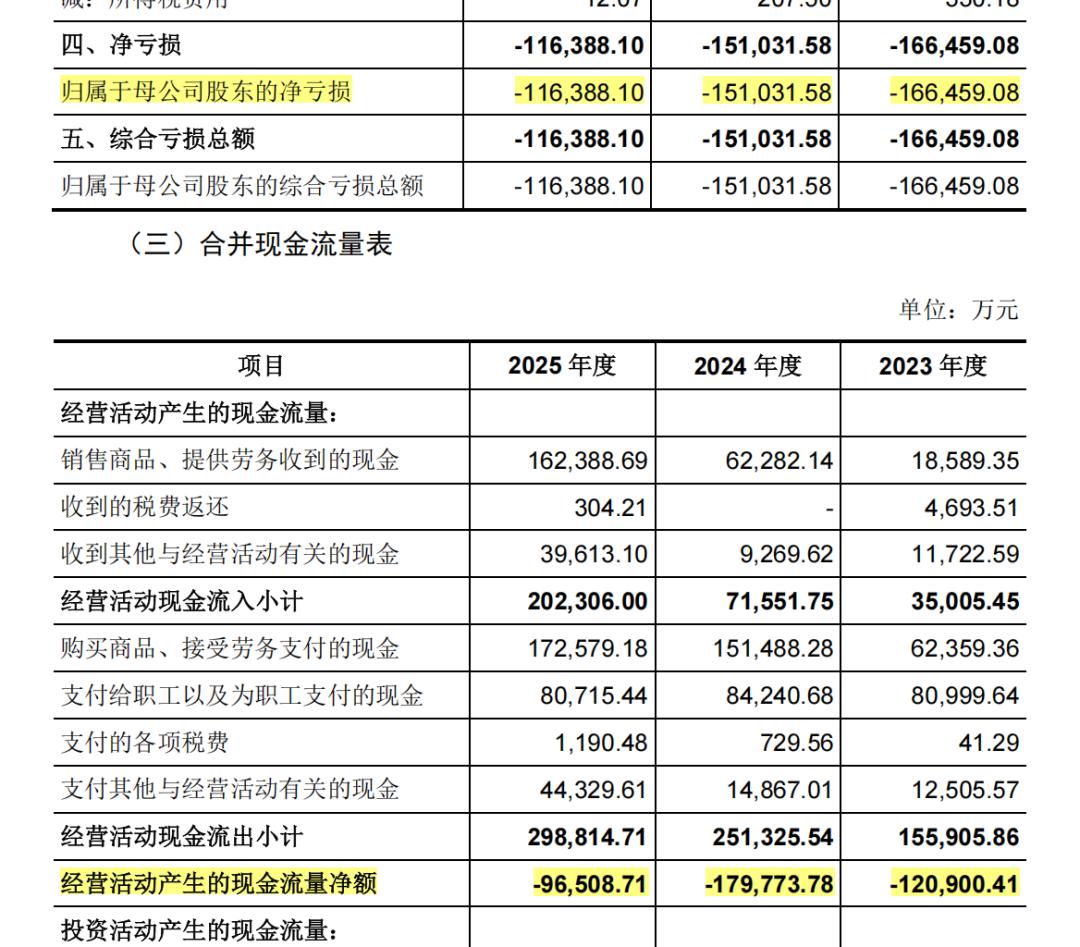
This may sound a bit strange. If I change the plus and minus signs, you will understand the situation. For example, if a company says it has earned more than 100 million yuan, but its operating cash flow only has an inflow of more than 10 million yuan, what would you think of this company? Would you think that the company's profit quality is not high and that the current profit is only on the book, not real cash?
Then, reversing the plus and minus signs is the current situation of Enflame. Although the book is still showing a loss, the cash - bleeding is not as scary as it seems on the income statement, and a large part of the cash pressure at the operational level has been buffered.
In addition, we can also compare with other "Little Dragons" in the A - share market.
In 2025, Moore Threads' net profit attributable to the parent company was - 1.001 billion yuan, and the net operating cash flow was - 2.956 billion yuan. The operating cash bleeding was nearly three times the loss amount. Muxi Co., Ltd.'s net profit attributable to the parent company was - 790 million yuan, and the net operating cash flow was - 1.26 billion yuan. The operating cash bleeding was nearly 1.6 times the loss amount. Their operating cash outflows are more serious than the book losses.
This cash - buffering effect is one of the most important values that Tencent provides to Enflame.
For an AI chip company that is still burning money in the early stage, whether the technology can succeed is of course important, but whether it can survive until the technology truly succeeds is equally important. R & D can be advanced slowly, the ecosystem can be built gradually, and customers can be expanded step by step. However, once the cash flow is cut off, the story ends prematurely.
Therefore, the value that Tencent provides to Enflame is far more than "how much money it has invested" or "how many products it has purchased". It provides Enflame with an extremely scarce survival condition: having a large - scale customer, real - world scenarios, continuous orders, and relatively better payment and prepayment support.
To some extent, Tencent is helping Enflame to gain the most precious thing: time.
Market Share of Only About 1.7%
However, the capital market will ultimately not only examine whether a company can survive well but also whether it can grow fast enough.
This is also the core problem that Enflame faces after listing.
In terms of product evolution, Enflame has made progress. So far, the company has launched four generations of architectures and five AI chips.
From the Suisi 1.0 in 2019, to the Suisi 2.0 and 2.5 in 2021, to the Suisi 320 and Enflame S60 launched in the era of large - scale models, and the fourth - generation training and inference integrated chip Suisi 400 and the AI accelerator module L600 released in 2025, the product roadmap has been continuously advanced.
As of the end of 2024, the cumulative shipments and orders of the S60 have exceeded 100,000 units, and it has entered the customer systems of Tencent, Meitu, Yuanshiyun, etc.
The problem is that although there is a product rhythm, the market position has not been truly established.
IDC data shows that in 2025, the total shipments of China's AI accelerator card market were about 4 million units. Among them, NVIDIA shipped 2.2 million units, accounting for 55% of the market share. Huawei ranked first among domestic manufacturers with 812,000 units. Alibaba's T-Head and Cambricon shipped 265,000 units and 116,000 units respectively.
Enflame's disclosed data is 66,000 units, corresponding to a market share of about 1.7%. This means that Enflame has entered the game, but there is still an obvious gap from mainstream players.
There is also pressure on profitability.
In 2025, Enflame's overall gross profit margin was 31.78%, significantly lower than Cambricon's 55.23% and Moore Threads' 69.8%.
In the core AI accelerator card and module business, Enflame's gross profit margin was 32.7