Why is Visual China striving for an "A+H" dual listing?
Zhao Zifan (a pseudonym) has been in the photography industry for 20 years. In 2013, he started signing a contract to become a photographer for Visual China Group Co., Ltd. (hereinafter referred to as "Visual China"). Since junior high school, Zhao Zifan has been fond of taking pictures with film cameras. After graduating from university, he worked as a photography journalist, a visual director, and a hotel photographer. "For me, it's about turning the pictures I take into cash without wasting them. Sometimes I can earn about 6,000 yuan a year, and at most, I can earn over 10,000 yuan." However, when talking about his personal income from selling pictures, he said bluntly that "the pictures have been selling at lower prices in recent years."
Recently, this domestic largest visual content licensing service provider that has signed a contract with Zhao Zifan has attracted much attention.
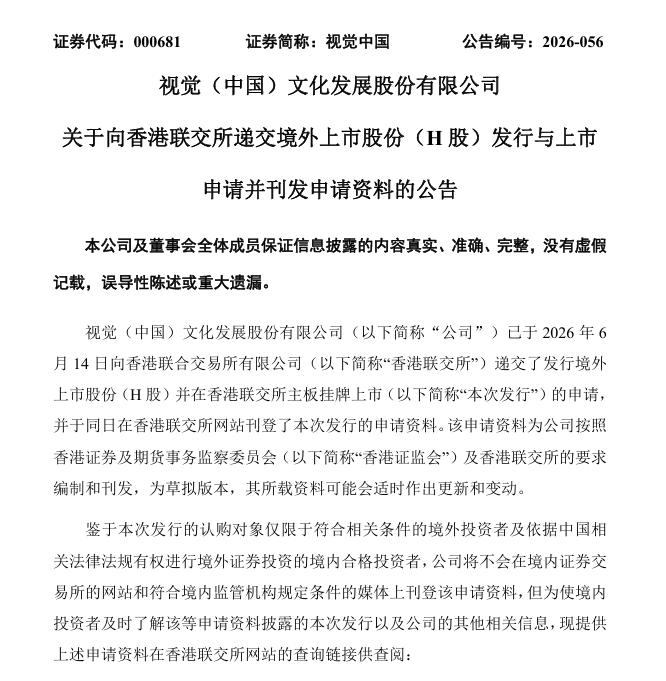
At noon on June 15th, Visual China issued an announcement stating that the company submitted an application to The Stock Exchange of Hong Kong Limited on June 14, 2026, for the issuance of overseas - listed shares (H - shares) and listing on the Main Board of The Stock Exchange of Hong Kong Limited. In November 2025, Visual China had already announced that the company was planning to list in Hong Kong. If the listing is successful this time, it means that one more member will be added to the "A + H" listing camp.
According to the prospectus, Visual China's net profit attributable to the parent company has declined for two consecutive years. From 2023 to 2025, the company's revenues were 781 million yuan, 811 million yuan, and 778 million yuan respectively, with growth rates of 11.94%, 3.89%, and - 4.03% in sequence; the net profit attributable to the parent company was 146 million yuan, 119 million yuan, and 83.0275 million yuan respectively, with growth rates of 48.14%, - 18.17%, and - 30.31% in sequence, and the profit scale continued to shrink.
One of the revenue sources of the photo library platform is based on the original image materials supplied by a large number of contracted photographers. The state of the creator ecosystem directly reflects the real prosperity of the company's core business. In this regard, reporters from "IT Times" interviewed several contracted photographers.
As of press time, Visual China's A - share market value is 16.127 billion yuan.
Contractors say: The earnings are sharply decreasing
After signing a contract with Visual China, how much can a picture be sold for?
Zhao Zifan told the reporter that the price is not fixed and depends on the purpose of the purchaser of each picture. For example, he has a picture of boiled tripe. If it is used for commercial purposes, it may be sold for over 100 yuan per picture. If it is only used for a WeChat official account tweet, it is only a few yuan per picture.
In 2021, photography enthusiast Cheng Ming (a pseudonym) signed a contract with Visual China. "I have a lot of photos on hand. Instead of letting them sit idle on the hard drive, it's better to have a channel to get some income." He said that at that time, he simply chose Visual China because of its industry status. As the largest commercial photo library in China, it has a wide range of customers, and the photos will have a broader market.
After signing the contract, Cheng Ming's works are licensed in an exclusive mode. That is, each picture uploaded to Visual China cannot be sold to other photo libraries or platforms, but the copyright of the photos still belongs to the photographer himself.
Practitioners generally find that the price of pictures completely depends on the customer's usage scenario. The cost of using pictures for new - media illustrations is low, and the corresponding share is meager; the pictures used for large - scale printing and commercial advertisements are sold at a higher price, and the income that photographers can get is also more considerable. For Cheng Ming, he doesn't have a fixed uploading rhythm. After taking pictures during his trips, he uploads them in batches. In a year, he can update about 300 to 500 pictures.
He shared a set of data with the reporter from "IT Times". In terms of the sharing ratio with the platform, it is 25% for pictures and 35% for videos. Cheng Ming still remembers a picture of Gongga Snow Mountain that he uploaded in March 2023. That time, the customer finally spent over 3,000 yuan to buy the commercial license of this picture, and he personally received over 900 yuan. This is also his highest single - picture income on the platform. Also in 2023, his video works also received high prices. Two videos were used for film and television production, and he earned nearly 1,000 yuan in total.
"There are mainly two sharing ratios for pictures on the platform. The ratio for news - related pictures has always remained at 50%, and the ratio for creative pictures was 50% in the early years and then became 25%." Zhao Zifan said.
The change in earnings started in the second half of 2024.
"There are fewer and fewer real - shot photos that can be sold at high prices. There was only one case last year that exceeded 200 yuan." Cheng Ming can clearly feel that AI has a direct impact on real - shot photography pictures. The orders that could bring high earnings in the past have shrunk significantly in the past two years. "AI - generated pictures have become more and more mature, and customers are not willing to spend high prices to buy pictures."
At the same time, Cheng Ming found that Visual China is also making adjustments. Originally, it only accepted real - shot photos and traditional design drawings. Now, it has also opened a channel for AI - generated picture contributions. A large number of low - cost and highly adaptable AI - generated pictures have flooded into the photo library, gradually squeezing the market space of traditional real - shot works.
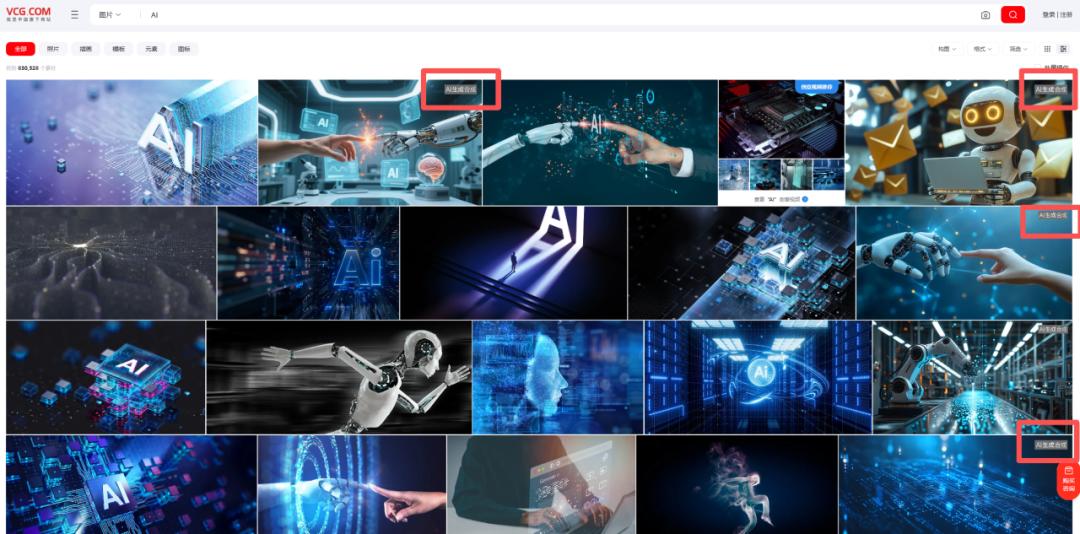
"Most of the mainstream orders on the platform now are low - priced new - media news illustrations. For this kind of orders, the photographer's single - time earnings are basically in single digits." Cheng Ming gave an example. Sometimes it's 2 yuan, sometimes 1.65 yuan. Occasionally, when there is a commercial procurement by an enterprise, the order that the photographer can get a share of several hundred yuan is already very rare; for AI - generated picture contributions, the single - time sales earnings are often less than 2 yuan.
"The change is huge. Now, maybe there is only the'return of emotional value'. It's okay to play around in my spare time." Another contracted photographer said.
Impact of AI and pressure on performance
Visual China was established in 2000 and listed on the Shenzhen A - share market in April 2014.
Frost & Sullivan predicts that the overall scale of the Chinese visual content service market will increase from about 52.9 billion yuan in 2025 to about 105 billion yuan in 2030, with a compound annual growth rate of about 12.1%. Among them, the market for visual content customization services will grow faster, with an expected compound growth rate of about 12.8% from 2025 to 2030; the market for visual content licensing services is expected to have a compound growth rate of about 5.5% during the same period, reaching about 8.3 billion yuan.
However, looking through Visual China's prospectus, it can be seen that the company is clearly under pressure in terms of performance. Financial data shows that in the past three years, the company's core licensing business has shrunk. The revenue from content licensing services decreased from 610 million yuan in 2024 to 524 million yuan in 2025, a year - on - year decrease of 14.1%. The official explanation is that mainly because customers have controlled their marketing budgets, resulting in a decrease in the company's customer spending on content licensing services. In addition, the rapid development of AI technology has changed the procurement and consumption patterns of some content.
The person - in - charge of a media institution told the reporter from "IT Times" that since the emergence of AI, they have hardly purchased pictures from Visual China. Since 2025, either the pictures are generated by AI or they are original photos. The reporter from "IT Times" observed that the use of AI - generated pictures has become a common consensus in the industry.
"AI is just one aspect. The 'decline period' of the photo library has shown signs in the past few years. The cost of setting up a photo library was relatively high and the threshold was relatively high in the early stage, while now the threshold for image shooting and production has been significantly lowered." The aforementioned photographer said.
Can AI data become the second growth curve?
Visual China seems to be ready to "bet on" AI. According to the prospectus, Visual China has 700 million content assets with clear copyrights. It has also built an AI capability system based on a multi - modal large - scale model for content recognition, annotation, search matching, and generation, and deployed AI agents on the content supply side and the customer service side.
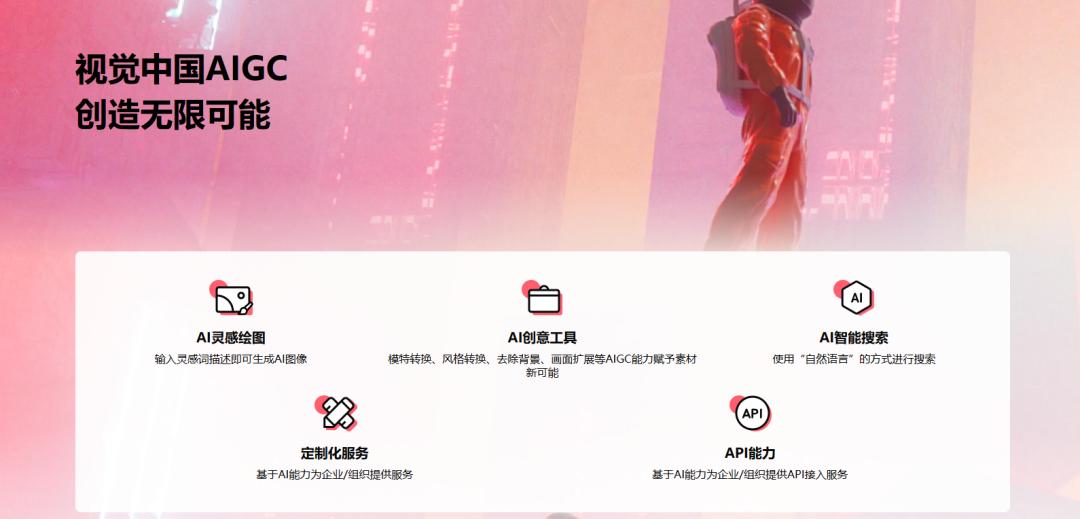
The prospectus shows that the funds raised from this issuance will be used to improve the "AI capabilities" to support the company's services. Some media reported that these assets will also be disassembled into structured data and sold to large - scale models that are in fierce iteration on a per - use or per - volume basis.
It is currently known that it has provided training data services to AI giants such as Microsoft, Alibaba, Tencent, and MiniMax.
"How to quickly scale up the AI business after the IPO and let investors see a clear growth path is the key to whether its strategic transformation can be recognized by the market." Yuan Shuai, the deputy secretary - general of the Zhongguancun Internet of Things Industry Alliance, said in an interview with the reporter from "IT Times". The core of whether this IPO can be successful lies first in whether it can tell a convincing business story of "picture content + AI" to the market. It is necessary to let investors see the new value of its existing copyright assets in the AI era and also present a clear implementation path for the AI business, rather than just staying at the general statement of improving AI capabilities.
Secondly, it is necessary to completely solve the hidden risks of asset compliance. Whether it is the copyright sorting of the original content library or the compliance review of new content sources, a solution that can convince the market should be presented. Only by laying a solid foundation for compliance can long - term competitiveness be established in the AI training data market.
"Stabilizing the basic business can buy enough time for the growth of the AI business. Otherwise, once the traditional business declines too quickly and the new business fails to keep up, it is easy to fall into the dual pressure of performance and valuation." In Yuan Shuai's view, one cannot ignore the basic business of traditional picture licensing in order to develop the AI business. After all, the main revenue still comes from the traditional business at present.
This article is from the WeChat official account "IT Times" (ID: vittimes), author: Sun Yonghui, published by 36Kr with authorization.