Why do we always misjudge AI? — The prediction paradox of AI
This is the era of artificial intelligence. It is full of paradoxes, and we move forward within these paradoxes. Artificial intelligence greatly enhances people's capabilities, yet people never seem to be able to accurately predict its future. They always make judgments that are either overly optimistic and unrealistic or overly pessimistic and see only difficulties, even those elite individuals at the top. This is the prediction paradox of artificial intelligence.
Historical predictions about AI have been very unreliable
This year marks the 70th anniversary of the term "artificial intelligence." The 70 - year development has been accompanied by many "absurd" predictions.
The young scholars who participated in the Dartmouth Conference later achieved great success. As the first - wave pioneers, they made extremely bold predictions. Many of the beautiful scenarios they envisioned for the next ten or twenty years have not been realized to this day.
Allen Newell and Herbert Simon jointly won the Turing Award. They predicted (1958): "Within ten years, digital computers will discover and prove an important mathematical theorem." Simon, who is also a Nobel laureate in economics, predicted (1965): "Within twenty years, machines will be able to do all the work that humans can do."
Marvin Minsky received the first Turing Award in the field of AI. In an interview (1970), he pointed out: "In three to eight years, we will have a machine with the average human intelligence. I mean, it will be able to read Shakespeare, refuel a car, play office politics, tell jokes, and fight." He also said (1967): "Within a generation, the problem of creating 'artificial intelligence' will be basically solved."
These ambitious goals were mercilessly extinguished in the first AI winter. In the 1980s, expert systems and neural networks emerged, and artificial intelligence welcomed the second wave. So, Business Week (July 9, 1984) excitedly declared on its front - page headline: "Artificial Intelligence, IT'S HERE!" In the same year, Roger Schank and Marvin Minsky warned against the AI frenzy at the American AI Conference and coined the term "AI Winter" by analogy with the nuclear winter. Three years later, the second AI winter indeed arrived.
The most predicted area in the last century was chess - playing. As optimistic as Allen Newell and Herbert Simon (1958) - within ten years, digital computers would become the world champion in chess, but it actually took 40 years. As pessimistic as the computational astrophysicist Piet Hut, who said in The New York Times (1997): "It may take 100 years or even longer for a computer to defeat a human Go player." However, only 19 years later, AlphaGo defeated the world Go champion Lee Sedol. It would be insincere to say that all predictions are wrong. Futurist Ray Kurzweil predicted in The Age of Intelligent Machines (1990): "By 1998, computers will defeat the world chess champion." In 1997, IBM's Deep Blue successfully defeated Garry Kasparov.
Prediction about the arrival time of AGI
Currently, large - scale models and intelligent agents are in full swing, and the development of artificial intelligence has welcomed the third wave. Various predictions have emerged again, mainly focusing on the realization time of AGI (Artificial General Intelligence). Generally speaking, there are mainly five types of judgments: ① It has already arrived (but we don't realize it), ② It will arrive soon (in one or two years), ③ It will arrive in the short - term (in three to five years), ④ It will arrive in the long - term (in five to ten years or even longer), ⑤ It will never arrive (this is a false proposition).
Sam Altman claimed in 2024 that AGI would be realized in 2025, and in 2025, he said it was "not a super useful term." Elon Musk (2024) said that "AGI may be realized next year or within two years" and still insisted at the beginning of this year that it would be realized this year. Amodei doesn't like the term AGI. He believes (2024) that powerful artificial intelligence may appear as early as 2026 or may take longer. These predictions belong to the "will arrive soon" category. If the predictions are correct, AGI has been realized or will be realized within this year. This is not a joke. Scholars from the University of California, San Diego, in an article in Nature (2026), believe that current large - language models already constitute AGI. Jensen Huang said in 2024 that AGI would be realized within five years, but this year he said it had already been realized.
Some people think it will take five years or even longer. Demis Hassabis (2025) thought that AGI would be realized in the next five to ten years, but this year he changed his statement to say that it will arrive around 2030 within one year. Pichai (2025) believes that it is impossible to realize it before 2030 and calls the stage before the arrival of AGI AJI (Jagged Artificial Intelligence). As shown in the following table.
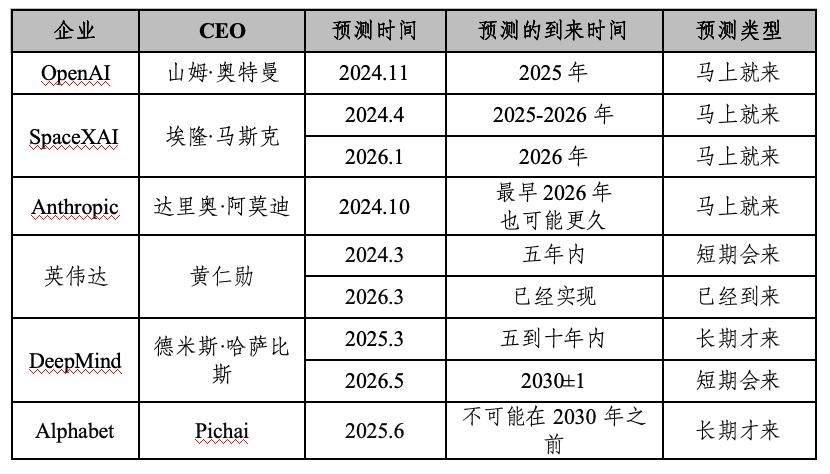
Table: Predictions of the arrival time of AGI by CEOs of well - known AI companies
In addition to super - optimists, moderately - optimists, and conservative realists, there are also skeptics who think "it will never arrive" in the prediction of AGI. Turing Award winner Yann LeCun said (2025): "AGI cannot be achieved only by large - language models." Iris van Rooij believes (2024): "It is impossible to create AGI with human - level cognitive abilities." Academician Zheng Nanning pointed out (2023): "Artificial General Intelligence is a future goal full of uncertainties." Academician Tan Tieniu said (2025): "There is still a long way to go for Artificial General Intelligence." Machine - learning pioneer Thomas Dietterich said (2024): "The whole concept has no scientific basis, and people should even be ashamed of using this term."
Prediction about AI programming and life - medicine
Programming is the best area for AI application. In March last year, executives of technology companies made predictions about the proportion of AI programming. According to the predictions of Anthropic and OpenAI, AI can write more than 99% of the code today; while according to IBM's prediction, the proportion of code that AI can write is 20% - 30%. As shown in the following table.
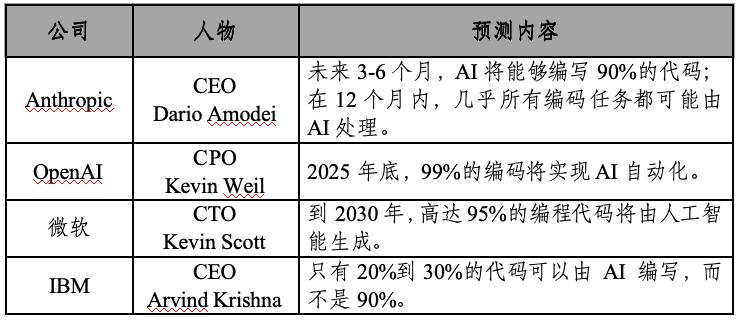
Table: Predictions of the proportion of code written by AI (March 2025)
According to the data disclosed by companies such as Anthropic, Google, Snap, Meituan, and Microsoft, the proportion of code generated by AI is between 20% and 80%. As shown in the following figure. It seems that the predictions of Anthropic, OpenAI, and IBM are all inaccurate. What needs time to verify is the prediction of Microsoft's CTO: "By 2030, up to 95% of programming code will be generated by artificial intelligence."
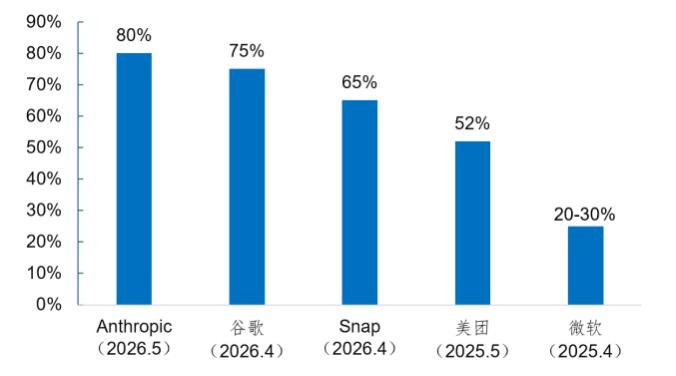
Figure: Proportion of code generated by AI in each company
The application potential of AI in the field of life - medicine is extremely large, and the predictions in this area are even more eye - catching. Demis Hassabis said in a 60 Minutes interview (2025): "In about the next ten years, AI may help cure all diseases." Amodei (2025) believes that AI can double human lifespan within 5 - 10 years. Elon Musk (January 2026) said that within three years, the Optimus robot will surpass the best human surgeons and can be deployed on a large scale.
It is extremely difficult to predict the external impact of AI
Since people cannot accurately grasp the development of AI technology, those predictions about the economic and social impacts of AI seem to lack scientific basis. For example, the impact of AI on employment.
In recent years, international organizations such as the OECD, IMF, World Economic Forum, UNCTAD, International Labour Organization, and World Bank, as well as consulting institutions such as Goldman Sachs, McKinsey, and Pew Research Center, have successively released reports on the impact of AI on employment. Each individual report is quite significant. However, when putting these reports together, it is found that the measurement results vary greatly, ranging from 0.4% to 67%, and are hardly comparable. It's disillusioning. As shown in the following table.
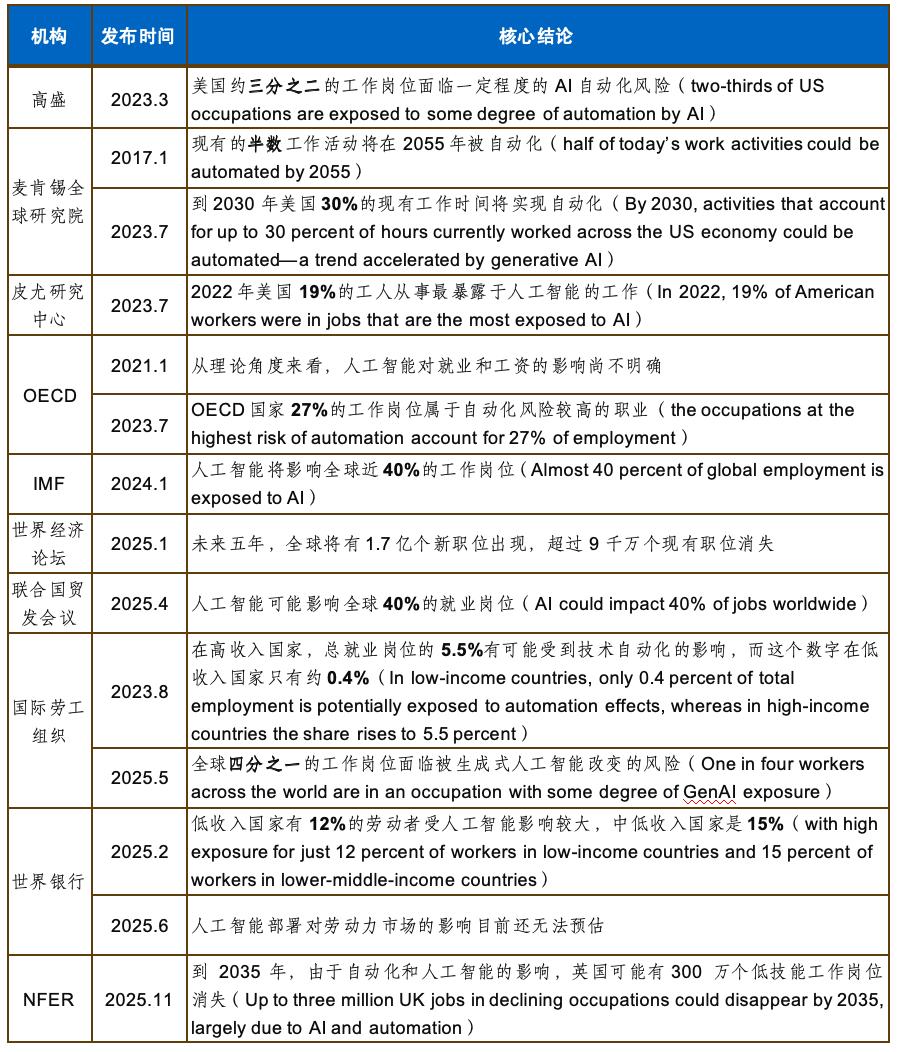
Table: Partial quantitative measurement results of the impact of AI on employment
Prediction is a ritual. People connect the past and present trajectories and extend them into the future. Experts manipulate magic, using ideal models and beautiful charts to draw quantitative judgments about the future. The bigwigs express themselves freely, enjoying the blind following of the public and the pursuit of the media, and are convinced that they are the ones who know the future.
However, the future does not follow a set script. It is often shaped by a complete break from the past, full of coincidences and paradoxes. I admit that I don't know what the future will be like. In fact, no one does. If we really knew, we would change our behavior accordingly, thus changing the course of the future.
This article is from the WeChat official account "Tencent Research Institute" (ID: cyberlawrc), author: Yan Deli, published by 36Kr with authorization.