A company worth nearly a trillion dollars, where the CEO only manages "one and a half" direct reports
The article "Anthropic CEO Dario Amodei Has Only One Direct Report" by Bloomberg is well worth reading for entrepreneurs. Dario Amodei's arrangement of "hardly managing people directly" seems counter - intuitive, but the organizational thinking behind it is very meaningful.
Many startups survive in the early stage thanks to the founder's judgment. However, once a company raises more funds, expands its team, and gains more important clients, the founder is easily consumed by meetings, recruitment, reports, and short - term goals. The company may still seem to be growing, but the founder gradually loses sensitivity to technological trends, product directions, and organizational culture.
This is especially important for AI companies. Because in AI entrepreneurship, it's not just about product speed and commercialization ability, but also the founder's judgment on technological routes, safety boundaries, application scenarios, and long - term missions.
So, Dario entrusts the operation to his sister Daniela and focuses on the direction, culture, and external narrative himself. In essence, he is protecting the company's scarcest asset, which is the founder's high - quality judgment.
This model may not be suitable for all companies, but it reminds entrepreneurs that organizational structure is not just an administrative arrangement, but a strategic choice. When a company is expanding rapidly, what is most likely to be lost is not efficiency, but clarity. Below, enjoy:
Silicon Valley is witnessing a rare corporate governance experiment.
At Anthropic, a company with a valuation approaching a trillion dollars, co - founder and CEO Dario Amodei doesn't manage a large executive team personally like the leaders of traditional tech giants.
Instead, he has only one direct subordinate in the true sense, his chief of staff, Avital Balwit.
As for the company's executive team, including key functions such as finance, commercialization, and daily operations, they mainly report to another core figure, Daniela Amodei, co - founder and president of Anthropic, who is Dario's sister.
This means that within Anthropic, Dario is more like the ultimate definer of the company's direction, technological judgment, and cultural values, while Daniela is the operational center that keeps the machine running at high speed.
This structure is very counter - intuitive.
In today's tech industry, more and more CEOs are reducing management levels and expanding the scope of direct management. OpenAI CEO Sam Altman has about six direct subordinates, and NVIDIA CEO Jensen Huang is known for his extremely flat organizational structure, with as many as 60 people reporting directly to him.
But Dario has gone to an extreme. The CEO of a company with a valuation approaching a trillion dollars, standing at the center of the global AI competition, hardly manages people directly.
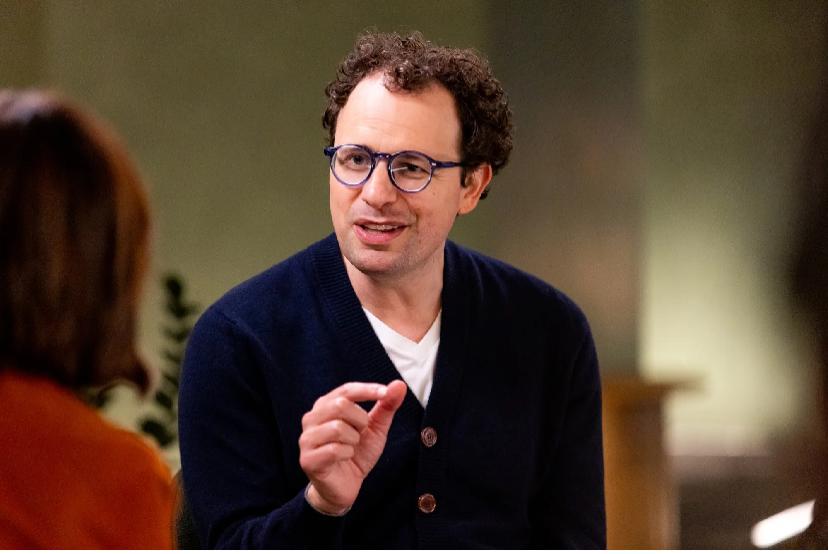
Dario Amodei, co - founder and CEO of Anthropic. Photo: Jason Henry/Bloomberg
This doesn't seem like a rapidly expanding tech company, but more like a precisely designed research institution. The purpose of Dario's approach is to consciously isolate the scarcest brains from daily operations.
It has to be said that Dario's alternative management philosophy hides a redefinition of the organizational form of AI companies by Anthropic.
01
The CEO of a Nearly Trillion - Dollar Empire Has Only "One and a Half" Subordinates
"It feels so free," Dario said in Bloomberg's The Circuit program. "It allows me to accomplish everything more easily than before."
As the CEO of Anthropic, Dario doesn't directly manage a large executive team, doesn't get involved in daily operation meetings, doesn't coordinate every business line personally, and doesn't fill his schedule with one - on - one reports. This is Anthropic's unique management structure, where Dario entrusts all this power to his sister, the company's president Daniela Amodei, and focuses on macro - level conversations and research directions himself.
Dario is not a typical Silicon Valley CEO. He is more like a scientist - type founder who is forced to stand at the center of the business world. He is a Ph.D. in biophysics from Princeton University and worked as a researcher in a laboratory in the early stage of his career. Due to differences in development direction with the company's leadership, he left OpenAI in 2021 and co - founded Anthropic with his team. Before that, he also served as a senior research scientist at Google.
It can be seen that he is not good at company operations and organizational processes, but is better at judging technological curves, understanding model capabilities, and thinking about the long - term impact of AI on human society.
"Most of the time, it's actually the difference between focusing on details and overlooking the overall situation. If you have countless specific tasks to handle tomorrow, it's very difficult to really focus on strategic issues. Therefore, it often makes sense to separate these two types of tasks so that both can be done well," Dario said in an interview with Bloomberg.
In contrast, Daniela has more experience in handling organizational and management affairs.
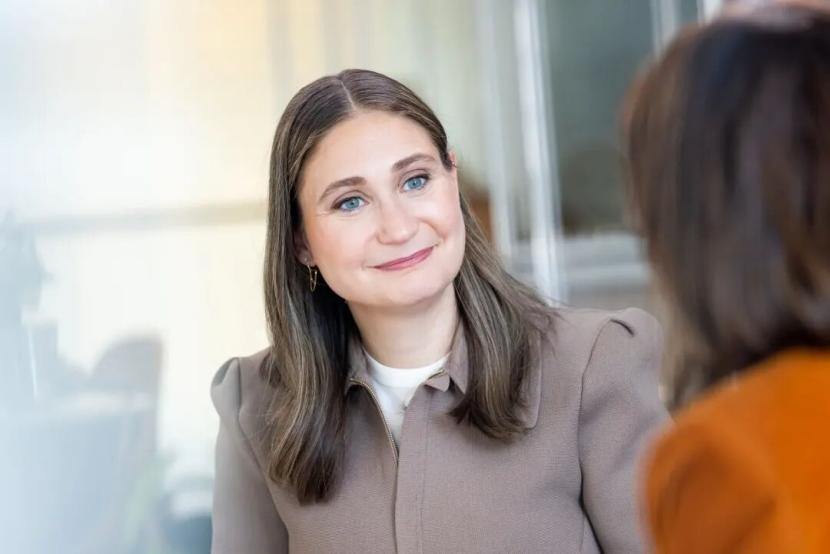
Daniela Amodei, co - founder and president of Anthropic. (Photo: Jason Henry, Bloomberg)
She was an early employee at Stripe and later led the security and policy team at OpenAI. Compared with Dario, she is more familiar with how people collaborate in the system, how culture is maintained, and how policies and security boundaries are implemented when a startup grows from a small team to a large organization.
So, the personalities and backgrounds of the two siblings are highly complementary. Dario is good at mathematics and grand concepts, while Daniela is an "Operator" who is responsible for turning Dario's "ideas floating in the universe" into actual actions.
Anthropic's operating structure is also an organizational choice made by a cutting - edge AI laboratory during the accelerated commercialization phase. It allows those who understand technological trends and safety boundaries to be consumed as little as possible by administrative affairs. And it allows those who understand organization and operation to handle the complexity of the company's expansion.
In an ordinary company, this structure may seem strange. But in the case of Anthropic, it has a certain rationality.
Because from the day it was founded, this company was not an ordinary commercial company.
It was founded in 2021 by a group of researchers who left OpenAI, starting as a response to differences in AI safety, corporate governance, and values. Dario and Daniela not only want to create more powerful models but also prove one thing: Can a cutting - edge AI company find a different path between commercial competition, technological arms race, and public responsibility?
This determines that the CEO of Anthropic cannot just be an operational CEO. He must also be the company's chief ideologist, chief cultural gatekeeper, and chief external narrator.
02
How Does the CEO Protect the "Scarcest Resource"?
In this Bloomberg report, the most thought - provoking sentence comes from Harvard Business School professor Raffaella Sadun: "The manager's time is the company's scarcest resource."
This is a common sense in management in an ordinary company. But in an AI company like Anthropic, it almost becomes a strategic principle.
Because in a cutting - edge AI laboratory, the CEO's time represents an extremely scarce judgment. For Dario, he faces a series of more abstract, difficult - to - standardize, and high - risk problems. For example, to what extent should the model's capabilities be advanced? Where should the safety boundary be set? Will AI change the employment structure?
There are no ready - made answers to these questions, and it's difficult to delegate them to middle - level processes. They require the founder to maintain a long - term ability to "view the situation from a high place."
This is what Dario calls the "zooming in and out" principle. So, Daniela is responsible for handling the daily operation system, while Dario focuses on macro - level conversations and research directions.
The boom in artificial intelligence has made many people worried about the future of humanity. 70% of Americans believe that artificial intelligence will cause large - scale unemployment, and nearly one - third of them are worried about losing their jobs. Dario has stated more than once in interviews or articles: "In the future, there is likely to be a special situation. The GDP will grow at a high speed, but the unemployment rate and underemployment rate will remain high, the number of low - income jobs will increase, and the social gap between the rich and the poor will continue to widen."
His similar views have always been considered by the outside world as over - transmitting AI anxiety. In The Circuit program, Dario also emphasized: "Social media only intercepts and distorts my words from a year ago. My analysis of risks is rigorous and comprehensive, but the outside world distorts it into'malicious marketing.' This is a chaos spawned by the social and public opinion environment in Silicon Valley. My original intention has never been to preach 'the end is near,' but to remind everyone to face potential risks and actively deal with them together."
Dario also added: "In all my interviews and reports, I have detailed the solutions to deal with risks, covering multiple fields such as tax policies, macro - economic regulation, and the cultivation of emerging jobs. I also used five full pages to distinguish between 'tasks' and 'jobs' and explained why this round of technological change is different from all previous technological revolutions."
This is also what makes Dario special. Many Silicon Valley CEOs are used to talking about opportunities, efficiency, and growth, while Dario constantly reminds people that the problems of AI cannot be understood only from a commercial perspective. It will also change social distribution, labor structure, and public governance.
Of course, as the company develops rapidly, Dario spends about half of his time inside the company, talking to employees about Anthropic's culture and how this culture should work.
When an AI company's valuation approaches a trillion dollars and commercialization accelerates, with a large number of talents from big companies such as Google, Meta, and OpenAI pouring in, the most likely thing to happen to the company is to be reshaped by external cultures.
Dario is well aware that if he doesn't actively tell new employees how Anthropic operates, they will naturally copy the big - company logic they are familiar with.
So, he must repeatedly explain Anthropic's values, emphasizing why safety is important for the company, why it can't just pursue speed, and why the stronger the model's capabilities, the more restraint the company needs.
In The Circuit program, Dario also mentioned a detail: He stands in front of the whole company every two weeks and spends an hour talking about what he is thinking, what is happening in the industry, and what is happening in the outside world. This process is almost unfiltered. This communication is almost "completely unrestricted."
For Dario, this kind of honest communication is not just about information transmission, but also an organizational calibration.
In an AI company that is expanding rapidly and facing constant external disputes, the most common problem among employees is not knowing what the founder is really thinking. If the founder's true judgment only stays within a small circle, the organization will soon be fragmented by speculation, noise, and departmental goals.
So, Dario's choice to share his thoughts openly is essentially to reduce the information gap within the organization.
Another benefit of this sharing is that it can also keep the company's employees in step.
Dario said that when he feels that 3000 employees are standing with him, it is a powerful amplifier in itself. One person's judgment is limited, but when this judgment is fully understood by the organization, it will turn into collective action ability.
This is especially important for Anthropic.
Because the external challenges this company faces are not ordinary. It has to compete with OpenAI, Google, Meta, and xAI in terms of model capabilities, and also face complex issues such as regulation, employment impact, military cooperation, and AI safety. The larger the company, the stronger the external scrutiny, and the more it needs to form a consistent and coherent position internally.
So, this safety culture that has not been completely diluted by commercialization has become Anthropic's truly scarce resource.
What Dario calls "not managing operations" actually means moving management from specific affairs to a higher level to control Anthropic's sense of direction, risk awareness, and value consistency.
Daniela is responsible for making the company run, while Dario is responsible for constantly reminding the company why it should run this way and where it can't deviate.
This is what makes Anthropic's organizational structure most special. It protects the company's scarcest strategic judgment and turns this judgment into the common language of the entire organization.
03
The Most Stable Founding Team May Also Be the Biggest Governance Challenge
Dario's management style allows Anthropic to retain a bit of the temperament of a research - oriented company during its rapid expansion, which is really rare.
In fact, many tech companies will experience a similar fate. In the early stage, they are driven by the founder and the core team, with technological beliefs, product intuitions, and a bit of idealism in the organization. After the company grows, financial goals, process control, departmental interests, and the rhythm of the capital market start to take center stage. Slowly, the company still has the same name, but its temperament has changed.
Anthropic is now at the crossroads of an IPO. It has grown from a once - safety - oriented laboratory to one of the most important AI companies in the world, with a valuation approaching a trillion dollars, rapid revenue growth, a continuous increase in corporate clients, and it has to compete head - on with OpenAI, Google, xAI, and Meta.
When a company reaches this scale, it's hard not to be pushed by commercialization. The most prominent value of this model is that it brings rare stability to Anthropic.
In today's AI industry, talent flows very fast. It's not uncommon for co - founders to split, core researchers to jump ship, and executives to change frequently. But at Anthropic, all seven co - founders who founded the company together are still in the company. This shows that the early core layer of Anthropic still maintains strong cohesion. Dario and Daniela also regard this as proof of the company's stable culture.
In a cutting - edge AI company, the continuous tenure of the founding team is itself a governance advantage.
Because in the competition of AI companies, it's not just about models, clients, and financing. Deeper down, it's about judgment. When the founding team is still there, the company is more likely to maintain long - term consistency when facing technological routes, commercialization pressures, safety disputes, and policy risks. Especially for a company like Anthropic with strong value - based characteristics, if the core team splits frequently, the outside world will soon doubt how long it can adhere to its safety mission.
But this model is not perfect and has certain hidden concerns. The most prominent problem is that Daniela bears too much pressure alone.
In Anthropic's structure, daily operations, executive management, organizational coordination, and communication with the board of directors all highly depend on Daniela. She is the key fulcrum for the company's operation.
This of course reflects Dario's trust in her. But after a company's valuation approaches a trillion dollars, the capital market will ask more realistic questions. If Daniela leaves, if she runs out of energy, or if there is a judgment error at a critical stage, does Anthropic have a clear enough alternative mechanism?
There is also a real - world problem. Although Dario has regular conversations with company employees, he is still too far from front - line management. If a senior manager has a major crisis and needs to be demoted or fired immediately, the multi - level feedback may delay the golden time for crisis public relations. This is the drawback of the CEO being too far from front - line management. When he needs to take action in the future, he may lose his touch.
A more long - term test is whether Anthropic can resist becoming a large - scale company. This is a test that all mission - driven tech companies will face.
Google once had the slogan "Don't be evil." OpenAI once emphasized non - profit and technology for the public good. Many companies had idealistic narratives in the early stage, but when they grow large enough, the narratives are often rewritten by reality.
As Anthropic prepares to go for an IPO between the end of 2026 and 2027, institutional investors and the board of directors may put pressure on this somewhat maverick and even family - workshop - like governance