The "Shake to Open" ads have finally been regulated, but I still dare not move my fingers carelessly.
The annual "618 Shopping Festival" has arrived as scheduled, and the splash ads of major commonly used apps have been taken over by several e-commerce platforms one after another. You habitually want to click the "Skip Ad" button in the top right corner, but you're not sure if it was a slight tremor of your right hand or if you just missed the target. Suddenly, the lively welcome page of the e-commerce app pops up.
You let out a sigh, angrily close this uninvited shopping app, and your mood for slacking off is almost completely dampened. You even forget what you picked up your phone for just now.
Even when it's not the shopping festival, the "Shake-to-Advertise" ads are still active. You never know when they'll appear, only that every time they do, it takes at least 5 seconds to get rid of them. Once, twice, countless times, these few seconds stolen by the ads are gradually eroding the already fragmented lives of ordinary people.

How outrageous are the "Shake-to-Advertise" ads? Even Tim, the founder of Filmora, has complained about them. (Photo/Bilibili @Luo Yonghao's Crossroads)
The public has suffered from the "Shake-to-Advertise" ads for a long time, and even the state can't stand it anymore.
The Information and Communication Administration Bureau of the Ministry of Industry and Information Technology (hereinafter referred to as the "MIIT") recently stated that during e-commerce promotion events such as the "618", some apps use illegal means to induce users to click in splash ads and pop-up information windows, or mislead users to trigger jumps through highly sensitive "Shake-to-Advertise" methods. It requires relevant enterprises to make immediate rectifications. If they violate the regulations, they will be dealt with in accordance with the law, including being summoned for talks, publicly criticized, and having their apps removed from the shelves.
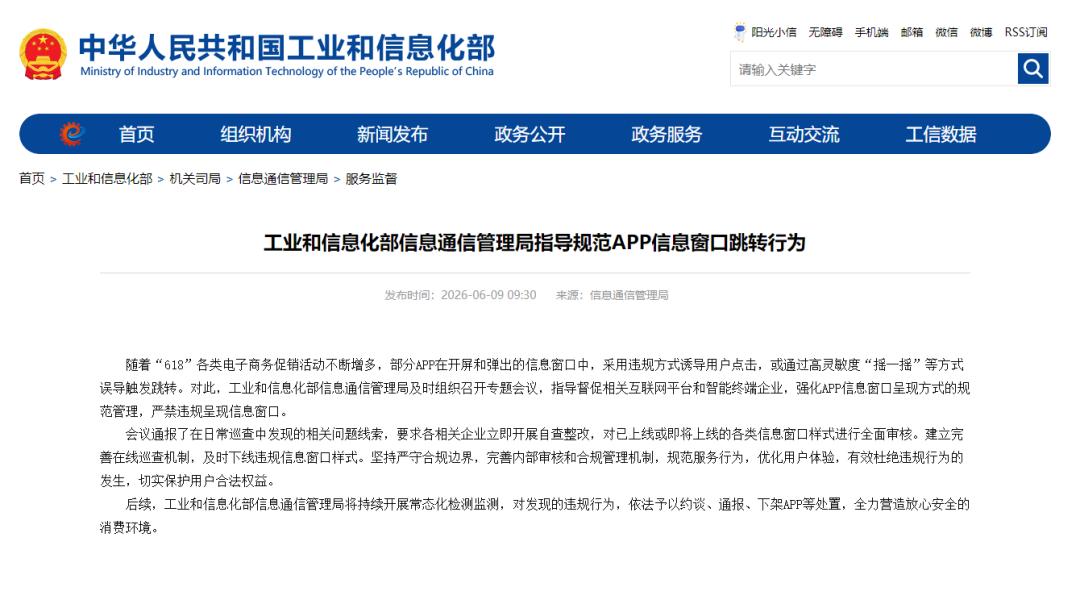
The Information and Communication Administration Bureau of the MIIT held a special meeting before this year's "618", requiring relevant enterprises to immediately conduct self-inspections and rectify the presentation methods of app information windows, including the "Shake-to-Advertise" ads. (Photo/MIIT)
The MIIT's statement is very stern. Does it mean that the good days of this "digital psoriasis" are coming to an end? To truly achieve this, relying solely on the strict measures from the regulatory authorities may not be enough.
1
"Shake-to-Advertise" Ads: A Cancer in Business
Except for the advertising and marketing industry, no one has a good impression of the "Shake-to-Advertise" ads.
The key lies in the fact that in every aspect, it is truly a "psoriasis" - it takes advantage of the mandatory exposure feature of splash ads and the sensitive characteristics of the gyroscope and acceleration sensor in smartphones to capture the moments when you raise your hand, take a step, or even when your fingertips tremble slightly.

The "Shake-to-Advertise" ads take advantage of the sensitive characteristics of the gyroscope and acceleration sensor in smartphones. (Photo/News Queen)
The "Shake-to-Advertise" ads are like hooligans smoking at the village entrance. Whether a girl wants to talk to them or not, they'll whistle as long as she passes by. The "Shake-to-Advertise" ads are assaulting your eyes, wasting your time, occupying your memory, and dividing your energy in this way. You can't defend against them and there's no way to escape.
Moreover, these may not even be ads from e-commerce platforms. They could be disguised as ads but are actually mandatory download buttons. Even I, who is skilled in operating smartphones, have been unfortunately hit by these "disguised ads" many times and forced to download an e-commerce app that claims to be able to get red envelopes, wasting dozens of megabytes of data for nothing.
It's easy for young people to fall into the trap, not to mention the elderly who are not good at using smartphones. On social media, many netizens have complained that there are always some strange apps on their elders' phones, "like weeds that can never be cleared away". After a thorough check, they found that the culprit is the "Shake-to-Advertise" ads.

Many elderly people don't know where the pages come from when they encounter "Shake-to-Advertise" ads, and they don't know how to stop the ads from popping up. (Photo/Old Buddies)
Users are constantly harassed by the "Shake-to-Advertise" ads, so there are naturally many complaints and jokes online. But it's hard to imagine that when this thing first appeared, it was actually under the banner of "innovation".
In just a few years, the "Shake-to-Advertise" ads have become a "menace" invading all smartphones. How immoral is this "innovation"? They are everywhere in major social and entertainment apps, which users can still understand. But when they appear in rigid scenarios such as map navigation, subway riding codes, campus course schedules, and express delivery lockers, it's no exaggeration to say that they are a cancer in business that doesn't care about people's lives.
Whenever such a situation occurs, angry users are always confused. Do the brand owners think they are joking with them or just testing their tolerance?
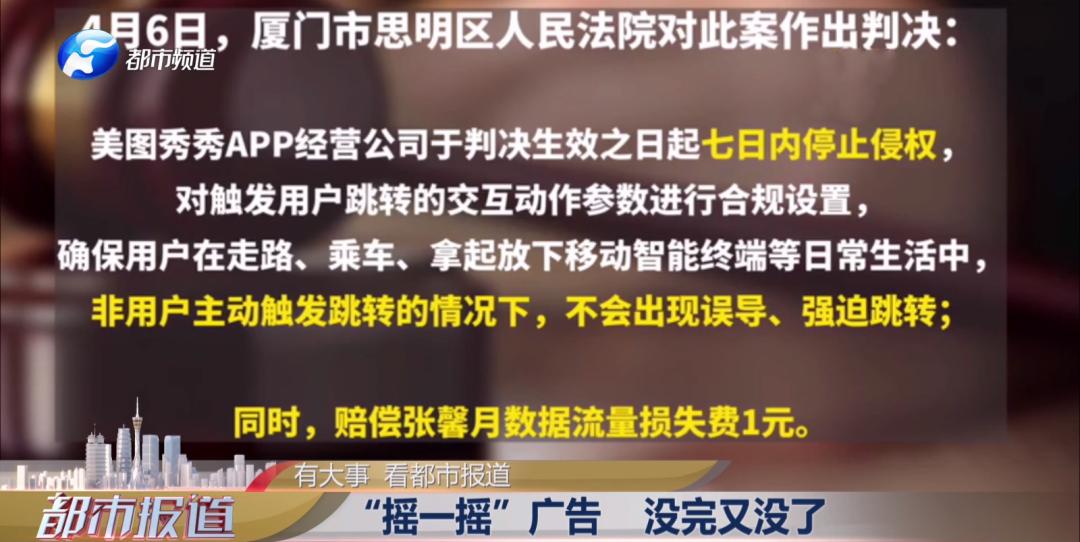
Some people have even taken app developers to court because of the "Shake-to-Advertise" ads. (Photo/Urban Channel of Henan TV Station)
2
Restricting "Shake-to-Advertise" Ads
Regulation Is Just One Aspect
Before the MIIT made this statement, the regulatory authorities had actually been keeping an eye on this "innovation".
Since July 2021, the MIIT, the State Administration for Market Regulation, the Cyberspace Administration of China and other departments have successively issued a number of regulations, clearly stating that there should be obvious "Skip/Close" buttons and "Click to Jump to Third Party" signs on ads; only by clicking on specific areas can the jump be triggered; users should not be misled or induced to operate; ads should not pop up frequently; ads should be able to be closed with one click, etc.
In 2022, the MIIT guided the China Academy of Information and Communications Technology (CAICT) to jointly formulate the "Evaluation Specification for App User Rights Protection Part 7: Deceptive, Misleading and Coercive Behaviors" (Group Standard T/TAF 078.7 - 2022) together with the Telecommunication Terminal Industry Association and several key industry enterprises. This standard sets standards for the relevant parameters of the "Shake-to-Advertise" jump interface, including that the device acceleration of the "Shake-to-Advertise" action should be no less than 15m/s² (about 1.5 times the acceleration of gravity), the rotation angle should be no less than 35°, and the operation time should be no less than 3 seconds.
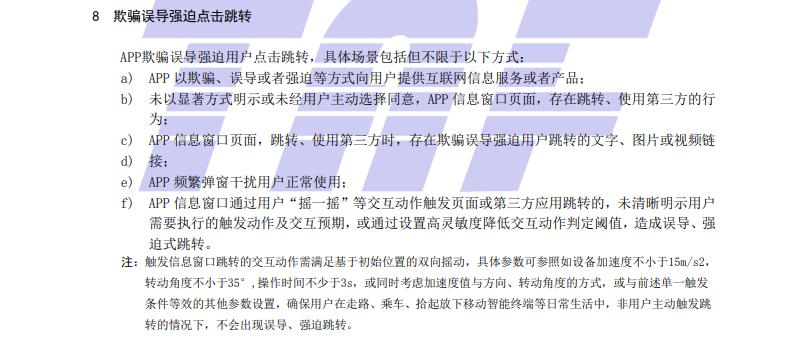
The "Evaluation Specification for App User Rights Protection Part 7: Deceptive, Misleading and Coercive Behaviors" (Group Standard T/TAF 078.7 - 2022) has clear standard specifications for the "Shake-to-Advertise" ads.
The "Regulations on the Administration of Internet Advertising" that came into effect on May 1, 2023, also stipulate that when publishing Internet ads in the form of pop-ups, advertisers and ad publishers should prominently mark the close sign to ensure one-click closing, and there should be no behavior that affects one-click closing; the regulations also apply to the splash ads displayed and published when starting Internet applications.
However, "where there is a policy, there is a countermeasure". Most apps still use the same old tricks to continue to induce users to fall into the trap. Soon, some people found that there were new variants in the apps, such as "Flip the phone", "Tilt forward to open", "Swipe up to open", etc. Some ads even have vibration effects, "jump as soon as it vibrates".
Some netizens are even more worried that the front camera of their phones will become the next target of advertisers: "If there is a 'Blink-to-Advertise' in the future, do we have to wear sunglasses to use our phones?"

The regulatory authorities have taken actions against the "Shake-to-Advertise" ads for a long time, but most apps still "have countermeasures against the policy". (Photo/Across the Furious Sea)
The invasion of technology into daily life is ultimately driven by commercial interests. Advertising itself is a business, and this time it just uses the technical shell of "Shake-to-Advertise".
In the Internet era, clicks have replaced displays as the main form of advertising communication. After an ad is placed, there are three main payment models: CPM (pay per thousand impressions), CPA (pay per action), and CPC (pay per click), and the revenues obtained are often very different.
So in the eyes of the advertising alliance, splash ads are the most valuable ad slots. In addition, the "Shake-to-Advertise" ads use the CPC model, and the base price is very low (between 0.1 - 2 yuan). Even if users are forced to jump, advertisers are willing to pay this cost-effective fee.
As for the problems such as triggering the "Shake-to-Advertise" with a small tilt of the phone and the close button appearing a few seconds late, the answers are all hidden in the parameter settings of the app (SDK). These parameters are business secrets that are not disclosed to the vast majority of users.
Under this closed-loop system, the advertising alliance, the platform, and the advertisers have all completed their respective KPIs, and a world where only users are hurt has also been achieved. In other words, the time stolen from you and me by the "Shake-to-Advertise" ads has been successfully monetized.

The all-pervasive "Shake-to-Advertise" ads have enabled the advertising alliance, the platform, and the advertisers to complete their respective KPIs, and the only ones who are hurt are the users. (Photo/Unrivaled Internet Celebrity)
Of course, users don't have to just passively endure. Since 2023, some Android manufacturers have started to give users the option to turn off the "Shake-to-Advertise" ads through system upgrades.
With the statement from the regulatory authorities, some apps have also quietly launched a switch to "permanently turn off the 'Shake-to-Advertise' ads". Although these are just stopgap measures, at least from now on, you don't have to be on tenterhooks when you pick up your phone to slack off.
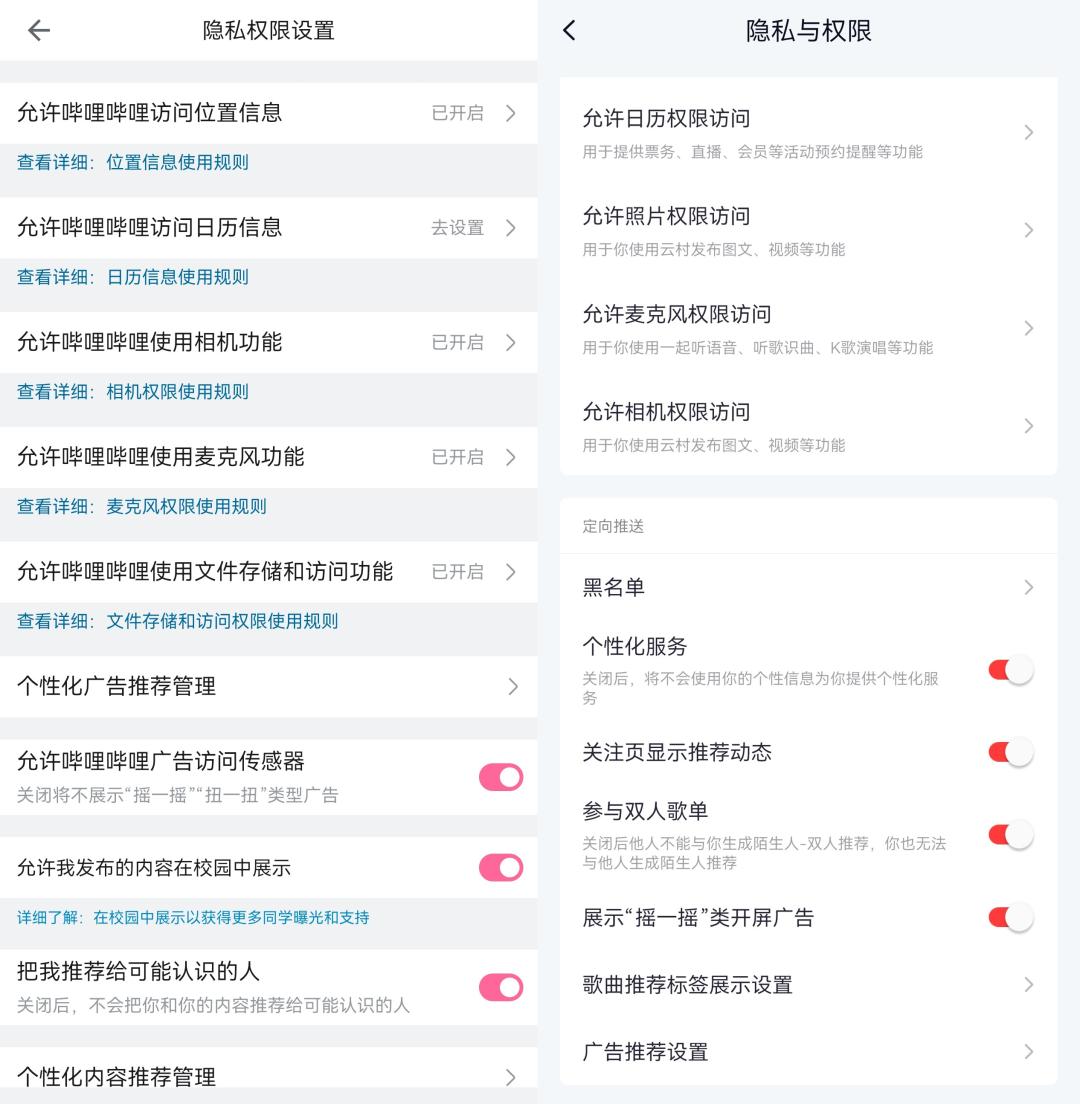
Mainstream apps including Bilibili (left) and NetEase Cloud Music (right) have added a switch for "Show 'Shake-to-Advertise' ads" in the privacy permission settings. (Photo/Screenshots of Bilibili and NetEase Cloud Music)
However, the key to making the "Shake-to-Advertise" ads truly disappear lies in the developers themselves. If they only want to take advantage of loopholes and protect their KPIs, no matter how many switches there are, they will just be useless decorations.
A technology that is disliked by users will eventually be eliminated by time.
Proofreading: He Yan; Typesetting: Forrest
References
[1] Shaking the phone triggers an ad. Who is the winner in the attention battle? | Southern Weekend, June 16, 2025
[2] Why did Apple stop the "Shake-to-Jump" ads? | Caixin Magazine, November 19, 2023
[3] Media Ethics Case Library | Has the phone become a "seismograph"? - An analysis of the technological bullying and ethical boundaries behind the "Shake-to-Advertise" ads | Media Literacy Laboratory, November 29, 2025
[4] To fight against the "Shake-to-Advertise" ads, I developed an app that only has the "Shake" function. | Chaping X.PIN, November 18, 2025