The World Cup can no longer give beer sales a boost.
The quadrennial World Cup has arrived as scheduled, but the beer stocks haven't witnessed the expected revelry.
This World Cup is jointly hosted by the United States, Canada, and Mexico, featuring 48 teams and 104 matches. Logically, it should be the most spectacular World Cup ever.
However, in China, this year's World Cup has been surprisingly lackluster.
One shopkeeper set up a high - definition projector, stocked up on thousands of yuan worth of beer and snacks, and sent out 4000 group messages to invite people to watch the games. But for the opening match at 3 a.m., there were no customers in the shop.
The most affected is still the once - standard accompaniment of the World Cup - beer.
Two days before the World Cup opening, the beer sector defied the market trend and soared. Huiquan Beer hit the daily limit directly, and Zhujiang Beer and Yanjing Beer also rose by more than 6% in a single day.
However, after the official start of the World Cup, in recent days, the overall beer sector has continued to decline. The stock price of Yanjing Beer has fallen by more than 10% in a single week, reaching the lowest point in the past year and a half.
The stock price of Tsingtao Beer has even dropped by nearly 30% from its 2024 high.
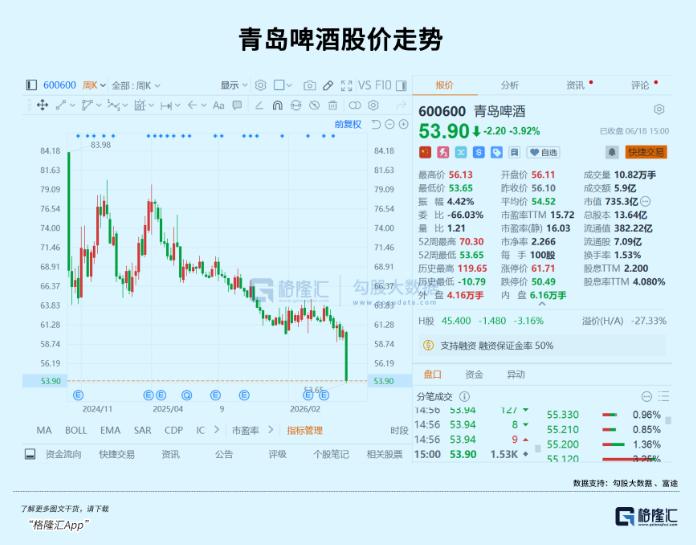
According to Flush ifind, the current valuation of the Shenwan Beer Index has reached 17.83, at the 0.08% percentile in the past decade.
The coldest World Cup in history can't boost the beer market.
01
Looking back at previous World Cups, the relative returns of the beer sector before the event were quite high.
Because the period before the World Cup is generally the peak - season stocking cycle, with strong demand at the factory shipping end. Coupled with the market's expectation of increased beer demand during the World Cup viewing, the stock price trend was often quite impressive.
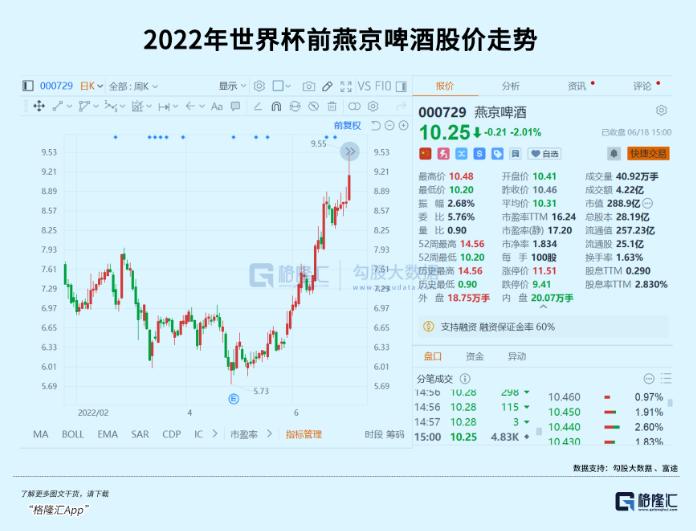
But this year, for the first time, the performance of the beer sector lagged behind the CSI 300 before the World Cup.
The most obvious reason is that the popularity of the World Cup itself has declined significantly.
An obvious influencing factor is the time difference.
In the past two World Cups, the match times corresponding to China were concentrated between 6 p.m. and 3 a.m., which were the prime viewing times for Chinese audiences.
This tournament is held in 16 cities across the United States, Canada, and Mexico, spanning four major time zones in North America.
For Chinese audiences, the key matches are mostly between 3 a.m. and 9 a.m., and almost all the knockout - stage highlights are in the early morning.
The expansion of the participating teams to 48 has diluted the quality of the matches. Meanwhile, the total number of matches has increased from 64 to 104, and the schedule has been extended to 39 days, leading to audience fatigue.
Moreover, the Chinese men's national football team has missed the World Cup for six consecutive sessions. Even with the increase in Asian quotas, it still failed to qualify, which has dampened the interest of many fans.
The most fundamental reason is that in the short - video era, the willingness of audiences to watch the entire match continuously is decreasing.
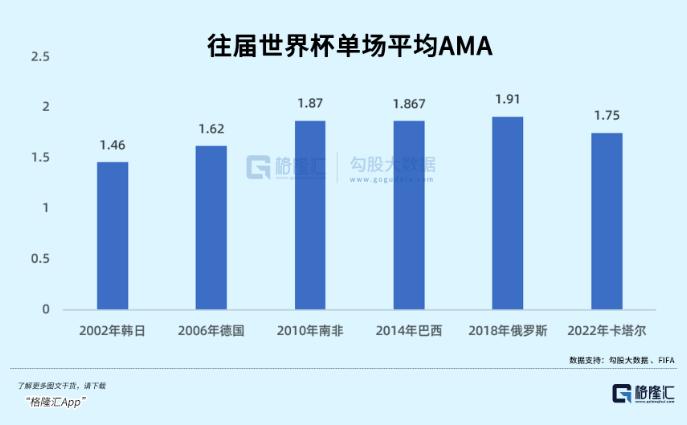
In terms of the average minute audience (AMA) per match, the 2018 FIFA World Cup in Russia reached a peak of 191 million person - times, while the 2022 FIFA World Cup in Qatar had dropped to 175 million, returning to the level at the beginning of the century.
Under the influence of various factors, the enthusiasm of Chinese enterprises to sponsor this World Cup has also cooled significantly -
There are only three Chinese sponsors for this World Cup: Lenovo, Hisense, and Mengniu, with a total investment of about $350 million, a 70% reduction compared to the $1.395 billion in the previous Qatar World Cup.
Correspondingly, the beer, which was expected to be boosted by the World Cup, has also fizzled out in China.
FIFA predicts that more than 1 billion pints of beer will be consumed globally during the World Cup.
The hosts of this World Cup, the United States, Canada, and Mexico, are also the world's three major beer markets, which will boost the global beer sales by 0.2% to 0.3% in 2026.
But in China, beer consumption has been hindered by the time difference.
The traditional World Cup beer - consumption scenario is to have a few glasses of ice - cold beer with barbecue and crayfish at a roadside stall in the evening or early night, chatting with friends while watching the game.
This year, the early World Cup matches generally start at 3 a.m. and 4 a.m. With matches starting at 3 a.m. and 4 a.m. and still going on in the early morning, the late - night beer - and - barbecue consumption model has been severely weakened.
In the consumption scenarios in the early morning and morning, beer is obviously not the preferred beverage.
Hot online and cold offline have become the most prominent features of this World Cup.
During the live broadcast of the group - stage match between South Korea and the Czech Republic on CCTV Sports Channel, the half - time ratings exceeded 1.4%, and the highest full - match ratings once reached 1.9%.
But the excitement only stays online.
Many bar streets have hung up the national flags of various countries early, but the matches starting at 3 a.m. haven't increased the occupancy rate.
Some craft - beer pub owners have simply given up staying open all night. They no longer extend their business hours to the early morning specifically for the World Cup, as the increased operating costs bring little profit.
According to the estimates of beer - industry insiders, the growth brought by the World Cup may be only about 5%, and it is concentrated in leading brands and some specific scenarios such as craft - beer pubs and food stalls.
Even lottery shops haven't been spared -
On June 8, the betting on World Cup group - stage matches started, but the weekly sales of sports lottery were only 3.777 billion yuan, a decrease of 244 million yuan compared to the same period last year.
The industry estimates that the viewing and consumption data of this World Cup in China may decrease by 30% to 50%.
The desolation of offline bars, restaurants, and lottery shops shows that the popularity of the World Cup can no longer be effectively converted into actual consumption behavior.
Many people have switched from the big screen to the small screen of their mobile phones. They may prefer to watch the games at home, order takeout, and share their feelings about watching the games with friends through social software.
The key to beer sales lies in the on - premise consumption channels.
The beer sold in restaurants, bars, and food stalls not only has a large sales volume but also has a high unit price and thick profit margins.
However, more and more people's consumption is shifting from group gatherings to individual consumption and from offline to online, which has become the biggest dilemma faced by the beer industry.
02
It has always been thought that baijiu and beer are in the same boat.
In 2025, the baijiu industry faced its biggest crisis ever, and the beer industry was no better.
In 2025, the beer production of industrial enterprises above a designated size in China was 35.36 million kiloliters, a year - on - year decrease of 1.1%. Compared with the historical peak in 2013, the average annual compound growth rate is about - 2.8%.
However, stagnant sales do not mean stagnant profits. In a situation where the total volume hardly grows or even declines, the profits of the entire beer sector still show double - digit expansion.
In 2025, the A - share beer sector achieved an operating revenue of about 69.85 billion yuan, a year - on - year increase of 2%, and a net profit attributable to the parent company of 8.53 billion yuan, a year - on - year increase of 16.7%.
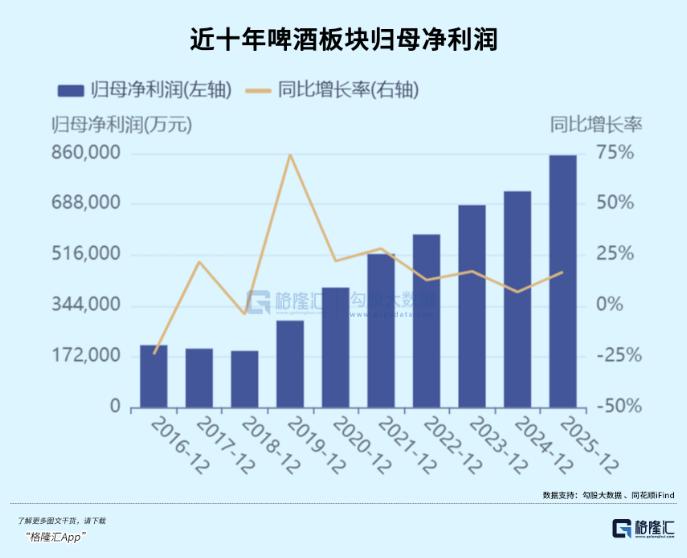
In the first quarter of 2026, the performance of the sector continued to maintain an upward trend -
Among them, the growth rates of non - recurring net profits of Zhujiang Beer and Huiquan Beer both exceeded double digits, and the growth rate of non - recurring net profit of Yanjing Beer even exceeded 69%.
Why is beer more resilient than baijiu?
First of all, beer is a mass fast - moving consumer good, with the mainstream price range between 5 and 10 yuan. The overall unit price is relatively low. Even in the downward period of the industry, there is almost no room for price cuts. Retailers and brand owners will not boost sales through price - cut promotions.
Therefore, the gross profit margin of the beer sector has basically remained stable in the past few years. Even with the dual effects of cost reduction and structural upgrading of leading beer enterprises, the gross profit margin has increased slightly.
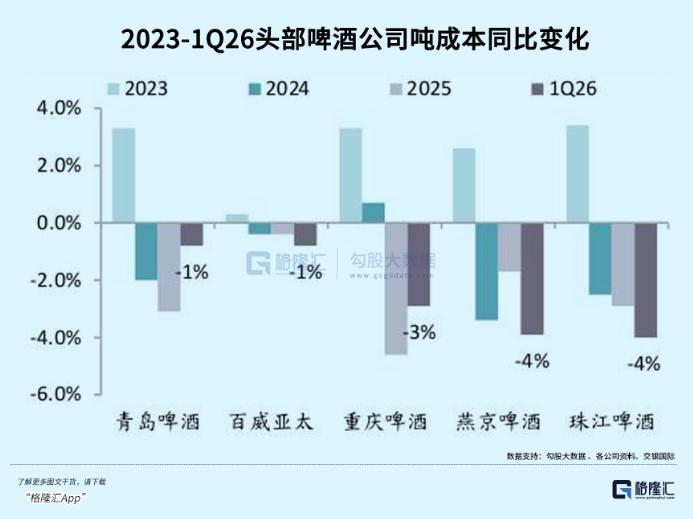
Secondly, after two decades of mergers and acquisitions, the pattern of the Chinese beer industry has been relatively stable, with the CR5 remaining stable at around 80%.
Therefore, although the industry has entered the stage of stock competition, it has also got rid of the stage of using price wars to grab market share. The competition in the industry is more about upgrading the product structure to increase the overall unit price per ton.
Then, why isn't the beer sector rising?
In the past decade or so, the most prominent story in the beer industry has been high - endization - the compound growth rate of the retail average price has exceeded 6%, and the sales volume proportion of high - end and mid - high - end products has increased significantly.
This logic supported the valuation expansion of the beer sector for several years, but now, the high - endization trend has stalled.
It is acceptable for either sales volume to increase while the price remains stable or the price to increase while the sales volume remains stable. But when the price can no longer rise, the market will naturally demand an increase in sales volume.
Therefore, the current trend of the beer sector is highly correlated with sales volume.
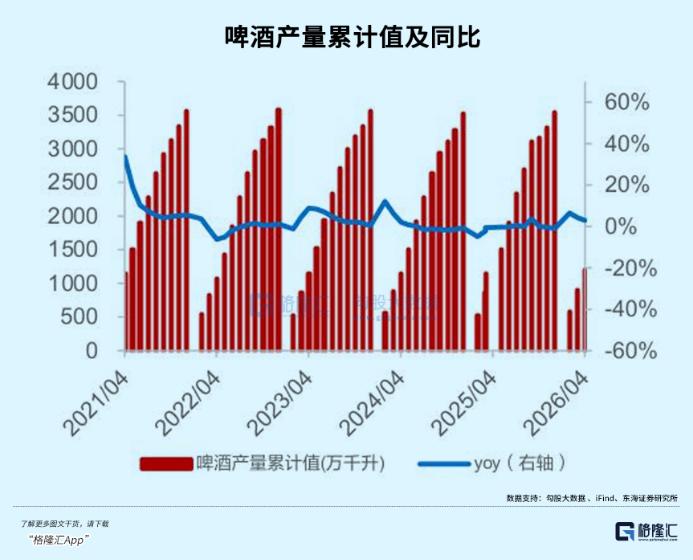
From January to February 2026, the staggered Spring Festival brought a good start, driving the beer sector to rise.
But from March to April, the data of the beer industry gradually weakened. In May, the situation was even worse. The beer sales volume decreased significantly compared with April, and the beer stocks began to decline continuously.
The confidence of dealers is also declining.
The contract liabilities of Tsingtao Beer at the end of 2025 decreased by 7.68% year - on - year, indicating that the channels are reluctant to pay in advance for goods, and the terminal sales are not optimistic.
It's difficult to raise the price, and the sales volume is falling. It's inevitable for funds to flee.
More cruelly, even though the sector's valuation has reached a new low, it doesn't mean that the beer sector is about to enter an upward channel.
The sales volume is falling, the high - endization trend is slowing down, the recovery of the catering industry is less than expected, and the boost from the World Cup has failed.
Before these fundamental factors are reversed, the low valuation is not a sufficient condition for the stock price to rise. Instead, it will become a value trap for investors.
03
Conclusion
The quadrennial World Cup has often played an important catalytic role in the beer industry.
However, this summer, this catalyst seems to have completely failed.
Behind the waning popularity of the World Cup, it also confirms a series of long - term challenges faced by the beer industry, such as the migration of consumption scenarios and the shrinkage of on - premise consumption channels.
And this can't be saved by just one World Cup.
What can really reverse the expectations of the beer sector is not the short - term popularity of the event, but the substantial improvement of sales data and the real recovery of catering consumption.
In the short term, the sales performance during the summer peak season, the recovery rhythm of the catering channel, and the changes in the cost side will be the key factors determining the sector's trend.
In the medium and long term, the high - endization space may further narrow, and the industry needs to find new growth points in the stock market.
Before the signals such as sales data and catering recovery become clear, the market's cautious pricing is likely to continue for some time.
This article is from the WeChat official account “Gelonghui APP” (ID: hkguruclub), author: Yuan He. It is published by 36Kr with authorization.