Valued at 9.5 billion, Jensen Huang invested in a world model startup
On June 18th, according to a report by the Financial Times yesterday, Odyssey, an AI unicorn and a world model startup in the United States, has secured $310 million (approximately RMB 2.096 billion) in financing. After this round of financing, the post - investment valuation of the company will reach $1.45 billion (approximately RMB 9.805 billion).
Its investors include Amazon, NVIDIA, AMD Ventures, venture capital firm Natural Capital, In - Q - Tel, a venture capital institution funded by the Central Intelligence Agency (CIA) of the United States, Jeff Dean, the chief scientist of Google DeepMind, and Elad Gil, a Silicon Valley investor.
In addition, AWS will become Odyssey's preferred cloud service provider. Odyssey will optimize its own models for AWS Trainium chips and deploy Amazon's latest chip products.
The training and continuous inference of world models require a huge amount of computing power. If Odyssey alone bears the costs of hardware and cloud services, the cost pressure will be extremely heavy. The cooperation between Odyssey and chip manufacturers this time will help it share the high costs required for training and running world models.
01 Launching Various Types of World Models and Supporting Self - developed PROWL Algorithm to Fix Simulation Defects
Odyssey was founded in 2023. The company specializes in training world models based on physical rules and object interaction logic to break through the limitations of pure language models. The most prominent core ability of Odyssey is to generate detailed and interactive video content based on text prompts.
Currently, Odyssey has launched several world models for different application scenarios, including Odyssey - 2 Max, the largest and most powerful general - purpose world model of the company to date, Starchild - 1, the world's first real - time multimodal world model, and Agora - 1, a multi - agent world model.
Specifically, Odyssey - 2 Max focuses on single - player long - sequence interactive video simulation. The following image shows a case generated by this model. It can be seen that the model can almost perfectly predict the rotation of a cup in the real world, and the generated physical accuracy is also at a relatively high level.

Most traditional world models can only learn and generate images and cannot output audio. However, Starchild - 1 launched by Odyssey can generate audio and video content in real - time synchronously in an autoregressive manner and continuously respond to the user's streaming input.
Agora - 1 is equivalent to a game engine developed through learning and training. This model supports up to 4 players to interact in real - time in the same generative virtual world. It infers interactive behaviors based on each player's actions, maintains a globally shared world state, and synchronously pushes the real - time generated image pixels to all players.
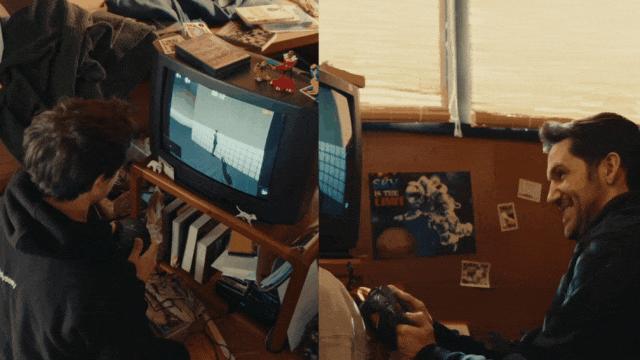
With Agora - 1, Odyssey has achieved multi - agent collaborative world simulation for the first time. The following image shows a shared deathmatch simulation scenario driven by Agora - 1.
Currently, even the top - notch world models still have flaws in pixel details and physical simulation, and cannot always strictly complete the inference according to the input actions.
To solve the above problems, Odyssey has developed the PROWL algorithm, which is an adversarial testing framework based on reinforcement learning. It is used to enable agents to actively discover systematic defects in world models, guide agents to efficiently explore potential problems in the models, and identify defects that are difficult to capture by traditional means.
PROWL uses reinforcement learning agents to mine defect samples to train world models. The optimized models then feed back to the agents to improve the error - finding efficiency. The two form a closed - loop feedback, continuously converting defects into training samples and iteratively optimizing the model accuracy.
Overall, the long - standing problems in the film, television, and game industries, such as the long production cycle and high labor costs of traditional CG 3D scenes and multi - player interactive levels, can be solved by using the world models launched by Odyssey. These models can help customers generate interactive virtual scenes with one click, which not only ensures good quality but also shortens the content production cycle and reduces costs.
In addition, as the scale of these models expands and the simulation quality improves, their application scenarios will cover more fields such as scientific research, robotics, national defense, and medical care. For example, users can use these models to build interactive virtual training scenarios for factory technicians and robot operation and maintenance industrial practical training.
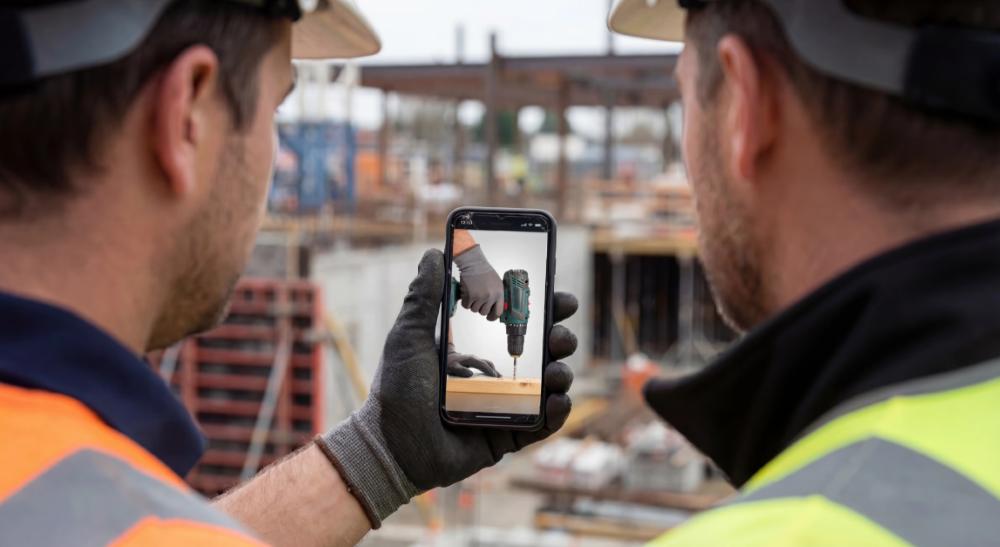
▲ World models used in employees' practical training scenarios (Source: Odyssey)
In the field of robotics, these world models can enable robots to simulate and preview complex tasks before actual operation by learning human control behaviors, covering actions such as grasping, navigation, and manipulation. Thus, they empower intelligent robots with general environmental operation capabilities to serve billions of users.
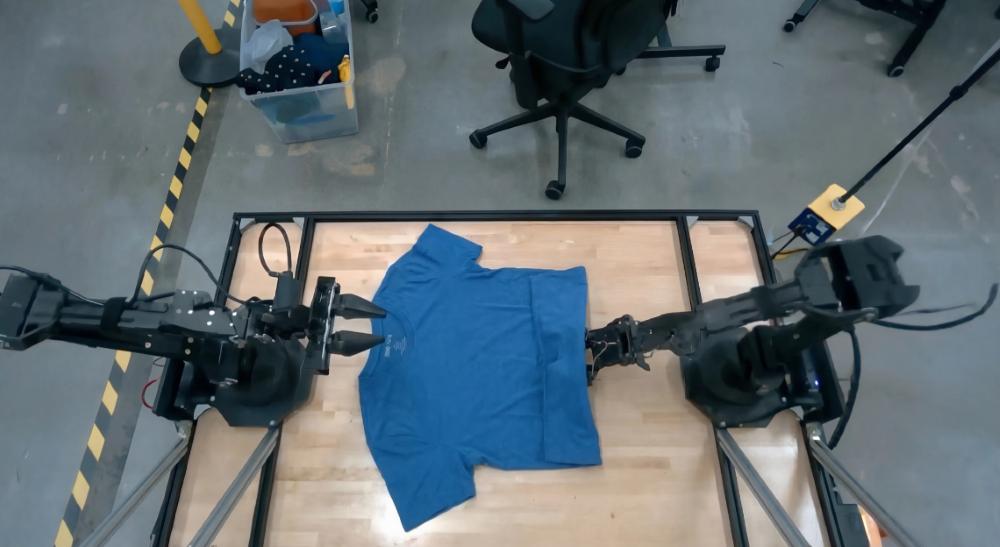
▲ World models used in practical training scenarios in the field of robotics (Source: Odyssey)
02 The Co - founders Were Former Autonomous Driving Practitioners, and Some Team Members Are from DeepMind and Apple
The co - founders of Odyssey are Oliver Cameron, the co - founder and former CEO of autonomous driving company Voyage and the former vice - president of product at Cruise, an autonomous driving company under General Motors, and Jeff Hawke, the former vice - president of technology at autonomous driving company Wayve.
Cameron graduated from Sheffield Hallam University in the UK with a Bachelor of Science degree.
He demonstrated a case where Odyssey's model could reproduce the multiplayer online version of the 1997 Nintendo game GoldenEye only by using pixels, actions, and sound effects as input prompts, without specialized training for the game's specific physical rules.
Cameron said, "Odyssey's model can more comprehensively understand the real world, including physical laws, body movements, and dynamic changes. It can understand things that are difficult to fully describe in all languages in the world."
He also revealed that Odyssey's development tools run on NVIDIA H200 and B200 chips, and the usage cost per person per hour is about $2 to $4. However, this cost does not include the model training cost.
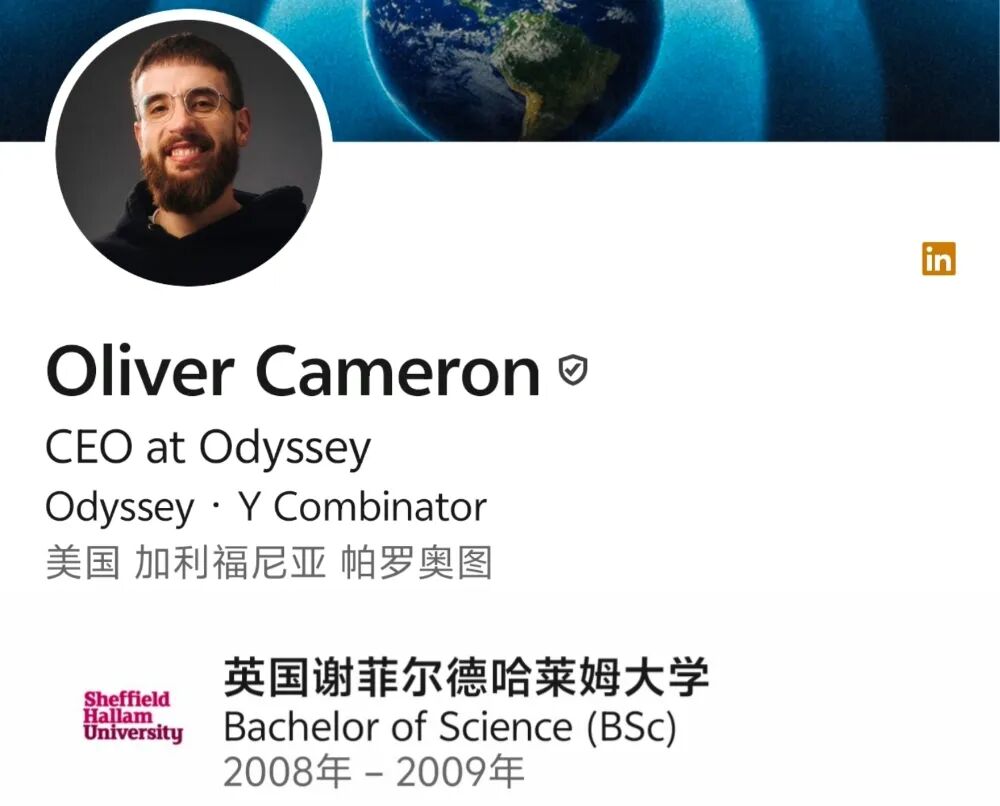
▲ Oliver Cameron's educational background (Source: LinkedIn)
Before co - founding Odyssey, Cameron founded Everyme, a private social app startup, and served as its CEO. In 2013, after the business entity of Everyme, Origami Labs, was acquired by eFamily and the business team members were incorporated into Nest under Google, Cameron joined Udacity, an online education institution in Silicon Valley, US, as the vice - president of engineering.
After leaving Udacity, he co - founded Voyage. In 2021, Voyage was acquired by Cruise, and he then served as the vice - president of product at Cruise for more than two years.
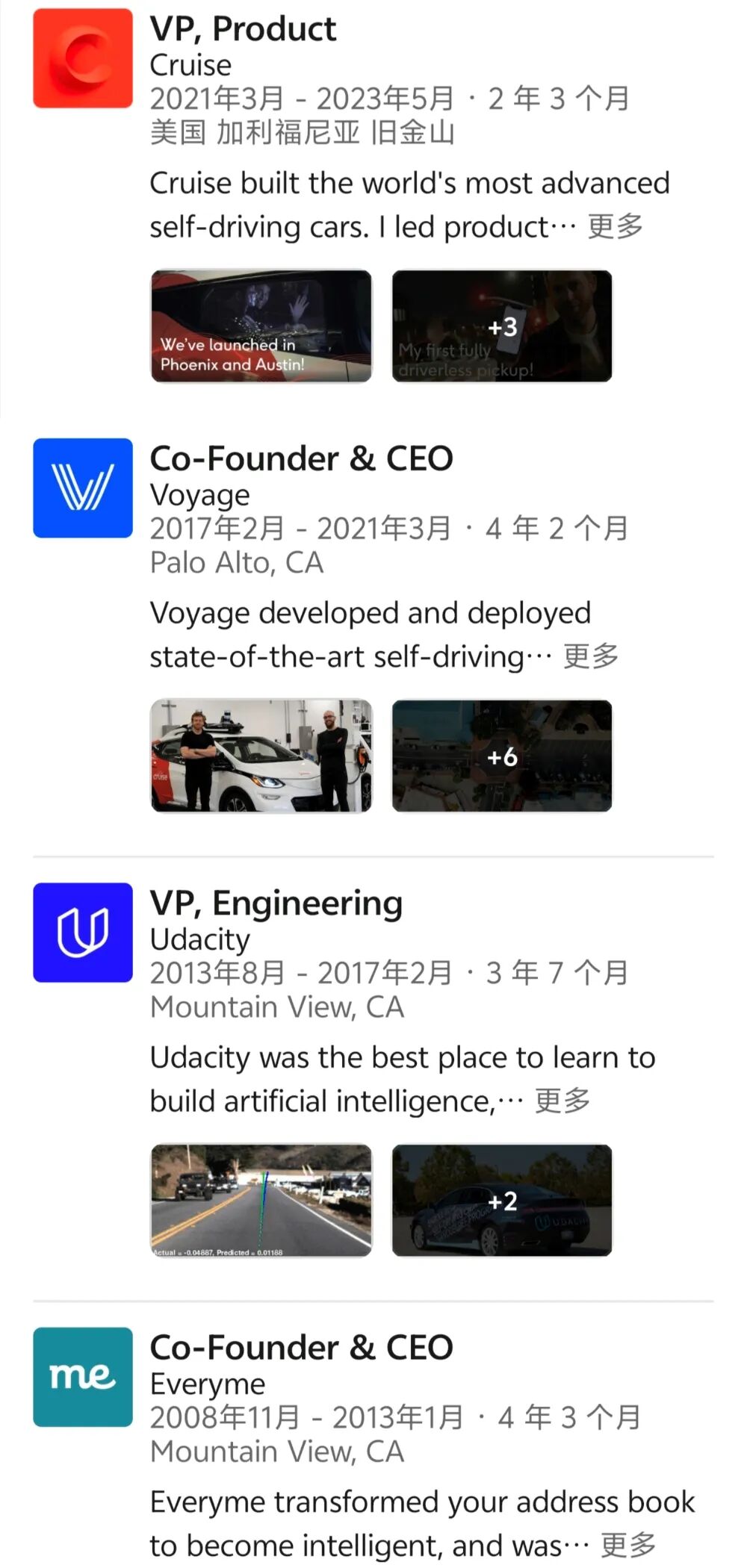
▲ Oliver Cameron's resume (Source: LinkedIn)
The other founder of Odyssey, Hawke, holds a double degree of Bachelor of Science and Bachelor of Engineering (Honors) from the University of Auckland in New Zealand. He obtained his master's degree from the Georgia Institute of Technology in the United States. Then, he went to the University of Oxford in the UK to pursue a doctorate in engineering science at the Applied AI Laboratory of the Oxford Robotics Institute.
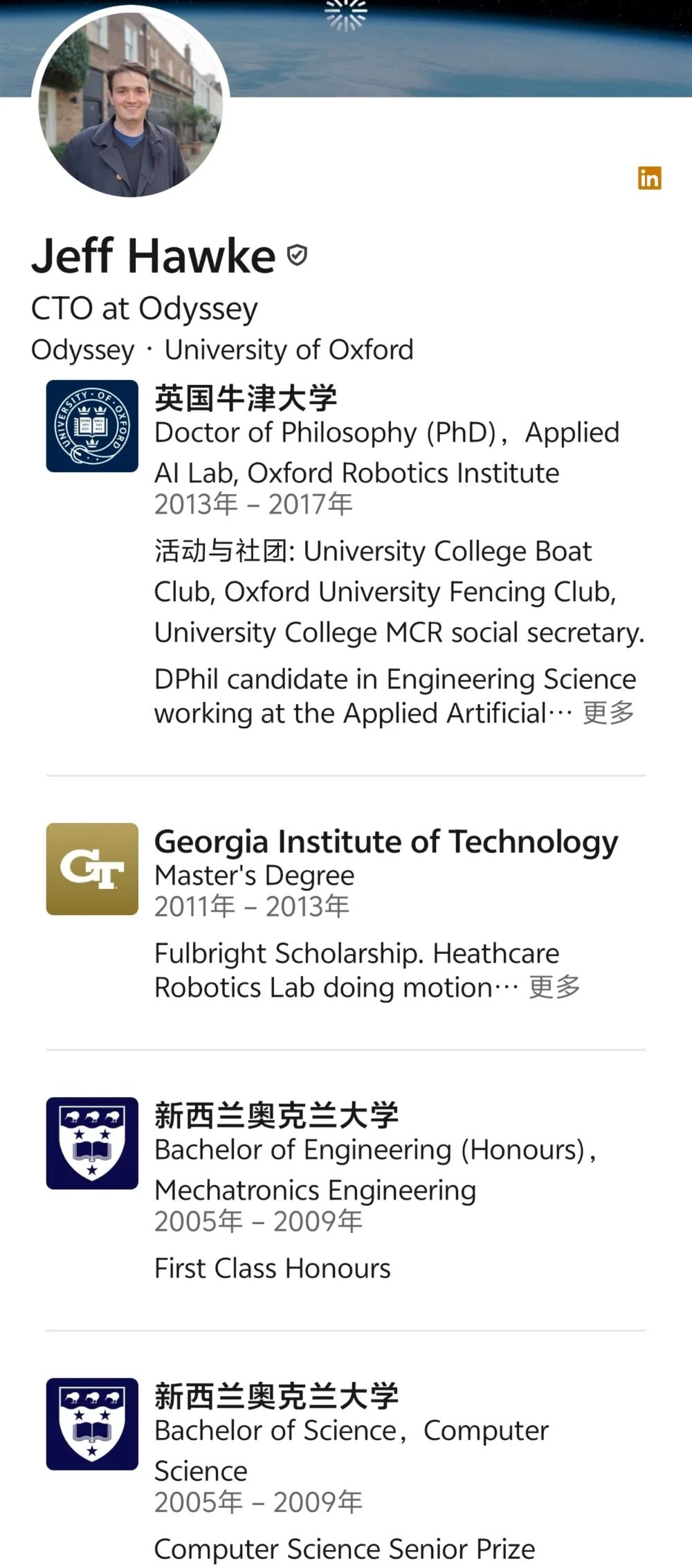
▲ Jeff Hawke's educational background (Source: LinkedIn)
Before officially engaging in technology research and development, Hawke worked as a senior consulting advisor at the Boston Consulting Group (BCG) in the United States. One year later, he joined Wayve as a founding researcher and vice - president of technology, leading the construction of a large number of core business systems and technical modules of the company.
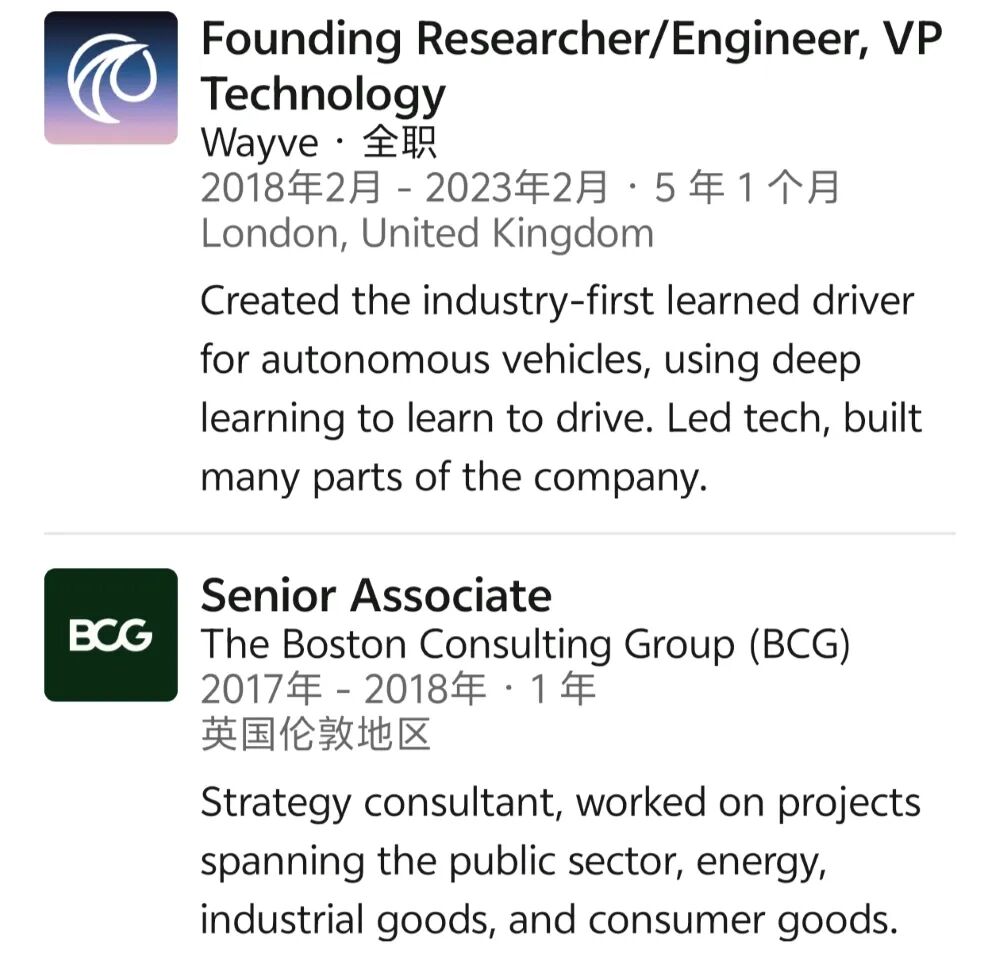
▲ Jeff Hawke's resume (Source: LinkedIn)
Odyssey currently has 55 employees, located in London, Zurich, and Palo Alto. Most of the company's team members come from large - scale AI laboratories and autonomous driving startups, including DeepMind, Meta, Apple, autonomous driving company Waymo, and Tesla.
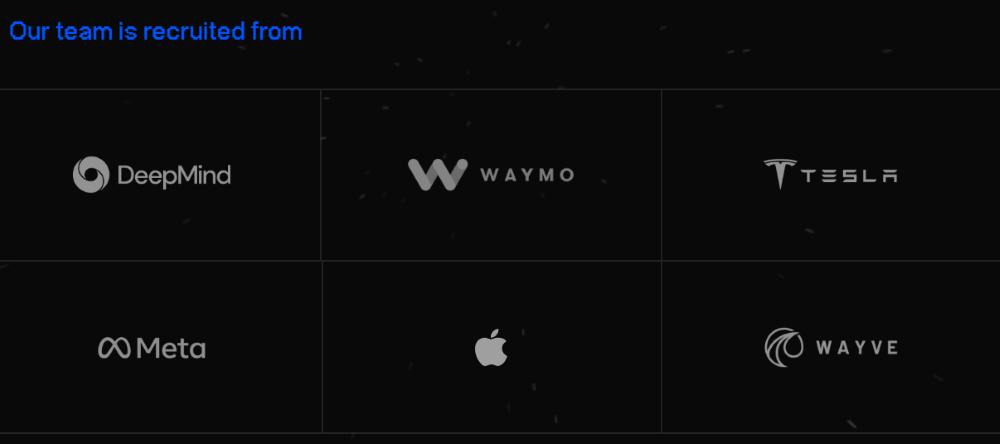
▲ Sources of Odyssey's team members (Source: Odyssey)
03 Conclusion: Tech Giants Flock to Invest in World Models, and Ecosystem Collaboration Will Determine Long - term Competitiveness
The financing lineup of Odyssey includes cloud providers, chip manufacturers, and top - notch AI scientists. This luxurious investment lineup reflects to some extent that the current AI capital is collectively optimistic about the technical route of physical simulation world models.
In addition to providing funds for Odyssey's R & D and commercialization, the underlying computing power infrastructure provided by AWS, NVIDIA and other manufacturers will also help the company relieve the pressure of bearing high model training costs.
As the costs of model training and inference continue to rise, the collaboration between model companies and cloud computing and chip manufacturers is becoming closer. For the world model track, future competition may not only depend on the model capabilities themselves but also on the construction speed of the industrial ecosystem.
This article is from the WeChat official account “Zhidongxi” (ID: zhidxcom), author: Liu Yu. It is published by 36Kr with authorization.