WeChat has taken the final step for AI to take over transactions
Previously, I thought all the feature updates of WeChat were just superficial and it dared not make bold moves. However, in the past two days, my view of WeChat has completely changed.
Here's what happened. In the past two days, the WeChat official has taken a series of actions regarding AI payment.
The first one is to launch an AI exclusive card for users, and the second one is to upgrade the AI Skills for developers from version 1.0 directly to 2.0.
WeChat has hardly promoted these two things, and there has been no movement on its official account. But if you look closely at these two things together, you'll find that this is actually a big deal.
These two things have a "WeChat" flavor, but at the same time, they are not typical of WeChat.
Take the AI exclusive card for example. It isolates risks and gives users maximum control. The balance, permissions, and bills are all transparent. This is WeChat's consistent approach: being cautious, restrained, and putting security first.
However, it is also quite bold. Once you put money into this card, the AI can use it under your instructions, just like when your parents gave you money to buy soy sauce when you were a child.
The same goes for Skills 2.0.
The open - source repository is directly posted on GitHub, targeting Agents, developers, and service providers. And it upgraded from 1.0 to 2.0 in just two months, which is a pace that doesn't seem typical of WeChat.
Yet, it also restricts some permissions and functions, preventing you from expanding the boundaries too much.
A Small Wallet Specifically for WeChat AI
To put it simply, the AI exclusive card of WeChat Pay is a wallet for WeChat AI. You transfer money into it and then specify which AI agents can use this card. When you tell the AI "Help me order takeout", the AI can pay from this card and handle the entire process of placing an order and making a payment for you.
But this card exists independently and is not connected to your main wallet.
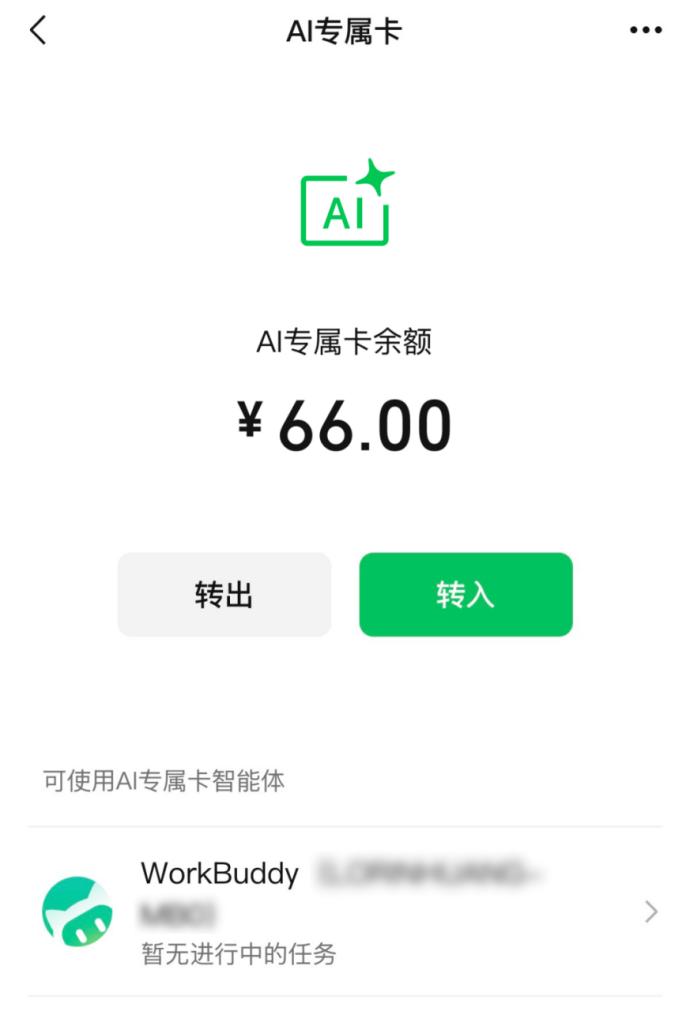
The biggest hurdle for AI to enter the field of consumption is not technology, but trust.
Most people think it's okay to let an AI recommend a restaurant for you. It's also not a big problem to let an AI pick a movie. But if you let an AI directly deduct money from your account, it feels completely different.
Think about it. If you have a few thousand yuan in your WeChat change and the bound bank card has a larger limit. If the AI makes a wrong judgment or a vulnerability is exploited, and all your money is transferred away by the AI, the loss won't be a joke.
Moreover, the consumption pattern of AI is different from that of humans. Humans will hesitate and compare before clicking the payment button. AI just acts immediately and places an order in a second.
Actually, the concept of the WeChat Pay card comes from two products, OpenClaw and WorkBuddy. They both have a dedicated sandbox folder, and the AI can only operate within this folder and can only call specified tools.
In addition, the entire payment process is visible.
You can see every penny the AI spends, including how much it spends, where it spends, when it spends, and the status of the task. If there is a problem, you know who to turn to.
To put it bluntly, the relationship between AI and money was previously disjointed.
AI can make recommendations and help you make decisions, but when it comes to the payment step, you still have to do it yourself. It's like a salesperson helps you pick out all the things, but you have to go to the cashier to pay in the end.
The AI exclusive card allows the AI to complete the last step of the transaction for you.
But the real highlight of this is not the card itself, but the payment system it represents.
In the past, all payment permissions were designed for humans. Entering passwords, pressing fingerprints, and face scanning are all for the scenario of "a person operating a mobile phone". But now, it's not just humans who operate mobile phones; there is also an Agent.
Agents are different from humans. A human can only place one order at a time, while an Agent may place orders in batches. Humans have an intuitive judgment of abnormal situations, while Agents don't.
So, what WeChat Pay needs to do is to completely overthrow the previous payment logic based on humans and design a new payment system for Agents from scratch.
The AI exclusive card is the first product to implement this new permission system. It looks like a card on the surface, but in fact, it's a testing ground.
If everyone starts using this card, it means the right direction has been taken. But if everyone still uses the old online payment methods, then new solutions need to be thought up from scratch again.
From 1.0 to 2.0 in Just Two Months
The AI exclusive card solves the problem of whether users dare to let AI spend money. But a transaction can't be completed with just buyers; there also need to be sellers to accept the payment.
What are the problems on the merchant side? Think about the daily life of a restaurant owner. To access WeChat Pay, he first has to figure out which product to use: basic payment, product vouchers, payment score, or entrusted deduction?
Even if he selects the right product, the access process still involves a lot of things, such as how to place an order, how to handle payment callbacks, how to verify signatures, how to prevent duplicate payments, how to reconcile accounts, and how to troubleshoot problems when they occur.
This is what WeChat Pay Skills aims to solve.
In the 1.0 era, WeChat made each product into a Skill: basic payment was a Skill, product vouchers were a Skill, payment score was a Skill, medical insurance payment was a Skill, and entrusted deduction was a Skill.
Each Skill contained knowledge about the corresponding product, code examples, and troubleshooting instructions.
At first glance, it seems okay, but when you encounter actual problems, you'll find there are still quite a few minor issues.
First of all, developers themselves don't know which product to ask about. They may not even be clear about the difference between "payment score" and "entrusted deduction". If you let them choose a Skill by themselves, they are very likely to make the wrong choice.
Secondly, the same error may be explained in five Skills, but the explanations are contradictory. Because the maintenance rhythm of each Skill is different, some are updated to the latest version of the API, while others still remain at the old version.
I think 1.0 is more like a manual rather than Skills. Moreover, AI is prone to hallucinations. As long as there is a mismatch in one part of the payment interface, it won't work.
However, just two months later, Skills 2.0 arrived.
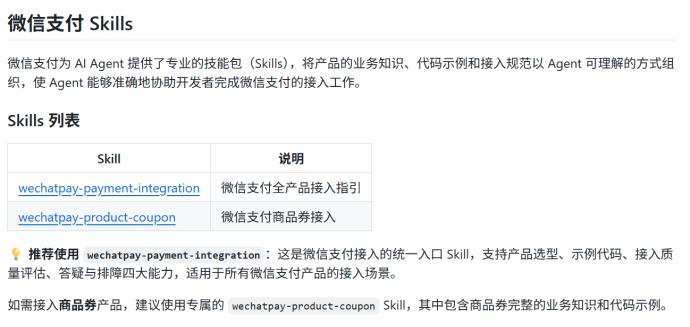
The biggest change in 2.0 is to integrate a bunch of scattered product Skills into a unified entry.
It's called wechatpay - payment - integration. When developers enter, they don't need to worry about which product to use. They just tell the AI their requirements, and the AI will decide which way to go.
This is like a receptionist. It can't directly solve your problem, but when you tell it your requirements, it can tell you how to solve it.
But the unified entry is just the first step. The real effort in 2.0 lies in several new additions.
One is the access quality assessment. 1.0 can tell you how to write code, but it won't help you check if it's written well. 2.0 adds signature checks, signature verification checks, callback processing checks, idempotency checks, reconciliation checks, and also checks the encryption of sensitive fields and the security of private keys.
These are the areas where problems are most likely to occur in payment access. Just because the API is working doesn't mean the payment is properly connected. Only when all these check items pass can it be considered successful.
Another one is dynamic troubleshooting.
The previous troubleshooting method was "If you encounter this error, it may be due to this reason", providing a bunch of possibilities for developers to troubleshoot by themselves. In 2.0, through the wechatpay - dev - cli tool and the APIv3 troubleshooting process, developers can be guided step - by - step to troubleshoot. How to handle a failed order query, how to locate a SIGN_ERROR, what causes a 401 error, each step has a clear sequence. It's an operation process, not a knowledge list.
There is also a very crucial point. 2.0 has significantly "downgraded" WeChat AI payment, restricting the free - play space of AI.
Code examples must come from the official documentation, interface fields must come from the official documentation, and error codes must come from the official documentation. AI can't write code from memory; it must first check the official knowledge base. Moreover, the official code examples are only provided for curl, Java, and Go. For other languages, it should be indicated that they are reference implementations and not officially maintained.
It may seem like WeChat is imposing restrictions on itself, but in fact, that's how the payment scenario is. You can't let AI be creative with the payment interface. If the name of a field is written wrong, it may not just result in an error. It could be a disaster if the money is deducted but the order is not generated.
The status of knowledge Q&A has also been downgraded.
The independent "knowledge Q&A" section in 1.0 has become part of "question - answering and troubleshooting" in 2.0. WeChat's idea is that if you're accessing AI payment, you should focus on payment and not waste computing power and time chatting with AI first.
In addition, 2.0 has incorporated a feedback mechanism into its framework.
Questionnaires and communication groups are written in the README, indicating that WeChat really needs the real feedback from developers and service providers.
For a business of WeChat Pay's scale to complete the reconstruction of the unified entry, the access quality assessment system, the CLI troubleshooting toolchain, and the strong constraints of the official documentation within two months shows that internal resources are clearly tilted.
But there is also another possibility, that is, being pushed forward by the feedback from merchants and developers.
After 1.0 was released on the open - source community GitHub, WeChat was able to quickly collect feedback, which accelerated the birth of 2.0.
Why Can't Apple Pay Do It?
Why is WeChat so committed to AI payment? I think it might be because it saw the progress of Siri at Apple's WWDC 2026.
Now, Siri can understand users' instructions through Apple Intelligence, understand the context from the screen content, and pull information between apps.
Based on App Intents, developers use this framework to send actions in the app to the system, and Siri can directly call them. In theory, it can open orders, create reminders, send messages, order coffee, and call a taxi.
But when it comes to the most crucial part - payment, Apple fails.
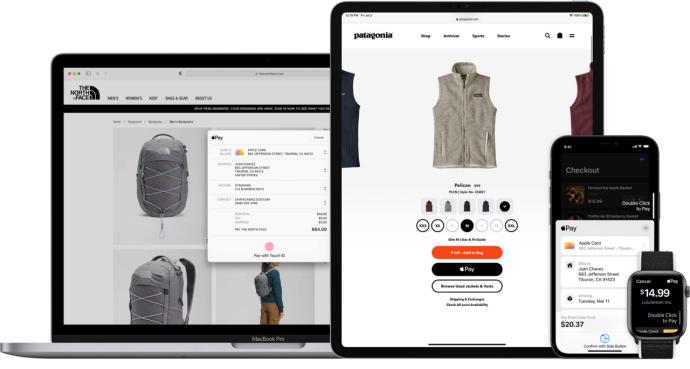
Apple does have Apple Pay and can pull up the payment panel. Users can confirm the payment with Face ID or Touch ID, and the encrypted token is handed over to the merchant for processing. But Apple Pay only takes care of the final payment confirmation and is not responsible for anything else.
For example, how to create an order, how to lock inventory, how to check for refunds, how to verify callbacks, how to prevent duplicate payments, and how service providers can access on behalf of merchants? Apple Pay says it has nothing to do with these and tells you to contact the merchants yourself.
WeChat Pay is different.
WeChat is not just a payment button. It has a chat entry, mini - programs, official accounts, merchant back - ends, service provider systems, membership systems, coupon systems, order systems, refund systems, and reconciliation systems.
These things usually just look like a list of functions, but in the AI era, they are ready - made transaction infrastructure.
On the user side, the AI exclusive card manages authorization. How much money the Agent has, where it can spend, and how much it can spend are all within the rules of WeChat Pay.
On the merchant side, Skills 2.0 manages access. From product selection to interface access, from code generation to quality inspection, from troubleshooting to reconciliation, everything is in a unified entry.
The intermediate transaction processing, risk control, order status transfer, refund, and settlement all run within WeChat Pay's existing system and don't need to be rebuilt. This is the difference.
To put it bluntly, WeChat has realized that it should now give full play to its unique advantages.
This article is from the WeChat official account "Zimu AI" , written by Miao Zheng, and is published by 36Kr with authorization.