Graduated from a leading tech company, starting an AI business
"I must study every day now. I study until late at night every day because AI is changing too fast. If I don't study, I'll fall behind."
"I keep five computers running around the clock, and I have more than 20 AI accounts. AI is an irreversible trend, and the window of opportunity is limited. We must act quickly. First-mover advantage is very important. Once you miss it, it's hard to catch up."
"In the AI era, the most core ability is not to master a certain tool, but to continuously learn the latest model changes and quickly embed these changes into the business."
"AI cannot fully make up for people's ability shortcomings. If you know nothing about a certain field, it's difficult to use AI tools effectively even if you have them."
The entrepreneurs who shared these insights include those born in the 1980s, 1990s, and 2000s.
They used to hold relatively "stable" positions in large companies or high-growth companies: some made decisions in key projects; some led teams and managed multiple business lines; some actually handled business transactions worth hundreds of millions...
In the narrative of the AI era, the spotlight often falls on two types of people: one is those who dropped out of top universities, achieved success at a young age, and got financing as soon as they started their businesses; the other is senior executives from large companies with impressive resumes, who immediately gained the support of capital after making a career change.
But the people we're going to talk about today don't fit into these scenarios. They have experience in large companies but haven't yet stepped into the spotlight. They're still exploring, still on the way, and still looking for new outlets in their own way.
After the emergence of AI, they realized that many things that used to require a team, processes, and even hierarchical structures to complete can now be redone by one person with the help of AI, and it's faster, cheaper, and in some cases, the results are not bad.
So, they started working in a new way: "Individual + AI system". On the surface, these people seem to be running "One-Person Companies" (OPC): no team, no complex organizational structure, and one person is responsible for the results.
But after having in-depth conversations with them, you'll find that they're not very willing to be defined by the term "OPC".
Because in their understanding, "One person" is not the end, but more like a temporary form, a transition, an exploration between the inefficiency of the old organizational form and the incomplete formation of the new one.
01 "Five computers running around the clock with more than 20 AI accounts"
Wang Shi, born in 1999, was originally a programmer. AI gave him the courage to start over. He believes his core competitiveness lies in "his understanding of AI".
He graduated from Beihang University with a master's degree. He joined Tencent through campus recruitment and later went to Baidu, working on basic infrastructure and inference optimization, which are closely related to AI.
When ChatGPT emerged in 2022, as an IT engineer, he naturally started using large models to write code, break down modules, and assist in reasoning. Different from most people's "tool-based use", before the emergence of Agents, he started doing something more radical: Instead of using AI in a single point, he embedded AI into the entire workflow.
The early experience was not stable. The models would make mistakes and be inconsistent. But what he saw was not the problems, but the trend. He gradually realized that an inflection point was emerging: AI was changing from "a tool for answering questions" to "a system component that can participate in modular work".
From then on, a bigger idea began to take shape: Maybe in the future, the mode of production will not be people using AI, but people and AI forming a system together.
What really made him break away from the path of large companies was continuous verification. He used his spare time to build his own AI workflow system: multiple models working together, controlling the output through constraints and protocols, breaking down complex tasks into chains, and letting AI execute the whole process. This system quickly produced visible results, and some tasks that used to be done manually were stably automated.
He realized for the first time that this might not be just "efficiency improvement", but "a change in the production structure".
So he started promoting it to real users and made courses to teach people how to build workflows. The earliest users came from several study communities with hundreds of people. He shared the content and methods generated by AI in the groups. At first, it was just for communication, but soon some people started paying voluntarily. He set the price between 399 and 599 yuan. Even before the product had a complete form, there were already stable purchases and repeat customers.
In his opinion, when users are willing to pay continuously and give feedback on real improvement, this thing is feasible. He gradually moved from "spare-time verification" to a "semi-entrepreneurial state".
This spring, Wang Shi chose to leave the large company and focus on his own business full-time. Now he keeps five computers running around the clock, with more than 20 AI accounts running simultaneously. Different AIs are responsible for different tasks: some for content generation, some for course breakdown, some for case expansion, and some for format verification. And he is like a "general director".
His daily work is no longer writing content himself, but constantly assigning tasks to AI, checking the results, and optimizing the process.
This state is completely different from traditional entrepreneurship. Wang Shi said : "It's not me working, it's AI working, and I'm just checking the results."
His deeper judgment comes from his understanding of the boundaries of AI's capabilities. He repeatedly emphasized: "The understanding of AI is the key for a person to start a business. It's not about 'what you know AI can do', but 'what you know AI can't do'." In his opinion, this ability to judge boundaries is itself a core competitiveness, even more important than experience.
"As an entrepreneur, you must have strong foresight. When new technologies emerge, you must be able to capture them immediately and judge their value." Wang Shi further explained. The future won't reward those who are "better at using AI" - because everyone will be able to use AI. It will only reward those whose judgments are based on their own practice.
Wang Shi is very cautious about "forming a team". He believes that "The combination of 'myself + AI system' may already be more efficient than a small team." But he still wants to find partners, although he feels that "this is a more difficult process than developing an AI product".
Currently, his income is still at a small scale, and he's also trying to raise funds, but the process is full of uncertainties. He said that he's met many unreliable people, whether they want to partner with him or invest in him. "You can't even imagine how many scammers there are now."
He admits that he does feel anxious now, mainly because of the time window: "AI is changing too fast, and opportunities won't wait for people."
He believes that the AI era is not a long-term gradual process, but a short-window competition. In this window, the key is not to "do it perfectly", but to "run faster". First-mover advantage is very important. Once you miss it, it's hard to catch up.
That's why Wang Shi hasn't made his product public yet. He only distributes it to paying users. He said, "This product is still in its early stage and can only develop 'under the water'. Otherwise, it will be copied quickly."
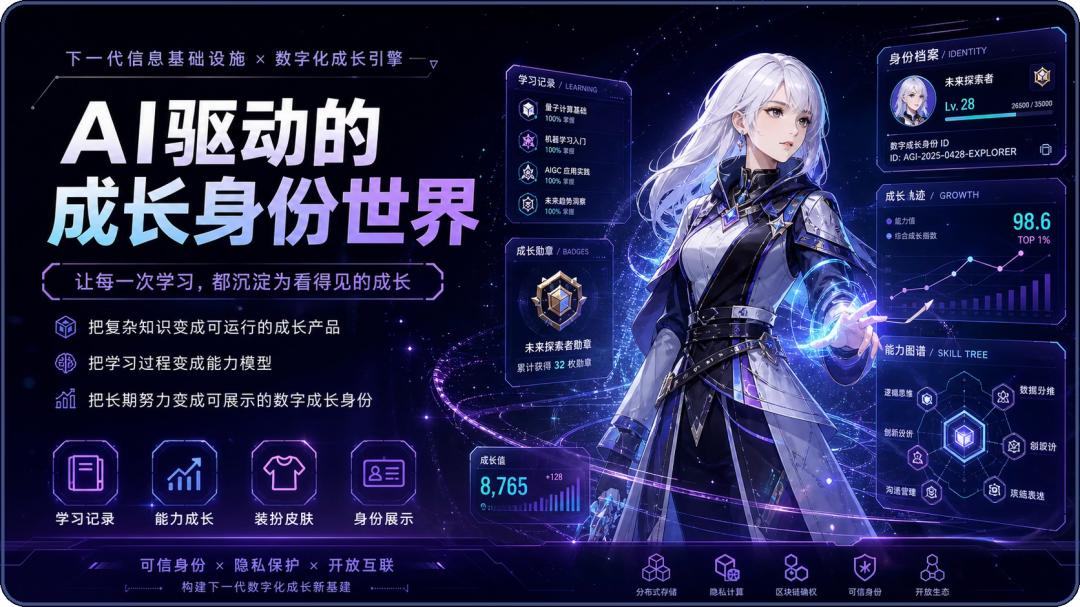
(A page of the introduction to Wang Shi's project BP)
In his opinion, what he's doing is an AI-native product. So-called AI-native doesn't mean putting an Agent on an old business, but redefining the most core object in the business because of the emergence of AI.
He said, "Now many products just wrap a large model with an interface, connect a few tools, and call it an Agent, thinking they're very powerful. But as soon as the underlying model is updated, this so-called 'power' will disappear instantly."
Wang Shi believes that the next-generation mode of production is not to replace people, but to enable a small number of people with high-level understanding to have the creativity that used to belong to a team or even an organization with the help of AI.
This is also the process he's exploring.
02 "A liberal arts student can also develop an AI product alone"
Xiaoman (a pseudonym), a post-90s, graduated from a top university and has strong learning ability. Her career path has almost precisely followed every wave of the times.
From exploring live courses when online education was booming, to researching AI learning systems when AI education was emerging, to joining a cutting-edge AI team after the explosion of large models, the high-intensity training in large companies has honed her ability to implement products.
However, as technology entered the era of large models, what really shocked Xiaoman was not just the technology, but also the speed of change.
In her opinion, the success methodology of the older generation was based on the social division of labor in the industrial era: spending twenty years delving into a field to become an expert, and then spending decades stably outputting and seeking breakthroughs. However, in the ever-changing large model team, she saw that "the stable contribution period of experts has been extremely shortened".
"You may spend a few days struggling with the latest architecture to become an expert, but after only a month of stable delivery, with the emergence of the next updated and more powerful architecture, your past accumulated experience will become invalid instantly." Xiaoman said.
She realized that the era of blindly sticking to a specific category has passed. What the AI era really needs is a lifelong learning ability that doesn't rely on accumulated experience, can quickly collaborate with AI to become a "temporary expert", and can quickly produce usable results in a very short time.
This insight into the impact of technology on productivity naturally led her to think about the operating efficiency of large company organizations.
In a mature business ecosystem, to resist risks, large companies must establish a precise and complex cross-departmental collaboration and review mechanism.
Xiaoman understands and respects this system, but she also feels a loss of creativity: "It takes countless discussions for a product to go from idea to implementation; the launch of a function often involves the coordination of multiple departments."
Many times, people spend a lot of time discussing processes instead of solving problems. "Sometimes you'll find that people are not creating value, but maintaining the operation of the organization." She said.
The explosion of AI technology has broken this organizational state. What excited her is that she found that in the AI era, a liberal arts student with a Chinese major can really develop a product on her own.
She developed an AI product by herself with the help of some AI tools, and it's currently in the testing stage.
One of Xiaoman's most valuable assets during her time in the large company was her learning ability. Facing the AI wave, she quickly mastered all the mainstream AI tools: text-to-video, Vibe Coding, OpenClaw, Harness...

She has almost transferred all her skills and methods to the entrepreneurial scenario. Now, she writes PRDs (Product Requirement Documents) by herself, debugs Agents, designs product processes, and looks for partners. She almost takes on all the work that used to require a team.
"In the large company before, you needed countless people to reach a consensus to develop a function." She said, "But now I can directly incorporate my values into the product." This fascinates her very much. She said, "It's such a refreshing feeling!"
She's also imagining the future organizational form. In her eyes, "It may break the strong hierarchical relationship in the past. It may be more free and equal than traditional companies."
Now, Xiaoman still maintains a high-efficiency learning rhythm. She said: "I must study every day. I study until late at night every day because AI is changing too fast. If I don't study, I'll fall behind."
03 "Quickly embed the changes brought by AI into the business"
Shaohua (a pen name) is a post-00s who has been constantly switching career tracks.
He studied civil engineering in college. After graduation, he joined a real estate company, working in construction management and coordinating decoration projects. Those years were simple for him: he was tired but felt secure. His daily work was to go to the construction site, check the progress, communicate with the teams, and handle conflicts. A project often involved thousands of people, and problems always occurred and were solved on the spot.
He often mentions that experience not because he misses it, but because it was his first time to understand the "complex real world". He said that after that, he's less likely to be overwhelmed by any difficulties.
Later, due to industry changes, he left the real estate industry. Then he briefly entered the new energy industry, doing business-related work. This work mode highly depends on resources, personal connections, and external relationships, and he didn't like this kind of business entertainment.
He said, "I must 'climb out' of the original industry."
By chance, he entered the new media field, managing WeChat official accounts, shooting and editing videos, operating IPs, and working on digital human and AI-related projects. He said he felt "happier than before because there's continuous positive feedback".
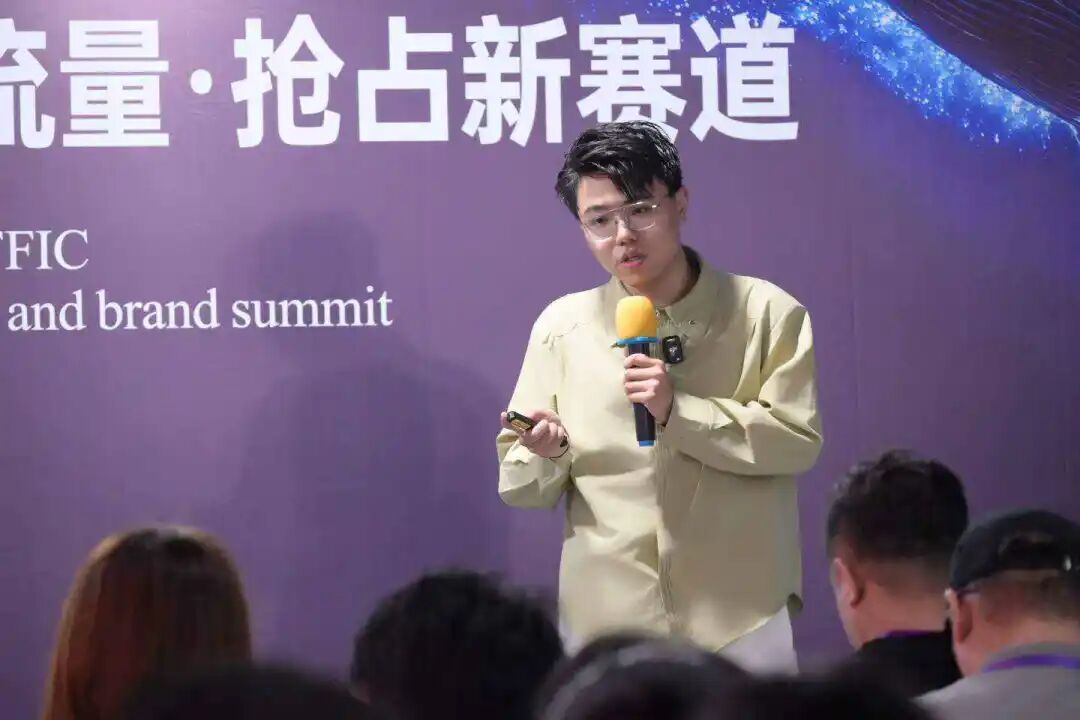
(Shaohua participating in an offline AI event)
From then on, he was both a business executor and a customer contact person, and he also had to be responsible for content creation and delivery judgment. He said that's when he really entered the entrepreneurial state of "supporting himself", which might be what people call OPC.
Soon, generative AI exploded. In early 2023, AI writing, PPT generation, and meeting minutes were not stable yet, but he already vaguely realized that "This might be a new entrance to a new era."
He signed up for online and offline courses, joined communities, studied tools, participated in offline AI events, and helped the event organizers. Over the years, he has invested more than tens of thousands of yuan in learning in the AI field and has been using various AI tools with high-frequency payments. But he thinks the money spent is worth it because the "cognitive return" he gets is the highest.
In his opinion, the most core ability in the AI era is not to master a certain tool, but to continuously learn the latest model changes and quickly embed these changes into the business.
However, although his work efficiency has improved, his working hours have actually become longer.
"Because the biggest change brought by AI is not to replace work, but to make learning an endless process." Shaohua said.
The models are updated every day, the tools are constantly iterated, and the customers are also learning about AI. He not only has to keep up with the technological changes but also understand these changes faster than the customers and then transform them into deliverable content. This has made his life a cycle: learning, verification, re-learning, and re-delivery.
He is now responsible for core decision-making himself, with two or three part-time college students responsible