The champagne has been popped even before we've crossed the starting line.
As you all know, DeepSeek has completed its first round of external financing: over 50 billion RMB, with a valuation exceeding 50 billion US dollars. This is the largest single-round financing in China's AI industry to date and also makes DeepSeek one of the AI startups with the highest valuation in China.
Liang Wenfeng has finally agreed to take the investment and given the market a chance to set a price. We can finally place it properly in the echelon of Chinese unicorns! The TOP 10 Chinese unicorn companies have finally welcomed a new face!
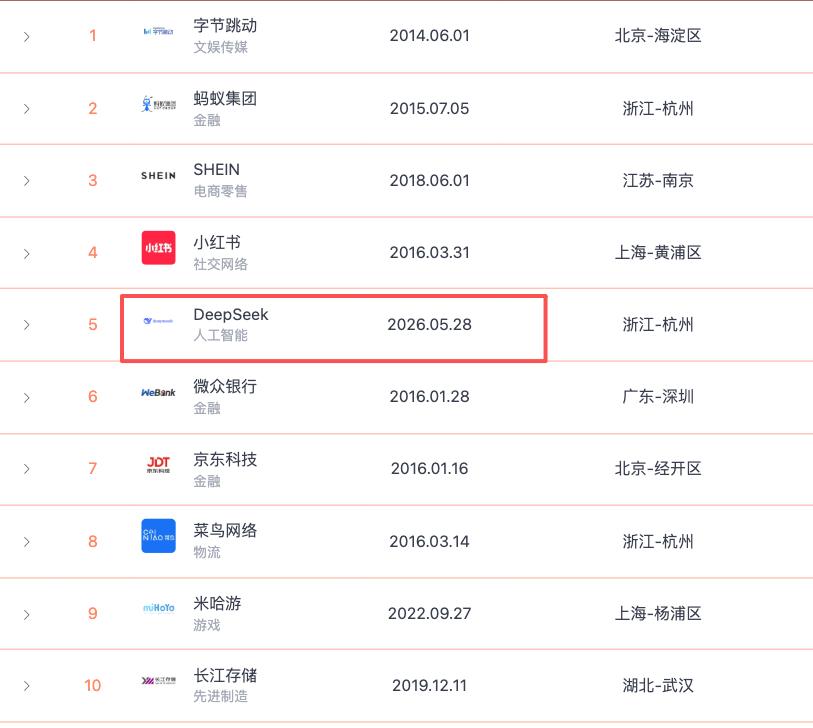
Okay, after getting as excited as everyone else, let's talk about some "confusions".
Now the market seems to be looking at the investors who got in with undisguised envy: Tencent, CATL, NetEase, JD.com, IDG, Lisi, Zhengxin Valley, Shixiang Technology, and the National Artificial Intelligence Industry Investment Fund.
Naturally, people wonder why well - known investors like Sequoia and Hillhouse missed this opportunity this time?
The market sentiment is expressed as: investing in DeepSeek is a huge victory.
It's amazing. Has there ever been such a case in the history of venture capital where people start celebrating at the starting line?
"Must - invest" and Liang Wenfeng's "Overbearing Terms"
How special is DeepSeek? Let's take a look at the "overbearing terms" Liang Wenfeng offered to the investors:
Tech giants like Tencent, CATL, JD.com, NetEase, and IDG Capital flocked to invest, but the funds didn't go into the company's main body. Instead, they went into a limited partnership managed by Liang Wenfeng.
Except for the National Artificial Intelligence Fund, which directly holds shares, even those with 5 billion or 10 billion RMB couldn't directly invest in DeepSeek.
External investors have no voting rights.
There is a five - year lock - up period, during which they cannot withdraw.
They also have to accept a thorough identity verification as limited partners (LP).
More importantly, Liang Wenfeng invested 20 billion RMB himself, becoming the largest contributor in this round. At the same time, through equity adjustment, his direct shareholding increased to 34%, and after full penetration, he holds about 84% of the beneficial shares, with 100% voting rights.
For a company that has been established for three years, the founder holds absolute control and offers "overbearing terms" to external investors, and yet China's top tech giants and well - known venture capital firms have all accepted them.
From an entrepreneur's perspective, Liang Wenfeng's operation is a textbook example.
The limited partnership structure, the five - year lock - up period, and the thorough LP verification have achieved a governance pattern where "capital only provides funds, and technology is up to me". By investing 20 billion RMB himself, he has gained absolute bargaining chips, screened for "long - termist" investors, and excluded short - term arbitrage capital.
This is essentially a resistance to the logic of capital. In the traditional VC game, we've seen too many founders being forced to exchange equity for funds and eventually being marginalized by the board.
Liang Wenfeng locked out this possibility before the financing.
An investor sighed on his WeChat Moments: "Tencent and JD.com invested billions of dollars but have no voting rights and can't withdraw for five years. Unless you're the only must - invest player in this field, no one can get such financing terms."
"Must - invest" - these four words are the key to understanding this financing.
History doesn't repeat itself exactly, but it rhymes
Is there really something that is "must - invest" in the world?
There has never been a shortage of collective misjudgments in the history of venture capital. When everyone is chasing the same certainty, it's often when the greatest uncertainty is being ignored.
The Internet bubble in 2000: The NASDAQ soared from 750 points to 5048 points. Investors had the same reason: "The Internet will change everything. It's too late if you don't invest now." As a result, the bubble burst, the index plummeted by 78%, and trillions of dollars evaporated. Even a company like Amazon, which truly changed the world, saw its stock price drop by over 90% - they got the right direction but still lost money.
The Chinese sharing economy bubble: Ofo and Mobike raised over 15.5 billion RMB in one year, and more than 70 companies flocked in. As a result, Ofo's capital chain broke, and Mobike's valuation shrank significantly when it was acquired by Meituan. Capital burned tens of billions of RMB, leaving a still - loss - making market.
Uber: Before its IPO, its valuation was 120 billion US dollars. Investors believed that "shared mobility would disrupt the taxi industry and form a monopoly". However, after its IPO, its valuation quickly dropped to 75 billion US dollars, and it accumulated losses of over 20 billion US dollars - the ride - hailing market has no network effect, and neither drivers nor passengers are loyal.
Additionally, Didi Chuxing in China raised over 20 billion US dollars in the primary market back then, and its total financing still holds the top position among Chinese startups.
However... you all know what happened later.
The common point of these cases is not the technology or business model itself, but a psychological state:
When investment becomes something you have to do rather than something worth doing, rationality is replaced by emotion.
Is DeepSeek "different this time"?
DeepSeek is fundamentally different from the above cases: it truly has world - class technology.
The low - cost and high - performance of the R1 model have been verified by global developers.
The V4 series continues to lead in global call volume.
But technological advantage doesn't equal investment value.
Xerox PARC invented the graphical user interface and the mouse, but these technologies ultimately made Apple and Microsoft rich.
Bell Labs invented the transistor and CCD, but AT&T's shareholders didn't get corresponding returns.
The core challenge DeepSeek faces is: how to transform its technological advantage into sustainable commercial value.
The open - source strategy has won it reputation, but it also means that competitors can freely copy its technological achievements.
The API pricing has been continuously dropping (the V4 - Pro has a permanent 75% price cut). Although it has expanded the user base, it has also compressed the profit margin.
Luo Fuli, a key developer of V3, was poached by Xiaomi, and Guo Dayang, a core contributor to R1, went to ByteDance. The stability of the core technology team is the lifeline of an AI company.
In the legendary four - hour meeting, Liang Wenfeng repeatedly "pleaded with everyone not to poach our people or encourage them to start their own businesses".
Caught between giants like OpenAI, Anthropic, Google, Meta, and ByteDance, whether DeepSeek can build a real competitive barrier remains a huge unknown.
A valuation of 50 billion US dollars means that DeepSeek must exit at a higher valuation in the future for investors to get returns. If the AI industry bubble bursts (as economists have warned, there are four risks in current AI investment: "over - investment, over - valuation, over - holding, and over - leverage"), then even the best companies may face a valuation correction.
Goldman Sachs pointed out in its May 2026 report that AI is driving up the global IT budget (from 5 trillion US dollars in 2024 to 6.15 trillion US dollars in 2026) instead of saving costs.
Companies are "buying AI, testing AI, and talking about AI", but AI has not generally entered the profit statement. High costs, technology integration difficulties, lack of application scenarios, and a long investment return cycle - these are all real dilemmas for AI commercialization.
If this judgment holds, the 50 - billion - dollar valuation may have overdrawn the growth of the next decade in advance.
Of course, if we compare it with Anthropic's valuation of over 900 billion US dollars and OpenAI's valuation of over 850 billion US dollars, DeepSeek seems quite cheap, right?
But you should know that OpenAI's ARR is about 25 billion US dollars, Anthropic's is about 30 billion US dollars, and DeepSeek's forecast for 2026 is at the level of 700 million US dollars.
In terms of the valuation/income multiple, DeepSeek is a bit expensive...
When "buying a ticket to enter" becomes a consensus
Let's look at Liang Wenfeng's "dream" financing terms again:
Investors have no voting rights and cannot participate in the company's governance. With a five - year lock - up period, they cannot adjust their strategies according to market changes. And with the thorough LP verification, even the way of investment is subject to review.
These terms essentially mean: you can share the financial benefits, but you can't interfere with the company's development.
Wow, doesn't it feel like when investors accept these terms, they actually become "limited partners" (LP) of DeepSeek -
They only provide funds, don't participate in decision - making, and just wait for dividends.
It's like everyone has set up a special fund.
But the return expectation of LPs is much lower than that of VCs. VC funds aim for an annualized return of 20% - 30%, while LPs usually only aim for 8% - 12%.
Tencent, JD.com, CATL, IDG Capital - these professional investment institutions or industrial giants accept these terms, which means they think they are buying not "high - risk equity" but a "must - have ticket".
This kind of mentality is exactly the most dangerous one in investment.
When everyone thinks that "investing means winning", investment itself has changed from a rational decision to a collective ritual.
Everyone wants to get in, and no one seriously assesses "what if they lose".
Consensus itself is a risk.
When all investors flock to the same target and drive up the valuation, they are actually compressing the future return space.
If DeepSeek is indeed a great company, but the 50 - billion - dollar valuation already includes all optimistic expectations, then even if it succeeds, investors' returns may be far lower than expected.
What matters is not whether you've invested, but whether you can get out
DeepSeek's financing is definitely a landmark event in the history of China's AI development.
It means that China finally has a company that has a place in the global AI first echelon, and it also marks that China's capital market's enthusiasm for AI has reached a new height.
Technological achievements are worthy of celebration, but investment value needs independent judgment.
The original intention of venture capital is to find undervalued opportunities in uncertainty.
If you start celebrating at the starting line, then whether the finish line still exists doesn't matter that much.
Anyway, I still admire Liang Wenfeng's great self - restraint in the impetuous business transactions. Respect.
This article is from the WeChat official account "IT Juzizi" (ID: itjuzi521), author: Judy. Republished by 36Kr with permission.