Bezos' third venture still couldn't avoid Musk
Seven months after announcing his return to the executive level and founding the AI startup Prometheus, Jeff Bezos rarely talked about his feelings of taking back the CEO position.
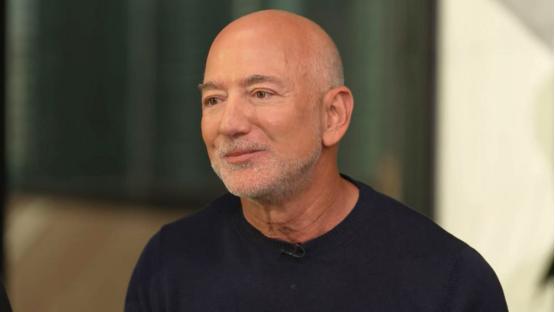
In a recent interview with CNBC, Bezos admitted that he didn't originally plan to be a CEO again.
After stepping down as the CEO of Amazon in 2021, Bezos handed over the daily management to Andy Jassy and took on more roles as the founder, chairman, and investor.
He still stands behind Amazon, Blue Origin, and The Washington Post, but no longer manages the daily operations of a company as a CEO.
However, for the sake of Prometheus, he returned to the front line and resumed the life of a startup. Bezos described this state as "Type 2 fun" - it's tiring in the process, but looking back, it's all worth it.
Prometheus has been established for less than a year, with only about 150 employees, but its valuation has reached an astonishing $41 billion.
This is the first time Bezos has personally gotten involved in a brand - new future since leaving Amazon.
Although, this future still can't avoid his old rival, Elon Musk.
Prometheus
In Greek mythology, Prometheus is the Titan who brought fire to humanity. He is not only related to "fire" but is also often interpreted as a symbol of craftsmanship, creation, civilization, and foresight.
On June 11th, Axios reported that Prometheus completed a $12 billion Series B financing, and the company's valuation reached $41 billion. The list of investors almost includes Wall Street and top global venture capital institutions, including JPMorgan Chase, BlackRock, Goldman Sachs, the internet investment giant DST Global, and the life - science and hard - tech investment institution Arch Venture Partners. Bezos himself also continued to participate in the investment.
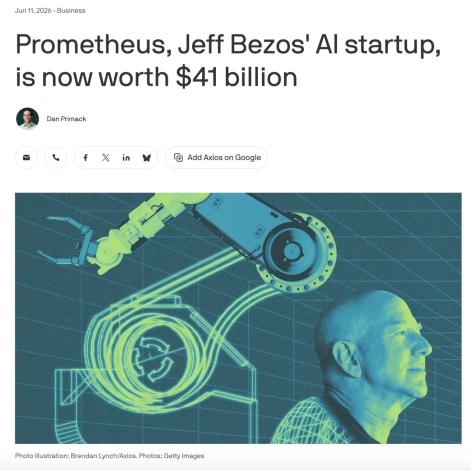
Last November, the company received $6.2 billion in Series A financing when it was launched; only seven months later, it completed a $12 billion Series B financing, with the single - round financing amount almost doubling. The cumulative financing of the two rounds exceeded $18 billion.
That is to say, as soon as it was publicly unveiled, it reached the top of the valuation in the physical - world AI field.
Figure AI, which makes humanoid robots, announced a Series C financing of over $1 billion in September 2025, with a post - investment valuation of $39 billion;
Skild AI, which develops the "brain" of robots, announced a $1.4 billion Series C financing in January this year, with a valuation of over $14 billion;
Another general - intelligence robot company, Physical Intelligence, has a confirmed valuation of $5.6 billion, and it is reported that the valuation in the new round of financing may exceed $11 billion.
However, Prometheus has a higher valuation than these star companies in embodied intelligence within less than a year of its establishment.
According to Bezos, what Prometheus aims to do is not robots, but a kind of Artificial General Engineer (AGE).
Simply put, Prometheus aims to enable AI to participate in the design, simulation, testing, and manufacturing of complex real - world products.
Jet engines, spacecraft, chips, cars, medical devices, drugs, consumer electronics, robots... The R & D cycles of these products often span years. A design scheme has to go through repeated simulation, prototyping, testing, failure, modification, and then restart.
What Prometheus wants to compress is this process - it aims to accelerate not a single task but the entire "invention cycle": from design to simulation, from testing to manufacturing, and then back to the next round of design.
More importantly, industrial AI is still an area waiting to be explored, a blue ocean full of future possibilities.
There are players in this field. Robot companies are working on embodied intelligence, engineering software companies are doing simulation and design optimization, NVIDIA is promoting a physical AI platform, and manufacturing giants are integrating AI into their production processes.
However, there hasn't been a real benchmark product yet.
This is related to the complexity of industrial AI itself. It deals not with text and code on the screen but with materials, structures, temperatures, energy consumption, costs, supply chains, and safety redundancies in the real world.
Here, AI can't just give a seemingly reasonable answer.
It must withstand simulation, pass testing, and finally be able to be actually manufactured.
The $41 - billion valuation of Prometheus doesn't buy a proven and mature company. It buys an unproven but extremely huge possibility once it succeeds.
Prometheus stole fire and gave humanity the tools to change the world.
Bezos' Prometheus wants to hand the "fire" of AI to engineers in the real world.
Bezos' Third Venture
If we don't count asset - type investments like the acquisition of The Washington Post, Prometheus is Bezos' third real - life venture.
The first one was Amazon.
In 1994, he left Wall Street and founded Amazon in Seattle. It started as an online bookstore. Later, this company grew into one of the world's largest e - commerce platforms. In 2024, Amazon's annual revenue exceeded $630 billion; its AWS also became one of the most important players in the global cloud - computing market.
Bezos built a set of infrastructure to support modern business: warehousing, logistics, cloud computing, advertising, membership systems, and an operating machine built around these systems.
The second one was Blue Origin.
In 2000, Bezos founded Blue Origin. If Amazon belongs to the digital world, then Blue Origin faces the physical world. There is no "rapid trial - and - error" here, only repeated design, manufacturing, testing, and launching.
Blue Origin is not just a paper - based space dream. New Shepard has completed multiple sub - orbital flights and sent tourists into space; the BE - 4 engine has become the main engine of ULA's new - generation rocket Vulcan; New Glenn is the core product for Blue Origin to enter the heavy - orbital launch market.
A rocket is not a pure software product. It must be ignited, tested, and launched in the real world, and be tested for physical stability and manufacturing accuracy.
Amazon gave Bezos the experience of "turning a complex system into a platform", and Blue Origin gave him the experience of "doing complex engineering in the physical world". With Prometheus, these two sets of experiences are combined.
Bezos mentioned in the CNBC interview that he was initially just a founding investor. Later, after seeing the project's progress, he realized that "I couldn't sit on the sidelines" and thus personally took on the role of co - CEO.
Because Prometheus is not a business suitable for remote investment. It aims to build not a lightweight application but a complex system for the real industrial world. It requires both AI capabilities and engineering understanding; it needs to understand both models and manufacturing; it needs the speed of software and also respect the constraints of the physical world.
And this exactly falls at the intersection of Bezos' experience over the past three decades.
Prometheus has the platform ambition of Amazon and the engineering difficulty of Blue Origin. Bezos' return to the CEO position is not just because he saw a new AI trend but more because he saw a familiar problem and finally found a new solution.
Moreover, this time Bezos is not alone in this venture.
Vik Bajaj, the other co - CEO of Prometheus, was an early core figure in Google's life - science business, participating in the establishment of Google Life Sciences, which later became Verily; he also served as the chief science officer at the cancer early - screening company Grail.
In other words, what Bajaj has been doing has always been between science, engineering, data, and the real industry.
This co - CEO combination is very interesting: Bezos brings Amazon - style platform capabilities and Blue Origin - style engineering experience; Bajaj brings experience in life sciences, hard technology, and complex R & D systems.
One of them is better at turning complex systems into large - scale platforms, and the other is more familiar with pushing scientific problems into the real industry.
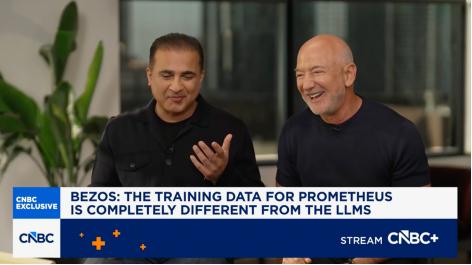
Bezos said in the CNBC interview that currently, Prometheus takes up most of his time, followed by Blue Origin and AI - related work within Amazon.
In a sense, this is actually a bit abnormal - in the past year, many well - known CEOs have chosen to step back, precisely because the AI era has arrived, and the company needs someone more suitable to lead the transformation.
But Bezos has gone in the opposite direction. Instead of going back to manage a mature giant like Amazon, he is investing most of his time in an AI startup that has been established for less than a year.
There must be a special reason for a 61 - year - old billionaire to return to the office. Maybe he has seen the next opportunity to change the world.
From the "Blue Sky" to the "Blue Ocean"
Blue Origin still exists. But it must be admitted that SpaceX has occupied the "blue sky" of commercial spaceflight.
Last week, SpaceX completed its IPO, initially raising $75 billion. Subsequently, the underwriters exercised the over - allotment option, and the total fundraising increased to $85.7 billion, making it the largest IPO in the world's history. On the first day of listing, SpaceX's stock price rose by about 19%, and its market value exceeded $2 trillion. Elon Musk was also pushed to the position of "the world's first trillion - dollar billionaire".
SpaceX has not only taken away the launch market but also the most exciting story in commercial spaceflight: reusable rockets, satellite internet, the vision of Mars, huge valuations, wealth creation for employees, and an IPO that can rewrite the capital - market record.
In contrast, although Blue Origin has New Shepard, BE - 4, and New Glenn, these achievements are not enough to change the situation. The right to define commercial spaceflight has fallen into the hands of SpaceX.
Moreover, Blue Origin was recently reminded harshly by the physical world.
On May 28th, during the engine static - fire test of the New Glenn rocket at Cape Canaveral, Florida, an explosion occurred, the launch pad was damaged, and the subsequent launch plan may be postponed for several months.
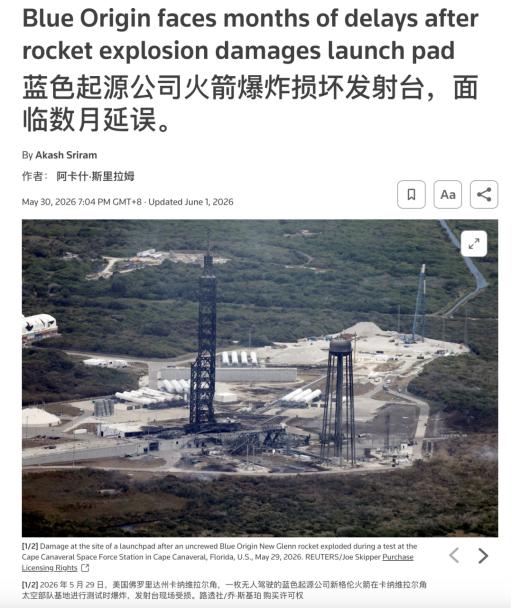
Spaceflight is cruel. Even if the company is rich, patient, and has a vision, and the founder is Bezos, the rocket won't take off on time just because of these.
The latest report from Reuters on June 16th shows that SpaceX's stock price continued to rise, closing at $201.80, and its market value reached about $2.655 trillion, exceeding that of Amazon and briefly surpassing Microsoft. That is to say, Elon Musk not only won the right to define in commercial spaceflight but also made SpaceX step on Amazon, which was founded by Bezos, in the capital market.
This makes Bezos seem to have the idea of "being suppressed everywhere, so I'd better find a new way".
It's a pity that Elon Musk is "capable of everything from the sky to the ground", and it's still hard to avoid him even when changing the battlefield. It's like an old rival starting a new game.
Tesla is working on self - driving and humanoid robots like Optimus; SpaceX is engaged in highly engineered rocket manufacturing; xAI is trying to integrate model capabilities into Musk's own company system... It can be said that Musk's AI route has never been limited to the screen from the start. He wants AI to enter cars, robots, factories, and rockets, and ultimately take over more physical labor in the real world.
But there are still differences. If Musk is betting on "how AI can perform tasks in the real world", then Bezos is betting on "how AI can participate in real - world inventions".
There is no shortage of players in the industrial AI track. OpenAI is improving its robot capabilities, Anthropic is entering industrial scenarios, and NVIDIA is building a Physical AI foundation. It's a time of intense competition, but it's still unknown who will become the entry point in the industrial AI era.
Prometheus wants to seize this position. It doesn't regard industrial AI as just a business direction but as the whole proposition of the company. It wants to compete for human engineering in the AI era.
This time, Bezos doesn't want to follow behind Musk anymore.
This article is from the WeChat official account “Zimu AI”, author: Yuan Xinyue. Republished by 36Kr with permission.