Li Xiang's "Li Auto Moment" has passed: Strategic dilemmas behind the RMB 3 billion loss
In Q1 2026, Li Auto presented a financial report that surprised the market: with a revenue of 23 billion yuan, a net loss of 2.3 billion yuan, and a halved gross profit margin.
The once "top student among new car - making forces" seems to be experiencing the most severe test since its establishment.
However, the financial report figures are just the surface. The deeper problem is: when the Li i6 becomes the only blockbuster, the L - series has hit a growth bottleneck, the after - effects of the recall of the all - electric MEGA are still lingering, and Li Xiang's narrative of "embodied intelligence" with an all - in AI approach has not yet materialized - has the strategic foundation of Li Auto really been shaken?
Q1 Financial Report: Three Truths Behind the 2.3 - Billion - Yuan Loss
The numbers themselves are not scary. What's scary is the trend behind them.
The core data of Li Auto in Q1: a revenue of 23 billion yuan, a net loss of 2.3 billion yuan (a net profit of 650 million yuan in the same period of 2025 and a net profit of 8 billion yuan in 2024), a halved gross profit margin, a sales volume of 95,142 vehicles (a year - on - year increase of 2.5%), and a significant negative turn in operating cash flow.
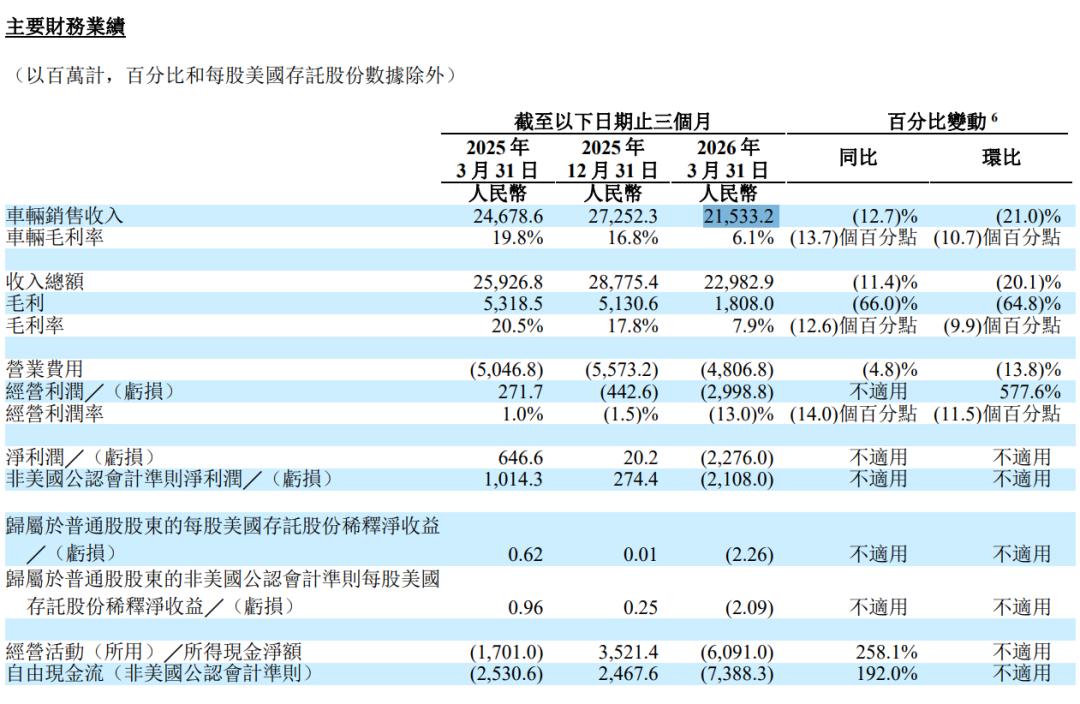
Source: Li Auto's Q1 2026 quarterly report
Three truths need to be clarified:
Truth One: The core reason for the loss is "selling at a low price".
Li Auto's vehicle sales revenue in Q1 was 21.5 billion yuan. The year - on - year decrease was mainly due to the reduction in the average selling price caused by different product combinations. The hot - selling Li i6 pulled down the average selling price, and the increased promotion efforts of the L - series led to a continuous decline in the "unit price of cars sold". When a car company that started with a high - end positioning begins to exchange price for sales volume, its brand moat has already started to loosen.
Truth Two: Leapmotor has snatched the extended - range market share.
In the Q1 2026 sales ranking of new car - making forces, Leapmotor topped the list with 110,200 vehicles sold, while Li Auto ranked second with 95,142 vehicles. Leapmotor is essentially a "low - end version of the Li Auto model" - it also focuses on extended - range vehicles and targets family users, but with a price 30,000 - 50,000 yuan lower. When Leapmotor lowered the threshold of extended - range SUVs to the 150,000 - yuan level, the 200,000 - 300,000 - yuan price range of Li Auto's L - series was "sandwiched from above and below".
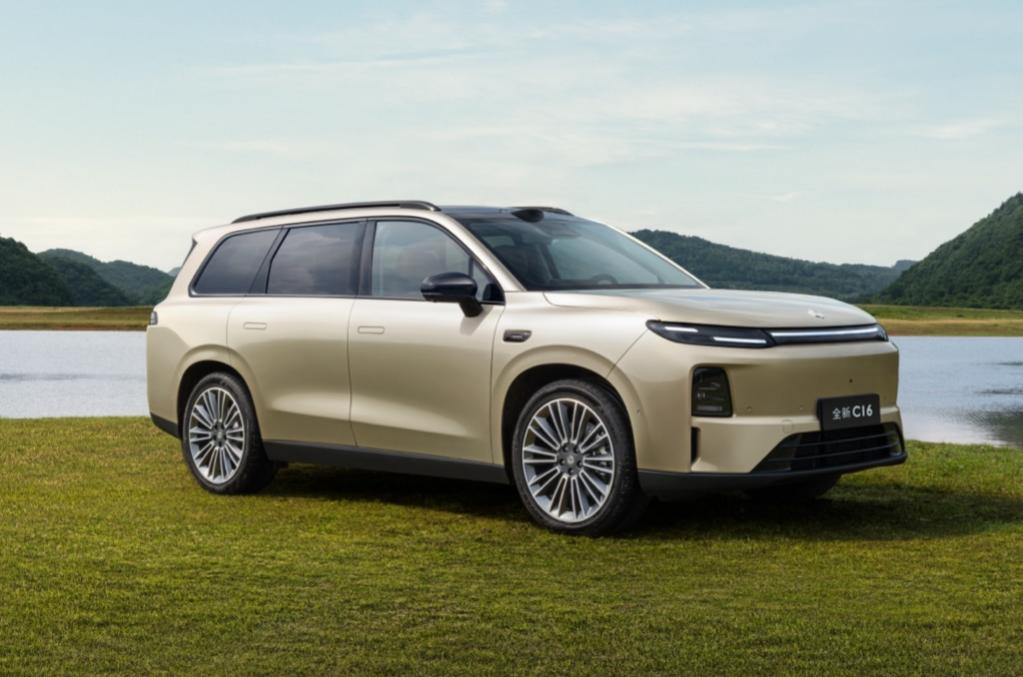
Leapmotor C16. Source: Internet
Many people often mock the "refrigerator, sofa, and large - screen TV" configuration, but the fact is that these configurations have driven the differentiation of the overall new - energy vehicle market. Many car companies have achieved good results by following Li Auto's path, such as Leapmotor. Now, the "refrigerator, sofa, and large - screen TV" configuration has become a standard, which proves the key role of this product strategy in the early stage.
Truth Three: The Li i6 has become the "sole support".
Li Auto's sales volume in Q1 2026 mainly relied on the Li i6. The L - series (once the main sales force) has hit a growth bottleneck, and the sales of the all - electric MEGA have been sluggish due to the recall event. Having one model support the sales volume for a quarter is an extremely dangerous signal, which means that other models either lack competitiveness or are in the product generation transition period.
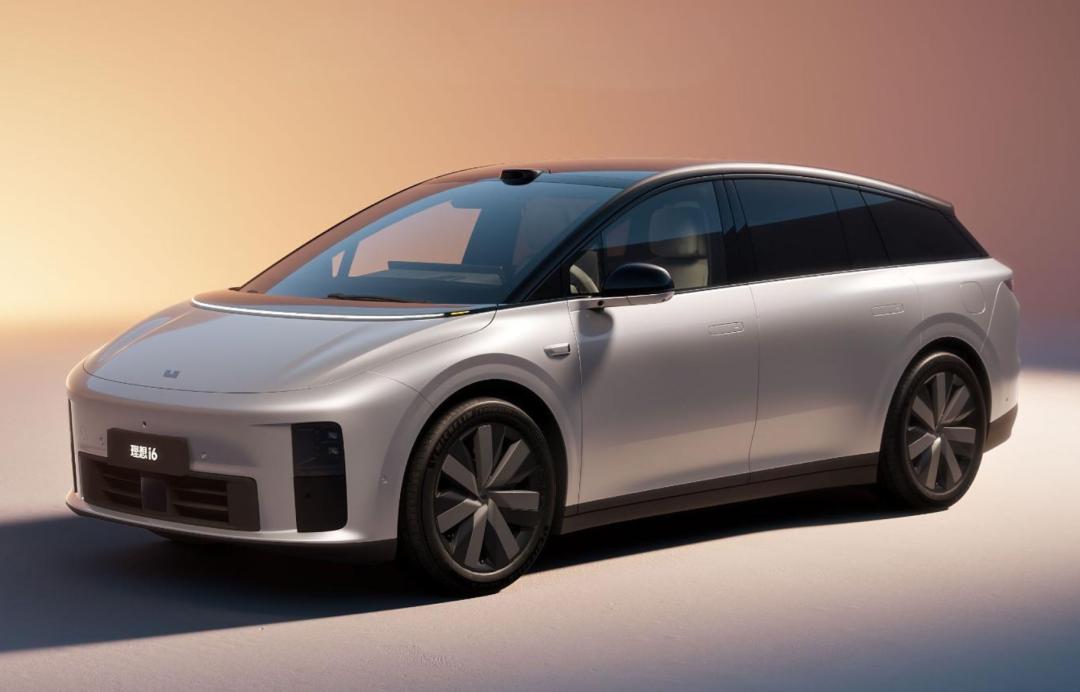
Li i6. Source: Internet
Li Xiang's Strategic Choice: All - in AI, a Foresight or a Misstep?
Facing the sales pressure, Li Xiang chose to "redefine Li Auto with an AI narrative".
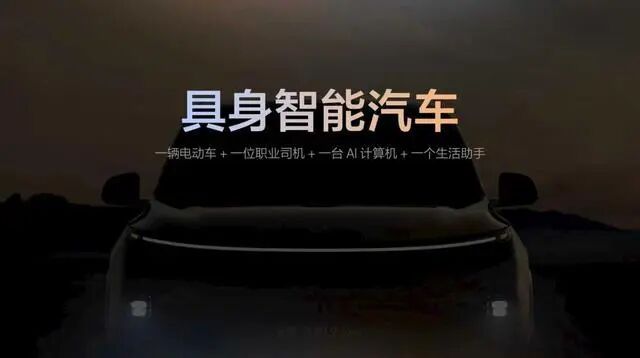
On February 5th, Li Xiang posted that the new Li L9 would be the "pioneering work of embodied intelligent robots". On May 15th, the Li L9 Livis was launched at a price of 509,800 yuan, with its positioning upgraded from a "high - end SUV" to an "embodied intelligent robot". On June 15th, Li Auto held the "Livis Day" software and AI press conference to systematically elaborate on the standards of "qualified embodied intelligence".
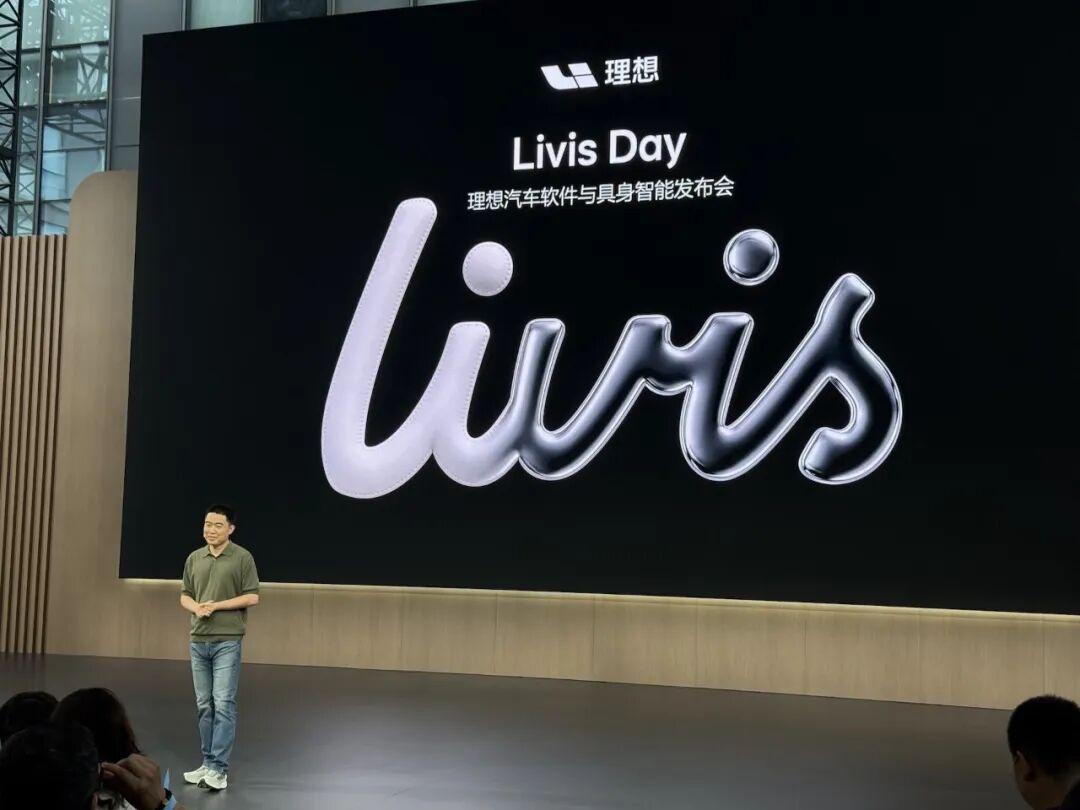
Source: Internet
Is there any rationality in this strategic shift?
The rational part is: cars are a natural carrier of "embodied intelligence". Lidar, cameras, chips, and wire - controlled chassis are the core components of robots. The competition in the automotive industry has shifted from "electrification" to "intelligence". The homogeneous combination of battery, motor, and range is no longer sufficient. AI must be used to build differentiation. AI is also a "protective amulet" for high - end positioning. The 509,800 - yuan Livis would have a hard time competing with the 498,000 - yuan NIO ES9 and Wenjie M9 if it only relied on configuration and size. It must have an "AI premium" to support it.
However, the misaligned part is also obvious: the AI story is too early, and the market is not buying it. Consumers who buy a 500,000 - yuan car want "today's luxury", not a "tomorrow's robot". The AI functions have not yet formed a "generational advantage". The gap between Li Auto's intelligent driving and that of XPeng, Huawei, and NIO is narrowing rather than widening, and the perception of being "the best in the industry" has not been established. There is no answer to how much more users are willing to pay for intelligent driving. The difference in intelligent driving between the 300,000 - yuan L7 and the 500,000 - yuan L9 Livis may only be 50,000 - 100,000 yuan, but the Livis is more than 200,000 yuan more expensive.
Source: Internet
So, "all - in AI" for Li Auto seems more like a "choice that has to be made". When the differentiation of traditional hardware has reached its limit, AI is the only direction where new stories can be told. However, there is still a long way between "being able to tell the story" and "consumers being willing to buy".
The SKU Dilemma of Li Auto's L - Series: 4 Models, Over 10 Configurations, and a 260,000 - Yuan Price Range
This is the most underestimated "internal bomb" of Li Auto's L - series.
The current SKUs of Li Auto's L - series on sale (by model × configuration version):
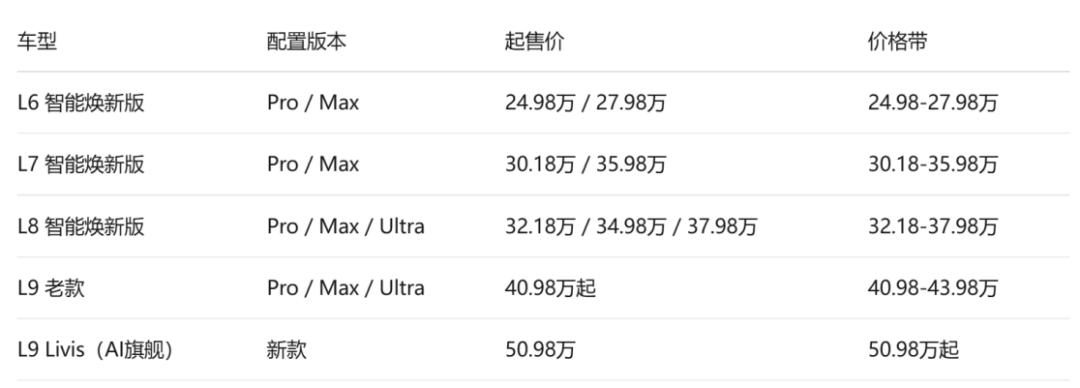
In total, there are about 11 main SKUs (2 for the L6 + 2 for the L7 + 3 for the L8 + 3 for the old - style L9 + 1 for the L9 Livis), with a price range from 249,800 to 509,800 yuan - an interval width of nearly 260,000 yuan, almost two completely different price ranges.
Problem One: Severe price overlap between adjacent models.
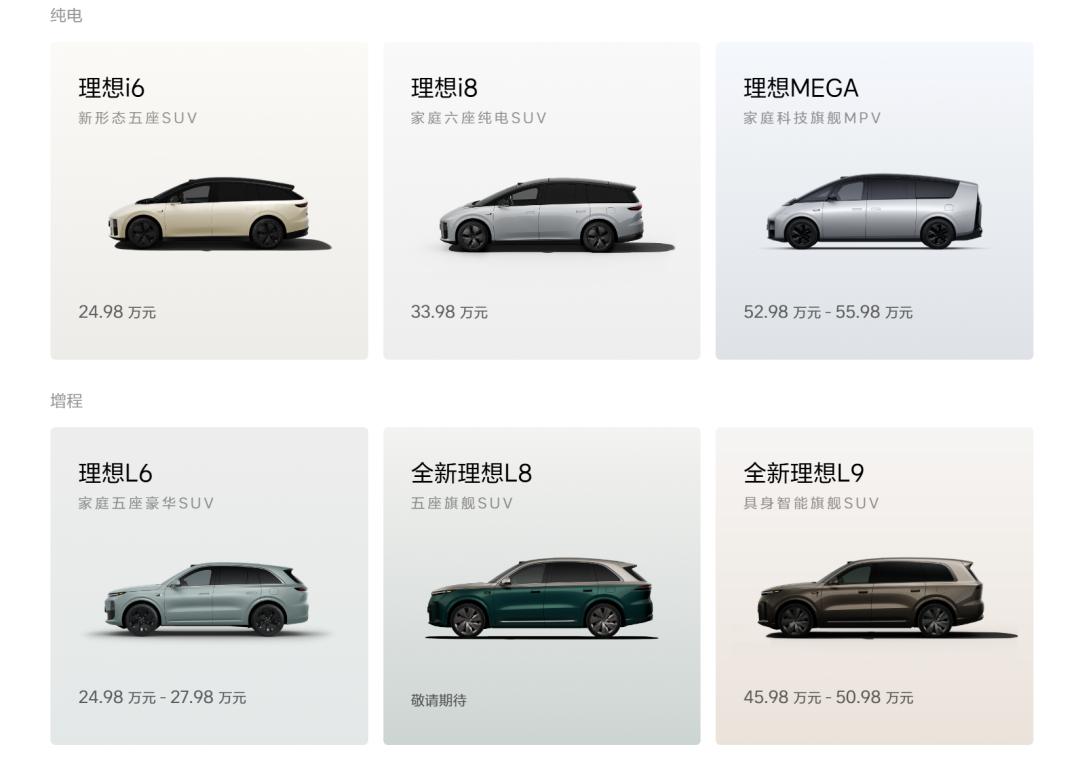
The price difference between the L6 Max (279,800 yuan) and the L7 Pro (301,800 yuan) is only 22,000 yuan. The L7 Max (359,800 yuan) is 38,000 yuan more expensive than the L8 Pro (321,800 yuan). The price difference between the L8 Ultra (379,800 yuan) and the L9 Pro (409,800 yuan) is 30,000 yuan. When customers go to the store, they will face the soul - searching questions: "What's the difference between the L6 Max and the L7 Pro with a 22,000 - yuan price difference? What exactly does the L7 Max have more in terms of configuration compared to the L8 Pro which is 38,000 yuan cheaper? Which one should I choose between the L8 Ultra and the L9 Pro with a 30,000 - yuan price difference?"
Source: Li Auto's official website
The answer is that except for the size and the number of seats (the L7 has 5 seats, the L8 has 6 seats, and the L9 is a full - size vehicle), the core configurations are almost the same, including the same extended - range system, the same intelligent driving hardware, and the same interior style. As a result, Li Auto has taught users to "choose a car based on the number of seats", but the actual experience difference is far less than the price difference - this makes all non - L9 SKUs fall into a "self - doubt about cost - effectiveness".
Problem Two: The user perception has been severely diluted.
When a brand sells 4 models simultaneously and covers a 260,000 - yuan price range, the "user portrait" of the "Li Auto" brand is no longer clear. People who buy the L6 think "I'm just buying a means of transportation", those who buy the L7 think "I want a large space", those who buy the L8 think "My three - generation family needs a 6 - seat car", and those who buy the L9 think "I want high - end". The "mental labels" contributed by these four groups of people to the brand are completely different. When you see a Li Auto on the street, you can't tell whether it costs 300,000 or 500,000 yuan. This "price ambiguity" will automatically lower the brand's high - end attribute.
Problem Three: Severe internal "cannibalization".
The 4 L - series models cannibalize each other's sales. The most affected are the L7 and the L8. The L6 seizes the entry - level users of the L7. "Since the L6 Max only costs 279,800 yuan, why should I buy the L7?" The L9 Pro seizes the users of the L8 Ultra. "The L9 Pro only costs 409,800 yuan, 30,000 yuan more than the L8 Ultra, but it's over 5 meters long, has 6 seats, and has a higher configuration." The L7 and the L8 have become the "sandwiched layer" - being pressured by the L9 above and pushed by the L6 below, they are in a difficult situation. As a result, only the L6 (due to its low price) and the L9 (due to its flagship status) can sell well in the L - series, and the L7 and the L8 are becoming more and more marginalized.
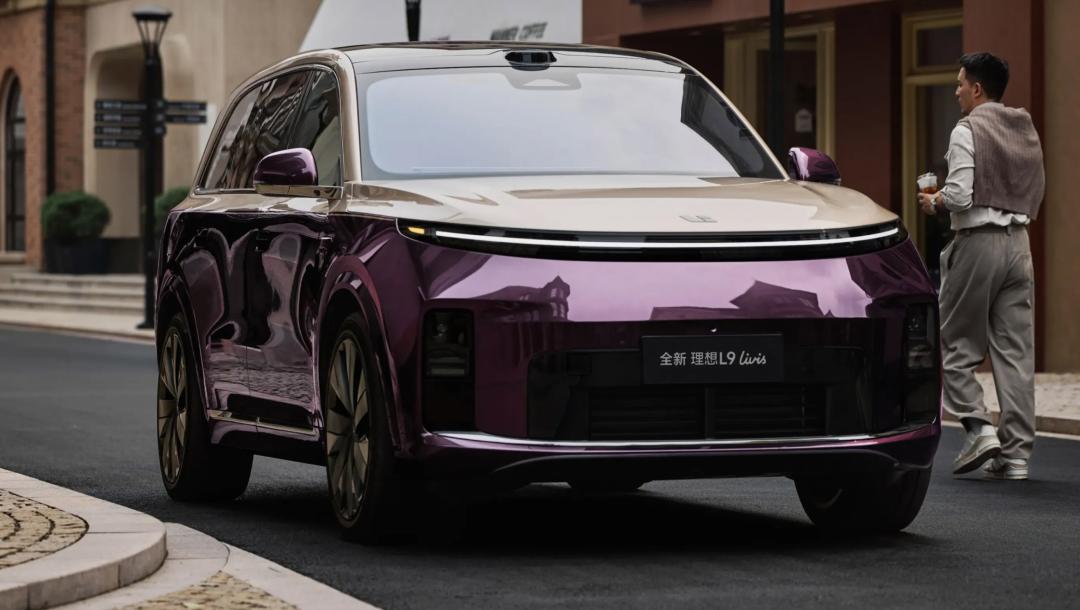
Problem Four: The L9 Livis has pushed the difficulty of "renewal" to the limit.
The L9 Livis, launched on May 15th at a price of 509,800 yuan, is the "AI strategic flagship" of Li Auto. However, it is also the most difficult part of the L - series renewal. The price range has become even wider. The old - style L9 was priced from 409,800 to 439,800 yuan, while the Livis is directly priced at 509,800 yuan, widening the price range of the same model by 70,000 - 100,000 yuan. The AI functions have not been fully realized. The L9 Livis is positioned as the "pioneering work of embodied intelligent robots", but the "Livis Day" on June 15th is the systematic release of the AI strategy, which means that only half of the AI story has been told when the Livis was launched. Facing fierce competition, the 509,800 - yuan Livis has to directly compete with the 498,000 - yuan NIO ES9 and Wenjie M9. The intensity of competition in this price range is incomparable to that of the 250,000 - yuan level where the L6 is located.
Source: Li Auto's official website
The deep - seated reason: Li Auto's product strategy is essentially "using the number of SKUs to replace product strength".