The wave of Insta360's share unlocking has arrived — why can't its stock price hold up?
Insta360, with a market value of over 6 billion US dollars, has encountered a hurdle.
On June 11th, Insta360 reached the one - year mark since its listing, and 227 million restricted shares were unlocked, corresponding to a market value of approximately 3.88 billion US dollars, accounting for 56.5% of the company's current total market value.
For Insta360, whose previous floating market value was only about 560 million US dollars, this means that the scale of the unlocked shares is nearly seven times the existing floating market value.
As of the close on June 12th, Insta360's stock price was 22.68 US dollars per share, with a market value of approximately 9.065 billion US dollars, a 4.26% decline compared to the close on June 10th.
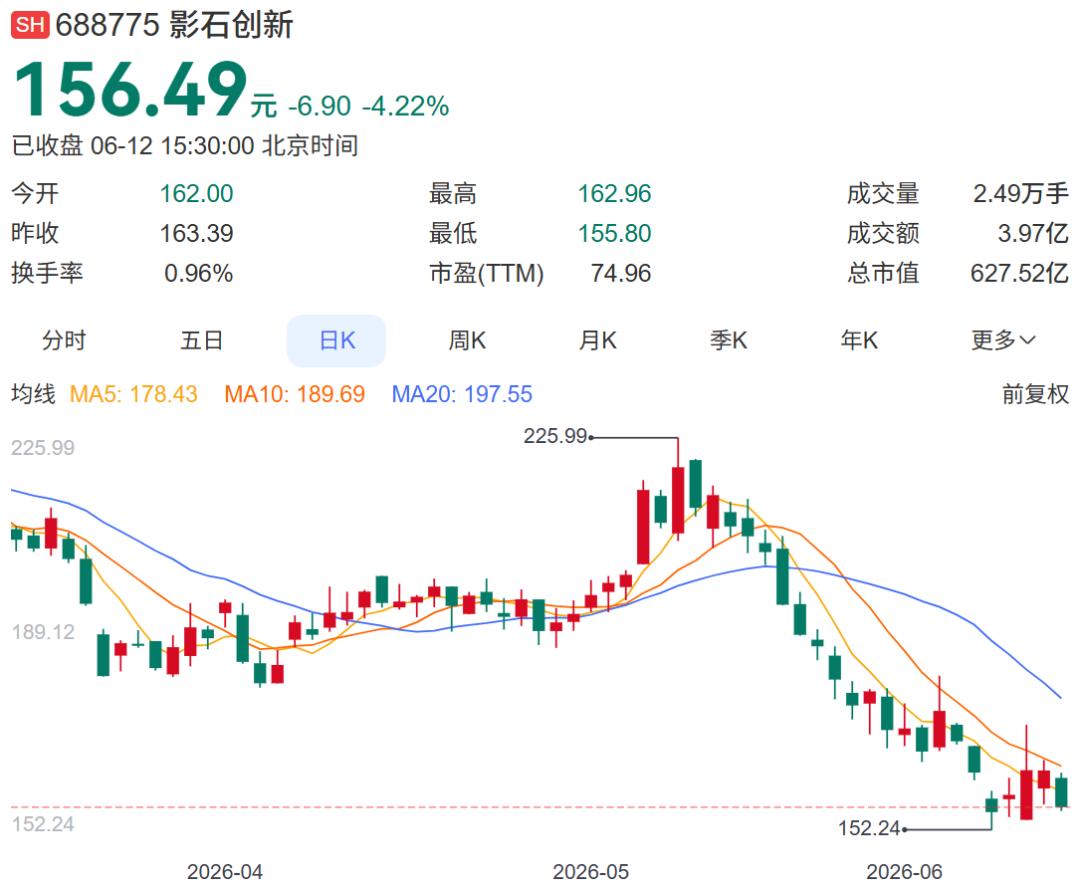
Unfortunately, Insta360 failed to withstand this wave of stress tests. This performance is in stark contrast to its glory a year ago.
On June 11th, 2025, Insta360 listed on the STAR Market at an issue price of 6.83 US dollars per share. In just three months, it reached a historical high of 54.57 US dollars per share, and its market value once approached 21.7 billion US dollars. Now, it has fallen by 60% from the high point, and the stock price shows more signs of weakness after the "floodgates" opened.
By analyzing its financial data, the underlying reasons can be found.
The co - existence of high gross profit margin and high sales expense ratio points to an issue that cannot be ignored: Does Insta360's 47.6% gross profit margin come from the irreplaceable charm of its products or from continuous marketing efforts?
This is a question about the quality of profitability and a re - examination of its business essence.
The Root Cause of Increasing Revenue but Not Profit
The root cause of Insta360's lack of momentum in its stock price can be found in its performance background.
In terms of revenue growth rate, Insta360's performance is indeed remarkable. In 2025, its revenue was 1.41 billion US dollars, a year - on - year increase of 74.76%, setting a new historical high. In the first quarter of 2026, the revenue increased by 83% year - on - year to 360 million US dollars.
However, the problem is that Insta360 has fallen into the vortex of increasing revenue but not profit.
In 2025, Insta360's non - recurring net profit not only did not increase significantly but also decreased by 10% to 123 million US dollars. In the first quarter of 2026, this downward trend was more obvious, with the non - recurring net profit only 9 million US dollars, a 61% "halving" year - on - year.
If we look at the specific single - quarter figures, this divergent trajectory is clearer. In the first quarter of 2025, the company's net profit attributable to shareholders was 25.5 million US dollars, increasing to 49.7 million US dollars in the second quarter, 39.4 million US dollars in the third quarter, and plummeting to 19.8 million US dollars in the fourth quarter.
Insta360 is "sacrificing" profit to exchange for high revenue growth.
Meanwhile, the gross profit margin also shows a downward trend. Insta360's gross profit margin declined from 52.93% in the first quarter of 2025 to 37.53% in the fourth quarter, a significant drop of 15 percentage points in a year.
Insta360 gave two explanations: on the one hand, it was due to the price increase of raw materials for storage components; on the other hand, it was due to the after - effects of market competition.
The increase in the cost of storage components is a supply - side challenge commonly faced by the entire consumer electronics industry. Liu Jingkang, the company's chairman, admitted in the 2025 annual report shareholder letter that "there is a certain pressure on short - term storage costs, and they may further increase in the future, affecting the company's gross profit margin."
However, in the eyes of the outside world, the price war that Insta360 has to fight is a more difficult challenge.
DJI launched the panoramic camera Osmo360 last year with a price of 434 US dollars, 116 US dollars lower than the initial launch price of Insta360 X5. According to IDC statistics, three months after the launch of Osmo360, it snatched half of the market share from Insta360.
The Insta360 X5 was forced to cut the price by 72 US dollars to compete, and the action camera and drone product lines were also involved in the price - cutting vortex. The price of the Insta360 A1 drone dropped from 980 US dollars to 797 US dollars, a 20% price cut. A professional institution's disassembly report shows that it is almost sold at cost.
The temporary price war is just a surface shock. The deeper impact is that Insta360's pricing power has been completely broken, and Insta360's grand plan has been strongly overturned by DJI.
For Insta360, the panoramic camera is just one of the popular product categories. The company's ultimate goal is to become a platform - type imaging technology company, with a comprehensive layout of action cameras, gimbal cameras, smart accessories, drones, and even portable "photography robots."
Liu Jingkang said, "Short - term profit has both multiple pressures and multiple buffers, aiming to exchange for long - term performance and healthy development."
However, judging from the current performance of increasing revenue but not profit, Insta360's long - term development will not be smooth sailing.
High Gross Profit Margin + High Sales Expense Ratio ≠ High Quality
Although Insta360's gross profit margin has declined, it still maintained a level of 45.74% in 2025. In the consumer electronics industry, this usually means that the product has a good brand premium and market pricing power.
However, when combined with the expense structure indicators, a contradiction emerges.
In 2025, Insta360's sales expenses were 243 million US dollars, a year - on - year increase of 103.31%, far higher than the revenue growth rate; the sales expense ratio was as high as 17.24%, meaning that nearly one - fifth of the revenue was used for marketing.
Meanwhile, its R & D expenses were 221 million US dollars, a year - on - year increase of 96.95%. The R & D expense ratio was 15.7%, about 1.5 percentage points lower than the sales expense ratio.
The double - digit growth of both sales expenses and R & D expenses means that Insta360 neither dares to stop the marketing engine nor can it stop R & D investment, because these two together support Insta360's high - growth story.
It seems that Insta360's high gross profit margin is the result of "marketing to shape high - end perception + R & D to create differentiated functions," which is a typical consumer electronics internet - celebrity - type profit model.
However, the core competitiveness of a technology company should be product strength driven by technological innovation, and marketing should play a supplementary role. But on Insta360's expense scale, the weight clearly tilts towards marketing.
Anker Innovations, a product - type company in the industry, had a sales expense ratio of 22.37% and an R & D expense ratio of 9.48% in 2025. The similarity with Insta360 is that both have a higher marketing expense ratio than the R & D expense ratio, but there are also differences between them.
Anker Innovations' business structure covers three major sectors: charging and energy storage (accounting for about 50% of revenue), smart innovation (smart security, cleaning, etc., about 27%), and smart audio - visual (about 22%). This corresponds to the channel layout of multiple product categories and multi - brand promotion, rather than high - density marketing under a single brand.
Insta360's main business is relatively focused (consumer - grade intelligent imaging devices account for nearly 90%), and the competition track is highly concentrated. The 17.24% sales expense ratio corresponds to high - intensity marketing penetration around a single brand.
Moreover, Anker Innovations' revenue scale of 4.41 billion US dollars in 2025 has formed an economies - of - scale effect, and the marginal cost of marketing has been continuously optimized. Insta360 only has a revenue of 1.41 billion US dollars, and the 17.24% sales expense ratio has a much greater squeezing effect on profit than Anker Innovations.
In this way, Insta360 needs to answer a fundamental question: Is the high revenue growth due to the strong product or the heavy marketing?
In the first quarter of 2026, Insta360's sales expense ratio was 18.1%, a slight year - on - year decrease of 0.8 percentage points. Meanwhile, the net profit margin dropped sharply from 13.01% in the same period last year to 1.31%, approaching the break - even point.
Obviously, although the slight decrease in sales expenses has brought a little breathing space for the profit side, it has been overwhelmed by greater pressure from both the cost and expense sides.
This is a signal that cannot be ignored: If Insta360 actively reduces marketing investment in the future to improve the net profit margin, whether the revenue can still maintain high - speed growth is a question mark.
Currently, Insta360 still has a price - to - earnings ratio of 74.51 times, far ahead of industry peers such as XGIMI Technology (38.09 times), Ezviz Network (35.34 times), and Anker Innovations (22.82 times).
Behind this premium is the market's bet on Insta360 to continue its high - growth. However, the fact that it increases revenue but not profit and relies on marketing is deviating from this valuation logic.
When a company's moat does not come from an irreplicable technological barrier but from continuous marketing investment, then its profitability quality is worthy of re - examination.
Insta360's basic business is still there, but these advantages are undergoing the most severe test under the double pressure of intensified competition and strategic spending.
Returning to the share unlocking itself, Insta360 is facing a situation where, on the one hand, Pre - IPO shareholders still have dozens of times of floating profits and have sufficient motivation to reduce their holdings; on the other hand, the growth rate of the fundamentals has peaked, competition has intensified, and the gross profit margin is under pressure, and the willingness of the secondary market to take over is rapidly being consumed. When the "high - growth narrative" encounters the "reality of share unlocking," the inability of the stock price to hold up may be the most intuitive market reaction.
This article is from the WeChat official account "AI Blue Media Association," author: Feng Hua, editor: Wei Xiao, published by 36Kr with authorization.