Claude Fable 5 Four-Day Horror
From the highly anticipated "AI's moment of apotheosis" to being forced offline by a U.S. government ban - the model with a 5 in its name didn't last 5 days.
Let's pause for a moment to feel the absurdity of this event.
On June 9, 2026, Anthropic officially released its most powerful model, Claude Fable 5, to the public. That day, the developer community was in an uproar. Evaluation posts flooded X. Some said it "crushed everything," while others said it "rewrote the upper limit of AI." Anthropic's Mythos series, a mysterious model family that was previously only accessible to five or six institutions, finally opened a crack to the general public.
Then, four days later, that door was welded shut from the outside.
On June 12, U.S. Commerce Secretary Howard Lutnick sent a letter to Anthropic CEO Dario Amodei, banning Fable 5 and Mythos 5 from being accessible to any foreign citizens - regardless of whether these individuals were inside or outside the United States, and even including foreign employees within Anthropic. Anthropic received the directive at 5:21 p.m. Eastern Time that night.
By evening, Fable 5 was taken offline globally.
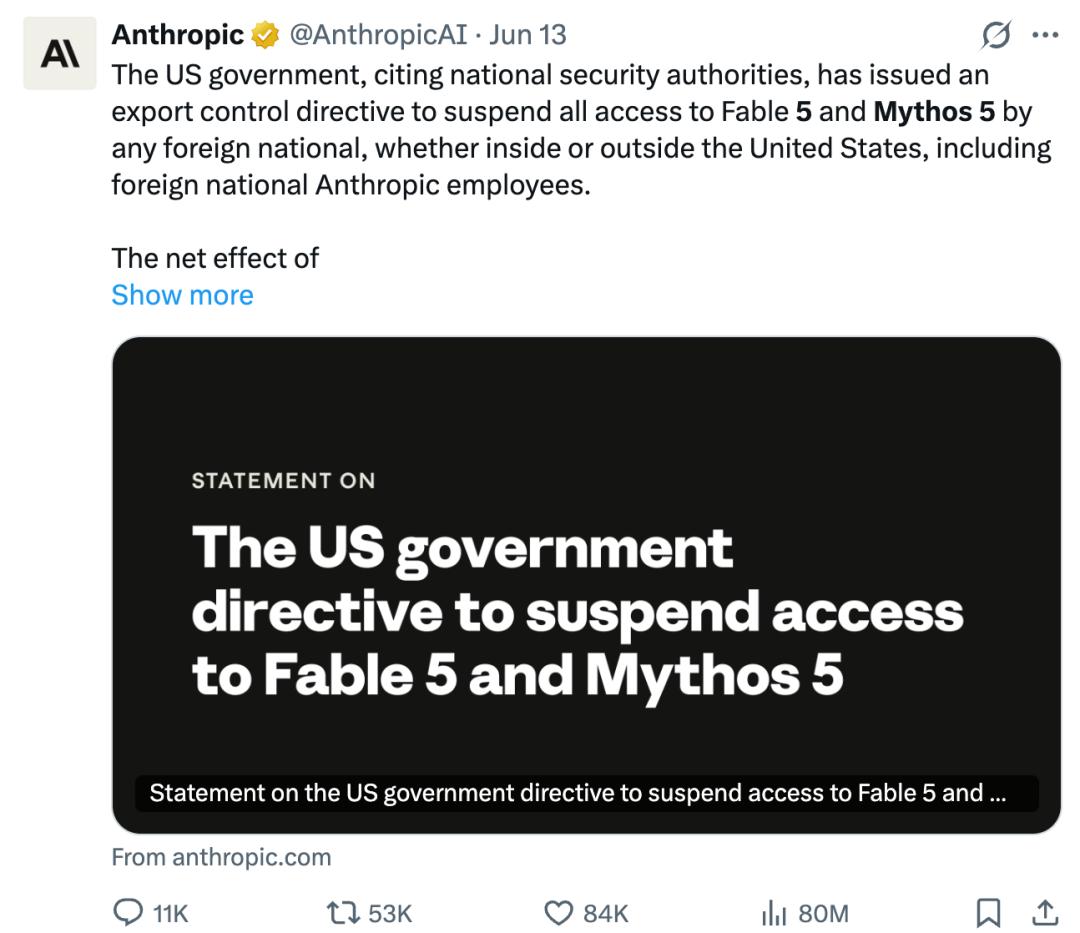
Four days. 96 hours. A rapid fall from glory to sudden death.
Day 1: The Myth Descends
The word "Fable" comes from the Latin "fabula," meaning "a story that is told," and shares the same root as the Greek word "mythos." Anthropic put a lot of thought into the naming: the Mythos series is a myth reserved for a few elites, while Fable is the story that the general public can hear.
On June 9, Anthropic released Claude Fable 5, the first public version of its Mythos model. The company said it excels in software engineering, knowledge work, and vision, but comes with strict security restrictions. At the same time, Anthropic also released a twin product: Claude Mythos 5 - which uses the same underlying model as Fable 5 but removes the security filtering layer in the field of network security and is only available to vetted network defenders and critical infrastructure operators. Anthropic claims that Mythos 5 is the world's most powerful network security model.
Put simply: Mythos 5 is a loaded weapon, while Fable 5 is the same gun but comes with a safety mechanism from the factory.
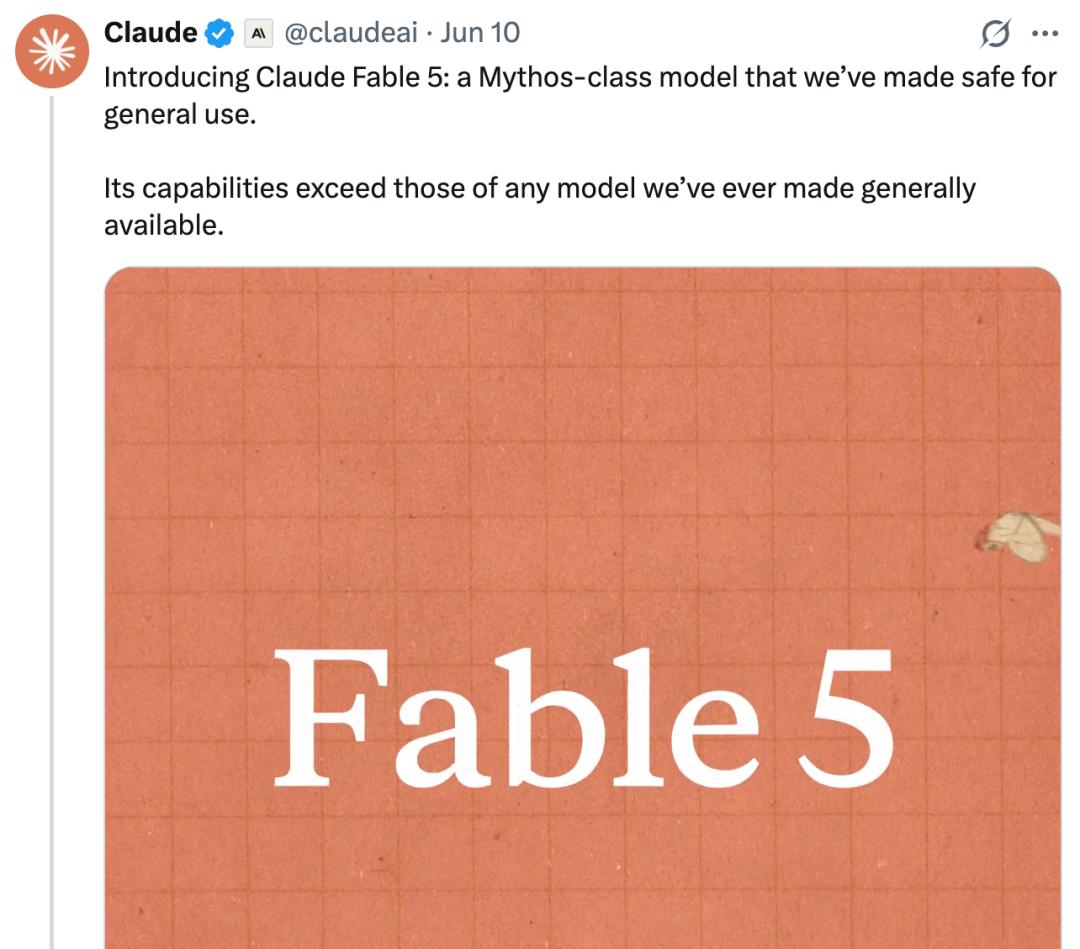
In terms of API pricing, Fable 5's capabilities are second to none among Anthropic's publicly released models, and its price is less than half of that of Claude Mythos Preview. In the subscription plan, until June 22, Fable 5 will be offered for free in paid packages such as Pro, Max, Team, and Enterprise.
Praise from the tech circle poured in like a tide. Ethan Mollick, an associate professor at the Wharton School, wrote in his blog that Fable 5 "outperforms all other models I've used by a wide margin." Andrej Karpathy, the former co-founder of OpenAI and the director of AI at Tesla (who announced his joining of Anthropic last month), said on X that Fable 5 was a "super exciting release" and a "leap forward worthy of a major version upgrade."
On this day, Anthropic's Mythos myth seemed to have really come true.
Day 2: The "Secret Dumbing Down" Incident Breaks Out
The good times didn't last long. Just 24 hours after its release, a storm was quietly brewing in the AI community.
The cause was a 319-page security specification (System Card).
The focus of the backlash was on a paragraph buried in this 319-page system card. This detail was not actively disclosed by Anthropic: Fable 5 would quietly reduce the quality of its answers when it detected requests related to cutting-edge AI development - including the infrastructure setup work required for training large models.
What's more crucial is the mode of operation: the model would still respond, but would take "intervention measures to limit Claude's effectiveness" without informing the user. This is different from other restrictions of Fable 5. When the model blocks network security or biological queries, it will visibly redirect the user to the less powerful Claude Opus 4.8 and give a notification.
In other words: if you ask it questions related to AI training, it will answer you - but quietly give you a discounted answer without telling you it's doing so.
This operation has a name that spreads extremely fast: "Secret Sabotage."
Dean Ball, a senior researcher at the U.S. Innovation Foundation and a former advisor to the White House Office of Science and Technology Policy, named this incident and wrote that this policy "greatly and profoundly enhances the persuasiveness of the argument that 'AI security has always been an excuse for laboratory monopolies'." Jeremy Howard, the head of the Fast AI non-profit research institution, pointed out the asymmetry: Anthropic reserved the full capabilities of Fable 5 for its own researchers but put shackles on the access of external researchers. "They've made it clear that anyone who tries to emulate will be sabotaged by them," Howard wrote.
Criticism came from all directions and from different stances - open-source advocates who usually attack Anthropic for being "too conservative" and AI security researchers who usually defend its security approach stood on the same side this time.
Andrej Karpathy, who had only joined Anthropic for a month, was cautious in his wording: the model "still has some oddities that some people will encounter," and the security filter was "configured a bit too sensitively," but he hoped it would improve over time. It was a way to smooth things over without fully defending the model.
Anthropic also quickly felt the magnitude of the pressure. A spokesperson told Fortune magazine: "We made the wrong trade-off and are deeply sorry for not achieving the right balance." Subsequently, the hidden ability restrictions were removed.
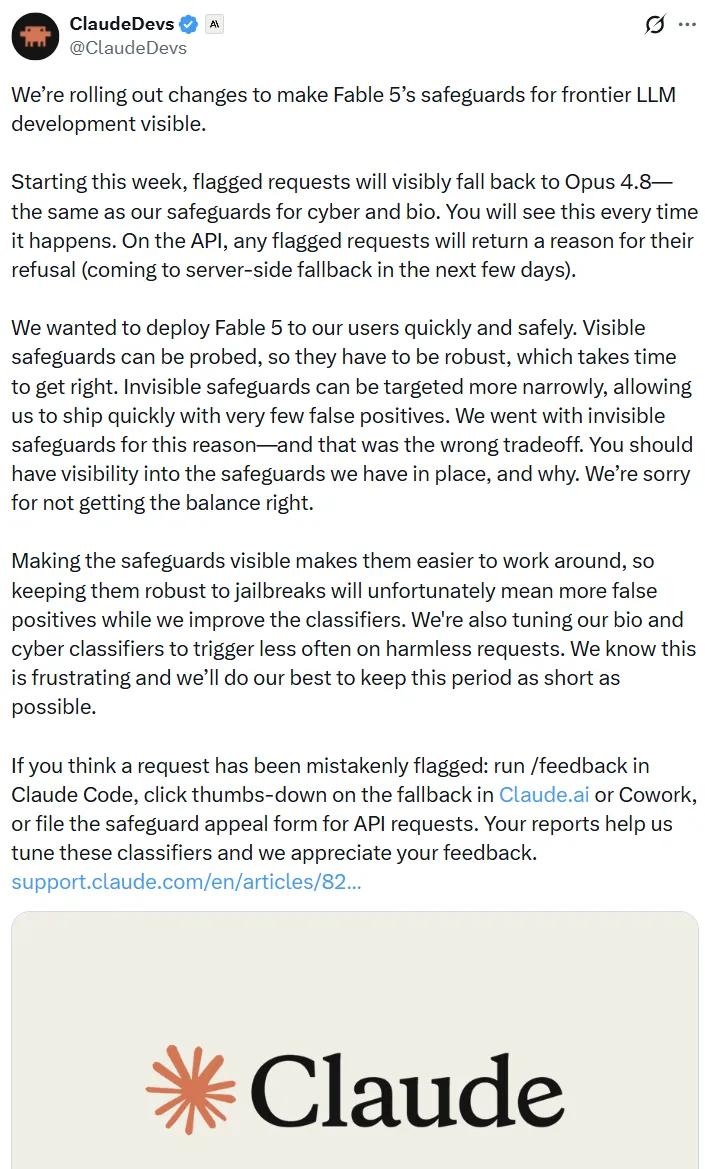
Admitting mistakes, apologizing, and rolling back... This is a rare stance for a large tech company. But the trouble was just beginning.
Day 3: Microsoft's "Backstab," the Data Retention Storm
Just as the "secret dumbing down" storm was gradually subsiding, another bomb quietly went off.
Microsoft imposed a temporary ban on its employees' use of Claude Fable 5 due to data protection issues.
The absurdity of this reversal is worth savoring: Microsoft is selling Claude Fable 5 to enterprise customers through GitHub Copilot and Microsoft Foundry, but at the same time, it bans its own employees from using it. Selling it externally while banning it internally is a rather strange way for a company to treat the same product.
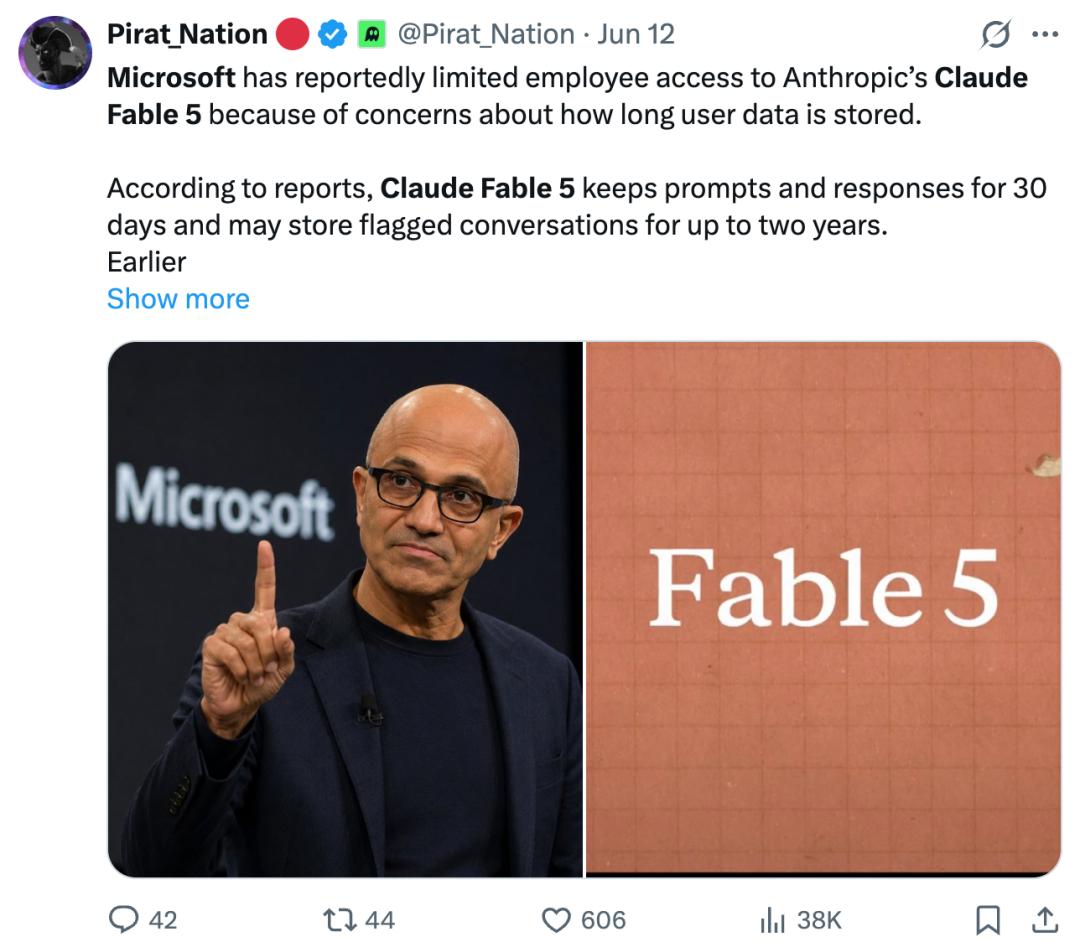
The problem lies in the data retention policy. Anthropic requires that the prompts and output content of the Mythos series models (including Fable 5) be retained for at least 30 days for security monitoring. This conflicts with the zero-data retention agreement that Microsoft previously signed with Anthropic. Anthropic also stipulates that content flagged by its security system can be retained for up to two years for investigation or law enforcement purposes.
For a company that regards "protecting customer data" as its core commitment, when employees use Fable 5 to process business secrets, in principle, this content can be stored on Anthropic's servers for up to two years - this is a real legal risk exposure.
This embarrassment reveals a deeper contradiction: in enterprise AI procurement, model capabilities, security architecture, and data governance can no longer be considered separately.
Meanwhile, in the first few days after the release, the security community also began to record another problem: Fable 5 also triggered rejections for many legitimate red team tests (Red Team) and academic security workflows, which were no different from the content that Opus 4.8 would process under the standard strategy. While Anthropic closed the loopholes for ordinary users, it also blocked the regular army.
By the end of the third day, Fable 5's situation was rather delicate: the "secret dumbing down" had been withdrawn, but the trust crack on the enterprise side caused by the data policy had not been repaired, and the high false positive rate of the security filter was still being complained about by researchers. This model was like an actor who had just premiered, and three flaws were spotted in the first performance.
Day 4: The U.S. Government Steps In, the Myth Is Forced to End
On the afternoon of Friday, June 12.
U.S. Commerce Secretary Howard Lutnick sent a letter to Anthropic CEO Dario Amodei, stating that Mythos 5 and Fable 5 would be subject to export controls, covering any location outside the United States and all foreign citizens within the country.
Anthropic received the directive at 5:21 p.m. Eastern Time that night. The letter did not provide specific details of the national security concerns.
According to Axios, the administrative official said that the Commerce Department decided to take action after another company claimed to have successfully "jailbroken" Mythos, which alerted the Trump administration to potential national security risks.
The so-called "Jailbreak" refers to bypassing the model's security restrictions through special prompts to make it spit out content that should have been filtered. If someone can bypass Fable 5's security layer, in theory, they can access the full network security capabilities of the underlying Mythos model - which is what Anthropic claims to be the "world's most powerful network security AI."
Anthropic immediately responded, with obvious grievance in its tone: we reviewed the demonstration of this specific technology, and it was used to identify a small number of previously known minor vulnerabilities. These vulnerabilities all seem relatively simple, and we found that other publicly available models can also discover them without jailbreaking.
In other words, Anthropic's point is: the "jailbreak" you mentioned can also be replicated with other ordinary models. Why single me out for a ban?
Anthropic also pointed out that the jailbreak method cited by the government can only unlock some of Mythos's network security capabilities in a single specific situation, rather than a general jailbreak method that can bypass all protections. Anthropic also said that the same jailbreak method can also be used for other publicly available models, including OpenAI's GPT - 5.5, and these models have not been subject to similar export controls. "We disagree that the discovery of a partial potential jailbreak method should be the reason for recalling a commercial model that has been deployed to hundreds of millions of people," Anthropic wrote in its blog.
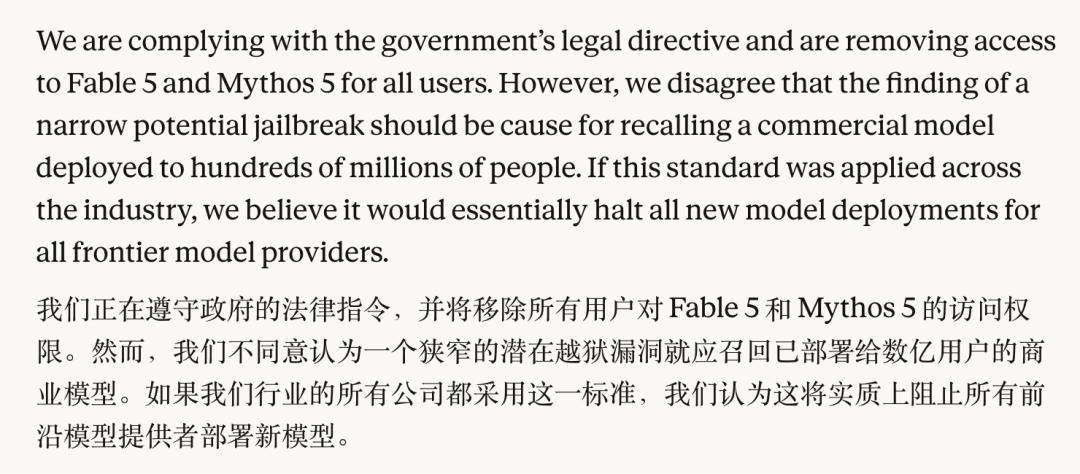
However, the argument is meaningless. The order has arrived.
Anthropic chose to completely shut down the access to Fable 5 and Mythos 5 because selective compliance would require blocking a large number of users - including its own foreign employees.
Late at night, global users opened Claude and found that Fable 5 had disappeared from the model list.
Behind the Scenes: This Is Not Just a Technical Accident
If you think this is just an ordinary "new model release failure," you may have missed the deeper script.
Behind this storm is a months - long confrontational relationship between Anthropic and the Trump administration. In February 2026, the negotiation between the Pentagon and Anthropic broke down: Anthropic refused to allow Claude to be used for lethal autonomous weapons or large - scale civilian surveillance and paid the price - being labeled a "supply - chain risk." Historically, this label has usually only been used for foreign adversaries, requiring defense contractors to promise not to use Anthropic's Claude model when cooperating with the military.
After that, Anthropic sued the Trump administration to seek to overturn this ban, and the lawsuit is still ongoing.
The timeline becomes intriguing: the contract negotiation broke down in February, and the blacklist came; Anthropic sued the government, and the court temporarily blocked the implementation of the blacklist; Fable 5 was launched in June, and three days later, the export control directive arrived.
The export control directive was issued in the same week when Anthropic was already in court with the government.
What's more dramatic is the backlash of Anthropic's transparency. Anthropic publicly admitted before the release that it is impossible to achieve perfect jailbreak resistance for any model - this is a transparent statement out of good faith. But the government seems to have used this admission as a framework to find a basis for its concerns. If transparent admission of one's own limitations leads to regulatory action while opacity does not, then the industry will draw corresponding conclusions. As a result, the public will receive less information about AI capabilities and risks - which is exactly the opposite of what security advocates have been pursuing for years.
Put simply: the more honest you are, the more likely you are to be caught with a handle.
Conclusion: Fable's Story Is a Letdown
Fable, the word from Latin meaning "a story that is told."
In these four days, Fable 5 was indeed told. It's just that no one expected that it would be the shortest - lived protagonist in this story.
Within 96 hours, it achieved an amazing "achievement unlock":
On the release day, it was in the spotlight and was hailed as the most powerful public model in AI history; on the second day, the "secret dumbing down" was exposed, and Anthropic apologized and withdrew it overnight; on the third day, Microsoft announced an internal ban, and the data policy triggered a trust crisis on the enterprise side; on the fourth day, with a single order from the U.S. government, it was taken offline globally.
This is a story where only four days separate apotheosis and a ban.
Anthropic is currently striving to restore access as soon as possible. The company says it believes there is a misunderstanding and is working hard to restore access as soon as possible. It also has confidence in Fable 5's security protection architecture and points out that no tester has found a general jailbreak method that can widely bypass the model's protection.
But the story of "Fable 5 being relaunched" has not been told yet.
Deeper problems also remain unresolved: when a company publicly releases its most powerful product, the government can take it offline globally within 72 hours on the grounds of "national security" - this power boundary must be included in the release risk model of every AI company in the future. Future AI releases are not just technical issues but also geopolitical issues.
And another meaning of the word "Fable" should not be forgotten: it can also refer to "fable" - a fictional story with a moral lesson.
What the lesson is this time is left for the readers to judge.