Chinese AI engineers have also boarded SpaceX's wealth rocket
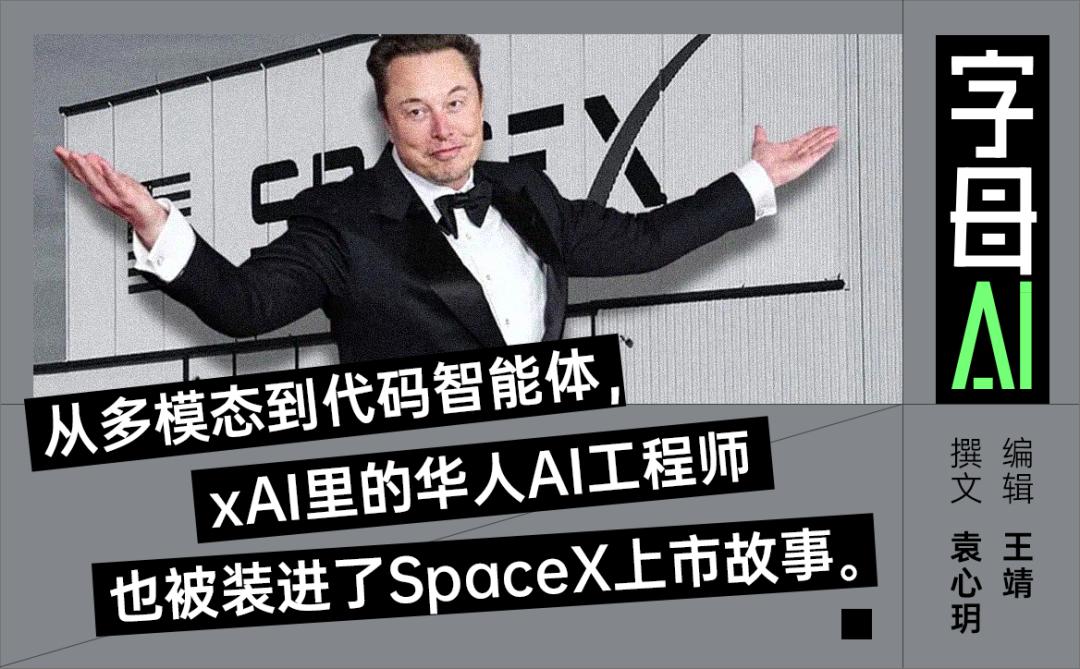
SpaceX's listing created a wealth myth.
Elon Musk became the world's first trillionaire, and his net worth reached a position never before seen in human business history.
More than 4,400 current and former employees became paper millionaires; about 400 of them hold stocks worth over $100 million.
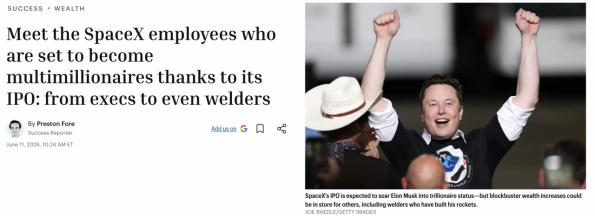
These new millionaires are not all founders, investors, or executives. There are engineers, welders, chefs, cafeteria staff, and so on.
On their first day at the company, they were given stocks. Those who held on waited for ten or twenty years until the day of SpaceX's listing and reaped extremely generous rewards.
This largest IPO in the world's history triggered a reevaluation of the wealth related to SpaceX employees' equity.
The listed SpaceX is not just about rockets, starships, and Starlink. After the integration of xAI, AI models, engineering automation, and multimodal capabilities have also been incorporated into the same capital story.
SpaceX's wealth rocket not only carries those in the launch pad, rocket factory, and Starlink network but also the model training team of xAI.
This team has just undergone a major reshuffle. Early core figures such as Zhang Guodong and Dai Zihang, who were in charge of Grok Code and Grok Imagine, have left one after another. The company has undergone a restructuring, and all the original co - founders of xAI except Elon Musk have left.
In the past, we cared about the talents who left, but those who stayed are also worthy of attention. There are quite a few Chinese names among them: Ronghang Hu, Long Zhao, Ze Liu, Jie Huang, Bill Yuchen Lin, Zhuoran Shen, Yingru Li...
For these core engineers who still remain in the xAI system and hold equity incentives, SpaceX's listing means that the rights and interests in their hands are brought to the cashing window of the public market.

Those who held on to their stocks waited for the rewards
SpaceX has been distributing stocks to employees at all levels since early on.
Some received stock options, while others received restricted stocks. No matter what the form, it was not a definite fortune, and many people didn't believe that the company could really go public.
After all, SpaceX was not a company that seemed to be a sure winner. In 2006, 2007, and 2008, the first three launches of the Falcon 1 all failed. It wasn't until September 2008 that the fourth launch finally achieved orbit.
Elon Musk later recalled to former NASA administrator Jim Bridenstine that at that time, SpaceX had no budget for another launch, and the fourth launch was put together with spare parts. If it had failed, there would have been no future for SpaceX.
Three months later, thanks to a $1.6 - billion commercial resupply contract for the International Space Station from NASA, SpaceX was really pulled back from the brink.
After that, SpaceX also experienced many twists and turns. The Falcon 9 mission failed, and there was an explosion at the launch pad. In the starship phase, failures, investigations, and rectifications were still part of the story.
What seems like an overnight - wealth story today actually seemed more like accepting an IOU that might never be cashed in back then.
But the fact is that on the day of SpaceX's listing, those who held on to their stocks all waited for their rewards.
Trevor Hise, mentioned in a New York Times report, is a typical example of an engineer. He joined SpaceX after graduating from college in 2011, starting as an intern and later becoming a launch engineer. He worked at SpaceX for 12 years. By the time of the listing, he still held more than 100,000 shares. Calculated at the issue price of $135 per share, these stocks were worth at least $13.5 million.
Juan Hernandez, a former SpaceX welder from Mexico, used to earn about $28 per hour at SpaceX and was granted about $10,000 worth of stocks. He sold some of his stocks in 2020 when SpaceX's valuation reached $36 billion. By the time of the IPO, he had 6,500 shares left, which were worth about $877,500 at $135 per share.
Moreover, SpaceX's closing price on the first day was $160.95, and it once exceeded $176 during the trading session.
Of course, not everyone waited until this day. There was a saying circulating within SpaceX: Some early employees didn't believe the company would really go public and exchanged their stocks for gift cards from the American chain restaurant Chili's when they left.
As the saying goes, "If you knew what would happen in three days, you could be rich for thousands of years." It's a pity that they thought the stocks in their hands were just a piece of waste paper at that time, never imagining that one day they could be worth more than a full feast at Chili's.

SpaceX's story is not just in the sky
When SpaceX went public, it wasn't just a rocket company that was pushed into the public market.
In the prospectus, SpaceX's business is divided into several different segments. The Falcon rockets are responsible for launches, Starlink is responsible for making money, the starship is responsible for taking the story to Mars, and the integration of xAI has added a layer of AI infrastructure to SpaceX's story on top of "space infrastructure."
When xAI was integrated into SpaceX, the engineers in the xAI model training team also became part of the SpaceX system.
It's worth noting that engineers who can enter the core model team of xAI usually don't just receive a cash salary. Public salary data shows that the salary structure of xAI engineers includes stocks/equity, and the integration of xAI into SpaceX itself is a stock - swap transaction.
For the core engineers who still remain in the xAI system and hold equity incentives, SpaceX's listing means that the rights and interests in their hands are brought to the cashing window of the public market.
In the past few months, xAI has undergone a major reshuffle. Early core figures such as Zhang Guodong and Dai Zihang, who were in charge of Grok Code and Grok Imagine, have left one after another, and the company has undergone a restructuring. By the end of March, according to public reports, all the original co - founders of xAI except Elon Musk had left.
Those who left may not have left empty - handed, and the vested equity may still participate in subsequent conversions. But for those who stayed, they not only caught up with SpaceX's listing but also retained the opportunity for further vesting and continued equity grants.
Among these remaining technical backbones, we see two groups of Chinese names worthy of attention.
One group is involved in Grok's multimodal capabilities: Ronghang Hu, Long Zhao, Ze Liu.
The other group is involved in reasoning, post - training, and code capabilities: Jie Huang, Bill Yuchen Lin, Zhuoran Shen, Yingru Li.
They are not names that appear accidentally in SpaceX's listing story. xAI recruited them during the most intense competition for talent in the field of large models. After the departure of the founding team and organizational restructuring, they still remain in the system.
They didn't build rockets.
But they also caught a ride on SpaceX's wealth rocket.

The remaining Chinese AI engineers

Ronghang Hu graduated from Tsinghua University with a bachelor's degree in 2015 and obtained a Ph.D. in computer science from UC Berkeley in 2020.
His Ph.D. thesis, titled "Structured Models for Vision - and - Language Reasoning," focuses on vision - and - language reasoning: enabling the model to answer questions based on images, locate objects in images based on natural language, or navigate in a visual environment according to language instructions.
In other words, Ronghang Hu was working on the core issues of today's multimodal models early on: enabling AI not only to see images but also to understand images and language together.
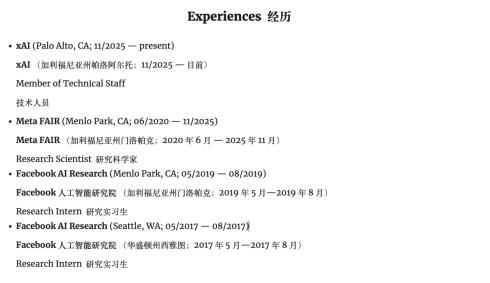
Later, he joined Meta FAIR and participated in the Segment Anything series. He was one of the core contributors to SAM 2 and SAM 3.
In November 2025, Ronghang Hu joined xAI from Meta FAIR and became an MTS (although it literally means "technical staff," Andrej Karpathy also held this title at Anthropic). He continued to work on multimodal AI.
The SAM series is one of Meta's most important visual foundation model projects in the past few years. In the year Ronghang Hu joined, xAI was vigorously strengthening its multimodal capabilities. Business Insider reported that xAI had recruited more than a dozen employees from Meta since 2025, and Ronghang Hu's entry into xAI coincided with this talent flow.
There isn't much publicly available information about Ronghang Hu after he joined xAI, but his technical path is clear. In the process of Grok's development towards image, video, and multimodal understanding, this type of talent is part of the underlying capabilities.
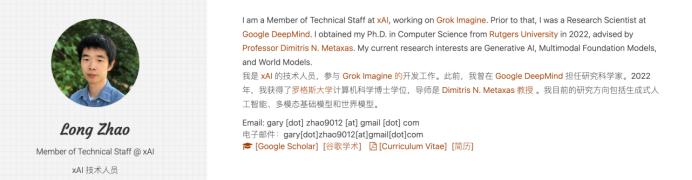
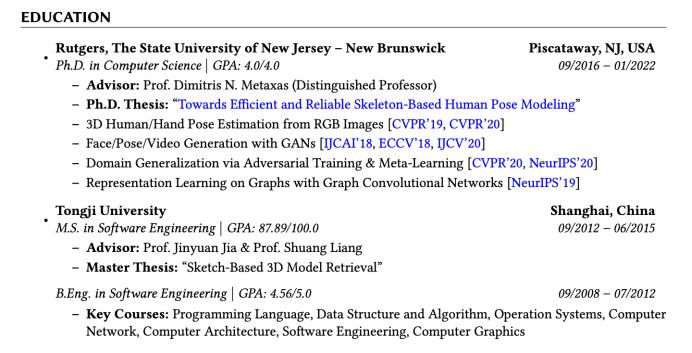
Long Zhao graduated from Tongji University with a bachelor's and a master's degree in software engineering.
During his master's program, he worked on 3D model retrieval based on sketches, which means enabling the system to find corresponding objects in a 3D model library based on a hand - drawn sketch. During his postgraduate studies, Long Zhao also interned at the Visual Computing Group of Microsoft Research Asia (MSRA), working on object candidate region generation and salient object detection.
Later, he went to Rutgers to pursue a Ph.D. in computer science under the supervision of Dimitris Metaxas. His research continued to focus on computer vision, machine perception, and generative models.
After graduating with his Ph.D., Long Zhao joined Google Research and later transferred to Google DeepMind.
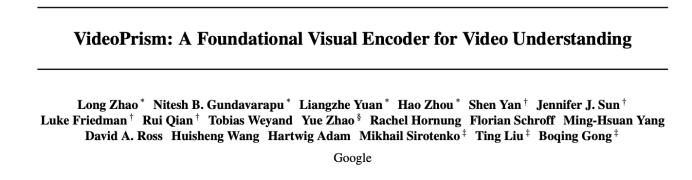
His representative achievement there is VideoPrism, a basic visual encoder for video understanding that can handle tasks such as video classification, localization, retrieval, caption generation, and video question - answering.
According to the official blog of Google Research, the training data for VideoPrism includes 36 million high - quality video - text pairs and 582 million video segments with text information. The paper claims that it achieved the best results at that time on 31 out of 33 video understanding benchmarks.
Long Zhao is one of the co - first authors of the paper.
Against the backdrop of cutting - edge model companies competing for multimodal and video - generation talent, Long Zhao moved from Google DeepMind to xAI and joined the Grok Imagine team.
Public information shows that he is a core contributor to Grok Imagine 1.0 and Grok Imagine Quality Mode. The former is the version where xAI officially entered video generation and video editing, and the latter further improves the generation quality, text rendering, and creative control.
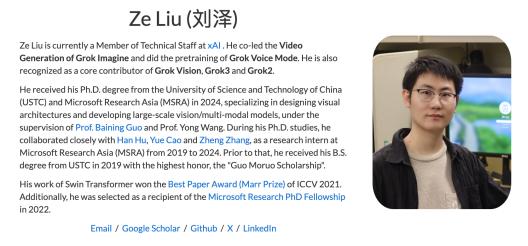
Ze Liu graduated from the University of Science and Technology of China with a bachelor's degree and later pursued a Ph.D. under the systems of the University of Science and Technology of China and Microsoft Research Asia. His research focuses on computer vision, visual architectures, and large - scale visual/multimodal models.
Microsoft Research Asia is often referred to as the "Whampoa Military Academy" for Chinese AI talent. Many researchers who later joined Meta, Google, DeepMind, and xAI used to intern, participate in joint training, or collaborate on papers