BBA cannot outperform Chinese domestic cars
When it comes to luxury brands like BBA, the keyword for them is definitely "not cheap". For high - end passenger cars priced above 200,000 yuan, it has always been the territory of foreign luxury brands such as BBA. In the words of netizens, this price range is "powerful", and it is one of the core criteria for measuring a car company's brand premium and industry influence.
However, in the new - energy era, especially when the penetration rate of new - energy vehicles has exceeded 60%, the dominance of BBA in the market for cars priced above 200,000 yuan has shown some signs of weakening.
According to the retail data for May 2026 (excluding imported cars) released by the Passenger Car Association: In that month, a total of 385,800 units of more than 160 high - end models were sold. Chinese brands sold 221,000 units, while foreign brands only sold 165,000 units. The sales volume of domestic brands exceeded that of foreign brands.
Of course, gaining an advantage in the overall sales of high - end cars is a huge improvement for domestic cars and also evidence of the Chinese auto market moving towards a new stage. However, this does not mean that BBA is completely out of the game.
From the perspective of the segmented market, that is, specifically analyzing the three core fields of SUVs, sedans, and MPVs: Domestic high - end passenger cars have gained control of the two major segments of SUVs and MPVs priced above 200,000 yuan. In the traditional high - end sedan market, BBA has held its ground relying on decades of brand perception, becoming its last line of defense.
Domestic Cars Capture the High - end SUV and MPV Markets
Domestic consumers have always loved SUVs, whether they are low - end or high - end. Otherwise, there wouldn't have been a market trend 20 years ago that "as long as you produce an SUV, it will sell well", and a group of domestic brands wouldn't have thrived during that period.
At that time, with the acceleration of urbanization, changes in family structure, and looser road rights, the average annual growth rate of SUVs often exceeded 20%. We witnessed the days when domestic models such as Haval H6, Geely Boyue L, and Changan CS75 PLUS dominated the SUV sales list. Of course, it also allowed many companies that didn't engage in independent R & D to survive for a while.
Later, with industrial upgrading, various models, including SUVs, have completed upgrades in product strength and car - making concepts, which has enabled domestic SUVs to successfully enter the market for cars priced above 200,000 yuan and have the opportunity to compete with luxury brands such as BBA.
This process was not smooth. At first, since the "low - end" impression of domestic cars had not been completely eliminated, most consumers' car - buying concepts were like this: either buy a domestic SUV for less than 200,000 yuan, or add another 100,000 yuan or more to buy a luxury - brand model. This consumption concept persisted for several years even though the product strength of domestic SUVs had been greatly improved.
The rapid development of the new - energy vehicle market has also accelerated the demise of this consumption concept. When domestic cars have generally surpassed foreign brands in terms of design, intelligence, and driving experience, consumers have begun to be willing to try domestic cars.
Today, as the largest segmented segment in the high - end market for cars priced above 200,000 yuan, the SUV segment has completed the replacement with domestic models first. Under the pressure of the times, BBA has lost its mainstream influence. Data shows that the domestic market share of SUVs in this price range exceeds 70%, and the market pattern is almost one - sided. Only Tesla Model Y remains the only representative of foreign brands.
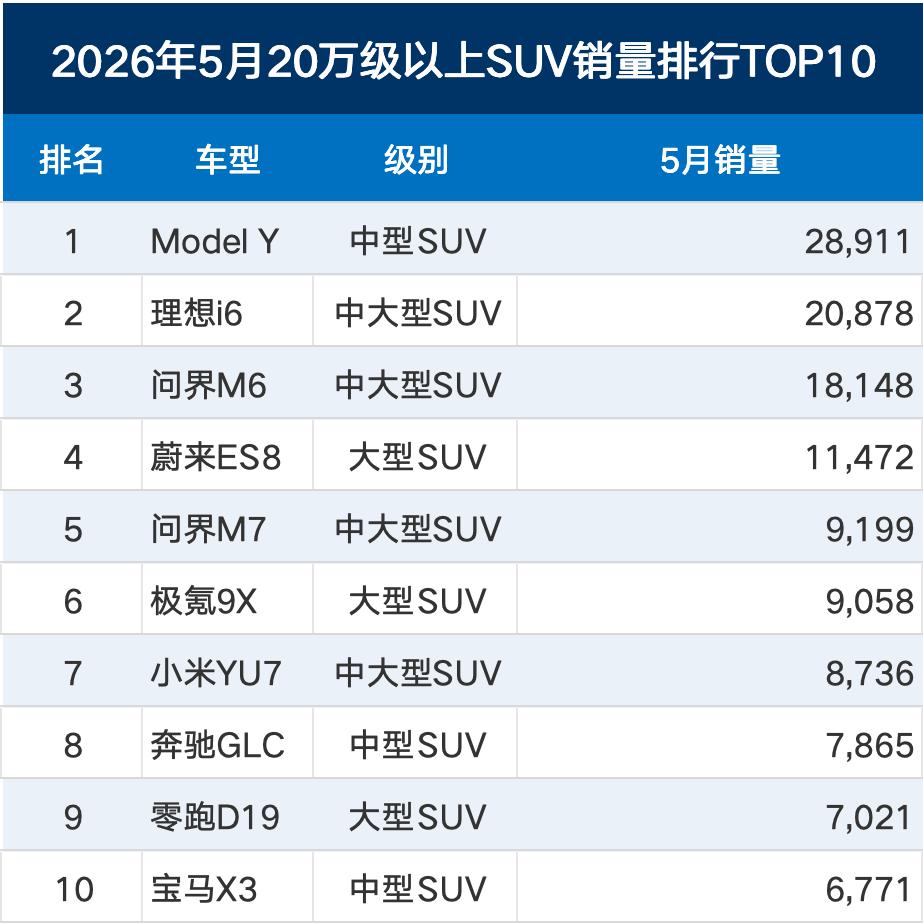
Specifically, the Tesla Model Y topped the category list with 28,911 units sold. The second to seventh places were all taken by six Chinese brands, including Li Auto, AITO, NIO, ZEEKR, and Xiaomi.
Among them, the monthly sales volume of the Li Auto i6 exceeded 20,000 units, crushing many German competitors. In contrast, the monthly sales volumes of the core SUV products of BBA, such as the Mercedes - Benz GLC, BMW X3, and Audi Q5L, all fell below 8,000 units. The total monthly sales volume of these three main models was 20,908 units, which was even less than the sales volume of the single Li Auto i6.
Putting aside the fluctuations of single models, the industry trend is even more irreversible. Currently, all SUVs with a monthly sales volume of over 5,000 units in the price range above 200,000 yuan are new - energy vehicles. Six domestic brands, including Li Auto, AITO, Xiaomi, and Leapmotor, have all achieved a monthly sales volume of over 7,000 units in the 200,000 - 400,000 yuan price range, squeezing the living space of BBA through multi - brand encirclement.
Even though the overall sales volume of the SUV segments of the three BBA luxury brands is considerable, after removing the support from sedan sales, the market volume and market share of the SUV segments have shrunk significantly.
Similar to the SUV segment, the MPV market has also completed the transformation led by domestic brands. The domestic market share of this category has reached over 60%. In contrast, traditional foreign MPVs other than BBA have collectively declined.
Among the top five high - end MPV models at present, four are Chinese brands. The Voyah Dreamer, Denza D9, Trumpchi M8, and Hongqi HQ9 have consistently ranked among the top. The sales volume of all models of the Buick GL8 has been equaled or exceeded by domestic high - end MPVs.
This breakthrough started from 2022 - 2023. The Denza D9 was the first to break the foreign monopoly, verifying the market feasibility of plug - in hybrid high - end MPVs in the 300,000 - 500,000 yuan range. Subsequently, a group of domestic car companies quickly followed up, completed their product portfolios, improved their after - sales systems, and rewritten the duopoly pattern of Buick and Toyota in one go.
Currently, only the Toyota Sienna holds the top sales position in the MPV segment.
BBA Sedans Are Still Competitive
As the SUV and MPV segments have suffered successive defeats, the high - end sedan market has become the last fortress for BBA to maintain its luxury market share.
Data shows that the domestic market share of sedans priced above 200,000 yuan is only about 40%. The dominance of this segment is firmly in the hands of German luxury brands, and the market logic is completely opposite to that of SUVs and MPVs.
In terms of the performance of specific models, in the top 10 list of high - end sedans in May, the Xiaomi SU7 and Tesla Model 3 took the first and second places, becoming the only breakers among domestic and new - force brands. The third to seventh places were all taken by five BBA fuel - powered sedans, such as the BMW 3 Series, Mercedes - Benz E - Class, and Audi A6L. The total sales volume of these five models exceeded 40,000 units, monopolizing the traditional high - end fuel - powered sedan market.
More intuitively, after removing new - energy models, BBA has almost no competitors in the traditional high - end fuel - powered sedan segment.
Of course, the real gap between domestic sedans and BBA is no longer in product hardware, but in the brand perception gap that has spanned two decades. SUV consumers give priority to functional values such as space, intelligence, and vehicle - use costs when purchasing a car, and their decision - making is rational. However, for the mainstream high - end sedan consumers in the 250,000 - 350,000 yuan range, the core needs are identity labels and business - social attributes. Models such as the Mercedes - Benz E - Class and Audi A6L have been deeply involved in the domestic market for more than two decades, firmly binding to the administrative and business vehicle - use scenarios, and building an identity recognition that is difficult to shake in the short term.
Meanwhile, the sedan market presents a clear three - stage pattern. In the entry - level high - end range of 200,000 - 250,000 yuan, the Xiaomi SU7 and Tesla Model 3 have completed market capture. In the core business range of 250,000 - 350,000 yuan, BBA's barriers are as solid as a rock. High - end domestic sedans priced above 350,000 yuan have not yet formed a large - scale volume. Even though the monthly sales volume of the Zunjie S800, a model priced at over 700,000 yuan, is only about 1,000 units, it cannot reverse the overall pattern.
Looking at the overall situation, BBA's current dilemma is not the failure of a single model or short - term price competition, but a structural loss in the market segments.
Relying on the dividends of electrification and intelligence, domestic cars have fully exploited the domestic and travel - demand markets, achieving a triple counter - attack in terms of product, reputation, and scale in the two major mainstream segments of SUVs and MPVs. In contrast, BBA has been relying on the brand dividends of the fuel - powered era, with lagging product iteration and high vehicle - use costs, and has lost the mainstream domestic customer group.
In the short term, the brand endorsement in business scenarios and consumers' consumption inertia can still support the stability of BBA sedans, and the brand premium of luxury brands is temporarily safe. In the long term, the upward development of domestic high - end brands, the youthification of business users, and the launch of new - energy business models are gradually narrowing the brand - generation gap in the sedan field.
In other words, the era when BBA could dominate all categories with its brand power has come to an end. They have lost the battle in the SUV and MPV markets. Only the sedan segment remains as their last stronghold, and this last luxury territory is also facing a new round of attacks from domestic cars.
This article is from the WeChat official account "Automotive Commune" (ID: iAUTO2010), written by Li Sijia, and is published by 36Kr with authorization.