The race for a clinical cure for hepatitis B has entered its decisive phase, with the fastest candidate expected to hit the market as early as 2027.
The long - distance race towards clinical cure for hepatitis B is about to reach the finish line. In this historical milestone - level breakthrough in new drug research and development, there are several Chinese faces.
The 2026 Annual Meeting of the European Association for the Study of the Liver (EASL 2026) was held in Barcelona, Spain at the end of May. The venue became an arena for multiple new hepatitis B drugs globally, and several new drugs for the clinical cure of hepatitis B released significant data.
The data from the global phase III clinical trial of the star drug bepirovirsen were announced at the meeting. Professor Hou Jinlin from the Department of Infectious Diseases at Nanfang Hospital of Southern Medical University is the core researcher (Core PI) of this study, and the relevant research results have also been published in The New England Journal of Medicine (NEJM).
The key B - Well data shows that the overall study population can achieve a significant clinical cure rate of 19%. The clinical cure rate for patients with lower viral activity can reach 26%, while that for patients receiving only standard treatment is 0%.
It's not just overseas companies in the arena. Several domestic companies have also made breakthroughs in the clinical cure of hepatitis B. Haobo Pharmaceutical, Tengshengbo Pharmaceutical, Hengrui Pharmaceutical, etc. have brought new progress.
Achieving clinical cure for hepatitis B is associated with a significant reduction in the risk of long - term liver complications, including liver cancer. The severe situation of the high incidence of liver cancer in China makes clinical cure an urgent need.
Challenges and Technical Routes for the Clinical Cure of Hepatitis B
Hepatitis B is the most prevalent chronic viral disease globally, with over 240 million people suffering from chronic hepatitis B (CHB) worldwide. It is estimated that there are approximately 75 million hepatitis B virus carriers in China, and there are over 450,000 hepatitis B virus - related deaths in China each year.
Although China has shed the label of a "hepatitis B - heavy country", the proportion of liver cancer and cirrhosis caused by hepatitis B remains high. The situation is severe. According to the data in Tengshengbo Pharmaceutical's prospectus, the proportions of patients with primary liver cancer and cirrhosis caused by HBV infection worldwide are 45% and 30% respectively. In China, the proportions of patients with primary liver cancer and cirrhosis caused by HBV infection are 80% and 60% respectively.
The difficulty in curing hepatitis B is related to integrated DNA and cccDNA. After the hepatitis B virus (HBV) infects liver cells, it can integrate viral DNA into the host genome and form covalently closed circular viral DNA (cccDNA) within the cells. Integrated DNA and cccDNA can persist in infected liver cells for a long time and are difficult to be completely eliminated, allowing CHB to persist.
In addition, the hepatitis B virus produces a large amount of circulating surface antigens and some other proteins. These products of the hepatitis B virus are immunosuppressive. Long - term high - level hepatitis B surface antigen (HBsAg) will lead to T - cell exhaustion and weakened self - immunity. This is an important reason why CHB is difficult to cure.
Existing nucleoside (acid) analogs intervene in the late stage of the viral life cycle to prevent viral DNA replication. However, they do not affect the transcriptional activity of cccDNA or the production of viral proteins, and rarely induce immune control. Long - term treatment is required, and there is a risk of drug resistance. It is difficult to achieve HBsAg clearance.
Another type of drug, long - acting interferon, has both antiviral and immune - activating effects and can achieve clinical cure in some patients. However, it has limitations such as a small effective population, a long treatment course, and significant side effects.
Therefore, the clinical cure of hepatitis B has become the holy grail pursued by global new hepatitis B drugs. Its criteria are extremely strict: HBV DNA and HBsAg in the blood cannot be detected continuously for at least 6 months after all treatments are stopped.
The clinical cure of hepatitis B not only solves the problem of long - term medication but also significantly reduces the risk of cirrhosis and liver cancer.
This clinical demand is urgent in China, and domestic patients are more willing to pay for clinical cure therapies. For example, although interferon, the only currently approved drug for hepatitis B cure, has obvious side effects and a low cure rate, a considerable number of patients in China still try interferon as a potential functional therapy.
To achieve the clinical cure of hepatitis B, global companies have tried various routes. Route 1: Target the HBV life cycle by going straight to the virus's lair. From the moment the virus enters liver cells to replication, assembly, and release, each step has new drugs "guarding". These include entry inhibitors, cccDNA inhibitors, RNA interference (small interfering RNA (siRNA), antisense oligonucleotides (ASO)), capsid inhibitors, and HBsAg inhibitors (nucleic acid polymers, NAPs).
Route 2: Awaken the immune army - target the host immune system. These include therapeutic vaccines, monoclonal antibodies, TLR - 7/8 agonists, PD - (L)1 inhibitors... These drugs attempt to remove the "immune fog" set by HBsAg, rebuild the combat effectiveness of T cells, and make the body itself the ultimate weapon to eliminate the virus.
Among the new drugs for the clinical cure of hepatitis B targeting different sites, small interfering RNA and antisense oligonucleotides have a more significant effect in reducing HBsAg.
In addition, since the clinical cure of hepatitis B requires the dual clearance of hepatitis B surface antigen (HBsAg) and hepatitis B virus DNA (HBV DNA) and the long - term maintenance of efficacy after drug withdrawal, it means that an effective hepatitis B cure will surely involve the combined treatment of multiple types of drugs. Research on the combined treatment of drugs targeting different sites is also being actively carried out. In addition to the combination of new drugs, research on the combination of new drugs with pegylated interferon - α (PEG - IFNα) is also increasing. According to the disclosed phase data, the combination of new drugs with PEG - IFNα is beneficial for further reducing the HBsAg level and maintaining efficacy. The exploration of different combined treatment regimens will be the development trend for the comprehensive clinical cure of hepatitis B in the future.
There are more than 40 research pipelines for hepatitis B cure globally. Arterial Network has compiled five major pipelines in the late - stage clinical phase that are worthy of attention.
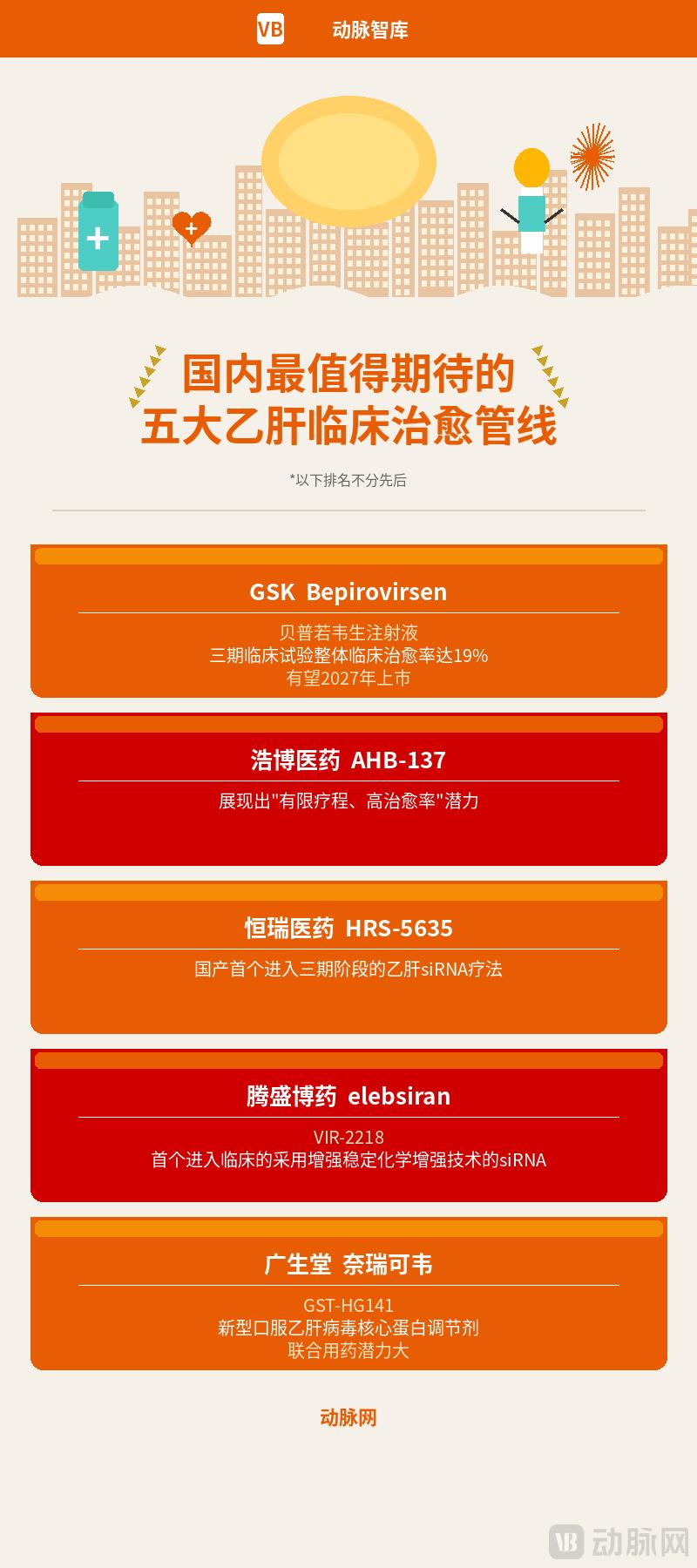
■ GSK Bepirovirsen: The new hepatitis B drug expected to be launched as early as 2027
Bepirovirsen injection is undoubtedly the most - watched pipeline in the global field of clinical cure for hepatitis B. Backed by GSK, its R & D progress is leading, and it has been included in the priority review in many countries such as China and the United States, and a marketing application has been submitted.
Chia Tai Tianqing is optimistic about the sales potential of Bepirovirsen in the Chinese market. In May 2026, it reached a cooperation with GSK to lock in the commercialization rights in the Chinese market.
As an antisense oligonucleotide (ASO) drug with a triple - mechanism, the base sequence of Bepirovirsen is complementary to HBV RNA. After entering liver cells, it can form a double - stranded structure with the target mRNA and be degraded through RNase H - mediated degradation, thereby inhibiting viral DNA replication, reducing the HBsAg level, and creating a window for the recovery of the immune system to increase the possibility of a sustained response.
In the key phase III clinical trials, both the B - Well 1 and B - Well 2 studies reached the primary endpoints. The combined data of the two trials showed that 6 - month treatment with bepirovirsen achieved a statistically and clinically significant 19% clinical cure rate in the overall study population (adult hepatitis B surface antigen (HBsAg) level ≤ 3000 IU/ml), reaching the primary endpoint.
In terms of approval, GSK has submitted a marketing application to the FDA, and the final decision is expected on October 26, 2026. At that time, whether Bepirovirsen can be the first to be approved in the United States will become the focus of the industry.
Bepirovirsen has also submitted a marketing application in China and has been included in the priority review process. On May 25, the drug administration released information on the delivery of drug notice letters, and Bepirovirsen was among them. This information was interpreted as a non - approval. On May 27, GSK resubmitted the marketing application.
Industry insiders revealed that the first application was not approved not because of issues with efficacy, safety, or data, but due to a system problem. No technical documents were added when resubmitting the marketing application, the priority review qualification remains, and the original schedule for launch in the first quarter of 2027 has not been affected.
■ Haobo Pharmaceutical AHB - 137: A promising domestic ASO drug
In the hepatitis B ASO drug track, Bepirovirsen is not the only one. Domestic pipelines are also very competitive. Among the three ASO drugs for the clinical cure of hepatitis B with relatively fast global clinical progress, domestic AHB - 137 occupies a place. AHB - 137 is from Hangzhou Haobo Pharmaceutical.
AHB - 137 from Haobo Pharmaceutical is a non - conjugated ASO drug. This drug also has a triple - action mechanism, aiming to achieve the clinical cure of chronic hepatitis B.
AHB - 137 has demonstrated positive clinical efficacy in multiple clinical studies. In 2026, at the European Association for the Study of the Liver (EASL), AHB - 137 first announced the follow - up data at the end of the phase II clinical trial for treatment - naive chronic hepatitis B (without background treatment with nucleoside [acid] analogs).
AHB - 137 monotherapy takes effect quickly. After 16 weeks of treatment, it can rapidly and potently inhibit HBV DNA and achieve HBsAg clearance. The follow - up data at 24 weeks after drug withdrawal shows that the virological response and antigen clearance status can be maintained for a long time after drug withdrawal. After 24 weeks of drug withdrawal, 32% of patients in the overall population (i.e., with baseline HBsAg of 100 - 10,000 IU/mL) achieved clinical cure (FC). Among patients with baseline HBsAg of 100 – 1,000 IU/mL, the clinical cure rate was 70%. Among patients with baseline HBsAg > 1,000 IU/mL, 33% reached the 'partial cure' state (sustained suppression of HBV DNA and HBsAg < 10 IU/mL).
An industry insider said: "In the research consensus in China, the United States, and Europe, a clinical cure rate of about 30% is generally regarded as a key milestone for a curative therapy to make a major breakthrough. As of now, AHB - 137 from Haobo Pharmaceutical is the world's first single - drug therapy to achieve this breakthrough in the main target hepatitis B patients."
AHB - 137 has completed the global phase I clinical trial and is currently simultaneously advancing multiple global phase II clinical trials and a phase III clinical trial in China.
■ Hengrui Pharmaceutical HRS - 5635: The first siRNA drug for the clinical cure of hepatitis B to enter phase III
siRNA is also a concentrated technical route for drugs for the clinical cure of hepatitis B. siRNA and ASO have similar treatment principles, both aiming to target mRNA through sequence complementarity.
New siRNA drugs for the clinical cure of hepatitis B take effect faster and require a lower dosing frequency compared to ASO drugs. However, more clinical data are needed to support the dosing effect.
Many companies, such as Johnson & Johnson, Hengrui Pharmaceutical, Qilu Pharmaceutical, Ruibo Biotech, Bowang Pharmaceutical, Chia Tai Tianqing, and Xingyaokunze, have deployed siRNA drugs for hepatitis B treatment. Among them, HRS - 5635 from Hengrui Pharmaceutical has taken the lead in advancing to phase III.
HRS - 5635 is a small interfering RNA (siRNA) drug independently developed by Hengrui Pharmaceutical for the treatment of chronic hepatitis B. HRS - 5635 is a novel covalently conjugated triple - branched N - acetylgalactosamine (GalNAc) double - stranded small interfering RNA, which can be selectively delivered into liver cells by binding GalNAc to the asialoglycoprotein receptor (ASGPR) on the surface of liver cells. Inside liver cells, it specifically targets HBV through the RNA interference (RNAi) pathway, inhibits the expression of HBV - related viral proteins, and exerts antiviral effects.
The results of the phase II clinical study of HRS - 5635 monotherapy for chronic hepatitis B show that HRS - 5635 has the potential to improve the clinical cure of chronic hepatitis B and also has good safety characteristics. It is expected to provide more treatment options for patients with chronic hepatitis B.
The R & D direction of siRNA drugs is mainly focused on combined treatment. The phase II study of HRS - 5635 from Hengrui Pharmaceutical in combination with PEG - IFNα for the treatment of chronic hepatitis B is ongoing.
In terms of progress, this drug has entered the phase III clinical trial stage. This phase III clinical trial plans to enroll 540 subjects with chronic hepatitis B and is expected to be completed in June 2028.
■ Tengshengbo Pharmaceutical elebsiran: An siRNA using chemically enhanced technology
There is another star drug among siRNA drugs for the clinical cure of hepatitis B: VIR - 2218 (ALNHBV02, elebsiran). VIR - 2218 was developed by Vir Biotechnology. In 2020, Tengshengbo Pharmaceutical obtained the exclusive rights to develop and commercialize elebsiran in the Greater China region from Vir Biotechnology.
Elebsiran is an investigational small interfering ribonucleic acid (siRNA) drug targeting the hepatitis B virus (HBV) administered by subcutaneous injection. It aims to degrade HBV RNA transcripts and limit the production of hepatitis B surface antigen. It has direct antiviral activity against HBV and hepatitis D virus (HDV).
It is the first siRNA to enter clinical trials using enhanced - stability chemical enhancement technology to enhance stability and minimize off - target activity, thereby potentially improving the therapeutic index.
Clinical studies show that VIR - 2218 monotherapy or combination therapy can significantly reduce the HBsAg level, laying the foundation for the clinical cure of hepatitis B. Currently, this drug is in multiple phase II clinical trial stages, exploring combination regimens with immune modulators such as PEG - IFNα and TLR8 agonists, aiming to achieve HBsAg clearance through the dual strategy of "reducing antigen load + restoring immune response".
However, the approval and launch of this drug have not been as smooth as expected. Tengshengbo Pharmaceutical believes that the future prospects of the elebsiran project are uncertain.
The progress of the elebsiran project has been affected by a dispute with the partner company Vir. According to a notice from Tengshengbo Pharmaceutical, as early as 2018, Tengshengbo Pharmaceutical signed a cooperation agreement with Vir Biotechnology of the United States. According to the agreement, each party can exercise the option to obtain an exclusive license to promote the development and commercialization of certain products originally developed by the other party.
In 2020, Tengshengbo Pharmaceutical exercised the option for the elebsiran project candidate drug. On December 19, 2024, Tengshengbo Pharmaceutical and Vir signed a sixth agreement letter to transfer the drug formulation production from Vir to Tengshengbo Pharmaceutical.
The turning point came in April 2026. Tengshengbo Pharmaceutical accused Vir of violating the cooperation agreement and the agreement letter and submitted an arbitration claim against Vir to the American Arbitration Association, demanding the transfer of elebsiran production to Tengshengbo Pharmaceutical or its contractor and corresponding compensation. The arbitration is still in its early stage, and Tengshengbo Pharmaceutical and Vir have not reached a settlement regarding the claim.
The progress of the elebsiran project will be affected. Tengshengbo Pharmaceutical said that the future prospects of the elebsiran project are uncertain. Unless and until the claim in the arbitration is satisfactorily resolved, Tengshengbo Pharmaceutical will not be able to invest in any phase III clinical studies of hepatitis B combination therapies containing elebsiran. The future launch of elebsiran in China is uncertain.
■ Guangshengtang Nairuikewei (GST - HG141) Small - molecule oral drug
In the field of clinical cure for hepatitis B, core protein all