After two years of stagnant growth, H&M restructures its global organization, with the Greater China region downgraded | Exclusive
Text | He Zhexin
Editor | Qiao Qian
36Kr has exclusively learned that Swedish fast - fashion giant H&M is advancing a global organizational structure adjustment: the original 9 regional business segments divided by geography have been broken up and re - split into 26 sales markets, which are classified under four newly established "continental - level" business divisions based on market performance.
During this round of adjustment, the Greater China region has been demoted to one of the 26 sales markets and is now under the management of the newly established Continent Asia Pacific business division. Saed El - Achkar, the former president of the Greater China region, will serve as the Managing Director of this business division. The appointment is expected to be officially announced around the release of the group's semi - annual report on June 25th, and the new structure will come into effect on July 1st.
In addition to the Greater China region, the Asia - Pacific business division also manages four sales markets, namely Southeast Asia (headquartered in Kuala Lumpur), Northeast Asia (Tokyo), India (Bangalore), and Australia and New Zealand (Sydney). The headquarters of the business division remains in Shanghai.
Along with the demotion comes a reduction in staffing. 36Kr has learned that the local team in the Greater China region laid off more than 40 people in this round, accounting for about a quarter of the original scale.
This adjustment started about half a year ago, with the most significant changes occurring in the Southeast Asian and East Asian markets. In mid - May, the Malaysian media Malay Mail first reported the news that H&M's Southeast Asian headquarters was moving from Singapore to Kuala Lumpur: 78 positions out of the 256 - person establishment in the former East Asian region were cut, accounting for about 30% of the regional support staff, and the vast majority of the layoffs took place in the Singapore office.
The report also cited internal records, stating that H&M implements a similar regional or structural adjustment about once a year. Many employees also told 36Kr that the demotion of the Greater China region to a sales market means that it is no longer regarded as an independent key business unit, and "it may be placed under the jurisdiction of different regions in the future based on business performance." According to 36Kr, the structural adjustment in the North American region has been ongoing for nearly three years due to the resistance of local trade unions and has not been completed yet.
Behind the adjustment is the fact that the transformation initiated by current CEO Daniel Ervér more than two years ago has not yet delivered growth. In January 2024, Ervér succeeded Helena Helmersson, who left abruptly, as the group's CEO and put forward the vision of making the H&M brand "fashionable" again while maintaining price levels. The H&M brand contributes the vast majority of the group's revenue, and its weakness is the root cause of the company's long - term slump. He then streamlined management levels, reduced the number of suppliers, shifted more production capacity from China and Bangladesh to Morocco and Egypt, and increased marketing investment targeting young consumers.
These actions have led to a recovery in profit margins: the group's operating profit margin in the fiscal year 2025 rose to 8.1%, the highest since 2018, but it is still far from the management's long - standing target of 10%. During the same period, sales in local currency terms only increased by 2%, and actually decreased by 3% in Swedish kronor.
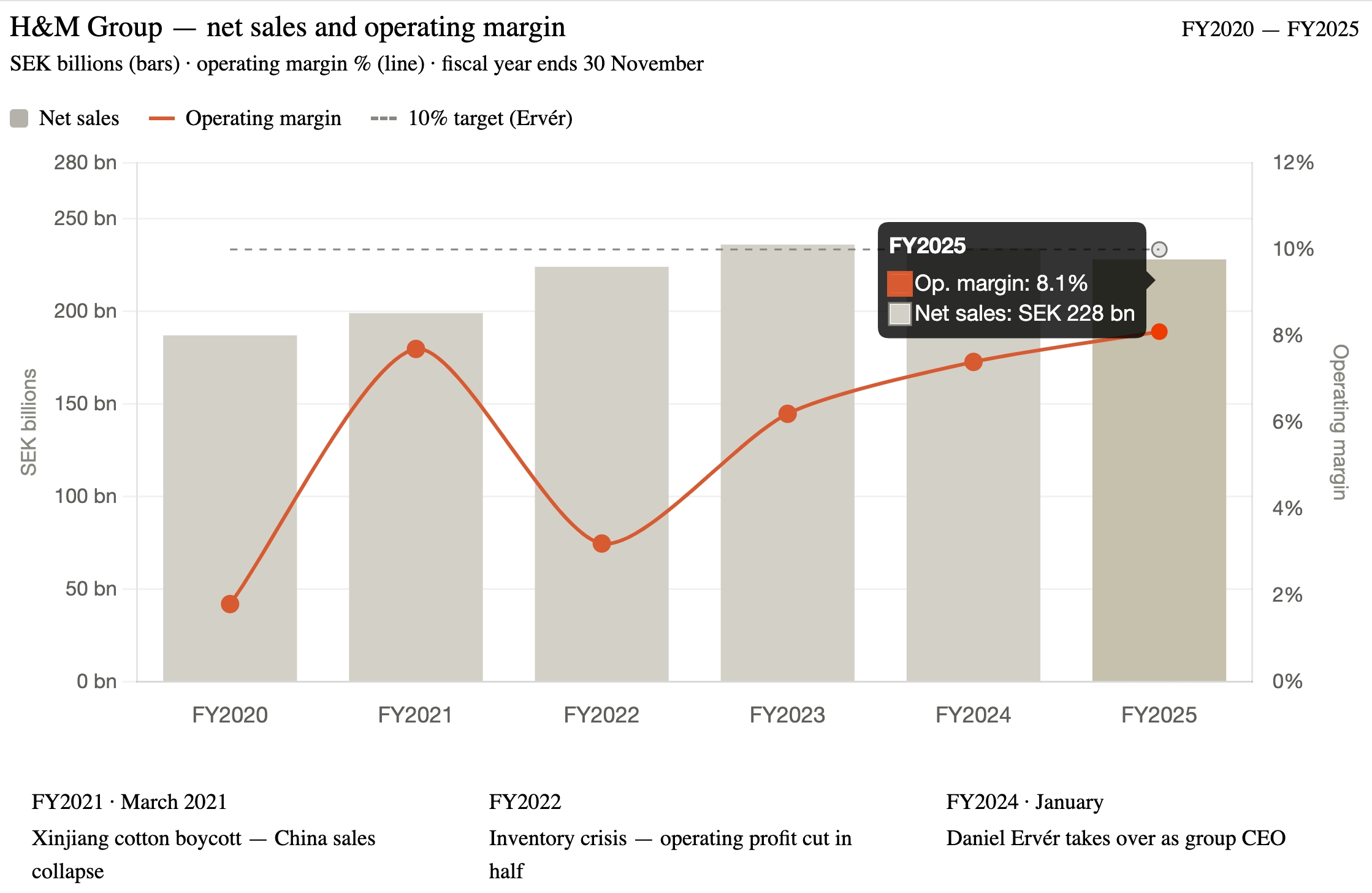
Sales and profit performance of H&M Group from fiscal year 2020 to 2025. Source: H&M financial report
"The improvement in profit margins during Ervér's tenure is impressive, but I still don't see growth," Lars Soderfjell, the head of Nordic equities at Finland's Alandsbanken, told Bloomberg. "The real question is whether H&M is still attractive to its core customer group - women aged 15 to 30?"
The Chinese mainland market can also be described as weak.
The number of H&M stores on the Chinese mainland has shrunk from more than 500 at its peak in 2019 to about 300. To seek growth, the brand entered Pinduoduo in October 2024, becoming the first international fashion brand to land on the platform, and opened a flagship store on Douyin in November of the same year. However, 36Kr has learned that the performance of the Douyin channel has been mediocre, while Pinduoduo has performed "slightly better" due to the large - scale platform subsidies.
Among the sub - brand camps, COS and ARKET have performed well, while & Other Stories has been under continuous pressure: the brand entered the mainland market in 2019 and opened a Tmall flagship store. In September 2021, it opened its first offline store in Shanghai's iapm. After closing its store in Sanlitun Taikoo Li, Beijing in April 2025, 36Kr has learned that & Other Stories' offline business on the Chinese mainland has been completely shut down.
There is another speculation in the capital market: the company does not seem to be in a hurry to boost the stock price so that the founding family can complete the privatization at a low price. Bloomberg has reported several times that the Persson family has been continuously increasing its stake. According to the Bloomberg Billionaires Index, this family with a net worth of about $23.4 billion currently holds more than 86% of the company's voting rights, and speculation about H&M's ultimate delisting has intensified. Since its market value peak in 2015, H&M's market value has evaporated by about half; globally, the number of H&M brand stores has decreased by 832 compared to the peak in 2019.
For this once - leading Swedish company in terms of market value, the continental - level structure, market demotion, and round after round of layoffs are all footnotes to the same proposition: profit margins can be repaired through contraction, but a viable path to growth has not been found yet.