On the night when SpaceX hit a $2 trillion market cap, we look back at the highs and lows of China's commercial space industry over the past decade
On the evening of June 12th, SpaceX completed its IPO at the highest valuation in history. The stock price soared to $176, and as of now, its market value has exceeded $2 trillion. Elon Musk has become the first billionaire in history with a net worth of over $1 trillion.
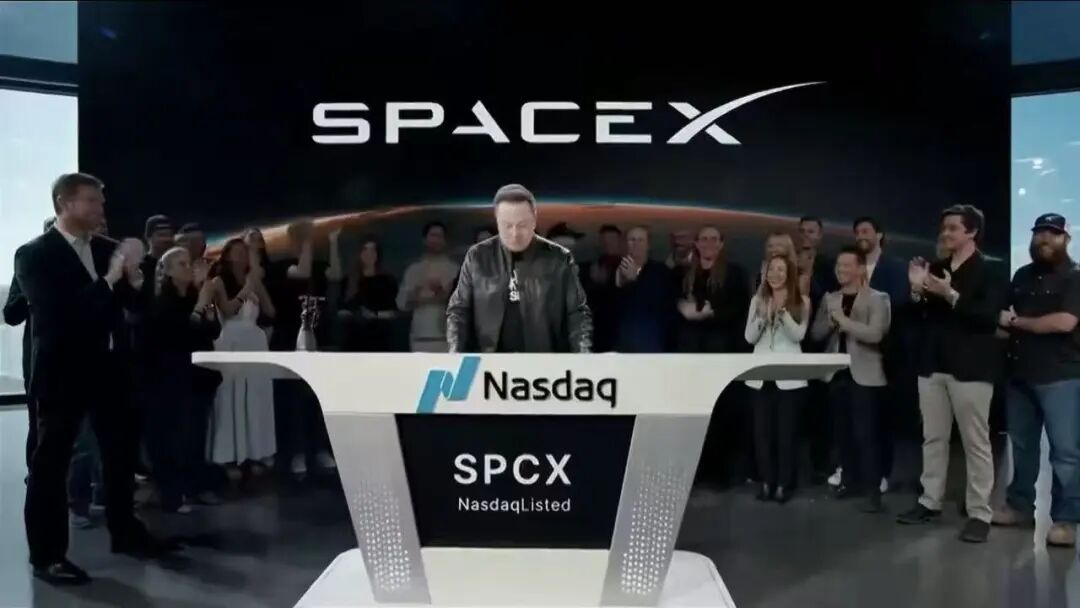
Elon Musk rings the bell at the "Starbase" in Texas.
Actually, long before SpaceX rang the bell, the enthusiasm in the industry across the ocean had already reached a boiling point.
In the past six months, commercial space has become one of the hottest sectors in China's primary market. Investors are lining up to meet with founders, and local governments are competing to attract projects. Some funds that rarely paid attention to the space industry in the past have also started to study rockets, satellites, and constellations. "There are hundreds of institutions vying for the top - tier projects in the market right now, and it's impossible to even get a chance to talk to them," an investor who has been following the commercial space industry for a long time told Yingke.
The speed and scale of capital inflows are breaking records. The financing amounts of leading companies often exceed 2 billion yuan. The largest single financing was the D++ round of iSpace in February 2026, with an amount exceeding 5 billion yuan.
This enthusiasm is not baseless. From the policy breakthrough in 2014 to the opening of the IPO gate in 2025, China's commercial space industry has just completed a ten - year cycle.
Over the past decade, disappointment and a cold market have been the norm, and occasional recoveries have been fleeting. Rockets are too expensive, the development cycle is too long, and a commercial closed - loop has been slow to emerge. The money invested shows no results in the short term, and "the primary market is running out of steam."
However, in 2026, the market sentiment has completely reversed. SpaceX's IPO has proven the value of this sector. With the opening of the listing channel in China, there is a clear path to realize the vision. "We're very excited. Only when there is an exit channel will we have more motivation to continue investing. Only with listed companies can the entire industry be driven forward," an investor said.
Moreover, they are confident that even if Chinese companies can't reach the level of SpaceX, they can still achieve considerable returns.
They are not blindly optimistic. Over the past decade, we have seen Chinese commercial space companies evolve from struggling to assemble engines to successfully launching rockets. There may not be an Elon Musk among them, but with the support of a large - scale manufacturing industry and policy support, the efforts to pave the way have never stopped.
Perhaps Chinese companies can really find a different path from SpaceX. "The United States has Tesla, while China has BYD, Geely, Great Wall, Chery, NIO, Li Auto, and XPeng. The United States has SpaceX, and there may not be just one winner in China's commercial space industry," an investor said.

From PPT to Rocket Launch
Similar to SpaceX, China's commercial space industry has gradually moved from a system - monopolized model to a market - oriented one.
Those who have been following the commercial space industry for a long time still remember the shock that SpaceX brought to the industry around 2015. The recovery barges in the Atlantic Ocean waited for the rockets to return time and time again. The rockets crashed into the sea, exploded, and disintegrated, but they also took off again and again. Each failure was accumulating data for reusable rockets.
"At that time, people realized that it no longer made sense to view the space industry as something lofty. They were almost making it happen with an industrial logic," a commercial space industry veteran recalled.
The so - called re - doing the space industry with industrial logic centers around cost and efficiency. Traditional space projects are national undertakings that emphasize extreme reliability, using the highest - level aerospace - grade components and pursuing success rates regardless of cost. In contrast, commercial space uses a large number of proven industrial - grade products, reducing costs by shortening the R & D cycle and optimizing the supply chain. This path has been verified by SpaceX and has gradually become an industry consensus in the low - Earth orbit application environment.
China's turning point came in 2014. The State Council issued the "Guiding Opinions on Innovating the Investment and Financing Mechanisms in Key Areas to Encourage Social Investment," clearly encouraging social capital to enter the space field for the first time. Subsequently, a group of technical personnel from the China National Space Administration, China Aerospace Science and Industry Corporation, and the Chinese Academy of Sciences left the system and founded the first batch of Chinese commercial space enterprises.
"At the beginning, there was really nothing. It was just a group of people drawing PPTs," the above - mentioned person recalled to Yingke. At that time, China's commercial space was more of a concept, and most of the funds willing to bet on it came from institutions with strategic layout attributes, such as the Chinese Academy of Sciences and local industrial funds.
On December 21, 2015, the first - stage rocket of the Falcon 9 was successfully recovered at the Cape Canaveral Landing Zone. For the first time in human history, a vertical recovery of an orbital - class rocket was achieved, and reusable rockets went from theory to reality. In the following years, SpaceX iterated rapidly, and Starlink began large - scale networking, presenting a brand - new industrial model to the world. Market - oriented funds started to discuss a question: Can China have its own SpaceX?
But at that time, this goal seemed out of reach. "We were very surprised when we first conducted due diligence," an investor from a market - oriented fund recalled. "Everyone said it was private commercial space, but many core components still had to be imported, and startups couldn't even get supplies from in - system units."
For a long time, there was no real private space supply chain in China. Key links such as engines, servo mechanisms, special materials, and electronic systems were mostly in the hands of in - system units. The limited production capacity was prioritized for national tasks, making it difficult for private enterprises to obtain supplies.
"Around 2016, we could only build solid - fuel rockets, which were essentially transforming mature missile technology into launch vehicles. But many key components were also unavailable, and we couldn't assemble a complete rocket. Even if we could buy them, they were very expensive,"
This means that the capital invested couldn't immediately turn into products. The entire industry had to build infrastructure from scratch.
Around 2017, the situation in the industry began to loosen. Some aerospace and military - industrial groups started to open up some resources to private enterprises. The components available for purchase were mainly for sounding rockets, but commercial space enterprises at least had the opportunity to move from verification to practice.
Therefore, 2018 became the first year of China's private commercial rockets. In this year, three private enterprises, iSpace, OneSpace, and LandSpace, completed four sub - orbital rocket launches and one maiden flight test of a launch vehicle.
However, this kind of attempt couldn't be transformed into continuous and standardized production. It was still the national team that finally pressed the accelerator button for the industry. In 2023, China Satellite Network Group launched large - scale tenders for the entire industrial chain, connecting the entire supply chain and providing an entry opportunity for private space enterprises.
For the commercial space industry, which has long lacked demand - driven development, this was a landmark event. "After the China Satellite Network Group and Yuanxin came into being, the planned scale of the two constellations is close to 30,000 satellites, which has truly driven changes in the primary market and the industrial chain," an investor who has been following the industry for a long time said.
At the same time, independent engine suppliers, servo mechanism suppliers, and suppliers of core components such as fuel tanks for rockets also emerged one after another, and the cost of key rocket systems continued to decline. Chen Shuguang, the founder of Dahang Yueqian, recalled that "in 2023, when researching the industry, more than 90% of the components and more than 90% of the value of the entire rocket could already be completed within the private system."
The core of commercial space is to let the market handle market - related matters. "In the long run, there will definitely be tens of thousands of satellites in the sky. If we continue to use a semi - commercial logic like in the past decade, the cost will never come down," a satellite industry practitioner said. "In the next decade, the further industrialization of the supply chain is an inevitable trend."
From within the system to outside the system, commercial space is no longer just a story on a PPT but has become the roar on the launch pad.
The next question is: How can we make money?

How far is commercial space from making money?
Chinese commercial space companies can build rockets with market forces, but they still can't achieve self - sufficiency.
There is a closely - linked logical chain in space commercialization: Reusable rockets reduce launch costs, lower launch costs promote satellite profitability, and only after satellites are profitable can they continue to form constellations and continuously purchase launch services, ultimately forming a closed - loop. This is the current operating logic of SpaceX.
The first step in the closed - loop is rocket reusability.
Reusability requires the first - stage rocket to precisely control its attitude, ensure stability, and land at a precise location when returning to the atmosphere, which places higher requirements on the overall stability and control ability of the rocket.
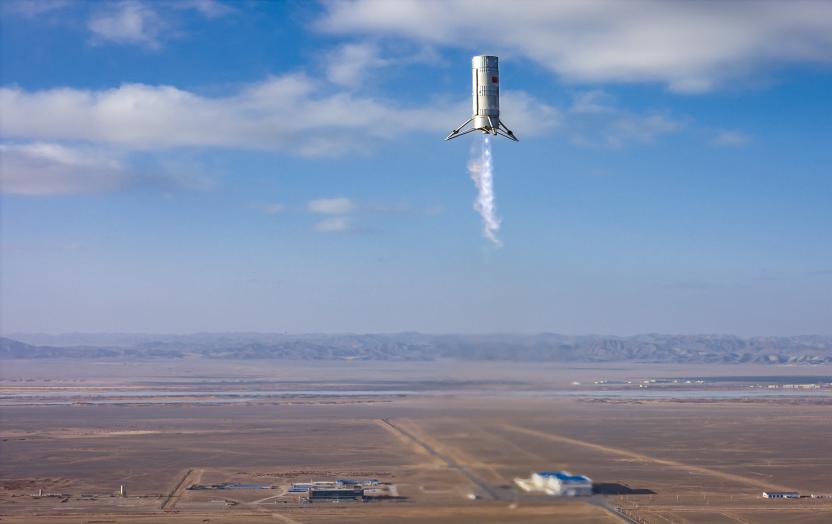
The first - stage rocket (Source: LandSpace official website)
Specifically at the engine level, solid - fuel engines are naturally single - use, while liquid - fuel engines can support greater payload capacity and are the basis for reusability.
Modern launch vehicles often use a parallel engine layout, where multiple engines work together. Fewer parallel engines can reduce system complexity, improve overall reliability, and reduce comprehensive costs. To achieve fewer parallel engines, the thrust of a single engine must be increased.
Currently, the thrust of relatively mature single - liquid engines in China is in the 80 - ton and 120 - ton classes. In comparison, the single - engine thrust of SpaceX's Falcon series, which has achieved successful recovery, exceeds 200 tons.
What seems to be just a numerical gap actually represents completely different engineering difficulties. After the thrust is increased, the temperature, pressure, and gas flow velocity in the combustion chamber will approach the limit. The combustion chamber, nozzle, and turbopump are exposed to high temperature and pressure for a long time, making them prone to ablation, deformation, and fatigue, and the requirements for materials, processes, and cooling design increase exponentially.
"Now, many companies can draw the blueprints for a 200 - ton - class engine. But after the flow rate is increased, the entire system needs to be re - engineered, and the engine, pipelines, control, and structure all need to be re - coordinated. This is essentially a super - project," a rocket engine practitioner told Yingke.
Without reusability, launch costs cannot be controlled. "The reason why people criticize the commercial space industry for not making money is simple: it costs too much. The most expensive part is the launch," a former commercial satellite company employee said.
Today, the launch cost of the Falcon 9 has dropped to several thousand dollars per kilogram. According to Elon Musk's vision, if the Starship achieves full reusability, there is a chance to enter an era of several hundred dollars per kilogram in the future. In contrast, although there are differences among different rocket models in China, the average launch cost is generally between 60,000 and 70,000 yuan per kilogram.
Many commercial satellite companies have planned a large number of satellites but can't afford the rockets. "Everyone is struggling to launch satellites into space, knowing that to some extent, they are working for the rocket companies," the above - mentioned person said. The industry generally believes that if the reusability technology can reduce the cost to less than 30,000 yuan per kilogram, the demand for satellite launches will be significantly released.
However, the release of satellite demand does not necessarily mean a commercial closed - loop.
What makes SpaceX special is that it has a rocket launch, satellite manufacturing, and Starlink operation system all in one, forming a complete closed - loop through vertical integration.
China's commercial space path is more like an industrial cluster: rocket companies, satellite companies, operators, material and component enterprises grow independently and then build an ecosystem through collaboration. This model can leverage the advantages of China's manufacturing system, but it also means a longer chain, more participants, and a more difficult - to - form closed - loop.
Even if reusability matures and launch costs decrease in the future, the industrial chain still has to cross the next threshold: how to make money from satellites. Lowering the launch cost only reduces the entry ticket price for orbiting and does not directly generate revenue.

Conceptual diagram of satellite Internet (Source: Visual China)
Starlink has users from more than 160 countries and regions around the world, with an annual revenue of $11.4 billion. So, who will Chinese satellites serve, and who will pay for them?
If only targeting the domestic market, China's terrestrial communication network is already highly developed, and the demand for direct satellite connection is not that urgent, making it difficult to support the entire industrial chain in the long run.
Therefore, many industry insiders believe that China's commercial space industry must ultimately enter the global market and compete with SpaceX for a share of the pie.
"For island countries like Indonesia, building a terrestrial communication network is very costly, and the advantages of satellite Internet are very obvious. If China's constellations want to achieve commercialization in the future, they will ultimately have to go global. And at that time, the direct competitor will be Starlink," a satellite industry practitioner said.
However, it's still too early to talk about global competition. For China's commercial space industry, the prerequisite of low - cost launch has not been achieved. This industry still requires a large amount of capital, time