Public offering quantitative strategies are not a low-cost substitute for private equity strategies
During the past six months when private quantitative funds were worried about the decline of excess returns, public quantitative funds, which were often regarded as useless, have become extremely popular with supply falling short of demand.
In mid-May, with an interval of less than a week, Huaxia and Tianhong each sold over 10 billion yuan of their newly issued quantitative products, triggering rationing. Some popular ongoing public quantitative funds began to limit purchases and turn away customers. Starting with E Fund's Ke Xin limiting purchases to 50 yuan, Guojin, Bodao, China Merchants, Penghua, and Changxin have successively limited the purchases of their quantitative products, with the limit ranging from 500 yuan to 500,000 yuan.
The co - existence of purchase limits and rationing is a rare sight in the more than a decade of development of domestic public quantitative funds.
On the other hand, private quantitative funds, which have been booming for two or three years, have started to be criticized by customers for their poor excess returns.
Especially in the second quarter when the market was concentrated in the "light" sector, any diversified stock - holding strategy was ineffective, and any high - low switching was wrong. In a bull market with a narrow structure, even though trading volume and volatility still created a favorable trading environment for quantitative trading, private quantitative funds were like punching at cotton. Individual stocks did not rise while the index did, so the excess returns were naturally not very optimistic.
As the situation changes, public quantitative funds seem to be changing from long - term followers to successors, which the industry is not quite used to.
How did public quantitative funds find their ecological niche?
No Longer Restricted
The rise of private quantitative funds in the past few years and the emergence of many billion - level institutions have brought different development ideas to public funds. At least compared with the "BGI Trio Era" in the past, the development direction of public quantitative funds has shifted from limiting tracking errors to pursuing excess returns.
Around 2010, Li Xiaowei, Li Haiwei, and Tian Hanqing successively left Barclays Global Investors (BGI), a Wall Street index investment giant, and returned to China. They joined three public funds, Fullgoal, Invesco Great Wall, and Huatai - Peregrine, respectively, and established quantitative teams led by themselves, becoming the core force leading the start of public quantitative funds.
Perhaps because they saw the end - game of index investment in public funds in the United States early on, they almost all followed the same product layout path - starting with the most mainstream CSI 300 Enhanced, then gradually moving towards small - and medium - cap indexes such as CSI 500 and CSI 1000, and later extending to sector indexes such as the ChiNext and STAR Markets.
Meanwhile, many restrictions on public quantitative funds in aspects such as high - frequency trading of constituent stock proportions have also become shackles that public quantitative funds can never get rid of.
Therefore, whether from the perspective of product concept or practical conditions, reducing the tracking error of the index has become the main development direction of early public quantitative funds.
However, the A - share market is obviously an emerging market where the end - game is not yet in sight. Tracking error is obviously less in line with investors' needs than excess returns.
Quantitative private funds with more flexible thinking and trading - oriented frameworks mostly follow the narrative of alpha used by Wall Street hedge funds. The most obvious difference is that most of the main products of private funds are small - cap index enhancement products with more noise and a higher proportion of retail investors. Even when the small - cap index becomes crowded, they start to move towards full - market stock - selection quantitative products without deliberately limiting a specific index as the benchmark.
In 2024, a public quantitative product without "Index Enhancement" in its name, China Merchants Quantitative Selection managed by Wang Ping, appeared on the top - ten list of public quantitative funds.
From today's perspective, Wang Ping's rise is an important signal that public quantitative funds are exploring new paths. By 2025, half of the products on the top - ten list were no longer index - enhancement products. Guojin Quantitative Multi - Factor managed by Ma Fang jumped directly to the second place, China Merchants Quantitative Selection rushed to the third place, and Bodao Growth Zhihang managed by Yang Meng also rose to the eighth place.
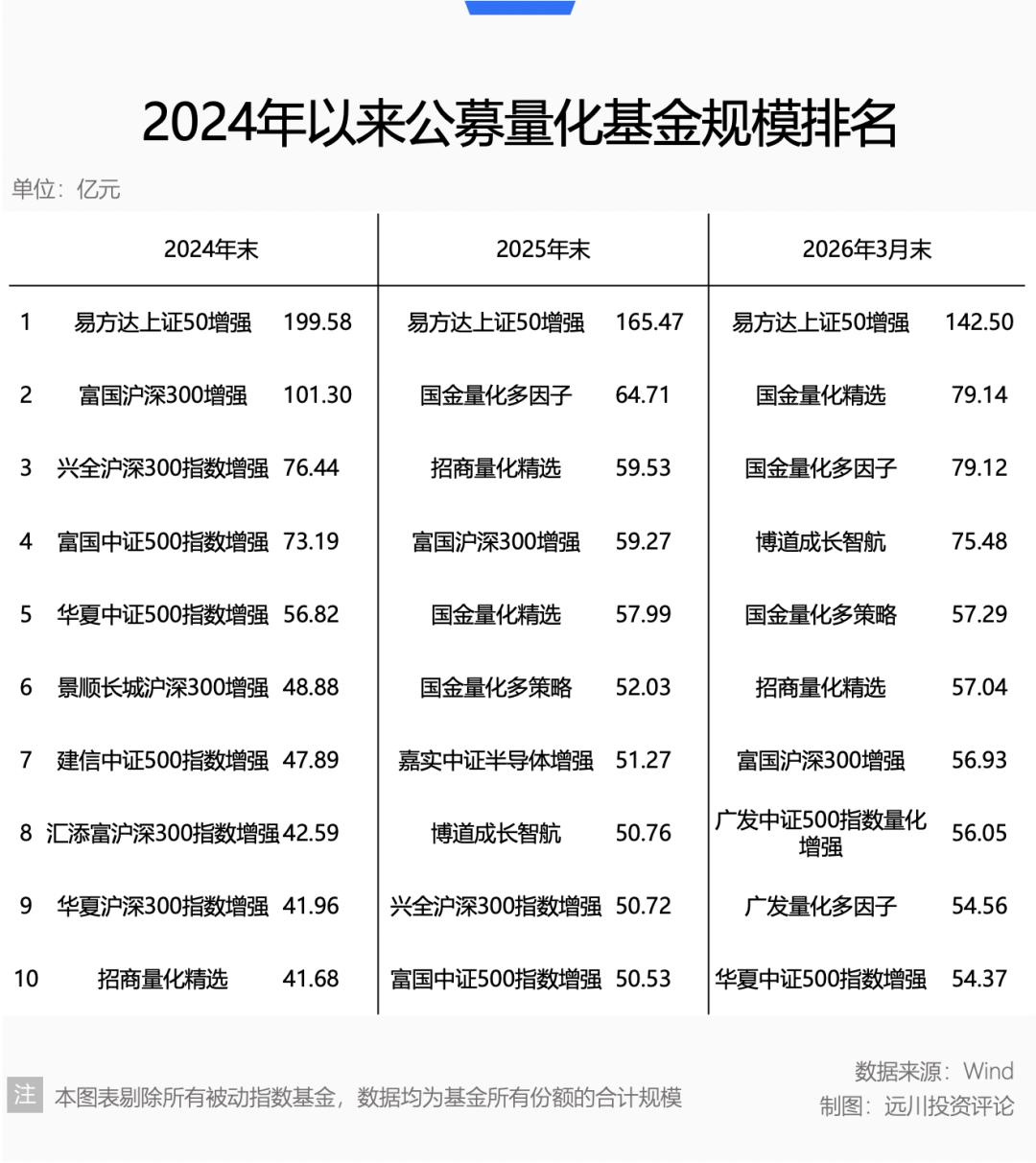
Since then, these more flexible public quantitative products that focus on "excess returns" have gradually replaced the share of traditional index - enhancement funds.
Ma Fang of Guojin divides the quantitative stock - selection model into four sectors: multi - factor stock selection, statistical arbitrage, event - driven arbitrage, and portfolio optimization. Multiple strategies run the model together without fixed factor exposure [11][12].
Yang Meng of Bodao has never limited her investment and research vision to the restrictions of public funds. Instead, she closely tracks the development trend of the entire quantitative industry. In the third quarter of 2023, she put her self - developed AI price - volume factor model into the operating products and operated it with the traditional multi - factor model at a 1:1 weight [13].
However, as the proportion of quantitative investment in the Chinese capital market increases, it has become a consensus among practitioners after the liquidity crisis caused by the collapse of small - cap stocks in early 2024 that it is getting more and more difficult to obtain excess returns through pure quantitative investment. Both private and public funds are looking for some differentiated ways out.
Although public funds have various trading restrictions and are not as flexible as private funds, compared with private funds that originated from the "price - volume culture", public quantitative funds that no longer set self - limits can also draw inspiration from their richer active equity culture for development.
The Boundary of Active Management
Seven years ago, the financial engineering team of the former Guotai Junan Research Institute used the metaphor of a jigsaw puzzle to help people better understand active quantitative investment [10].
Generally speaking, it is to first encapsulate the quantifiable parts of investment into fragments like mosaics to build a "map", and then leave the more refined judgments in investment to fund managers. They can judge the characteristics of stocks to pursue and avoid based on this map, better identify investment opportunities, and finally make the stock portfolio achieve a result of 1 + 1 > 2.
More simply put, whether and to what extent fund managers intervene has become the key to distinguishing active quantitative investment.
Based on this, the author classifies the current public active quantitative products according to the degree of human intervention.
The first type is to divide the style at the top - level design of the product, but after the product starts to operate, the actual investment is carried out in a quantitative way without human intervention, that is, the product idea of smartbeta.
For example, Zhang Xueming of China Europe divides the four mainstream style factors - prosperity, dividend, value, and quality - as the fixed factor exposures of four products respectively to determine the style background of the products and create his own product matrix. In his strategy, as long as the stocks meet the screening criteria of the fixed factors, stocks from any sector may be included in the portfolio by the model.
For example, in China Europe Prosperity Selection managed by him, the core of the high - prosperity factor screening is "high growth + anti - crowding".
In the fourth quarter of last year, the model considered that the overseas computing power sector was highly crowded and the performance expectations were already too high, so it took profits. Secondly, the model believed that new prosperity drivers had emerged in sectors such as innovative drugs, chemicals, and small metals, and the current prices did not fully reflect these factors. The model thought that the future stock price performance of these sectors would be better, so it replaced the positions concentrated in AI and energy storage [6].
The second type is to make some timing judgments during the actual operation process, including judgments for sudden extreme situations, and timely judgments combined with investment environment noise and current returns.
For example, Wang Ping of China Merchants Fund revealed two obvious intervention measures in an external interview.
In 2018, he believed that the market style would still favor large - cap stocks in the next few years, so he chose to continue to increase positions in the liquor and medical sectors. At the end of 2020, although the factor analysis of the model at that time judged that growth factors were dominant, he believed that "the valuations of some growth stocks were too high and they were subject to the upward pressure of inflation and faced the risk of correction". Therefore, he shifted part of the portfolio to industries such as chemicals, electronics, and machinery to preserve the returns [3].
When active intervention takes one more step, it reaches the third form, where the subjective equity team directly participates in quantitative investment. The most typical example is E Fund's Ke Xin managed by Bao Zhengyu.
The emergence of E Fund's Ke Xin has an important premise - six years ago, when other funds were still competing in index enhancement or pure quantitative investment was just starting, E Fund adjusted its quantitative investment department from the index investment research section to the active equity investment research system.
After Bao Zhengyu joined E Fund in 2022, she first took over a subjective fund focusing on value investment and then issued a subjective fund focusing on dividend investment. It was not until the end of 2024 that she began to manage the first fund that combines subjective and quantitative investment, E Fund's Ke Xin.
From the very beginning of its design, E Fund's Ke Xin was clearly defined as "fundamental research + quantitative stock selection". It first screens stocks around four dimensions: growth ability, profit quality, operational efficiency, and financial structure, and then uses a quantitative model to include market attention, volatility, historical returns, and sentiment indicators into the scoring indicators to dynamically rank and optimize the weights of the candidate stock pool [7].
In the actual operation stage, Bao Zhengyu's combination of subjective and quantitative operations is very obvious.
Specifically, in the first half of 2025, E Fund's Ke Xin maintained a moderate style exposure. In the third quarter, it rhythmically increased the exposure related to growth, while reducing the weights of some factors with value - oriented and high - dividend characteristics, and moderately enlarged the composite exposure of "growth - profit improvement - momentum". In the fourth quarter, it further allowed more active deviations in style and industry [4].
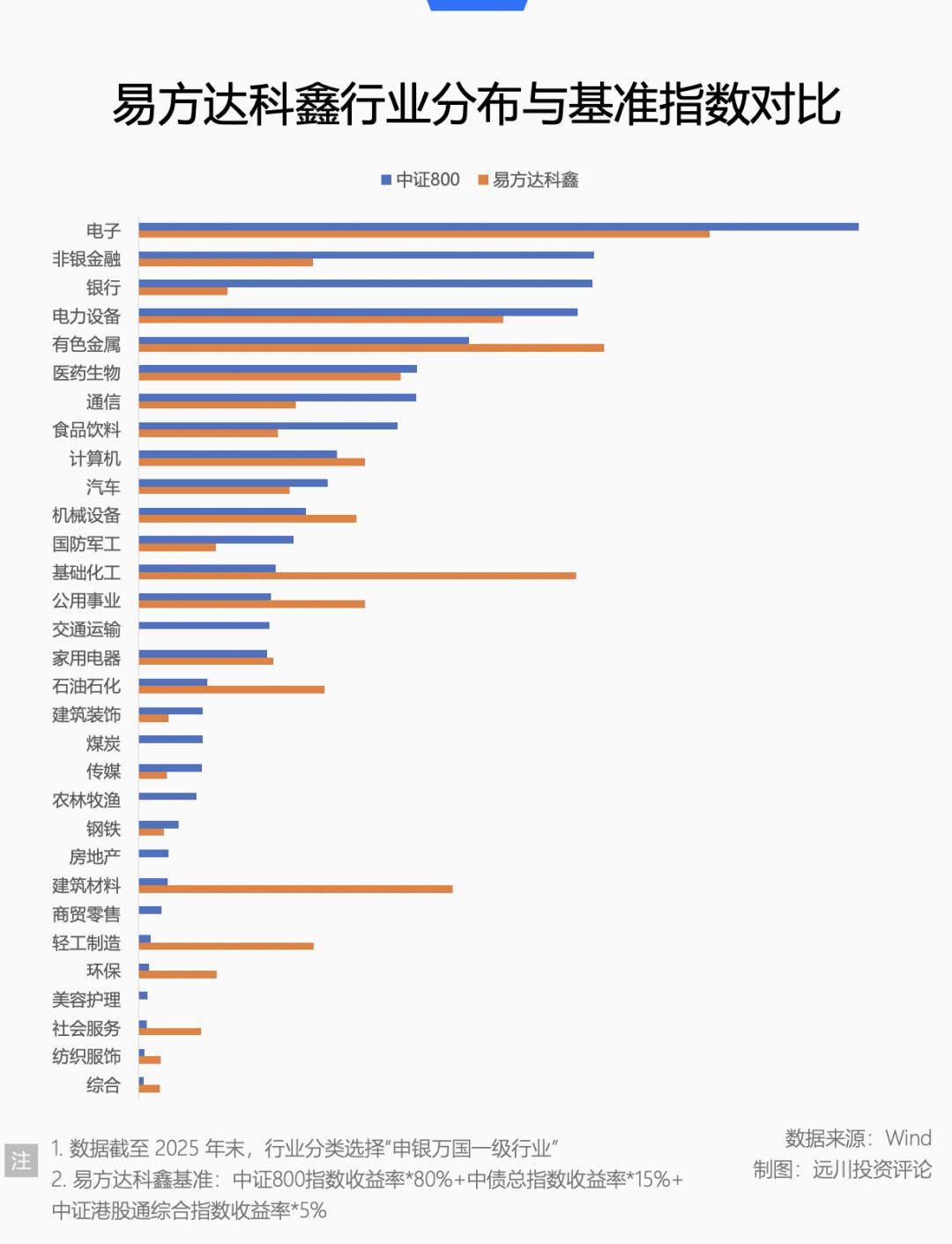
The fourth form has a more subtle boundary.
According to Wind's classification and statistics of public active quantitative funds, as of the first quarter of this year, the top ten heavy - holding stocks of more than 17 public active quantitative funds accounted for more than 60% of the fund's assets, with a concentration comparable to that of many subjective equity funds.
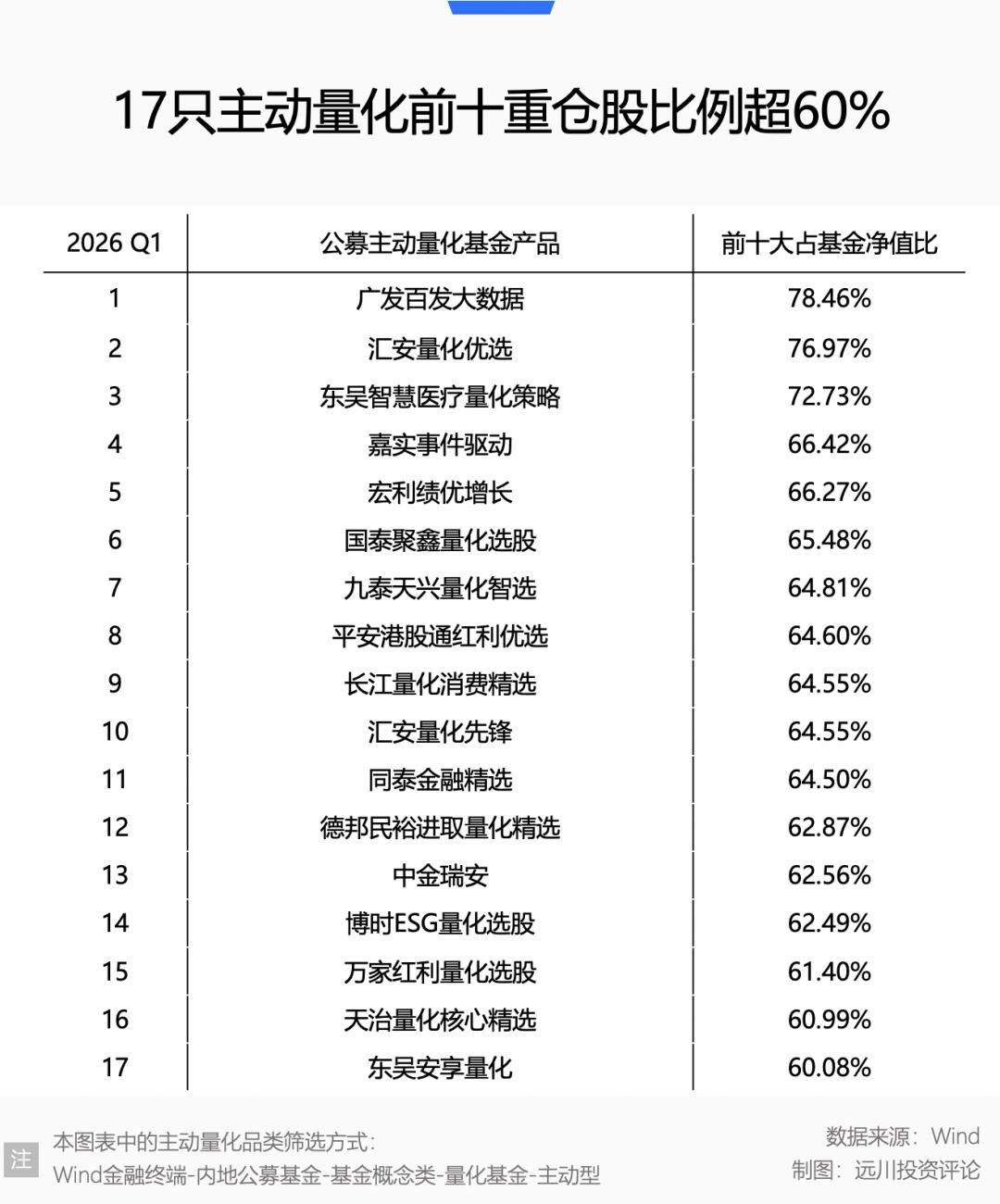
So, where exactly is the boundary of active management in active quantitative funds? How to retain the original positioning of quantitative products?
A channel person told the author that in his opinion, the simplest and crudest way is to look at the proportion of stock holdings. In most cases, the position of a single stock in a real quantitative fund will not exceed 5%.
Epilogue
Whether from the perspective of trading speed and strategy iteration efficiency or from the perspective of business models such as salary and employee benefits, public quantitative funds still seem unable to be on an equal footing with private quantitative funds. After all, even a public fund with a management scale of trillions will not book two weeks at the Shangri - La in Qiantan as a transition for a new employee who has not found a house yet.
Expecting to get a "substitute experience" of private quantitative funds with a lower management fee is, to a large extent, an unreasonable expectation for public quantitative funds.
However, public funds also have their own advantages over private funds born from pure quantitative investment. Especially large - scale public fund platforms with rich asset categories and complete investment and research systems, under the premise that the penetration of AI technology can more quickly popularize and spread some quantitative practices, the accumulation of the large investment and research teams in micro - stocks, meso - industries, and macro - economy over the past few decades should give rise to some more characteristic combinations of "active management" and "quantitative investment".
Meanwhile, public quantitative funds are also answering another more grand question - if a person does not have the wealth and resources of high - net - worth individuals, nor the information and services of channel institutions, can they still obtain high - quality quantitative investment strategies?
From this perspective, public quantitative funds have their unique significance and survival environment, which is also a great comfort to the investment and research personnel who still stick to this field at this moment.
References
[1] It's getting hard to make money in private quantitative funds, Jiemian News
[2] Fullgoal's quantitative funds are emerging, Li Xiaowei: The secret of stable excess returns, Daily Economic News
[3] More than 60% of monthly profits, what makes these quantitative funds win more often and lose less, Smart Investors
[4] E Fund's Ke Xin's third - quarter report in 2025 and annual report in 2025
[5] Public quantitative funds: Review of 2025 strategies and outlook for 2026 strategies, Shenwan Hongyuan Research Institute
[6] China Europe Prosperity Selection's fourth - quarter report in 2025
[7] E Fund's Ke Xin's fund contract
[8] E Fund's Ke Zhi's annual report in 2025 and first - quarter report in 2026
[9] 2024 annual stock quantitative strategy - Private fund investment strategy, Guojin Securities research report
[10] Why is "active quantitative investment" a revolution in the field of quantitative investment? Current Guotai Haitong Securities Research official account
[11] Guojin Quantitative Multi - Factor's fund contract
[12] A new benchmark for public quantitative funds, with a return of 174% in more than five years, Ma Fang of Guojin can catch the strongest market trends in each round, Liuli Investment Report
[13] Bodao Yuanhang's third - quarter report in 2023
This article is from the WeChat official account "Yuanchuan Investment Review" (ID: caituandzd), author: Lan Liqi, published by 36Kr with authorization.