The leading player in the flying car sector is facing sluggish sales.
"The first stock in the flying car industry," EHang Smart, has hit the brakes on both its performance and sales.
The latest financial report released by EHang Smart shows that in the first quarter of this year, the company's net loss reached 126.4 million yuan, a year-on-year increase of 61.2%. What's more eye-catching than the loss is the sales volume. In the first three months of this year, EHang only sold 4 units of the EH216 series eVTOL, a year-on-year decline of nearly 63.6%.
This exposes a cruel reality: after obtaining the world's first eVTOL type certificate, the commercial explosion that EHang had anticipated did not arrive as scheduled.
Currently, EHang's most important customers are still local state-owned asset platforms. According to Caixin's statistics, since obtaining the certificate in October 2023, the cumulative delivery of EH216 - S has exceeded 400 units, and most of the customers are local state-owned enterprises.
State-owned orders can support the early market of the industry, but it's difficult to solve two problems: whether the demand is sustainable and when the funds will be recovered.
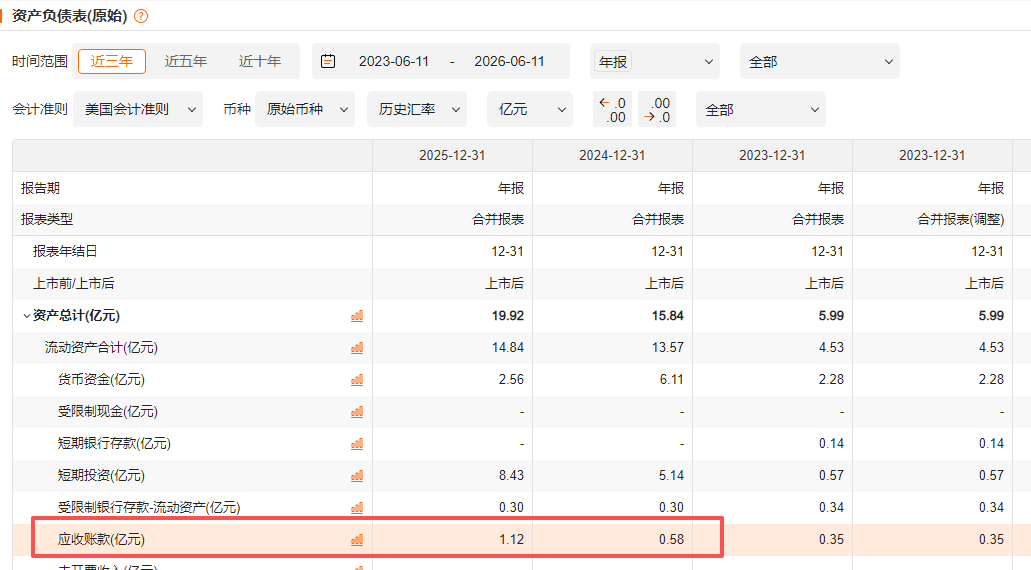
From 2024 to 2025, EHang's accounts receivable increased from 58 million yuan to 112 million yuan, almost doubling. This happened against the backdrop of a decline in revenue. During the same period, EHang's revenue dropped from 456 million yuan to 418 million yuan.
What's more troublesome is that before EHang could wait for the industry to explode, powerful players have already entered the market.
GAOYU, incubated by GAC, and Huitian, supported by XPeng, represent the forces of state-owned automobile enterprises and technology giants respectively entering the track. As the advantages of resources, funds, and technology are continuously released, EHang's first - mover advantage is being continuously diluted.
The capital market has obviously noticed this change. Since the beginning of this year, EHang's stock price has nearly halved. Compared with the high in 2021, EHang's stock price has fallen by about 95%, and its market value has roughly evaporated by 44 billion yuan.
For EHang, obtaining the certificate is just the beginning, and the real difficult challenges are just around the corner.
More certificates, worse stock price
The story of EHang Smart starts with a "tech geek"'s flying dream.
Founder Hu Huazhi graduated from the Department of Computer Science at Tsinghua University and participated in the development of early GIS geographic information system software in China. However, compared with codes and systems, flying is obviously what he truly loves.
According to public information, Hu Huazhi started to contact professional model airplanes in his teens and later obtained an airplane driver's license. He once joked that as soon as his monthly salary was paid, it was basically spent the next day, and most of it was invested in his flying hobby.
In 2005, Hu Huazhi started his business, initially engaged in the business of large - scale command and control systems. What really inspired his idea of starting a business in manned aircraft was a flying accident that happened to his relatives and friends.
After the accident, he began to think repeatedly about a question: what kind of aircraft is safe enough? How to ensure the aircraft can return smoothly in extreme situations?
In 2014, Hu Huazhi officially decided to develop manned aircraft. In 2016, EHang launched its first eVTOL product, the EHang 184. The EH216 - S, which later became the core product, was developed through continuous iteration on the basis of this technical route.
In 2019, EHang, which had been established for only five years, listed on the NASDAQ and became "the first stock in the unmanned aviation industry." Before going public, the company had received multiple rounds of financing support from ZhenFund, GGV Capital, Galileo Capital, Lever VC, etc.
However, the halo of "the first stock" did not change the reality of long - term losses. From 2017 to 2023, the company's cumulative loss reached 1.246 billion yuan.
The real turning point came in 2023.
After a three - year certification process, the EH216 - S obtained the world's first eVTOL type certificate issued by the Civil Aviation Administration of China. For the entire industry, this is a milestone event, which also means that flying cars have officially obtained the qualification for commercialization.
According to the initial imagination of the market, after obtaining the certificate, EHang should have had a revaluation of its value. But the reality is just the opposite.
In February 2021, EHang's stock price once reached as high as $129.8. But by the end of February 2025, EHang's stock price had dropped to $22.96. By June 11, 2026, the stock price was only $6.82. This means that compared with the high point in 2021, EHang's stock price has fallen by about 95%. Even compared with the end of February 2025, it has fallen by about 70% in more than a year.
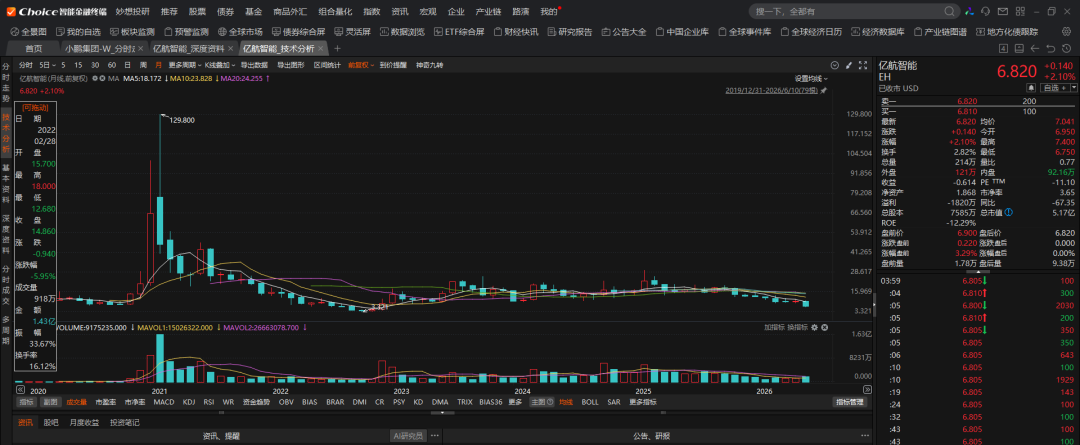
The change in market value is more intuitive. At the peak in 2021, EHang's market value once reached as high as $6.802 billion. Now it has dropped to only about $512 million. Simply calculated at an exchange rate of 1 US dollar to 7 yuan, it means that the market value has evaporated by about 44 billion yuan compared with the high point.
This contrast is not normal. You know, in 2019 and 2020, EHang's revenues were only 122 million yuan and 180 million yuan respectively. At that time, the company had not obtained the most crucial certification, and the commercialization was far from clear as it is now. But the capital market was still willing to give it a valuation of tens of billions of yuan.
But today, EHang's revenue has more than doubled, exceeding 400 million yuan. The certification is more complete than before. There are also more business scenarios than before. As a result, the stock price not only failed to return to the high point but also dropped significantly below the position more than a year ago.
What this reflects behind is EHang's most embarrassing reality: With more and more certificates and more and more business, the capital market is no longer willing to pay for its story.
Dependence on local state - owned assets
The reason why EHang has been unable to get a revaluation from the capital market is essentially a problem of commercialization. In the simplest terms, it's "Would you dare to take a flying car?"
In 2024 and 2025, EHang lost 230 million yuan and 276 million yuan respectively. In the first quarter of 2026, the situation did not improve. The company's net loss was 126.4 million yuan, a year - on - year increase of 61.2%.
What's more eye - catching is the sales volume. In the first three months of this year, EHang only sold 4 units of the EH216 series eVTOL, a year - on - year decline of nearly 63.6%.
Where is the problem? From the regulatory level, EHang is at the forefront of the industry. But from the perspective of consumers, flying cars are still a new and high - risk thing.
eVTOL is not an ordinary consumer product. It relies on the coordinated operation of complex flight control systems, power systems, and electronic systems. Any failure in key links may bring serious consequences.
And safety and reliability cannot be established overnight by just a few certificates. It needs to be built up bit by bit through long - term flight data, real operation scenarios, and technical verification.
This kind of safety concern is probably difficult to be dispelled in the short term. A very representative detail is that in February 2026, an EHang EH216 - S was put up for auction on the Ali Auction platform with a starting price of 1.2 million yuan, only about half of the official guide price, but it was eventually unsold. This at least shows that there is still a long way to go for flying cars to form a mass consumer market.
Before the consumer demand matures, local state - owned asset platforms have become EHang's most important source of customers. In the past few years, driven by the low - altitude economy policy, various places have successively deployed low - altitude industries, and state - owned asset platforms have also become the main purchasers.
According to the information disclosed on EHang Smart's official website, on June 30, 2025, a company under Guizhou Guilv Group ordered 50 EH216 - S units from EHang for low - altitude tourism and sightseeing in scenic areas. On June 20, Jilin Provincial Aerospace Industry Development Investment Co., Ltd., a state - owned asset platform under Changchun Jingyue High - tech Zone, purchased 41 EH216 - S units for low - altitude sightseeing in cold regions, urban emergency response, and other scenarios.
According to Caixin's statistics, since obtaining the certificate in October 2023, the cumulative delivery of EHang's EH216 - S has exceeded 400 units, and most of the customers are local state - owned enterprises.
State - owned orders are very important for the early stage of the industry. It can help enterprises complete demonstration operations and promote infrastructure construction and scenario verification. But if the customer structure relies on state - owned platforms for a long time, problems will also arise.
Firstly, it's the sustainability of orders. Local projects largely depend on fiscal budgets and policy promotion. Once the fiscal situation tightens or the investment rhythm in the low - altitude economy slows down, the growth of orders may be affected. The decline in EHang's first - quarter performance and the sharp drop in sales may not be without this factor.
More importantly, it's the pressure of collecting payments. From 2024 to 2025, EHang's accounts receivable increased significantly from 58 million yuan to 112 million yuan, almost doubling. But during the same period, the company's revenue dropped from 456 million yuan to 418 million yuan. The revenue decreased, but the accounts receivable increased.
Perhaps for this reason, in 2024, EHang's net operating cash flow was 158 million yuan. By 2025, it had become - 180 million yuan.
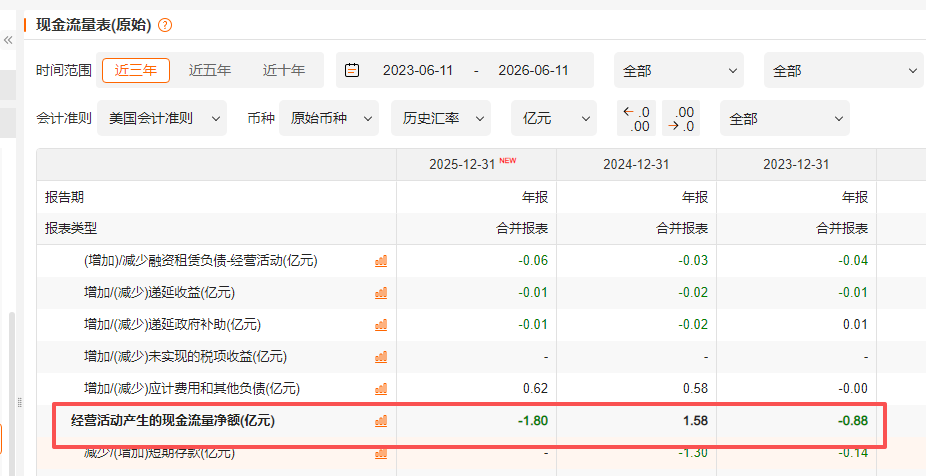
For a technology company that still needs continuous R & D investment, this is not an easy sign.
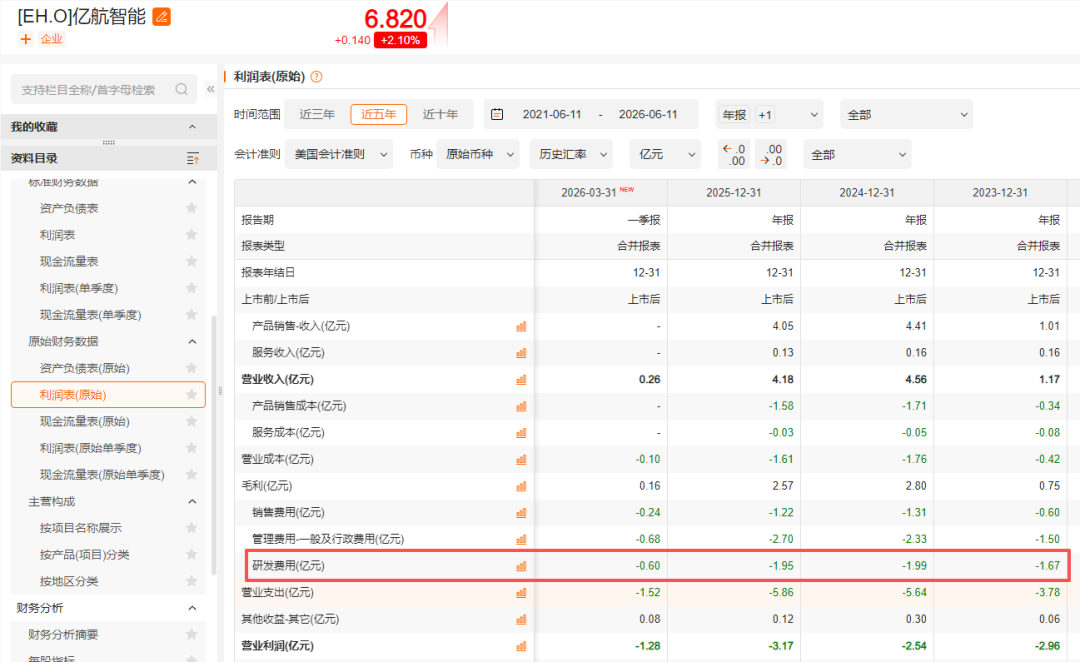
From 2024 to 2025, EHang's R & D expenses were 199 million yuan and 195 million yuan respectively, accounting for 44% and 47% of the revenue respectively. In the first quarter of 2026, the proportion of its R & D expenses to revenue exceeded 230%.
It is against this background that EHang recently emphasized its "aerial media business" again. In the first quarter, EHang completed 22 aerial shows and delivered 1,000 formation drones. The revenue from the aerial media business accounted for about 40% of the total revenue in that quarter.
In fact, drone formation shows were one of the earliest commercialized businesses of EHang.
As manned eVTOL became the core strategy, this part of the business gradually faded into the background. Now being put back in the spotlight, to some extent, it is also to prove to the market that the company still has a mature business that can contribute cash flow.
But for a company that once tried to reshape the urban air transportation mode, when drone shows become an important source of income again, it also shows one thing:
There is still a long way to go for flying cars to independently support the commercial closed - loop of a listed company.
Accelerated entry of giants
Perhaps some people will say that this is not a problem unique to EHang.
The flying car industry is still in its early stage, and the slow progress of commercialization is a challenge faced by the entire industry.
This statement is of course reasonable, but new problems also arise: If it takes a long time for the industry to mature, can EHang survive until then? And when the industry is truly mature, can EHang still maintain its leading position today?
Judging from the current situation, the answer is not optimistic.
First, let's see how long it will take for the track to mature. According to the "White Paper on the Development of Low - Altitude Economic Infrastructure" recently released by DJI, currently, eVTOL is still a long way from large - scale operation at the urban commuting level.
The problem behind this is not just whether the aircraft can fly. The airworthiness certification needs to be advanced for each model. Special takeoff and landing fields, charging facilities, and low - altitude traffic management systems all need to be rebuilt. The cost of a single flight is also much higher than that of ground transportation solutions. Not to mention that it still takes time to cultivate the public's acceptance of "taking a flying taxi."
In other words, for flying cars to be truly commercialized, the infrastructure, regulatory system, and business scenarios need to mature simultaneously, which is not easy to achieve in the short term.
There is also a judgment in the "White Paper" that is worth pondering: The policy enthusiasm has indeed given rise to a large number of "scenario concepts," but not every planned scenario has real demand and economic rationality.
What's more troublesome is that in addition to facing the industrial uncertainty when the track is not mature, EHang may also face the squeeze of multiple opponents such as state - owned automobile enterprises and technology giants in the future competition.
The most representative one is GAOYU, incubated by GAC. In May 2026, GAOYU's factory in Huangpu District, Guangzhou, was officially put into trial production, with a designed annual production capacity of about 100 units. In terms of product form, GAOYU's AirCab is highly similar to EHang's EH216 - S: both use a multi - rotor configuration, both carry two passengers, and both emphasize unmanned flight. In other words, the two companies are likely to compete directly in the same scenarios in the future.
And behind GAOYU stands GAC. In an industry with strong supervision, strong resource coordination, and strong infrastructure dependence like the low - altitude economy, the background of local state - owned assets is itself an important advantage.
Another source of pressure