Paying taxes by weight? Even the massive road-dominating electric vehicles will be charged a "road maintenance fee" — who is panicking the most?
In recent years, you may have noticed a change: new energy vehicles around you are getting bigger and heavier.
The electric SUV parked next to you has a roof taller than you, and its width fills the entire parking space. When it drives by, the road seems to creak.
This is not an illusion. Nowadays, new energy vehicles, especially flagship SUVs and sedans, are truly heavy when they are launched. The curb weight often reaches 2.5 tons, 2.6 tons, or even exceeds 3 tons. In the era of fuel vehicles, such heavyweights were usually only seen in full - size luxury SUVs.
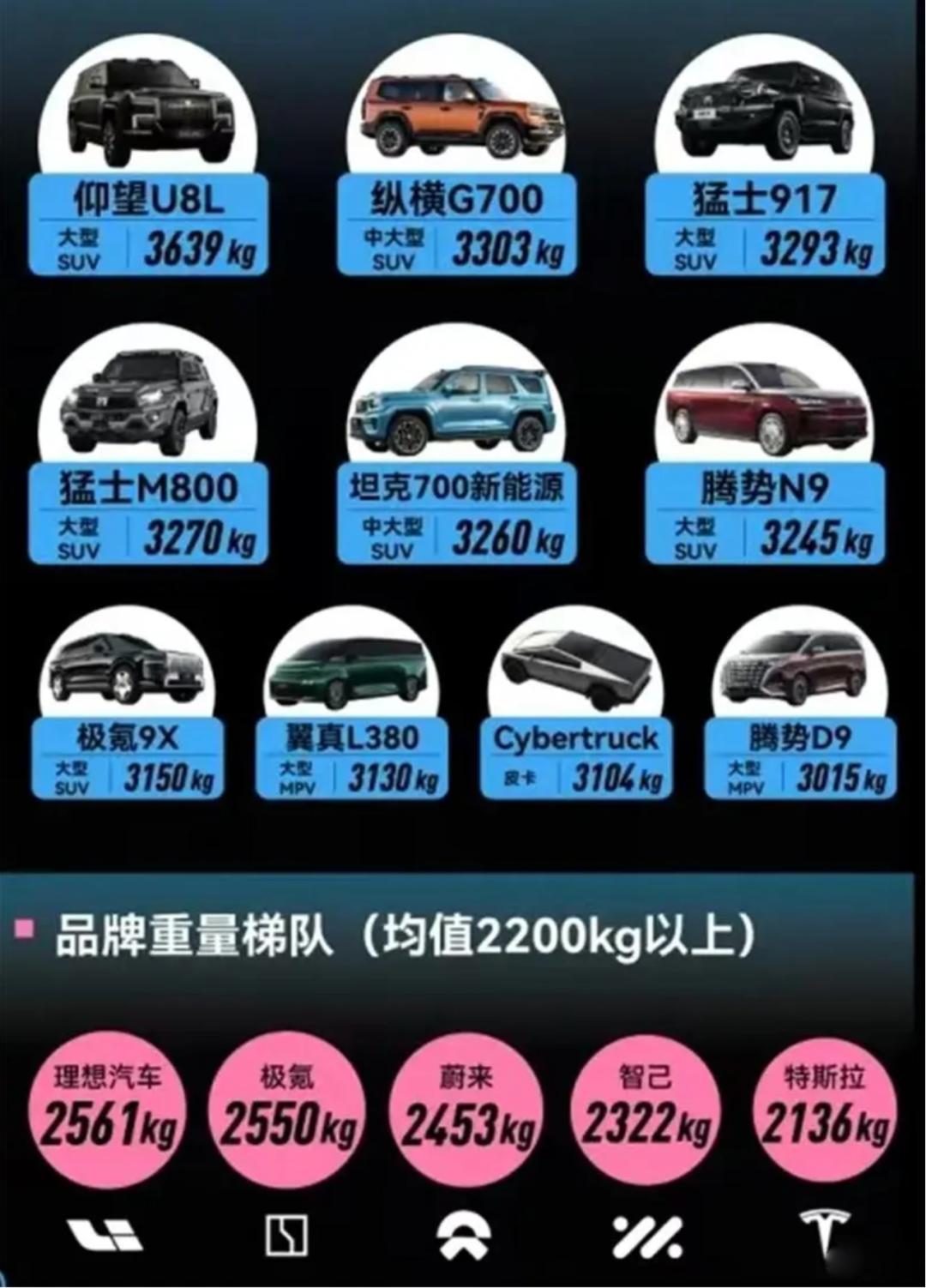
Picture/Curb weights of some popular models Source/Screenshot from Internet and New Energy Outlook
A more intuitive comparison is that the average curb weight of domestic pure - electric passenger vehicles is about 350 kilograms higher than that of traditional fuel vehicles in the same class.
That is to say, the self - weight of an ordinary electric vehicle is equivalent to an empty fuel vehicle with four or five adults sitting in it. So, how heavy are today's electric vehicles? Which one is the heaviest? Why are electric vehicles made so heavy? Can we help them "lose weight"?
1. Is a starting weight of 2.5 tons becoming the norm? These "heavyweight players" are crushing the roads
According to the data declared to the Ministry of Industry and Information Technology, the "weight ceiling" of new energy vehicles has been constantly refreshed.
The Yangwang U8 has a curb weight of 3,460 kilograms, approaching 3.5 tons. A passenger vehicle gives the feeling of a light truck. Its range - extender system, plus four motors and a large - capacity battery, make the weight difficult to control.
Although the Yangwang U7 is positioned as a flagship sedan, its curb weight reaches 3,223 kilograms, and it fluctuates between 3,095 and 3,290 kilograms for different battery versions.
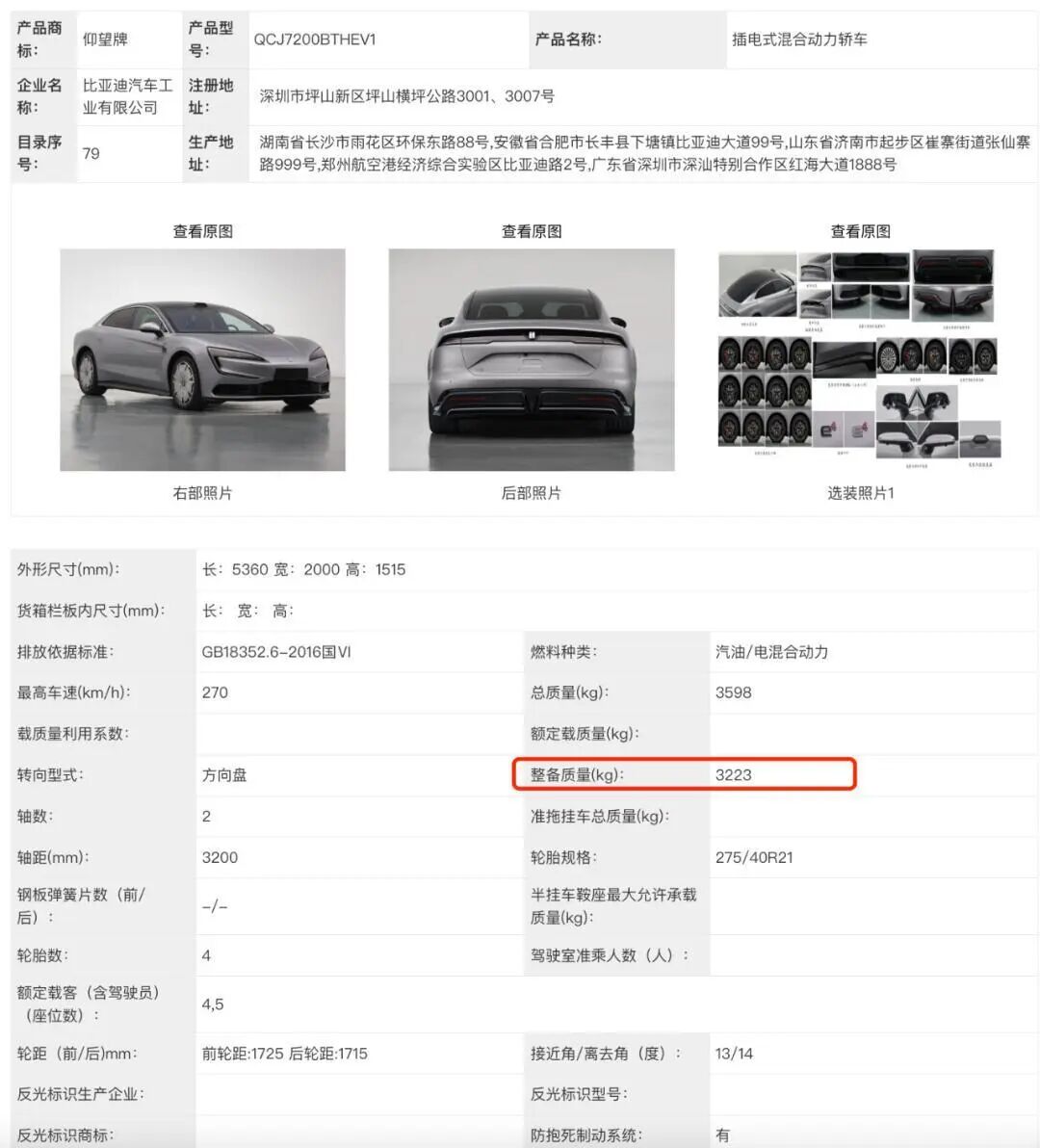
Picture/Curb weight of Yangwang U7 Source/Screenshot from Internet and New Energy Outlook
As a seven - seat mid - to - large SUV, the BYD Tang L has a curb weight of about 2.6 tons; the top - spec version of the NIO ES9 reaches 2,915 kilograms, about 2.9 tons; the pure - electric version of the Dongfeng Mengshi 917 weighs 3,293 kilograms, and the range - extender version is also close to 3,130 kilograms; the Li L9 weighs about 2,570 kilograms; the AITO M9 weighs about 2,560 kilograms; the curb weight of the Zunjie S800 is also close to 3 tons, and when fully loaded, it is heavier than many light trucks.
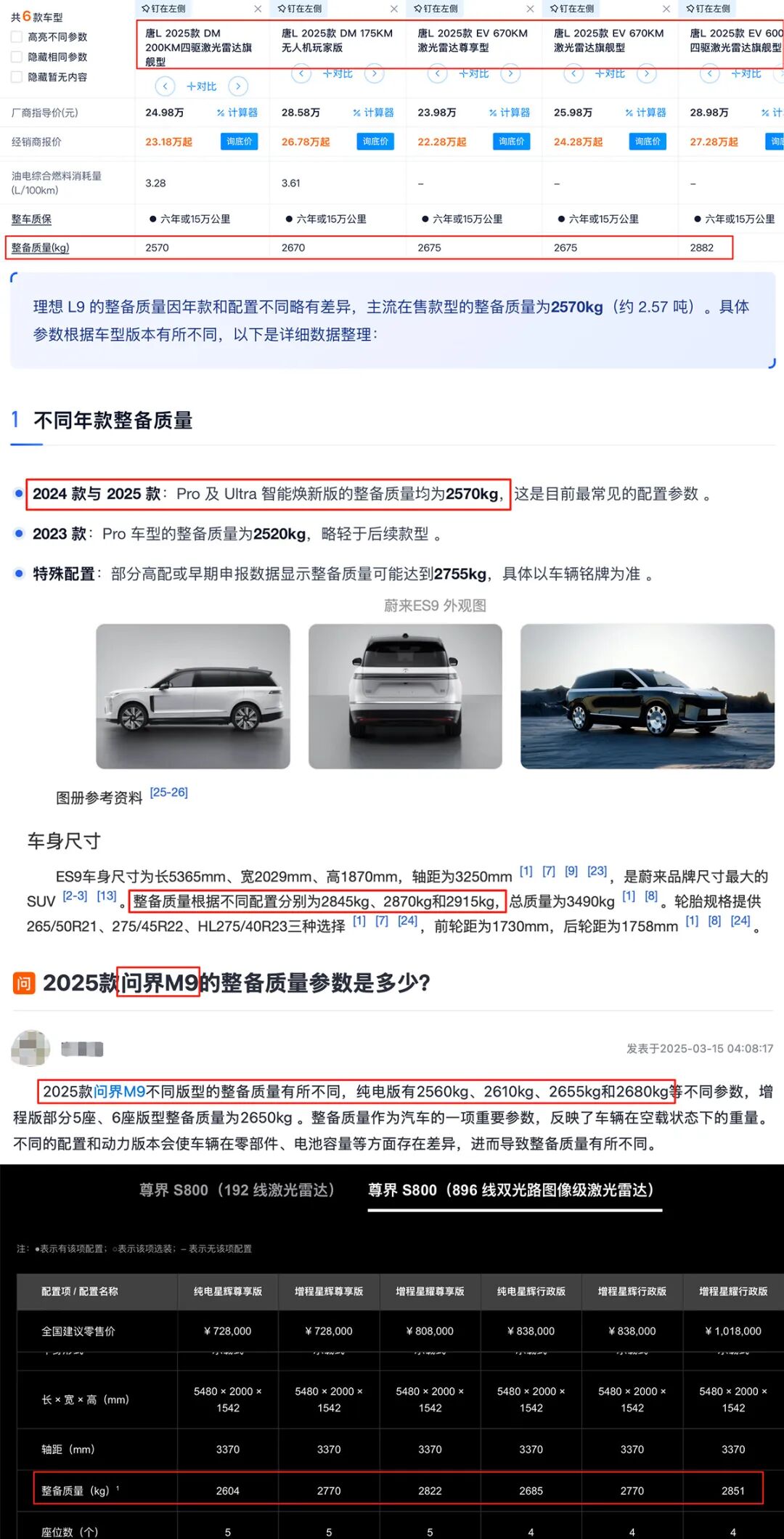
Picture/Curb weights of BYD Tang L, NIO ES9, Li L9, and Zunjie S800 Source/Screenshot from Internet and New Energy Outlook
Of course, some people may say that these vehicles are large in size, and large SUVs of fuel vehicles are also heavy. This statement makes some sense. The Land Rover Range Rover weighs about 2.8 tons, the Maybach GLS weighs about 2.8 tons, and the Toyota Land Cruiser weighs about 2.73 tons. However, the problem is that these large fuel vehicles have always been niche products in the million - level market, while new energy vehicles over 2.5 tons have now entered the mainstream price range of 300,000 to 500,000 yuan.

Picture/Curb weights of Land Rover Range Rover, Maybach GLS, and Land Cruiser Source/Screenshot from Internet and New Energy Outlook
The heavier the vehicle, the impact is not only on energy consumption and handling but also on the road surface. In road engineering, there is a well - recognized fourth - power law: the damage of a vehicle to the road surface is proportional to the fourth power of the axle load. A simple calculation shows that a 3 - ton vehicle driving over the road causes about 16 times more damage to the road surface than a 1.5 - ton vehicle.
This has sparked increasing controversy. The dissatisfaction of fuel vehicle owners is quite representative: The road maintenance fee is included in the oil price through the oil tax. Electric vehicles don't refuel and don't pay the oil tax, but they damage the road more severely because they are heavier. Is this fair?
Currently, the plans of charging by mileage or by electricity consumption are still under discussion, but the idea of "taxing based on vehicle weight" has emerged. Policies can play a guiding role. Experts suggest introducing a "vehicle weight tax" - the heavier the vehicle, the higher the annual tax payment. This practice has precedents abroad. For example, some European countries levy an additional registration tax on vehicles over 2 tons.
If a similar policy is implemented in China, car manufacturers will be more motivated to reduce the weight during the design stage instead of simply piling on materials; consumers will also calculate more carefully when choosing a vehicle: how much more tax they need to pay each year for the extra weight. Just as the displacement tax promoted the popularization of small - displacement turbocharged engines back then, the vehicle weight tax can also force the entire industry to turn towards lightweighting.
2. The three main culprits for the "obesity" of electric vehicles: batteries, safety, and "configuration competition"
Why are electric vehicles generally much heavier than fuel vehicles in the same class? The reasons can be summarized into three main aspects.
The first culprit: the battery pack.
This is the heaviest "organ" of an electric vehicle. Take an 80 kWh battery pack as an example. A battery pack using lithium iron phosphate formula weighs about 500 kilograms, and a ternary lithium battery pack is a bit lighter, about 420 kilograms. A battery pack over 100 kWh can easily weigh over 600 kilograms, accounting for a quarter or even a third of the vehicle's total mass.
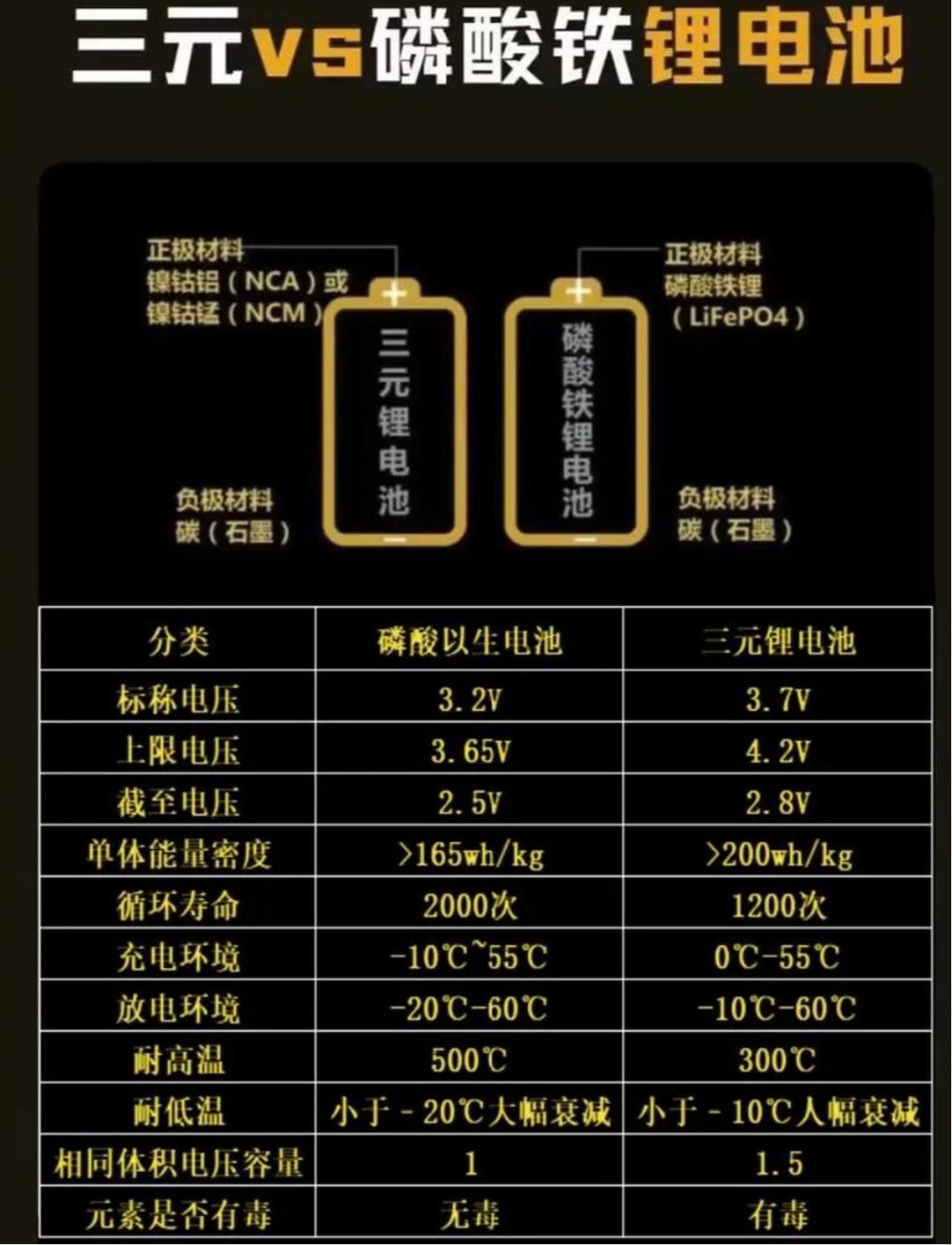
Picture/Parameter comparison between ternary lithium and lithium iron phosphate Source/Screenshot from Internet and New Energy Outlook
The reason is simple. There is a ceiling for the energy density of batteries. Currently, the energy density of mainstream battery cells is between 200 and 260 Wh/kg. To achieve a longer range, more battery cells have to be added. This is like asking a person to carry more things. The only way is to give him a bigger bag, and the bag itself becomes a weight burden.
The second culprit: the "armorization" of passive safety.
The battery pack itself is heavy, but for safety reasons, it has to be "armored". The requirements for collision tests such as side pole collisions and bottom scraping are extremely strict. Car manufacturers have to thicken the body sill beams, install bullet - proof level protective plates at the bottom of the battery pack, and use aluminum or steel materials to make a sturdy shell. From the perspective of passive safety, electric vehicles are not deliberately increasing weight but have to do so to meet safety standards.
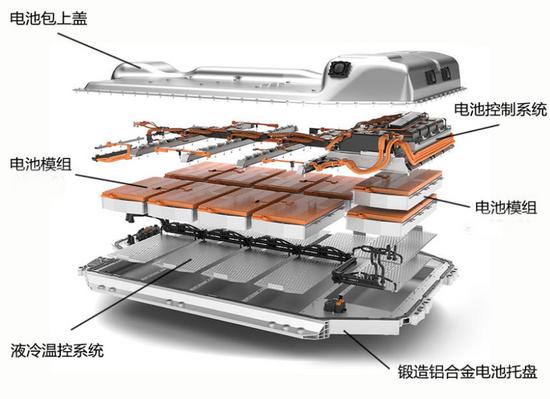
Picture/Illustration of battery pack protection Source/Screenshot from Internet and New Energy Outlook
The third culprit: the configuration competition.
Today's flagship electric vehicles are filled with a large - screen display, a panoramic sunroof, air suspension, double - layer sound - insulating glass, seat massage, rear - seat entertainment screens... Each additional feature adds 20 to 50 kilograms of extra weight. In order to create a so - called "luxury feeling", the sound - insulating cotton is laid thicker than the carpet at home, the motor is wrapped with a sound - absorbing cover, the doors are made with a double - layer structure, and even the fragrance system is equipped with a motor pump set.
Do consumers like these things? They do. Are car manufacturers willing to provide them? In the highly competitive market environment, not providing them means losing. So the "configuration competition" is getting out of control.
Actually, the idea of reducing the vehicle weight is not complicated. From the most lightweight perspective, car manufacturers can create a "light - enjoyment version" - cancel the sunroof, reduce the sound - insulating cotton, and use fabric seats, which can reduce about 50 to 80 kilograms. However, consumers may not be willing to spend more than 300,000 yuan on a "bare - bones" vehicle.
Starting from the safety structure, promoting the integrated die - casting technology is a feasible direction. Under the traditional process, a rear floor requires more than 70 parts to be spliced, while the integrated die - casting can form it in one go. The number of parts is reduced from 70 to 1, and the production time is shortened from 1 to 2 hours to 3 to 5 minutes. With fewer parts and fewer connectors, the weight naturally decreases. Tesla is at the forefront in this field. The total weight of the Model Y is reduced by about 10% through integrated die - casting.
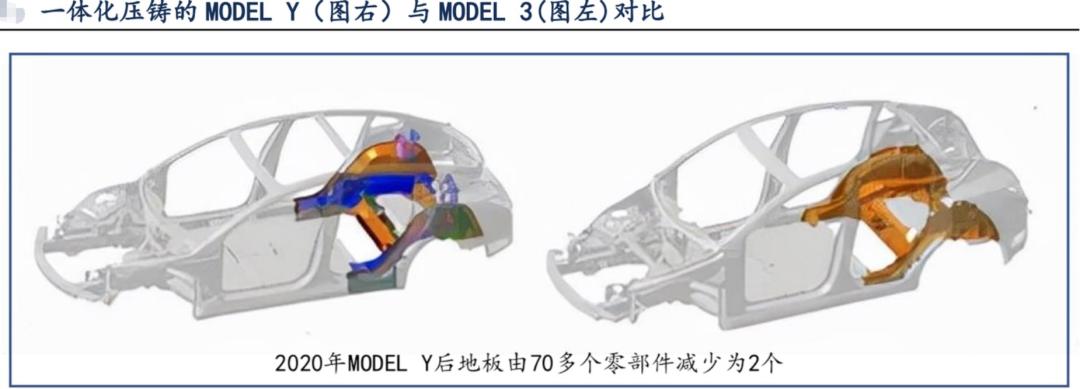
Picture/Tesla's integrated die - casting technology Source/Screenshot from Internet and New Energy Outlook
At the same time, optimizing the battery pack shell by replacing the heavy steel plate with high - strength aluminum alloy or carbon fiber composite materials can also bring significant weight - reduction effects. For example, if the chassis suspension is changed from steel to an all - aluminum structure, it can "lose weight" by about 20%.
3. Addressing the root cause: "slimming down" the battery is the fundamental solution
Looking back, among the three main culprits, although the weight increase caused by configuration and safety structure is considerable, the most fundamental one is the battery. If the battery weight cannot be reduced, no matter how well other aspects are done, it can only treat the symptoms rather than the root cause. Therefore, if new energy vehicles want to "lose weight", they have to start with the battery.
There are two directions for battery weight reduction. The first is to change the chemical system. For a 100 kWh battery pack, a lithium iron phosphate battery pack weighs about 600 kilograms, while a ternary lithium battery pack can be reduced to about 480 kilograms, directly reducing 120 kilograms. The cost will increase, but for high - end models, this cost is acceptable.
The second direction is more cutting - edge and has more amazing effects - the condensed - state battery with a higher energy density.
The single - cell energy density of the condensed - state battery can reach 500 Wh/kg, about twice that of the current mainstream ternary lithium batteries. What does this mean? A simple calculation: A vehicle originally equipped with a 100 kWh lithium iron phosphate battery has a battery pack weighing about 600 kilograms. If it is replaced with a ternary lithium battery, the battery pack weighs 480 kilograms. If it is further replaced with a condensed - state battery, the battery pack weight can be compressed to less than 360 kilograms.
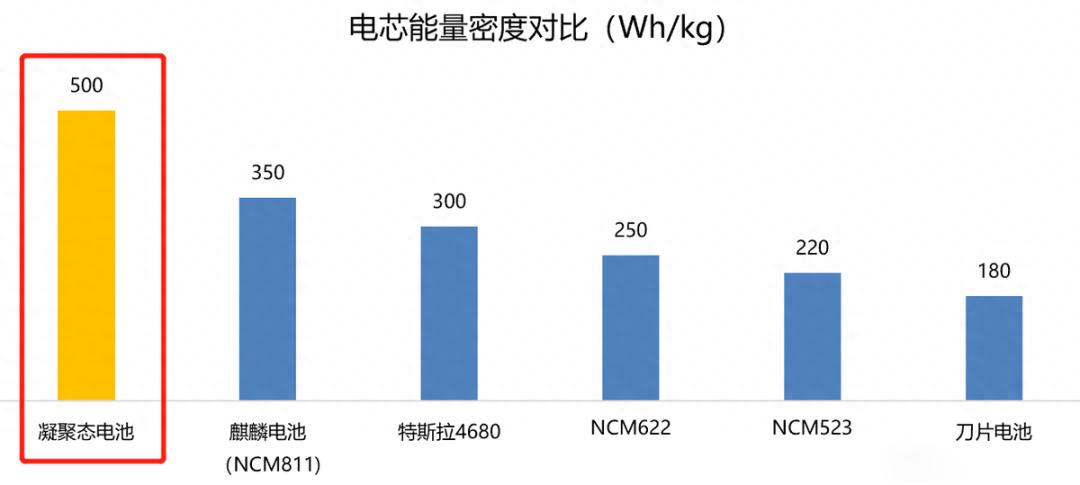
Picture/Energy density comparison between condensed - state battery and other batteries Source/Screenshot from Internet and New Energy Outlook
Why can the condensed - state battery reduce weight? In simple terms, it does not use the highly fluid electrolyte in traditional lithium - ion batteries but a semi - solid gel - like electrolyte. This material is non - flammable and does not leak, so the safety design of the battery pack can be greatly simplified - there is no need for a thick thermal runaway isolation layer, large - volume pressure - relief valves and explosion - proof valves, and the battery pack shell can even be changed from metal to a lighter polymer composite material.
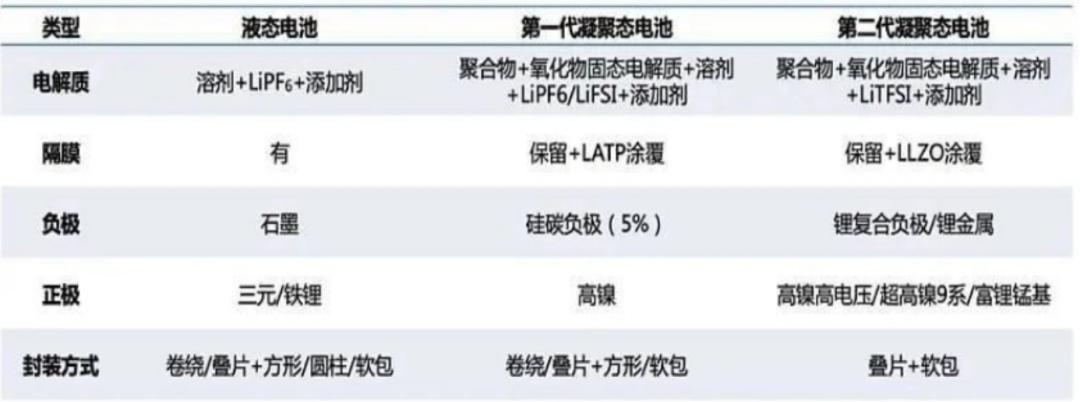
Picture/Parameter comparison of three types of batteries Source/Screenshot from Internet and New Energy Outlook
Storing the same amount of electricity with half the weight is the core value of the condensed - state battery. Calculated, only the battery can reduce the weight by more than 240 kilograms, and the total vehicle weight is almost on the same starting line as that of a fuel vehicle in the same class.
Of course, the condensed - state battery has not been widely used in vehicles yet. It is mainly used in the aviation field where both safety