What magic does "Floating Life Courtyard" have, with a foreword written anonymously by the top idol "Kong Kong"?
In 2017, Zhou Zhifeng sold a property in Beijing and exchanged it for a courtyard near Caishikou.
The courtyard is less than 180 square meters. However, with the ingenious design of the architect, it has been divided into multiple independent yet connected spaces such as a tea - room, a dining room, a kitchen, a small garden, and a master bedroom, creating a winding and secluded path. In the midsummer, an ancient Chinese scholar tree that is 120 years old next to the courtyard spreads its lush branches and leaves, almost covering most of the small courtyard under its "reign".
On the other side of the Chinese scholar tree, just across the street, lies the Fayuan Temple with a history of 1,300 years. The lilacs in the Fayuan Temple bloom in early April, covering the whole temple like a blanket of snow. The fact of "living in front of or beside the temple" became the main reason for Zhou Zhifeng to buy the courtyard.
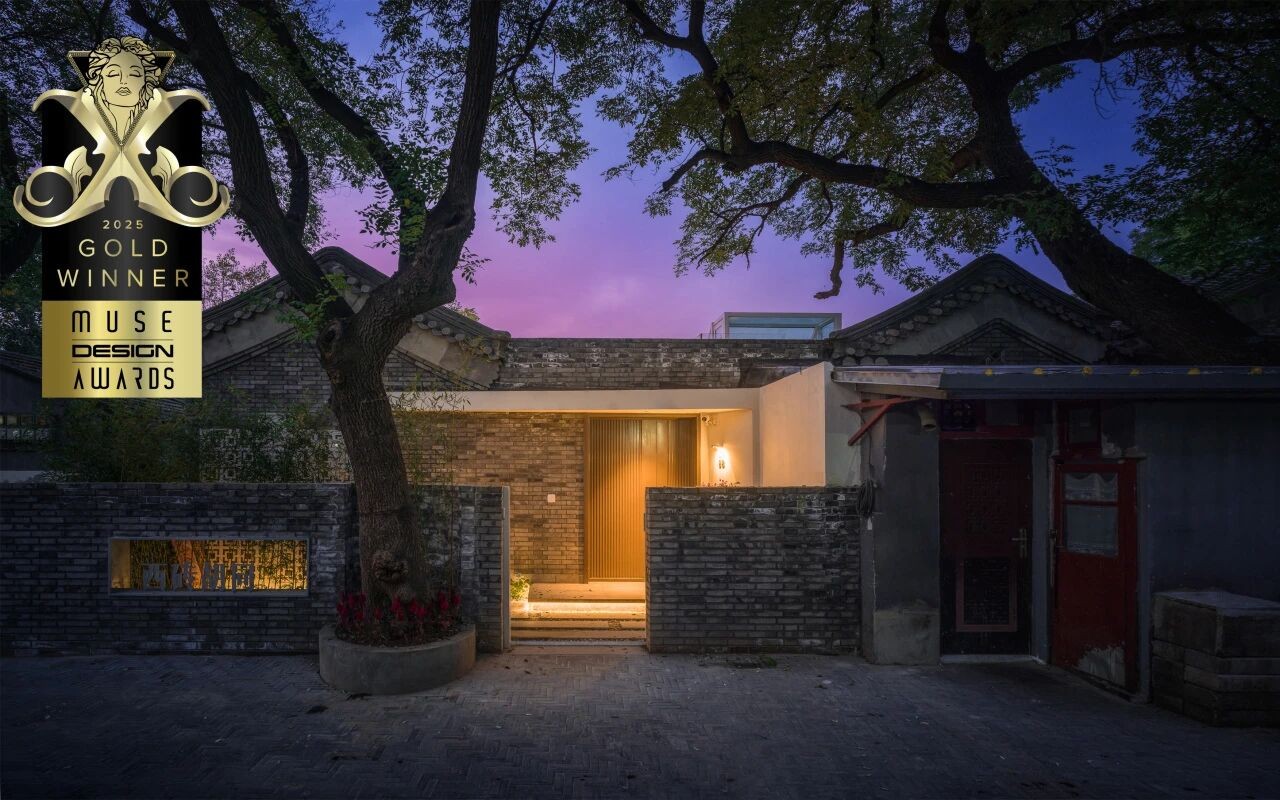
Source: JueMao International Art Design
He lived in a temple when he was a child. His grandparents were gentry landlords, and the family was once wealthy. Later, this kind of success became the reason for being identified as having a "bad status". The ancestral mansion was distributed to the villagers, and his family was resettled in an abandoned temple. Zhou Zhifeng and his parents moved into two side halls that were only a little over one - person tall.
The experience of living in the side halls of the temple became his earliest memory of space. In the following years, it turned into his longing for having his own space.
The temple had a special smell. It was the smell of sunlight passing through the ancient trees and shining on the bluestones, mixed with the smell of moss, grass striving to grow, and sandalwood.
So, when he was 14 years old and read the poem "Visiting the Rear Chan Courtyard of the Broken - Hill Temple" - "In the early morning, I enter the ancient temple; the rising sun shines on the tall woods. Along the winding path, a secluded place appears; the Chan rooms are hidden deep among the flowers and trees." - he resonated from the bottom of his heart.
Now, he has returned to this familiar atmosphere and smell. In the small courtyard next to the Fayuan Temple, the summer sunlight becomes soft after being "filtered" by the century - old Chinese scholar tree. From time to time, a little bird "breaks in", plays with the flowers and plants in the courtyard for a while, and then flies away.
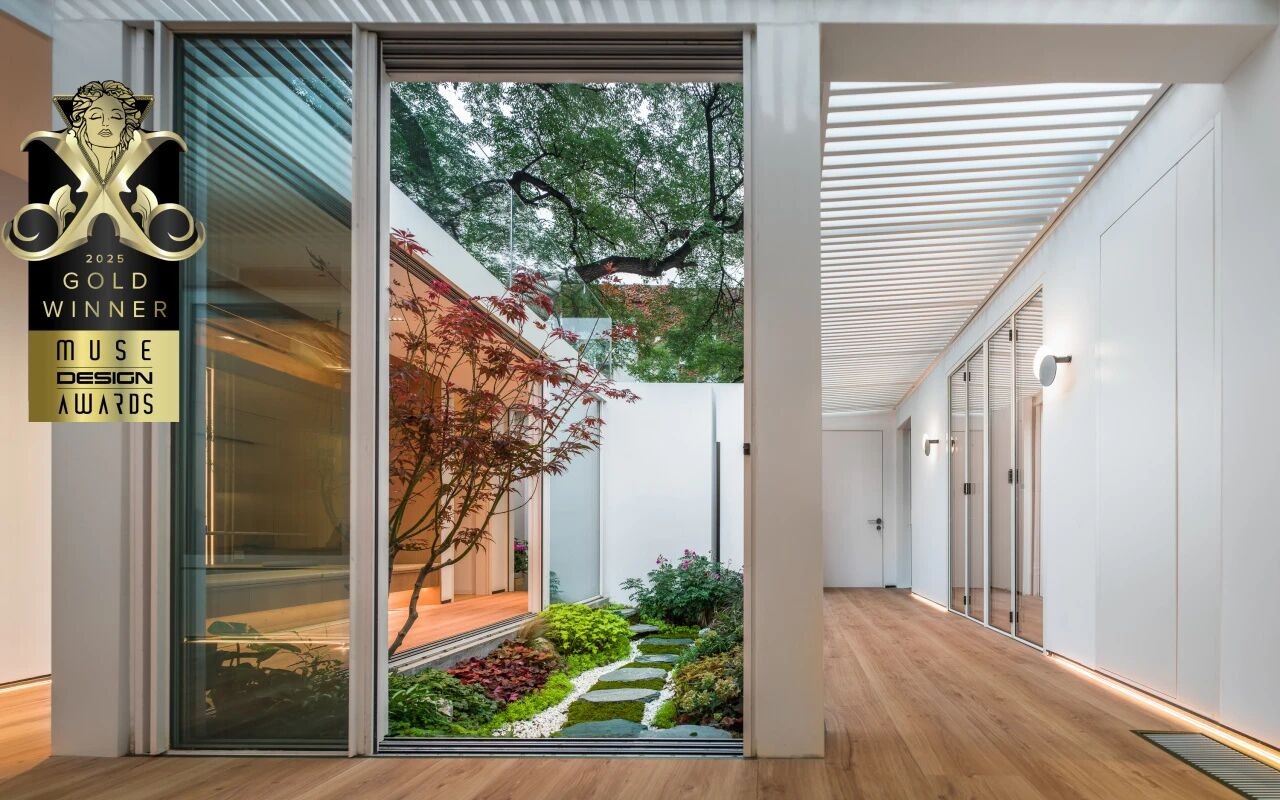
Source: JueMao International Art Design
His friends sometimes come over, including Liu Xiaoqing, He Jiong, Wang Baoqiang, Yu Zheng, and the former foreign ambassador Li Huaxin... They come here to drink tea and chat. There are no waiters here, and there is no restraint. This small courtyard is like a "safe haven" away from the noise, and also like an island where the vitality of the surrounding trees, flowers, and birds is infinitely magnified, allowing people to hide themselves and calm their hearts.
01
The Fayuan Temple has a kind of magic.
Tourists in April love the ancient purple lilacs in the temple. When they are in full bloom, it's like fireworks rising in the sky, adding a filter to all the spaces.
Some people like the Fayuan Temple because of their experiences there.
The Fayuan Temple is one of the oldest temples in Beijing. Its construction started in 645 AD, the most glorious period of Li Shimin's reign, and was completed 51 years later, in 696 AD, during the reign of Empress Wu Zetian. When Liu Xiaoqing, who is good at playing the role of Wu Zetian, came to Zhou Zhifeng's small courtyard, she specially visited this millennium - old ancient temple that was completed during the "Empress Wu Zetian" era.
This small temple has carried a lot of history. It was built because a large number of soldiers died during Li Shimin's eastern expedition to Liaodong. Li Shimin ordered the construction of a temple to commemorate them.
Later, the powerful Tang Dynasty declined, and the weak Song Dynasty barely survived. Emperor Qinzong of the Song Dynasty was once imprisoned in the Fayuan Temple after being captured. After Yuan Chonghuan, a tragic figure in the Ming Dynasty, was framed and executed, his head was secretly taken by his subordinate to the Fayuan Temple for a spiritual repose. Tan Sitong, one of the Six Gentlemen of the Hundred Days' Reform, also had a similar experience. After his death, it is said that Wang Wu (or a monk) secretly transported his body to the Fayuan Temple (Tan Sitong's former residence is nearby), and the monks in the temple held a memorial service for him.
The fates of many famous people ended here, but the Fayuan Temple and the land around it have always been breeding hope. In the alleys next to the Fayuan Temple, there are two well - known guild halls: the Hunan Guild Hall and the Shaoxing Guild Hall. The former participated in organizing the new - era revolution in China, and the latter is the place where Lu Xun wrote his most incisive works such as "Diary of a Madman" and "Kong Yiji".
In addition, there are also the Xiangxiang Guild Hall, the Jinan Guild Hall, the Liuyang Guild Hall, the Dongguan Guild Hall, and the Jiangsu Guild Hall. They surround the Fayuan Temple, forming a place full of historical events.
The story of the Fayuan Temple was written into a novel by Li Ao, becoming his most well - known work: "The Temple of Fayu in Beijing".
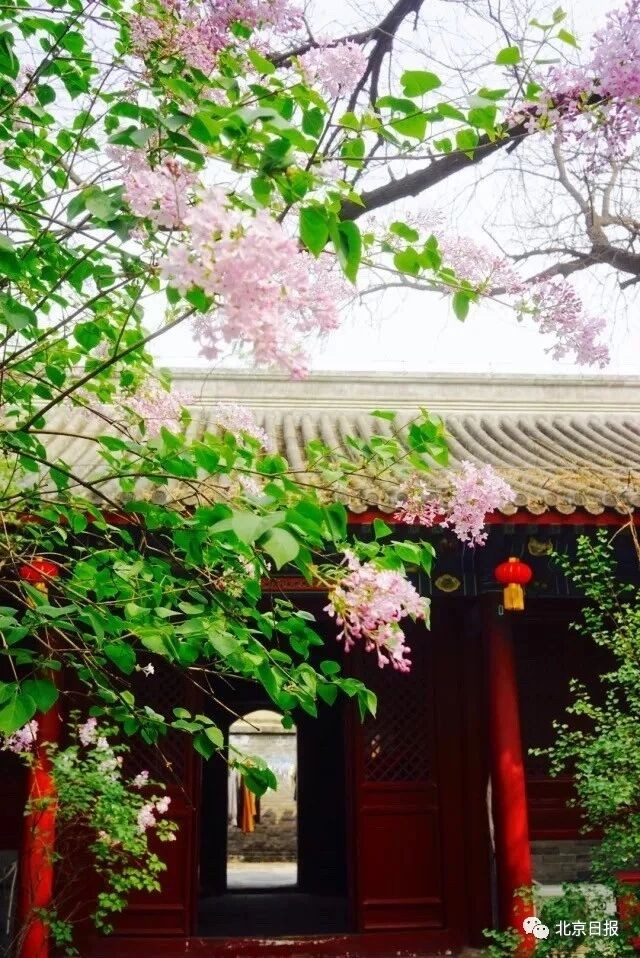
Fayuan Temple, Source: Beijing Daily
Now, this area has become the most low - key yet top - popular hutong in Beijing, both profound and modern.
Zhou Zhifeng likes to take a stroll in the hutongs in his free time and has become familiar with the owners of nearby coffee shops and bookstores. Sometimes, after sending his child to school in the morning, he returns to the small courtyard, buys more than twenty steamed buns at Zhang's Beef Bun Shop at the intersection, and distributes them to the neighbors along the way.
However, he will actively maintain a "just - right friendship" with the neighbors - this is a part of his life philosophy. Some neighbors found out that he is a "successful person" and many came to him asking for job introductions, but he refused them all.
"Sometimes we create troubles for ourselves." He said. People's hearts are delicate. If you help the Zhang family, the Li family will think you are partial. If you solve the jobs of two people, most of the others will have opinions. Neighbors are most afraid of being treated differently. Over time, more and more contradictions and rifts will appear.
There is only one brand of white wine in his courtyard. No matter who comes, there is no choice, and everyone has to drink the same.
He is a person who entered the society early. In today's trendy language, he is "socialized". Behind "socialization" is the arduous journey of a boy from a small town in Sichuan without any background, who gradually became a top - notch professional manager in the circle.
That small town is called Tuobei Town in Zizhong, Neijiang, Sichuan. It is located on the continuous mountains between Neijiang and Ziyang. In the era of inconvenient transportation, the coal from Huangjinggou in Weiyuan was transported to Neijiang, a major material distribution center, by horses. Due to the long journey, the horse teams would stop and rest at the ridge of Tuobei Town. The locals jokingly called this transportation route the "Coal Silk Road".
There are an old street, a teahouse, a stage, and a temple: the Chuanzhu Temple. There is a couplet hanging on both sides of the temple gate: "Wherever there is water in a thousand rivers, there is a moon; wherever there are no clouds in ten thousand miles, there is a clear sky." The mixed atmosphere is really a bit similar to the hutongs next to the Fayuan Temple thousands of miles away.
When talking about his hometown, the small town on the mountain, Zhou Zhifeng suddenly sang a song: "The moonlight falls on the eaves / Falls on the distant mountains / The boy under the mountains / Walks around the winding mountain roads / His figure is faint / But he is brave step by step."
"It's 'The Moon Shines on the Mountains'," his eyes shining, unconsciously with a bit of Sichuan - flavored Mandarin. "I really like this song."
When he was in school, he walked about five kilometers on the mountain road to school alone. "In those days, there was a kind of fairy - like morning mist in Sichuan. Walking on the mountain road in the early morning, the white mist rolled under his feet, and the distant mountains loomed in the sea of clouds." At night, the moon shining on the mountains created another kind of hazy feeling.
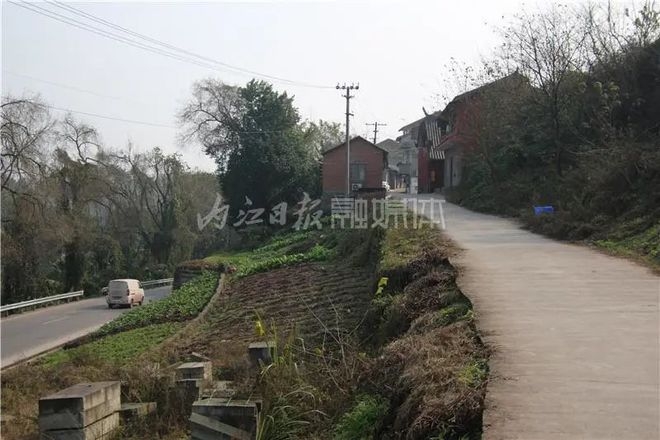
The end of the old street, Source: Neijiang Daily
In those days, it seemed to be an inevitable path for children in the mountains to leave the mountains. His parents went out to work early, and he was a left - behind child for a period. Later, he also left the mountains and became one of the most successful "small - town youths".
He became the president at the age of 27. Facing a complex business system where unexpected situations might occur every day, he was under great pressure. When he was in a bad mood, he would climb Xiangshan.
"I'm different from others. I go climbing at four or five o'clock in the afternoon. I would carry a small blanket and a stick. I'd spread the blanket on a rock on the mountain, drink water, and listen to music. I felt like an immortal between heaven and earth, with the setting sun and the birds. There was only myself. I think many things need to be digested by myself." The four words "walking inward" have run through his whole journey.
"Between heaven and earth and all things, I can find myself and make my state stable and less anxious. When going down the mountain, I would hold a stick. I was afraid of snakes and dogs. And I would sing loudly. The feeling of singing loudly when going down the mountain was like boosting my courage. Looking back now, it was a very wonderful feeling of youth. A president in his twenties, a bit strong but not that strong, needed to connect with heaven, earth, and all things to find inspiration and courage."
Now, his small courtyard is another place to connect with heaven, earth, and all things and to "see oneself". In the small courtyard, the scale of time changes from being measured in minutes and seconds on the streets and in cubicles to being measured in centuries. It's easy to get rid of impetuosity, and people become gentler.
Vogue Bazaar took a photo of him - a person sitting on the roof under a tree, with the house, the person, and the Chinese scholar tree merging into one - and it became one of his favorite photos.
Sometimes, he would point to the Chinese scholar tree and say to his friends, "Look, it has stood here for more than a hundred years. How long have we stood here?"
There is also a top - stream idol friend, rarely seen by others, who wrote a whole preface for him in a book. The signature is only two words: "Kongkong". In the preface, he wrote, "He rides the tides of wealth, steers the course of the team, and finally chooses to steer his own life and anchor in this courtyard." No one knows who he is, but everyone can't help but guess in their hearts after reading it.
Leaving the mountains in Zizhong was to "see heaven and earth, see all sentient beings". Building the small courtyard next to the Fayuan Temple was initially to earn higher rent, but after it was built, both his friends and he himself fell in love with this place and "saw themselves" here.
Is it more difficult to see life and death or to see oneself?
He answered without hesitation, "I still think it's more difficult to see life and death. You may be able to find yourself in countless nirvanas, setbacks, pains, and joys. Life and death are the most important things and the bottom line."
He added, "Although I think life and death is a positive proposition, I won't keep talking about life and death as a topic. Don't talk about it too much. Because life and death are my bottom line. I think the greatest courage is to live. You must live. Only by living can you see heaven and earth, see all sentient beings, and see yourself. Only by living can you meet your friends."
02
Zhou Zhifeng's small courtyard is very "clean" and also has the same kind of temperament as its owner: safety.
In the middle of the small courtyard is an open - air garden of about 10 square meters. Three rooms are located in three corners of the courtyard, and the kitchen is in the other corner. Next to the kitchen is the dining room, facing the tea - room on the other side across the garden. Each space is not large. It's just right for seven or eight people to sit in the tea - room and the dining room.
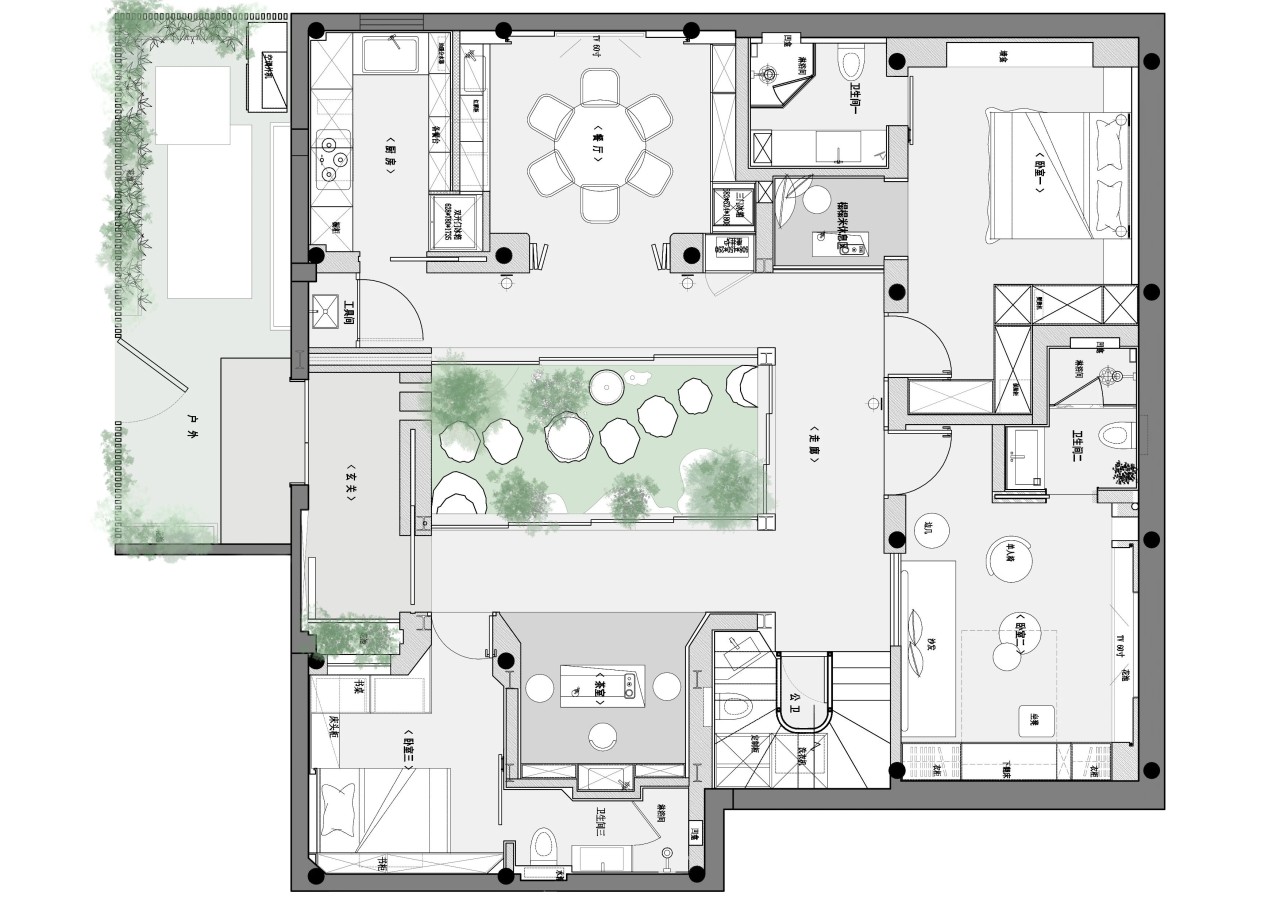
Source: JueMao International Art Design
There are no waiters in the small courtyard. Zhou Zhifeng and his friends have to do the cleaning and tidying themselves. Even He Jiong will help tidy up the dining table when he comes.
"We don't need service because service is not safe." In Zhou Zhifeng's small courtyard, everyone can be themselves, without putting on airs. There are no strangers, and except for the century - old Chinese scholar tree, no one is peeping at them.
Occasionally, a little bird will come to "disturb" them.
One day, when He Jiong was drinking tea in the small courtyard, he suddenly heard a clear "knocking" sound. Teacher He reminded, "Someone is knocking on the iron gate."
Zhou Zhifeng listened quietly and smiled. He pointed to the tree and said, "No, look over there." It was several birds chirping on the roof opposite the tea - room.
In the small courtyard, one just needs to focus on being oneself. This is what attracts Zhou Zhifeng's friends to come here again and again.
The house number of the small courtyard is 88. In Chinese culture, people like auspiciousness, and "88" sounds like "getting rich" in Chinese. As soon as the guests enter the door, they receive this auspicious signal, and their mood relaxes a lot. There is a plaque hanging on the wall of the dining room, which says "