After DingTalk's leadership reshuffle, the author of "Working Inside DingTalk" published another lengthy article
On June 12, Teng Yaxin (with the nickname "Yousu"), the author of Inside the Ding and the former product manager of DingTalk's ONE project, posted another long article on her personal social platform to respond to the outside world's controversies. This is her first public statement since she posted a 75,000 - word resignation article on June 4, which sparked widespread discussions across the internet.
In the article The Cloudy Sky May Not Be Empty, she stated that when she posted the article at the time of her resignation, she just wanted to reflect on many common and systematic problems encountered in the process of large organizations building AI. These problems are not limited to DingTalk, Alibaba, or even China. Her simplest wish for writing that article was to let more colleagues who are working on AI products avoid detours.
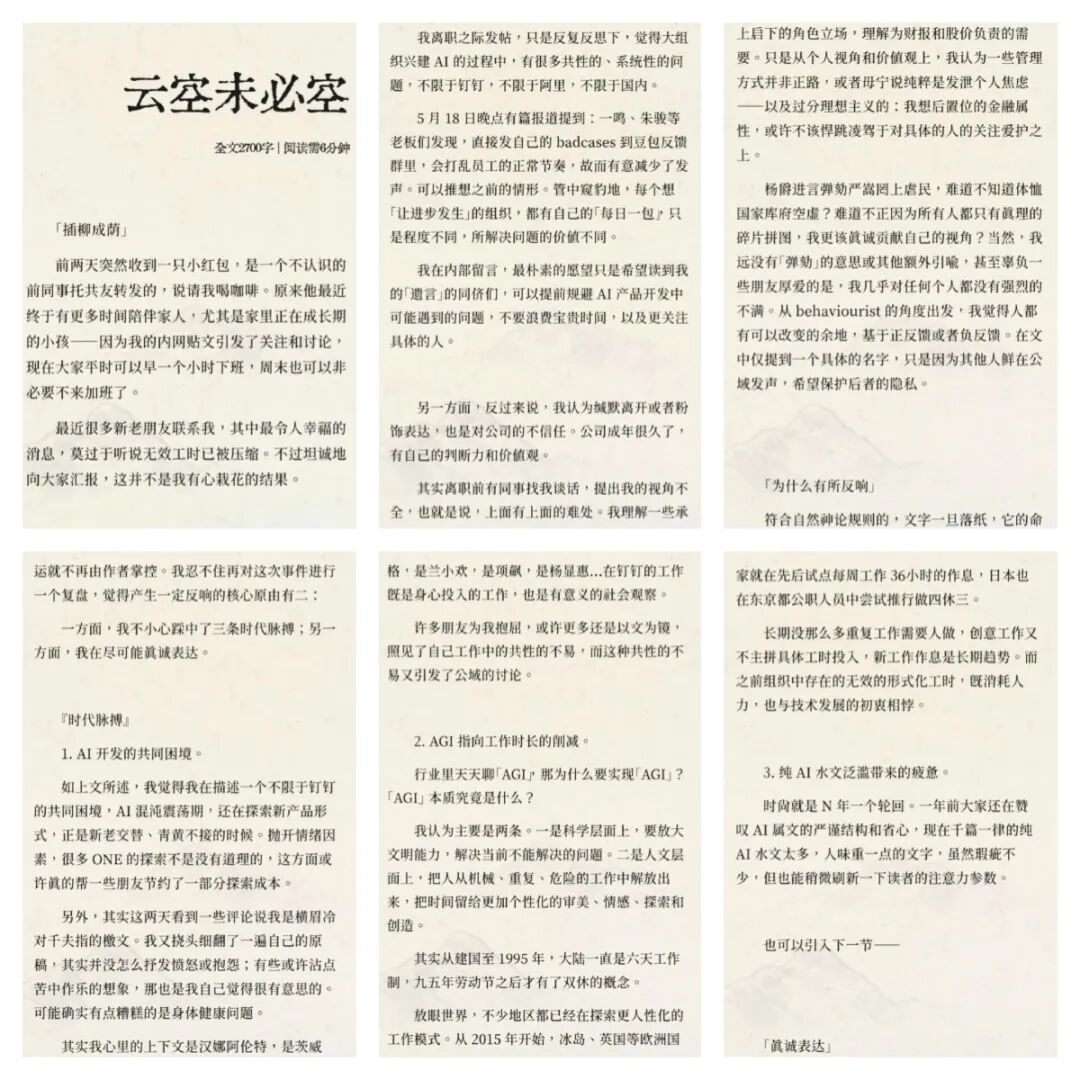
The author of Inside the Ding posted an article
Regarding the fact that Inside the Ding quickly went viral and caught the attention of the whole internet, she believes that the reason this article touched so many people is that it essentially hit two core pain points in the current AI industry. Firstly, it's the common dilemma in AI development: Currently, the AI technology is in a chaotic and volatile period. The new product form has not been finalized yet, and the industry is in a stage of transition between the old and the new. Many teams are groping their way forward, and it's inevitable to take detours and make mistakes in the exploration process.
Secondly, AGI points to the reduction of working hours. The industry talks about AGI every day, but many people ignore its core value. She believes that from a scientific perspective, we should amplify the capabilities of civilization to solve problems that cannot be solved currently. From a humanistic perspective, we should liberate people from mechanical, repetitive, and dangerous work and leave time for more personalized aesthetics, emotions, exploration, and creation. "In the long run, there won't be so many repetitive jobs for people to do, and creative work doesn't mainly rely on specific working - hour input. The new work schedule is a long - term trend. And the ineffective formal working hours that existed in the organization before not only consume human resources but also go against the original intention of technological development."
Looking back at the development context of the whole event, this public opinion storm that started with a resignation article quickly escalated in just eight days and finally triggered an upheaval in DingTalk's management. On June 4, Teng Yaxin posted a 75,000 - word resignation article titled Inside the Ding on Alibaba's internal network. From the perspective of a front - line core product manager, she reviewed the whole process of DingTalk's flagship AI project ONE, from its project establishment, closed - door R & D, the highlight moment when its daily active users exceeded 3 million after its launch, to the subsequent collapse of user word - of - mouth, business strategy adjustment, sector split - off, and finally the complete end of the project.
After the release of Inside the Ding, public opinion quickly fermented. On June 8, Ma Ruila, the vice - president who left DingTalk in May this year, posted an article titled Outside the Ding in response. He said that after reading Inside the Ding, he "couldn't calm down for a long time" and repeatedly wrote three words: "Heartache". He frankly said that he fully understood the high - pressure working state mentioned in the article, as well as the vicious cycle of hard work with little result, frequent reporting, and repeated iterations without improvement. "What I feel heartache about is that such a young and innovative product finally needs to use 70,000 words to extricate itself from a system and seek liberation."
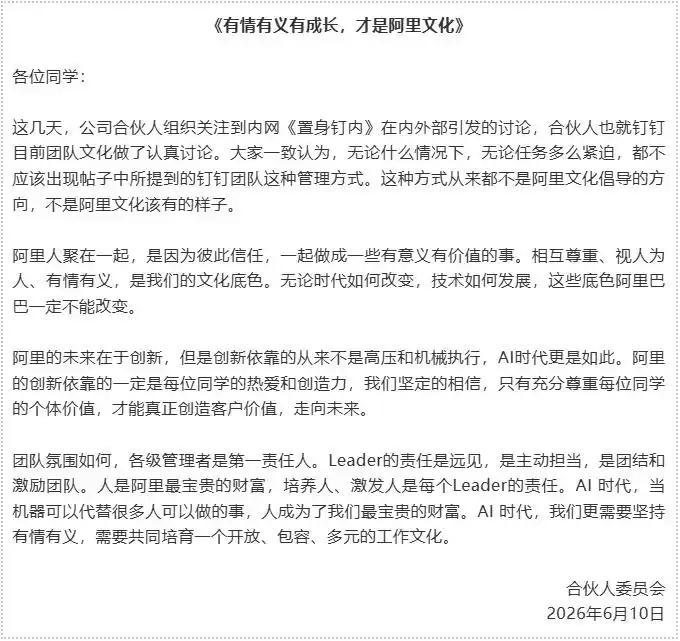
Alibaba's Partner Committee posted an article
Facing the intensifying public opinion storm, Alibaba's Partner Committee posted an article titled Love, Loyalty, and Growth Are the Essence of Alibaba Culture on the company's internal network on June 10, making its first response to the discussions triggered by Inside the Ding. In the post, the Partner Committee criticized the management style of the DingTalk team. "Under any circumstances, no matter how urgent the task is, the management style of the DingTalk team mentioned in the post should not have occurred. This style has never been the direction advocated by Alibaba culture and is not what Alibaba culture should be like." The committee said that innovation in the AI era depends not on high - pressure and mechanical execution but on employees' love and creativity.
Just 24 hours later, on June 11, Alibaba Group announced a major adjustment to DingTalk's management: Chen Hang (with the nickname "Wuzhao") stepped down as the CEO of DingTalk, and Chen Yusen, a tech geek born in 1992, took over. Public information shows that Chen Hang is the founder of DingTalk. He led the team to incubate DingTalk in 2014 and officially launched the product in 2015. In July 2021, Chen Hang left Alibaba due to differences in concepts with Alibaba on the "Cloud - Ding Integration" strategic direction and founded Liangqingyiyang Company. At the end of March 2025, at the invitation of Alibaba CEO Wu Yongming, Chen Hang returned to take the position of DingTalk's CEO and promoted AI - native projects such as ONE. By the time of his resignation this time, Chen Hang had only served as DingTalk's CEO for a little over a year.
Chen Yusen, who took over as the CEO of DingTalk, is the youngest division CEO at Alibaba and a well - known tech geek at a young age. He has won many championships in top - level computer competitions at home and abroad. The network security company Changting Technology he founded at the age of 22 was acquired by Alibaba Cloud. In 2025, Chen Yusen started an internal venture at Alibaba Cloud and led the R & D of the AI Agent product MuleRun, which has been widely recognized in the industry.
This article is from the WeChat official account "Jiemian News", author: Li Kefeng. Reposted by 36Kr with authorization.