The first national-level special plan for urban renewal! Over 250 billion yuan in financial support
On June 8th, the State Council Information Office held a regular policy briefing. Four departments provided a detailed explanation of the "15th Five-Year Plan for Urban Renewal" recently released.
In addition to clarifying the key tasks for urban renewal in the next five years at this press conference, the most important thing is to solve the most crucial problem in urban renewal, 'Where does the money come from?'
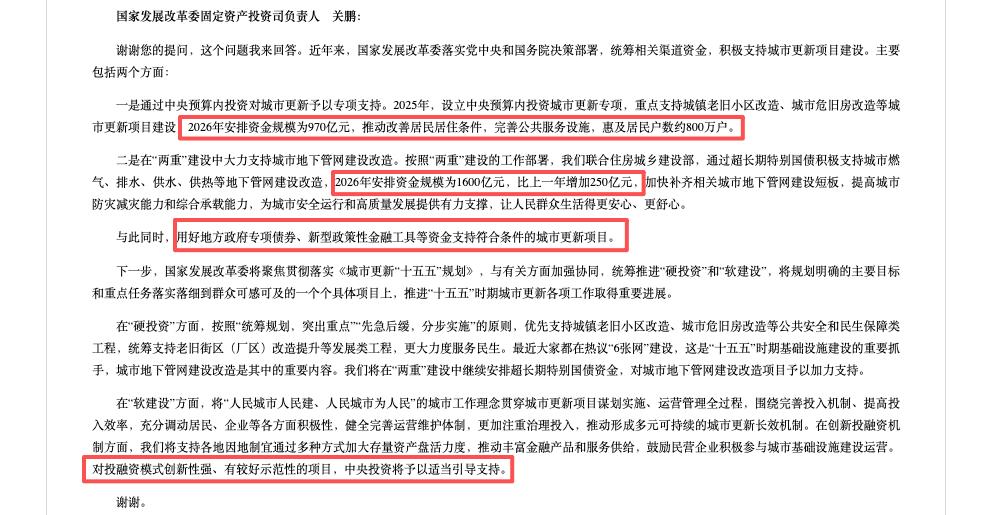
1. Provide special support for urban renewal through central budgetary investment. In 2026, the allocated funds will reach 97 billion yuan to promote the improvement of residents' living conditions, improve public service facilities, and benefit about 8 million households.
2. Actively support the construction and renovation of urban underground pipe networks through ultra-long-term special treasury bonds. In 2026, the allocated funds will be 160 billion yuan, an increase of 25 billion yuan compared with the previous year.
3. The Ministry of Finance has supported 50 key cities to take the lead in piloting for three consecutive years. The central finance provides fixed subsidies to cities in the eastern, central, and western regions respectively. During the "15th Five-Year Plan" period, the central finance will maintain a relatively large support intensity.
4. Local government special bonds, new policy-based financial instruments and other funds support eligible urban renewal projects.
Urban renewal projects are large in scale, long in cycle, and high in investment. Fund guarantee is the key to implementation. This meeting clarified the sources of funds and the task list, which means that promoting high-quality development with urban renewal as a strategic starting point is no longer just a blueprint, but a real fact that will happen in the next five years.
01
The "15th Five-Year Plan for Urban Renewal" is the first national-level special plan in the field of urban renewal. It clarifies the goals, key tasks, and major projects during the "15th Five-Year Plan" period. The State Council Information Office held a regular policy briefing on the morning of June 8th to introduce and interpret the "15th Five-Year Plan for Urban Renewal" in detail.
Qin Haixiang, the deputy minister of the Ministry of Housing and Urban-Rural Development, said that in line with the construction goals of a modern people-oriented city that is innovative, livable, beautiful, resilient, civilized, and intelligent, six key tasks have been deployed, including cultivating and strengthening new drivers of urban development, creating high-quality urban living spaces, promoting the green and low-carbon transformation of urban development, enhancing urban safety and resilience, promoting the prosperous development of urban culture, and improving the level of urban governance. At the same time, 14 major projects and actions such as the construction of "good houses", the renovation of old urban residential areas, the construction of complete communities, the renovation and improvement of old blocks and factory areas, and the improvement of municipal infrastructure are listed in the form of columns.
It can be seen that the real estate industry has been positioned as one of the core links in urban renewal.
1. In the part of cultivating and strengthening new drivers of urban development, real estate is attributed to activating the potential of urban stock resources
Accelerate the construction of a new model for real estate development, and improve the basic systems for commercial housing development, financing, and sales. Optimize the supply of affordable housing, strengthen the housing security for low-income urban families with housing difficulties, better meet the basic housing needs of wage-earning groups with housing difficulties and low incomes, and gradually solve the temporary housing difficulties of groups such as new urban residents and young people. Increase the supply of improved housing according to local conditions, and regulate the development of the housing rental market. Promote the transformation and development of real estate development enterprises and their participation in urban renewal. Deepen the reform of the housing provident fund system, expand its scope of use, and strive to meet the diverse housing needs of depositors at different stages, and support flexible employees to participate in the housing provident fund system.
From this part, it can be summarized as "guaranteeing rigid needs", "optimizing improvements", and "promoting transformation".
"Guaranteeing rigid needs" is mainly carried out from two aspects: the supply of affordable housing and the rental market, mainly to solve the housing needs of low-income families and housing - difficult groups, as well as the temporary housing needs of new urban residents and young people.
"Optimizing improvements" is mainly implemented according to local conditions in different cities, which is also in line with the development of the mid - to high - end market in core cities in recent years.
"Promoting transformation" mainly encourages enterprises to shift from incremental development to stock operation and participate in the process of urban renewal and operation.
Finally, the housing provident fund system is mainly extended from "buying a house" and "renting a house" to "repairing a house" and "maintaining a house".
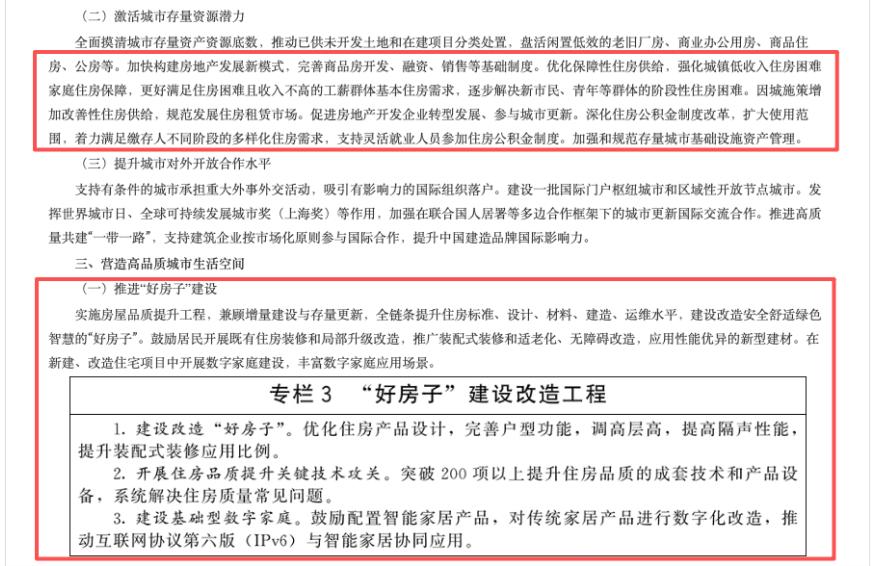
2. In the part of creating high-quality urban living spaces, promote the construction of "good houses"
Implement the project to improve housing quality, taking into account both incremental construction and stock renewal, and improve the standards, design, materials, construction, and operation and maintenance levels of housing in the whole chain to build and renovate "good houses" that are safe, comfortable, green, and intelligent. Encourage residents to renovate and partially upgrade their existing housing, promote prefabricated decoration, aging - friendly and barrier - free renovation, and apply new building materials with excellent performance. Carry out the construction of digital homes in new and renovated residential projects to enrich the application scenarios of digital homes.
From this part, the focus is that the construction of "good houses" is not limited to new residential buildings, and the upgrading and renovation of existing residential buildings will also become the focus in the future.
Qin Haixiang said that in the construction of "good houses", the focus is to implement the project to improve housing quality and build and renovate "good houses" that are safe, comfortable, green, and intelligent. On the one hand, improve the quality of new houses, improve the housing standards, design, materials, construction, and operation and maintenance levels in the whole chain, implement the "Residential Project Specification", optimize housing design, and improve the functions of house types. On the other hand, do a good job in the renewal and renovation of old houses, encourage residents to renovate and transform their housing, promote prefabricated decoration, aging - friendly and barrier - free renovation, and support the independent renewal of old housing. At the same time, a number of scientific and technological projects to improve housing quality are also deployed to break through a number of key technologies, empowering the construction of "good houses" with technology.
This echoes with "promoting the transformation and development of real estate development enterprises and their participation in urban renewal. Deepening the reform of the housing provident fund system and expanding its scope of use", which means that in the future, we not only need to be able to build good houses but also operate them well.
02
Urban renewal projects are large in scale, long in cycle, and high in investment. "Money" is an unavoidable core issue. This meeting provided clear figures and paths.
First, the clear budget for funds.
Guan Peng, the person in charge of the Fixed - Asset Investment Department of the National Development and Reform Commission, said that, firstly, provide special support for urban renewal through central budgetary investment. Secondly, actively support the construction and renovation of urban underground pipe networks for gas, drainage, water supply, heating, etc. through ultra - long - term special treasury bonds. At the same time, make good use of local government special bonds, new policy - based financial instruments and other funds to support eligible urban renewal projects.
From the announced fund scale in 2026, the central budgetary investment is 97 billion yuan, and the ultra - long - term special treasury bonds are 160 billion yuan, with the total exceeding 250 billion yuan.
However, these funds are not "flood - irrigation" but "selective and key support".
Guan Peng said that "in terms of 'hard investment', follow the principles of 'overall planning and highlighting key points' and 'prioritizing urgent matters and implementing step by step'", "encourage private enterprises to actively participate in the construction and operation of urban infrastructure.", "For projects with strong innovation in investment and financing models and good demonstration effects, central investment will provide appropriate guidance and support."
This means that the 250 - billion - yuan funds will be "precisely irrigated" to the most urgent and effective places.
Secondly, regarding the central financial funds and policy tools, Guo Fangming, the director of the Economic Construction Department of the Ministry of Finance, said that "for three consecutive years, a total of 50 key cities such as Beijing, Shanghai, Shenyang, Luoyang, Urumqi, and Chengdu have been supported to take the lead in piloting. The central finance provides fixed subsidies to cities in the eastern, central, and western regions respectively.", "During the '15th Five - Year Plan' period, the central finance will maintain a relatively large support intensity and continuously optimize policy design to improve the efficiency of fund use."
This is also a reiteration of "selective and key support" to a certain extent. For local governments and enterprises, they need to come up with better projects and results in the future.
The logic of using central financial funds is undergoing profound changes.
03
From the perspective of the real estate industry, both the "15th Five - Year Plan for Urban Renewal" itself and the regular policy briefing held by the State Council Information Office inject great certainty into the industry and are important opportunities for the industry's transformation and development at this stage.
Firstly, the scale of renovation has a structural expansion. The renovation of dilapidated houses, old blocks, and factory areas is doubled, releasing a large amount of stock renewal space and opening up new growth tracks for real estate enterprises.
Secondly, real estate is positioned as one of the core links in urban renewal. The plan clearly constructs a new real estate model, guiding real estate enterprises to shift from traditional incremental development to stock operation and quality upgrading, helping the industry get rid of the dependence on the old path. On the supply side, the construction of "good houses" and the renovation of old residential areas, blocks, and factory areas directly bring certainty to the supply; on the supporting side, the upgrading of communities, transportation, and public services significantly improves the livability and asset value of housing.
Finally, the part of "promoting the classified disposal of land that has been supplied but not developed and ongoing projects, and revitalizing idle and inefficient old factories, commercial and office buildings, commercial housing, public housing, etc." can effectively hedge the pressure of traditional development and help the industry develop steadily, healthily, and sustainably.
It can be predicted that a systematic change has come.
This article is from the WeChat official account "Ding Zuyu's Review of the Real Estate Market", author: Editorial Department, published by 36Kr with authorization.