SpaceX 1.8 trillion IPO: Elon Musk is set to sell a defiant, world-challenging AI cloud
At 9:30 PM Beijing Time tonight, the NASDAQ opened, and the largest IPO in history entered its first trading day. SpaceX, with the ticker symbol SPCX, had an issue price of $135, corresponding to a valuation of approximately $1.8 trillion. During the subscription phase, over $250 billion in funds were vying for a $75 billion quota. Retail investors received 30% of the allotment, three times the convention for offerings of the same scale.
Rather than the price, the first page of the prospectus is more worth a look. SpaceX's mission statement is a bit longer than the version people are familiar with: "Build the systems and technologies needed to make life a multi - planetary species, understand the true nature of the universe, and extend the light of consciousness to the stars."
The middle part, "understand the true nature of the universe," was originally the corporate mission of xAI. One sentence encompasses two companies.
In the past four months, Musk has repackaged a rocket and satellite internet company into an AI computing infrastructure company, or more directly, a cloud. The story of rockets can't support a valuation of $1.8 trillion, nor can satellites. Only the cloud can support this figure.

1
There's already a cloud in the prospectus, on the ground
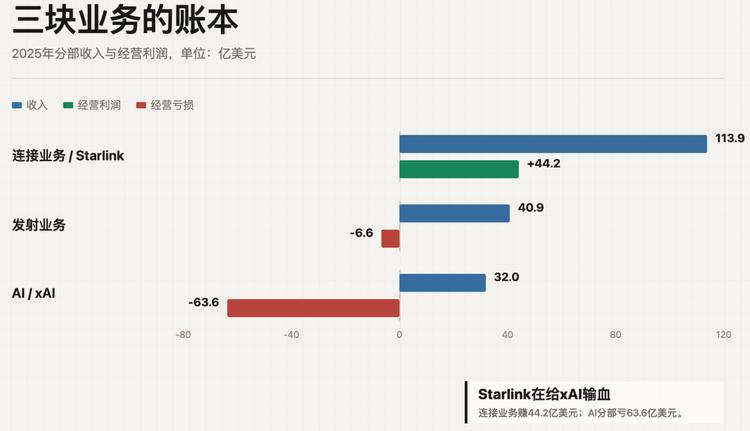
The prospectus divides the company into three segments. The connectivity business where Starlink belongs had revenues of $11.39 billion last year and an operating profit of $4.42 billion. It's the only profitable segment among the three. The launch business had revenues of $4.09 billion and a loss of $660 million. The third segment is called AI, which is the merged xAI, with revenues of $3.2 billion and a loss of $6.36 billion.
After the consolidation, SpaceX, which had a net profit of $790 million the year before last, had a net loss of $4.9 billion last year, and the losses accelerated in the first quarter of this year. The flow of money is clear. Starlink is transfusing blood into xAI, and the intensity is increasing. The capital expenditure of the AI segment in one quarter is $7.7 billion, more than twice the total revenue of Starlink in the same period.
Starlink itself is increasingly looking like a telecommunications operator. The number of users increased from 2.3 million to 10.3 million in three years, but the average revenue per user per month dropped from $99 to $66. Every step of the growth is achieved by sacrificing the unit price. It's truly a cash - cow, but this cow has profits but no imagination.
Two other contracts better illustrate what this company is becoming. The prospectus reveals that Anthropic pays SpaceX $1.25 billion per month to rent the computing power of Colossus 1 and 2 in Memphis, and the contract runs until 2029. Google pays $920 million per month to rent approximately 110,000 NVIDIA GPUs from October this year until 2029. If both contracts are fully realized, the total annual revenue will exceed $25 billion, higher than SpaceX's total revenue last year.
Wholesaling computing power to other AI companies is the job of cloud providers. SpaceX doesn't beat around the bush either. The official names of the two contracts are "Cloud Service Agreement".
The customer list is even more interesting. Anthropic and Google are both direct competitors of Grok. Grok itself is far from making money. The combined subscription revenues of Grok and X last year were only $365 million, but xAI has developed two competitors into its largest computing power customers.
Of course, this ground - based cloud is still small in scale today. The bulk of the $3.2 billion revenue in the AI segment still comes from X's advertising and subscriptions. Both computing power contracts also state that they can be terminated with 90 days' notice. There's also a notable detail in the prospectus. Colossus 1 and 2, with a total capacity of about 1 gigawatt, were built in just 122 days and 91 days respectively. The speed itself is a selling point.
The structure of this IPO is not complicated. The cash flow of Starlink, the $75 billion in new funds from the public market, and Musk's absolute control are tied in the same direction, supplying blood to the stories of xAI and orbital computing power.
The blood - supply has a time limit. The debt incurred for AI infrastructure has piled up to approximately $30 billion, of which $20 billion is bridge loans due within 15 months after the IPO. This company, which has never lacked private capital for over two decades, needs the public market for the first time, not entirely for its vision. Some on Wall Street have interpreted the clustering of large - scale IPOs such as SpaceX and OpenAI as a signal that the AI market is approaching its end. The financing window won't stay open forever.
The entire prospectus is a financing plan designed for a high - stakes bet on AI.
2
How was AI integrated into a rocket company?
This cloud was sewn into SpaceX over about a year, and the final packaging only took four months.
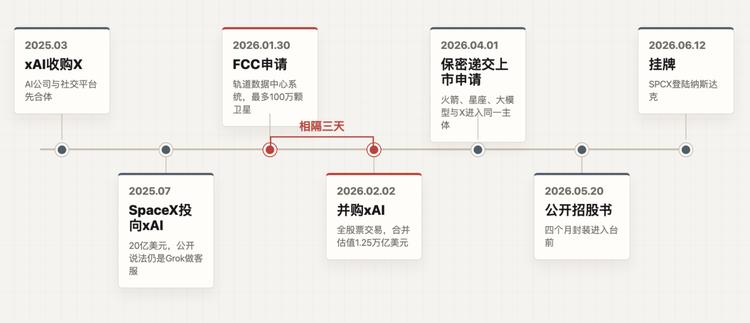
In March last year, xAI acquired X. In July, SpaceX invested $2 billion in xAI. At that time, the public explanation was only that Grok would provide customer service for Starlink. At the end of January this year, SpaceX submitted an application for an "orbital data center system" to the FCC, with a constellation scale of up to 1 million satellites.
Three days later, Musk announced that SpaceX would acquire xAI through an all - stock deal. SpaceX was valued at $1 trillion, and xAI at $250 billion, resulting in a combined company worth $1.25 trillion, exceeding any previous merger in history. Mergers usually take quarters, but this one was measured in days.
Both companies are private companies controlled by Musk, and the transaction doesn't require shareholder voting. The share - exchange ratio was determined internally. The preferred shares of xAI subscribed by Tesla with $2 billion at the beginning of the year were automatically converted into SpaceX shares upon delivery.
At the beginning of April, SpaceX confidentially submitted a listing application to the SEC, and the prospectus was made public in late May. Rockets, the world's largest satellite constellation, a large - model laboratory, and a social platform were all packaged into the same listed entity within four months.
The reasons for the merger given by Musk in the announcement all revolve around space. "Space - based AI is obviously the only way to scale," along with the more well - known quote "It's always sunny in space."
The vision part also matches this structure. "Mars" appears 63 times in the text. The company has identified a potential market of $28.5 trillion for itself, claiming to be the largest in human history, of which $26.5 trillion is attributed to AI, and rockets have become a minor part. Musk's new compensation plan is also included, with 1 billion restricted shares. The unlocking conditions include reaching a market value of $7.5 trillion and establishing a permanent settlement of at least 1 million people on Mars.
After the IPO, Musk will hold approximately 42% of the shares and about 82% of the voting rights. It's normal for minority shareholders to have little say in a listed company, but SpaceX has taken it to the extreme. The combined influence of all other shareholders can't outweigh his. The company's articles of association even explicitly state that he's not expected to prioritize business opportunities for SpaceX. This is an open secret.
3
The most expensive cloud in the valuation hasn't gone into space yet
On the night four days before the listing, in the last scene of the roadshow, Musk released the first computing - power satellite, AI1, through a half - hour technical video. It's equivalent to an enlarged version of Starlink V3 without communication antennas but with a computing payload. It has a wingspan of 70 meters, wider than a Boeing 747.
The computing power of such a large satellite has a peak of 150 kilowatts, only equivalent to an NVIDIA GB300 cabinet in a ground - based data center. One satellite for one cabinet, that's the current exchange rate for the orbital cloud. Musk doesn't think this is a problem. He said AI1 is "much simpler than Starlink satellites."
Two prototype satellites will be launched early next year. The supporting Gigasat factory is located in Bastrop, Texas, with a planned area of over 11 million square feet. Everything from solar cells to satellite assembly will be done in the same park, aiming for mass - production by the end of next year. The schedule is clearly in Musk's style. First, increase the deployment speed to 1 gigawatt per year, and then increase it by an order of magnitude each year, achieving 100 gigawatts per year in three to four years. The prospectus is more conservative, stating that the deployment of orbital computing - power satellites will start "as early as 2028."
The troubles on the ground are the best advertisement for this plan. The backlog of grid - connection applications in the United States has reached approximately 2,600 gigawatts, and the capacity auction price of the eastern power grid has hit record highs for three consecutive years. SpaceX has calculated that if 100 gigawatts of computing power per year were placed on the ground, the required electricity would be about one - fifth of the United States' annual electricity generation. The ground - based power grid really can't generate that much electricity, which is the more reliable half of the space - based solution.
The other half related to physics is not as cooperative. In a vacuum, heat can only be dissipated through radiation. The 325 - square - meter heat - dissipation system of the International Space Station costs hundreds of millions of dollars and can only dissipate about 70 kilowatts of heat, less than half of that of a GB300 cabinet. Jensen Huang simply called the space data center "a dream." He calculated that a GB300 cabinet weighs about 2 tons, of which 1.95 tons is essentially the heat - dissipation system.
The semiconductor research institution SemiAnalysis released a calculation last week. According to current technology, the comprehensive cost of space - based computing power is 3.6 to 4.4 times that of ground - based computing power. If things progress steadily, it won't reach parity with the ground until around 2040. A Google research paper on space - based computing power also set a threshold: the launch cost has to drop below $200 per kilogram. The actual price of the Falcon 9 today is $1,400 to $1,800. This threshold isn't unattainable. The aerospace industry research institution Payload estimated that the internal cost of the single - use configuration of Starship V1 has been reduced to around $500 per kilogram. Cutting it in half again with V3 would reach the threshold.
Starship is the key to the entire schedule. Musk's calculation in the FCC document is simple: launching 1 million tons of satellites per year, with each ton generating 100 kilowatts of computing power, would exactly result in 100 gigawatts per year. However, the V3 configuration only completed its first flight three weeks ago. The spacecraft made a controlled splashdown, but the booster crashed on its return. The FAA's investigation is not yet complete. SpaceX's current actual annual launch capacity is about 2,500 tons, 400 times less than 1 million tons. Musk has given three years for this improvement.
SemiAnalysis also had a counter - argument, bypassing all orbital parameters. The tightest bottleneck for AI is chip production capacity. Next year, AI demand may consume 86% of TSMC's N3 process production capacity. Even if the cabinets are moved to space, the chip manufacturing still happens on the ground.
Musk also has a contingency plan for this. In March this year, he provided a demand estimate: the newly added global AI computing power per year is about 20 gigawatts, only 2% of the ultimate demand of his companies.
In the same month, Tesla and SpaceX announced a joint - venture chip factory, Terafab, in Austin, targeting a 2 - nanometer process. The ultimate goal is to produce 1 terawatt of computing power per year, with 80% supplied to space. A production line for radiation - resistant orbital chips, D3, is also specifically planned. Intel later joined the project with advanced processes. This project itself is also uncertain. SpaceX estimates that the total cost of full construction could reach up to $119 billion, and there will be only about 10 High - NA EUV lithography machines available globally next year. SemiAnalysis warns that full - scale production at Terafab would be equivalent to 24% of the global foundry production capacity. It took TSMC thirty years to reach this scale.
These debates won't have a verdict for a while. The opponents hold the laws of physics, while Musk holds the construction records. Both sides believe that time is on their side.
There's no shortage of peer endorsements in this field. Google's Project Suncatcher also plans to launch two prototype satellites early next year. Starcloud, invested in by NVIDIA, has sent an H100 into orbit and trained a small model. Bezos said that a gigawatt - scale space data center will emerge in 10 to 20 years, and he commented that Musk's schedule is "a bit aggressive." China's Trisolaris Computing Constellation launched its first batch of 12 satellites in May last year.
There's no disagreement on the direction. The differences are all in the schedule, and Musk always reports the most aggressive number. He says that in two to three years, space will become the cheapest source of AI computing power.
Musk has a history of being overly optimistic about schedules. He's been saying that fully autonomous driving will be ready "next year" for almost a decade, and the date for human - rated Mars missions has been revised multiple times. The market has learned to discount his dates but recognize his direction. However, this time is different. The $1.8 - trillion valuation is precisely based on the date. Even if the direction is correct, being ten years late would be a completely different story.
The largest computing - power cluster currently in orbit belongs to Canada's Kepler, with 10 satellites and a total of 40 NVIDIA edge processors, serving 18 customers. The gap between this and Musk's goal of 100 gigawatts per year is roughly equivalent to the distance from a home router to the entire AWS.
There's an even more far - reaching aspect to this blueprint. Musk mentioned at the beginning of the year that in the future, factories will be built on the moon to produce computing - power satellites using local resources and launch them into deep space using electromagnetic catapults. The coordinates buried in the IPO documents are even more distant, ultimately aiming for a "Kardashev Type II" civilization, which can fully utilize the entire energy of its parent star. In a pricing document, such paragraphs actually serve a very practical purpose: to raise the upper limit of imagination beyond the reach of any valuation model.
