Japanese cars really can't hold on this time
In the fiscal year ending in March 2026, Japanese automakers collectively delivered their worst annual reports. The situation was surprisingly similar, yet the miseries varied.
Toyota, the leading player, saw its net profit decrease by 38.7 billion yuan (RMB, the same below) year-on-year. The culprit was the US tariffs. However, given Toyota's large scale, its net profit still reached 163.5 billion yuan, more than five times that of BYD.
In contrast, the smaller players had their own set of problems.
Honda reorganized its electric vehicle business, halting three electric vehicle projects that were close to mass production. All the R & D and mold costs went down the drain. The Afeela model jointly developed with Sony also failed. Honda made a one-time charge of 55.7 billion yuan, directly leading to an annual loss of 18 billion yuan after turning from profit to loss.
Nissan's situation was even worse. It suffered losses for two consecutive years. Factory closures and layoffs incurred hundreds of billions in restructuring costs, and its profitability dropped to the third - tier level.
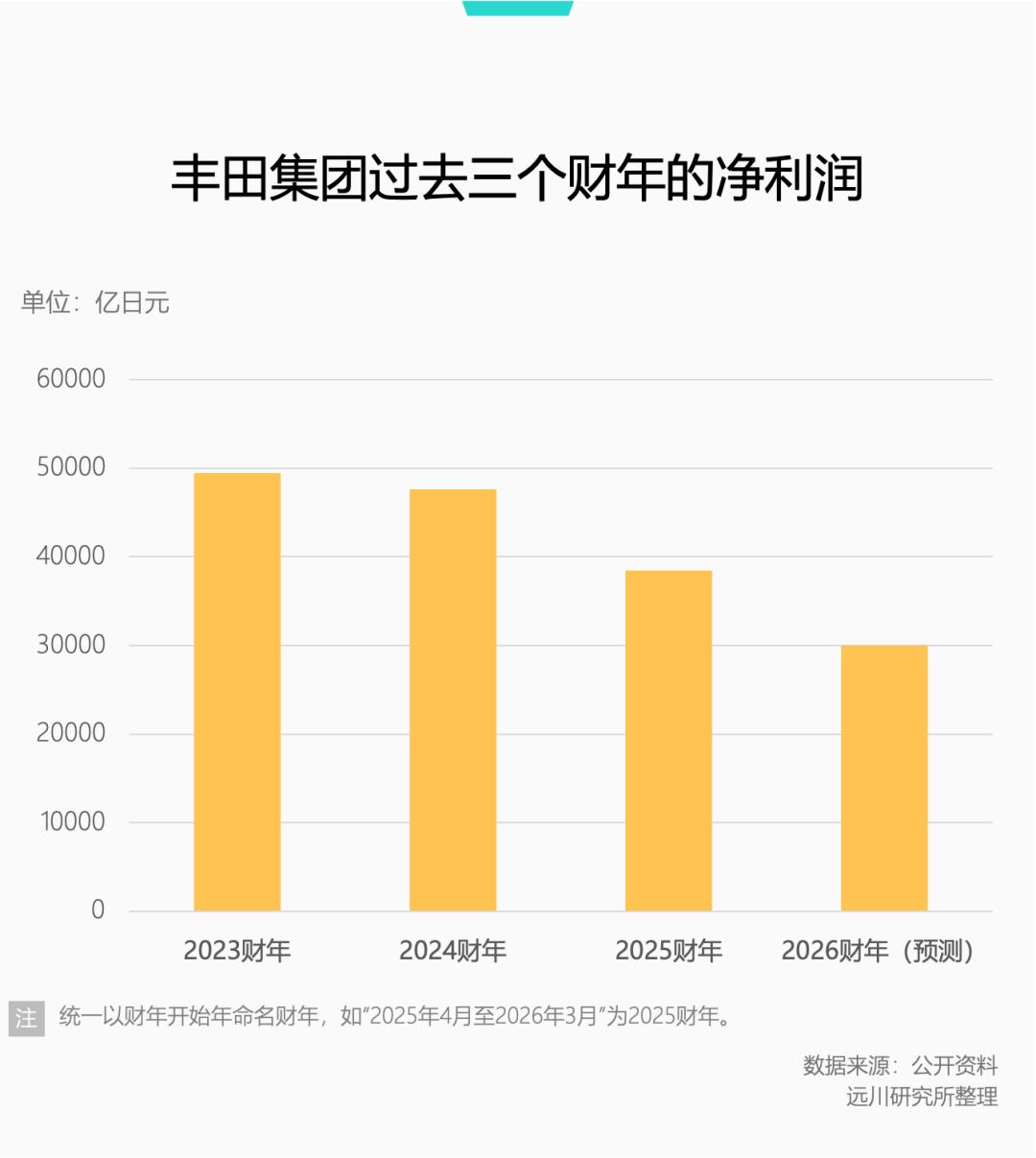
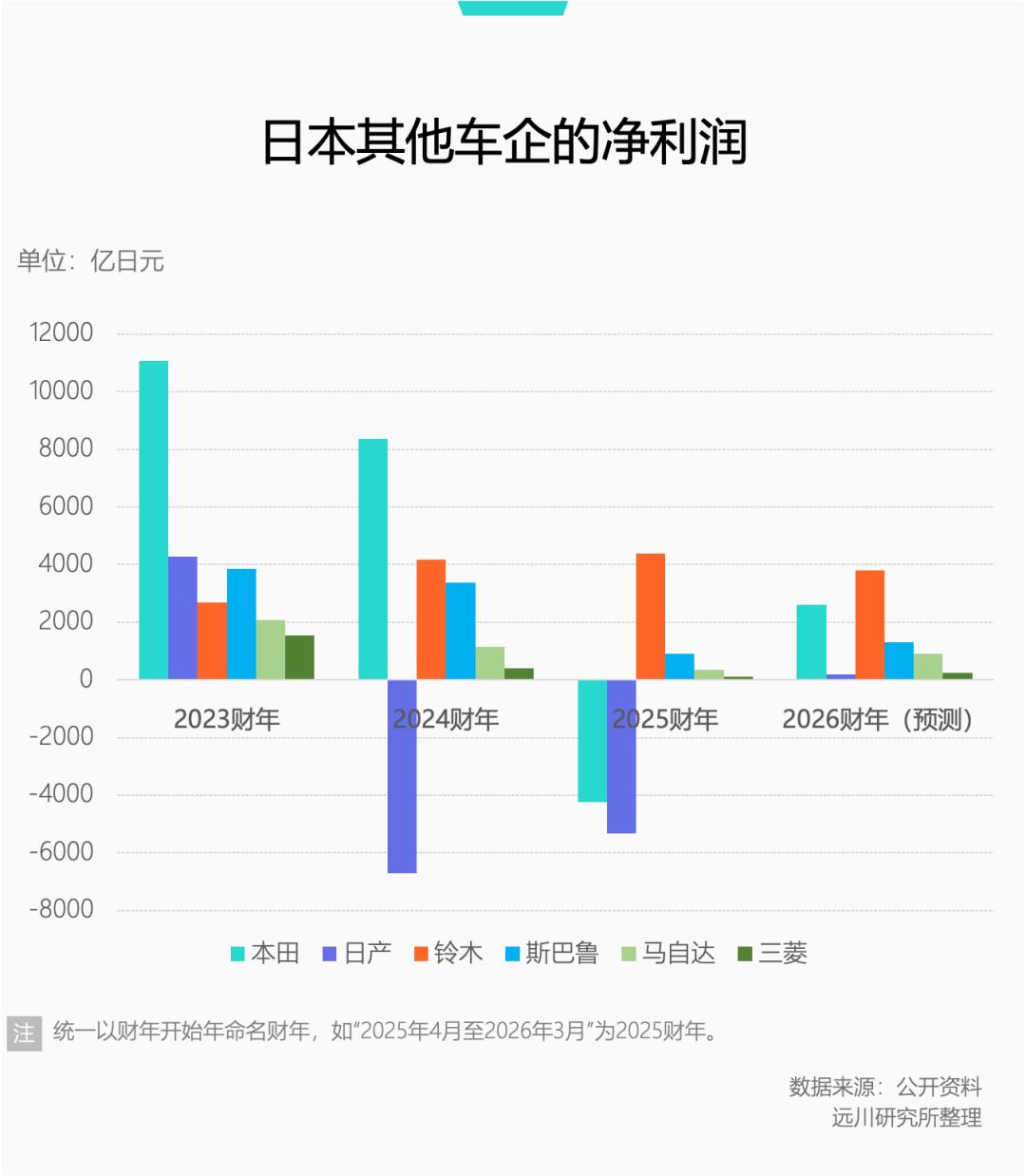
The performance in the old fiscal year was poor, and the guidance for the new fiscal year was also dismal.
According to the guidance for the fiscal year 2026 (from March 2026 to March 2027) given by the seven major automakers (Toyota, Honda, Nissan, Suzuki, Mazda, Subaru, and Mitsubishi), the total net profit was only 167.5 billion yuan, only 4 billion yuan more than Toyota's net profit last year, and 152.5 billion yuan less than the peak year of Japanese - made cars in 2023.
Recalling 2023, the profits of Japanese automakers hit record highs. Toyota's net profit of 210.1 billion yuan set a new record for Japanese manufacturing enterprises [1].
Who could have thought that this might well be the best year for the Japanese auto industry in the next decade?
Neither the East nor the West Shines
There has always been a view about Japanese cars: Japanese cars are struggling in China but thriving overseas.
This is indeed the case in the Chinese market. In 2020, Japanese cars had a 24.1% share in the domestic market, which shrank to 13.8% in the first quarter of this year.
The overall share shrank by 10%, but Toyota only suffered minor setbacks and faced relatively high profit pressure. The most severely affected were Honda and Nissan, whose sales were cut in half.
In January this year, the new - generation Honda Fit was launched in China with a limited release of 3,000 units. Unexpectedly, in a country with a population of 1.4 billion, only 3,000 people who really understand cars could be found.
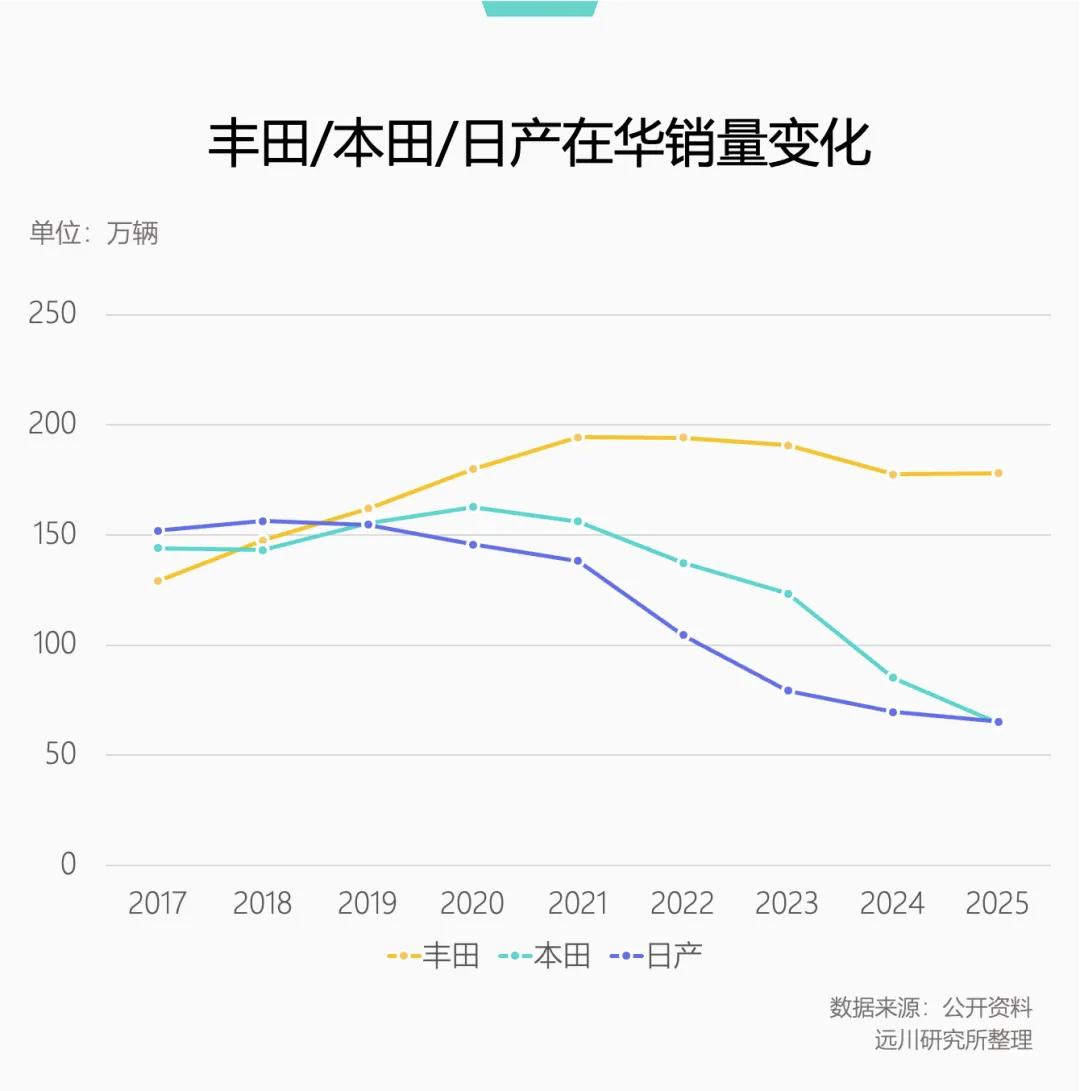
The failure in the Chinese market can be explained by the high penetration rate of electric vehicles. However, when looking at the overseas market, it is found that the foundation of Japanese cars is not as solid as expected.
The overseas market of Japanese cars can be divided into two major parts:
Firstly, in markets where Chinese cars have difficulty entering or cannot enter at all, such as India and the United States, Japanese cars have good sales.
Suzuki is the leader in the Indian passenger - car market. At its peak, it held a 51% market share, which has declined in recent years but still remains above 40%. The Indian market is characterized by a large base but low profitability. Even in a good year, Toyota can only sell more than 300,000 vehicles.
The United States is the largest single market for many Japanese automakers. Last year, Japanese automakers sold 6 million new cars in the United States, and Toyota's appeal was second only to that of the local General Motors [2]. Although the United States raised the tariff on Japanese imported cars to 15%, the main impact was on profits.
Secondly, in markets where Chinese automakers are making aggressive moves, Japanese cars have been greatly impacted.
Firstly, in Southeast Asia, Japanese cars have dominated for more than 60 years, with a long - term market share of over 80%. Especially in Thailand and Indonesia, Japanese cars used to have a share of over 90% and held absolute dominance.
However, after Chinese automakers entered Southeast Asia, they directly squeezed the market share of Japanese cars. According to Bloomberg statistics [3], from 2019 to 2024, the share of Japanese cars decreased by 6% in Indonesia, 12% in Thailand, and 18% in Singapore.
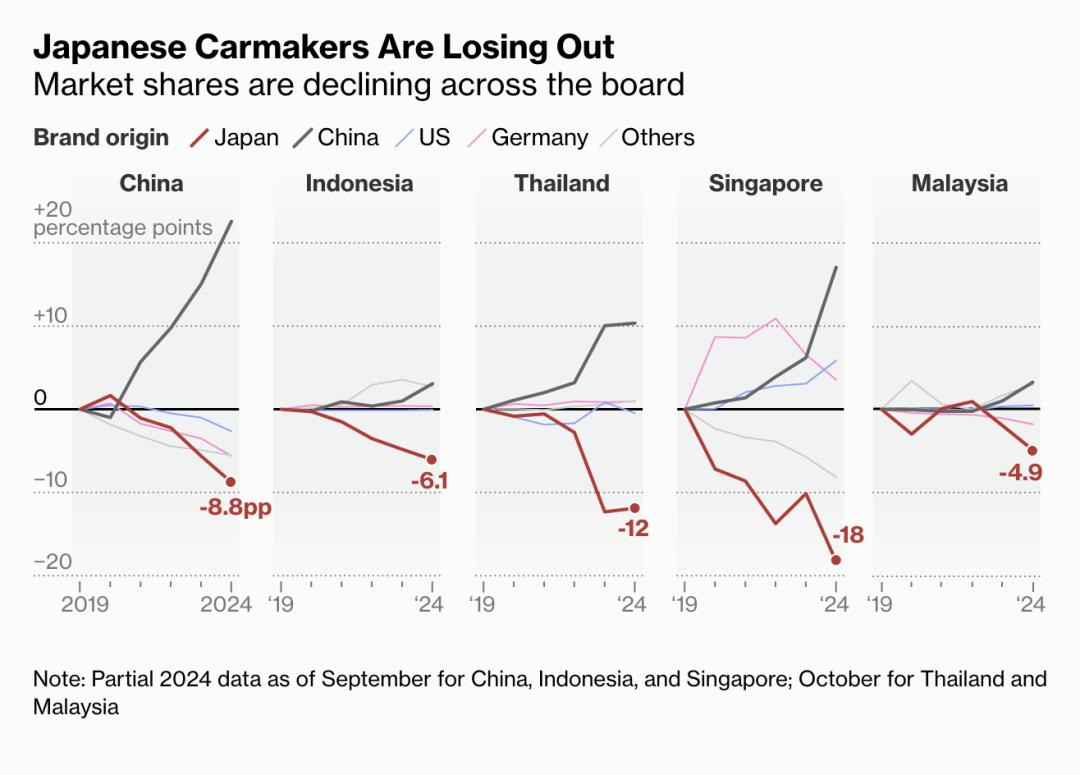
Meanwhile, in markets with low trade barriers against China, although the foundation of Japanese cars is solid, the growth rate of domestic automakers is very fast. We can compare the leading players, BYD and Toyota:
Indonesia: In 2023, Toyota sold 336,000 vehicles, while BYD sold 0; in 2025, Toyota sold 250,000 vehicles, and BYD sold 46,000 vehicles [4].
Thailand: In 2023, Toyota sold 276,000 vehicles, and BYD sold 29,000 vehicles; in 2025, Toyota sold 230,000 vehicles, and BYD sold 40,000 vehicles [5].
Brazil: In 2023, Toyota sold 192,000 vehicles, and BYD sold 17,000 vehicles; in 2025, Toyota sold 163,000 vehicles, and BYD sold 113,000 vehicles.
UK: In 2023, Toyota sold 109,000 vehicles, while BYD sold 0; in 2025, Toyota sold 90,000 vehicles, and BYD sold 51,000 vehicles.
A simple comparison of other automakers also shows the trend of "Japan standing still while China growing rapidly":
Indonesia: In 2023, Honda sold 139,000 vehicles, and Chery sold 4,000 vehicles; in 2025, Honda sold 56,000 vehicles, and Chery sold 19,000 vehicles.
Australia: In 2023, Nissan sold 39,000 vehicles, while Geely sold 0; in 2025, Nissan sold 35,000 vehicles, and Geely sold 5,000 vehicles in its first year in Australia.
This is a comparison of all energy - type vehicles. If we only look at the new - energy segment, the gap will be even more astonishing.
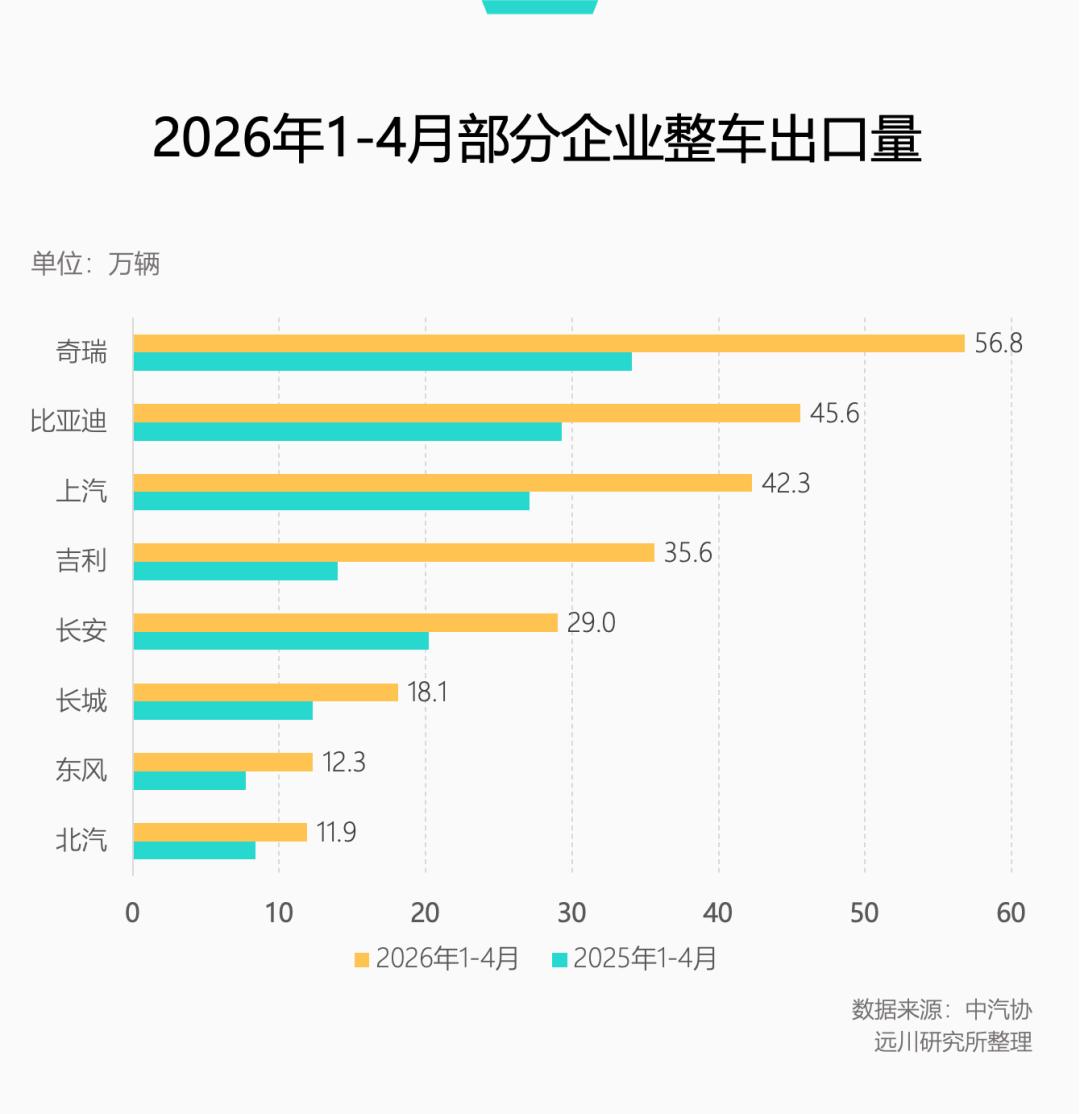
That is to say, the current survival situation of Japanese automakers cannot be simply explained by the China/overseas framework. The more direct reason lies in the energy structure.
Hybrids Are a Double - Edged Sword
Most of the relatively stable markets for Japanese cars have one characteristic: Hybrid electric vehicles (HEVs) are still popular.
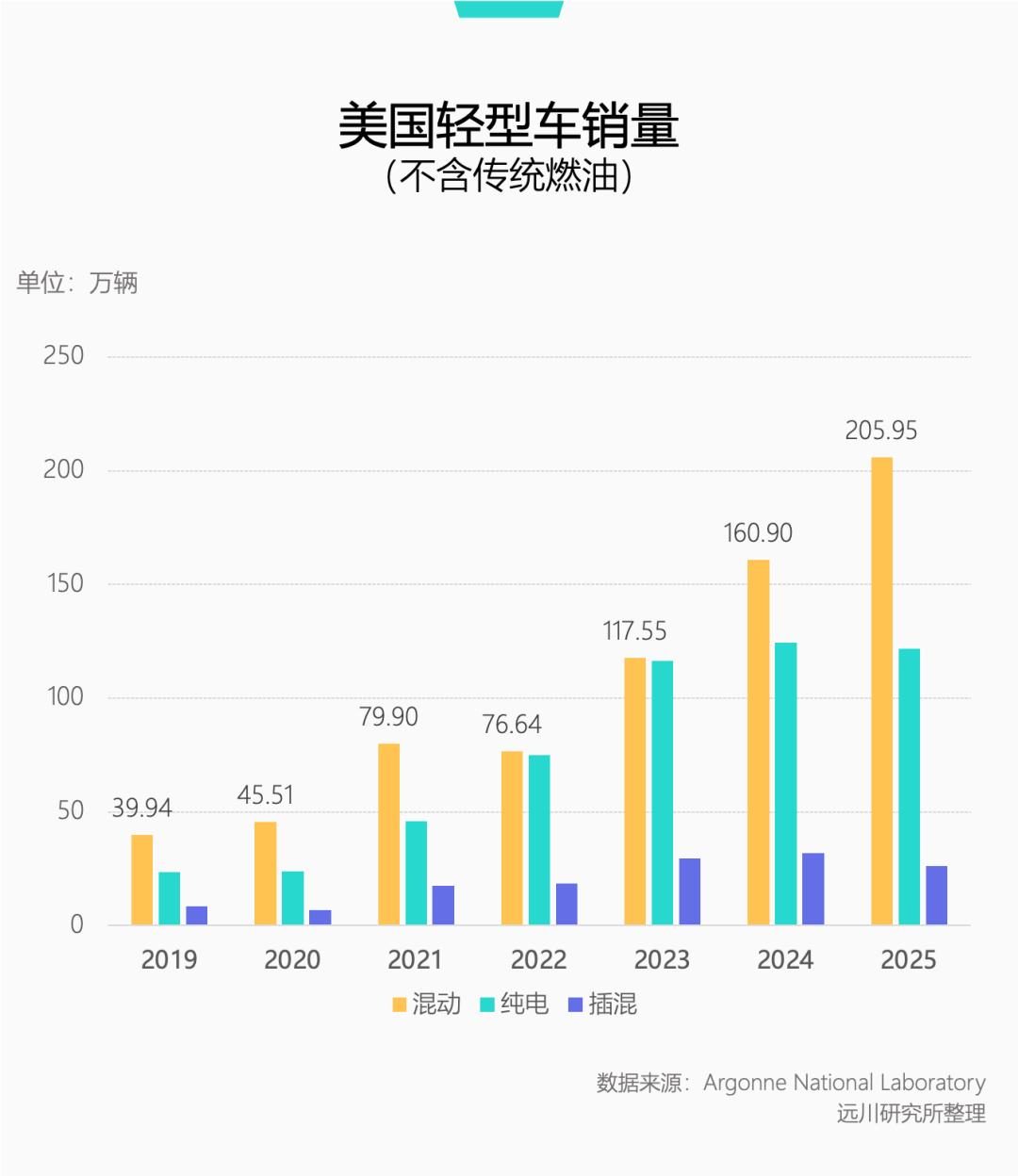
The most typical example is the United States. Classified by energy type, hybrids have always been the second - largest market after fuel - powered vehicles. On the contrary, after 2023, the growth of pure - electric vehicles has shown signs of weakness, while the growth momentum of hybrids has not stopped until now.
According to S&P Global data, in March this year, the share of hybrid vehicles in the United States increased to 15.3%. From the end of February to April, the sales of hybrid vehicles in the United States continued to increase by 37%, exceeding the 15% growth rate of the overall automotive market [6].
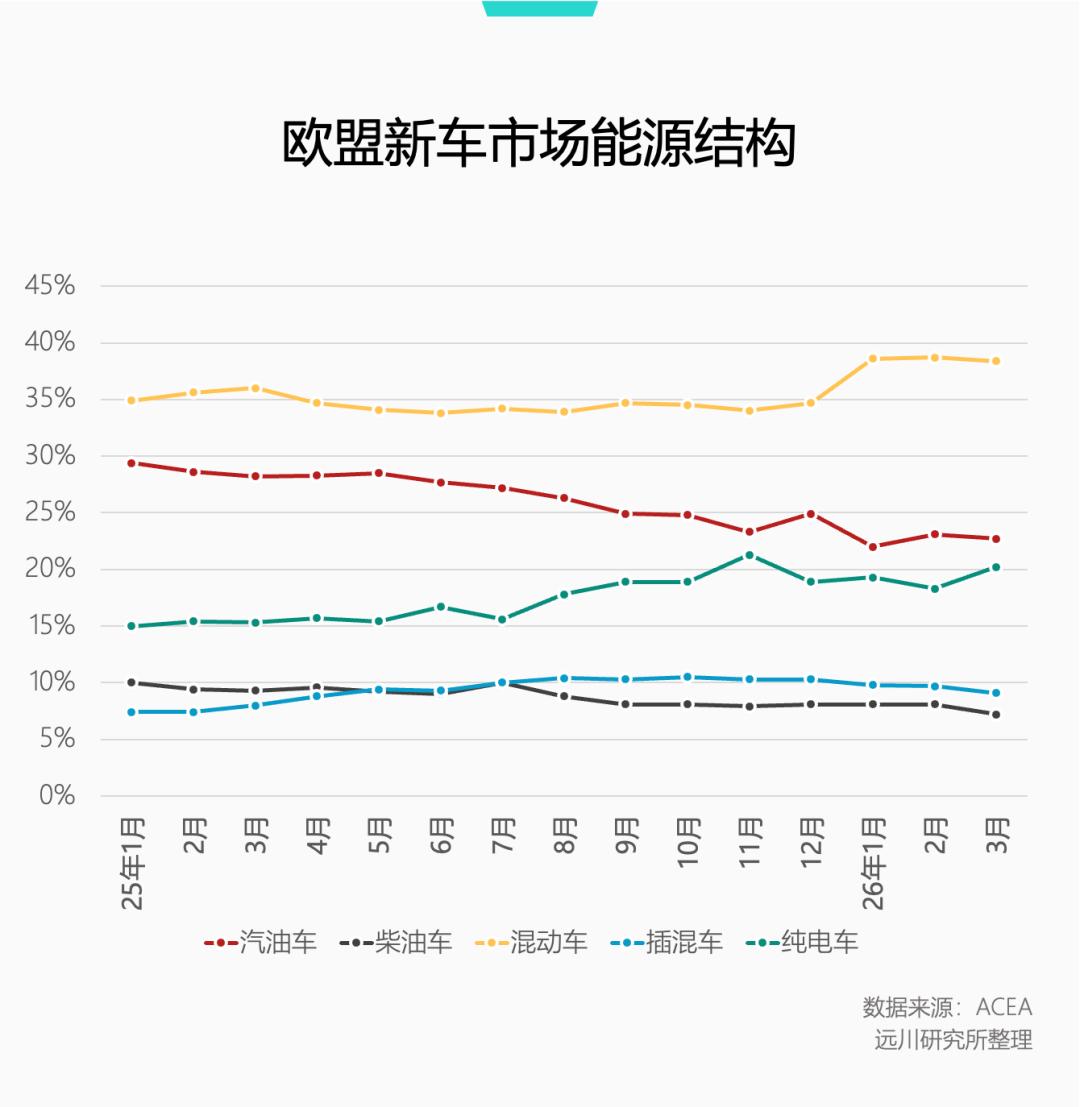
The situation in the EU market is similar. In the past year, the share of fuel - powered vehicles in the EU shrank by nearly 10%, but the penetration rate of pure - electric vehicles only increased by 5%. The remaining share was basically absorbed by hybrid vehicles.
Although the EU has been advocating the transformation to electrification, the infrastructure construction is seriously insufficient. From 2017 to 2023, the sales of pure - electric vehicles in the EU increased by 18 times, while the number of charging piles only increased by 6 times. Even in areas with relatively good infrastructure, there is a serious shortage of fast - charging piles.
In addition, in many parts of Europe, consumers need to bring their own charging cables for charging (usually new cars come with one). The reason is that there are often people stealing cables with professional hydraulic shears. Weak infrastructure and a tough social environment make consumers hesitant about the cause of energy conservation and emission reduction.
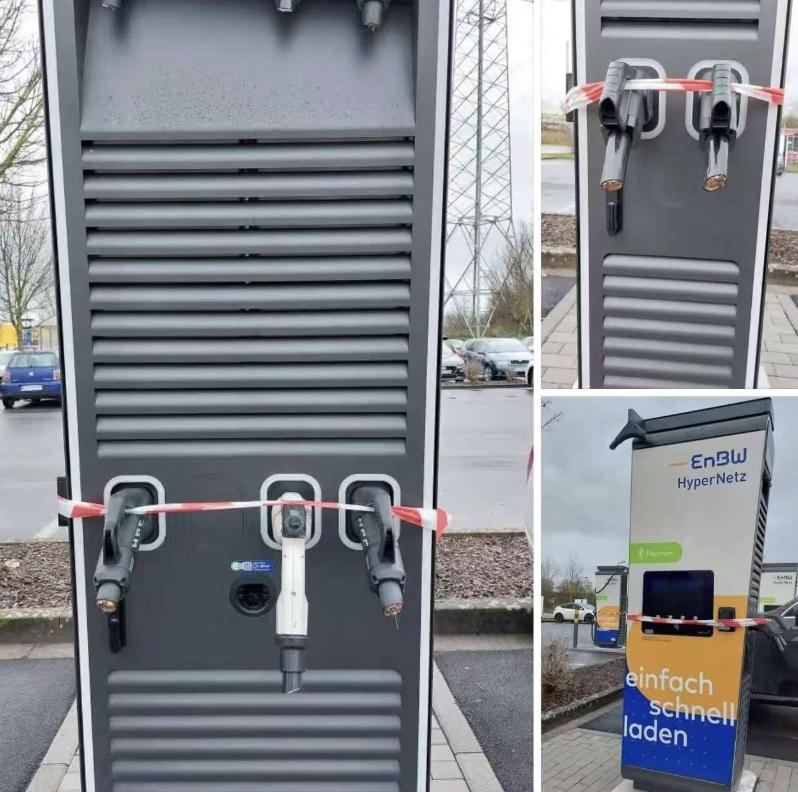
The cut is clean and the technique is professional.
By the first quarter of this year, the share of hybrid vehicles in the EU reached as high as 38.6%, supporting Toyota's annual sales of 1.2 million vehicles in the EU.
Japanese automakers have repeatedly failed in the pure - electric vehicle field, but they are unrivaled in the hybrid field. This track was defined by the Japanese, followed by the South Koreans, and not played by the Europeans and Americans at all. Chinese automakers have only started researching it in recent years.
Among them, Toyota's THS (Toyota Hybrid System) hybrid system was first installed in the Prius when it was launched. It has now developed to the fifth generation, laying the dominant position of Toyota in the hybrid technology field, with a long - term market share of around 40%.
Honda's i - MMD (now called e:HEV) had a somewhat bumpy experience. However, with its design logic centered on electricity, which combines low fuel consumption and the smoothness of electric vehicles, it has risen rapidly. In the United States, the CRV can sell 400,000 hybrid - version vehicles a year.
Because Nissan focused on pure - electric vehicles in the early years and did not launch hybrid products in time, it missed the early window of the hybrid boom. It did not mass - produce the e - POWER hybrid system until 2016 and is now making up for lost time by adding hybrid models.
That is to say, what really determines the survival situation of Japanese automakers is the acceptance of hybrids in different markets. Once the demand shifts, a crisis will emerge.
In November last year, Toyota launched a new - generation Hilux pickup truck at the Bangkok International Motor Show. The Hilux is a national favorite in Thailand and had not been updated for ten years. Intriguingly, Toyota unexpectedly added a pure - electric version during the update.
Toyota's explanation was "to provide consumers with more choices", but the real reason is probably that the hybrid market in Thailand and even Southeast Asia is shrinking, while Chinese new - energy vehicles are eyeing the market.
Last year, the penetration rates of new - energy vehicles in Thailand and Indonesia increased to 23% and 13% respectively. In April this year, the penetration rate of pure - electric vehicles in Thailand exceeded 23%, which was very close to the share of hybrid vehicles. If the pure - electric offensive continues, the Japanese automakers will have to give up the market they have built over decades.
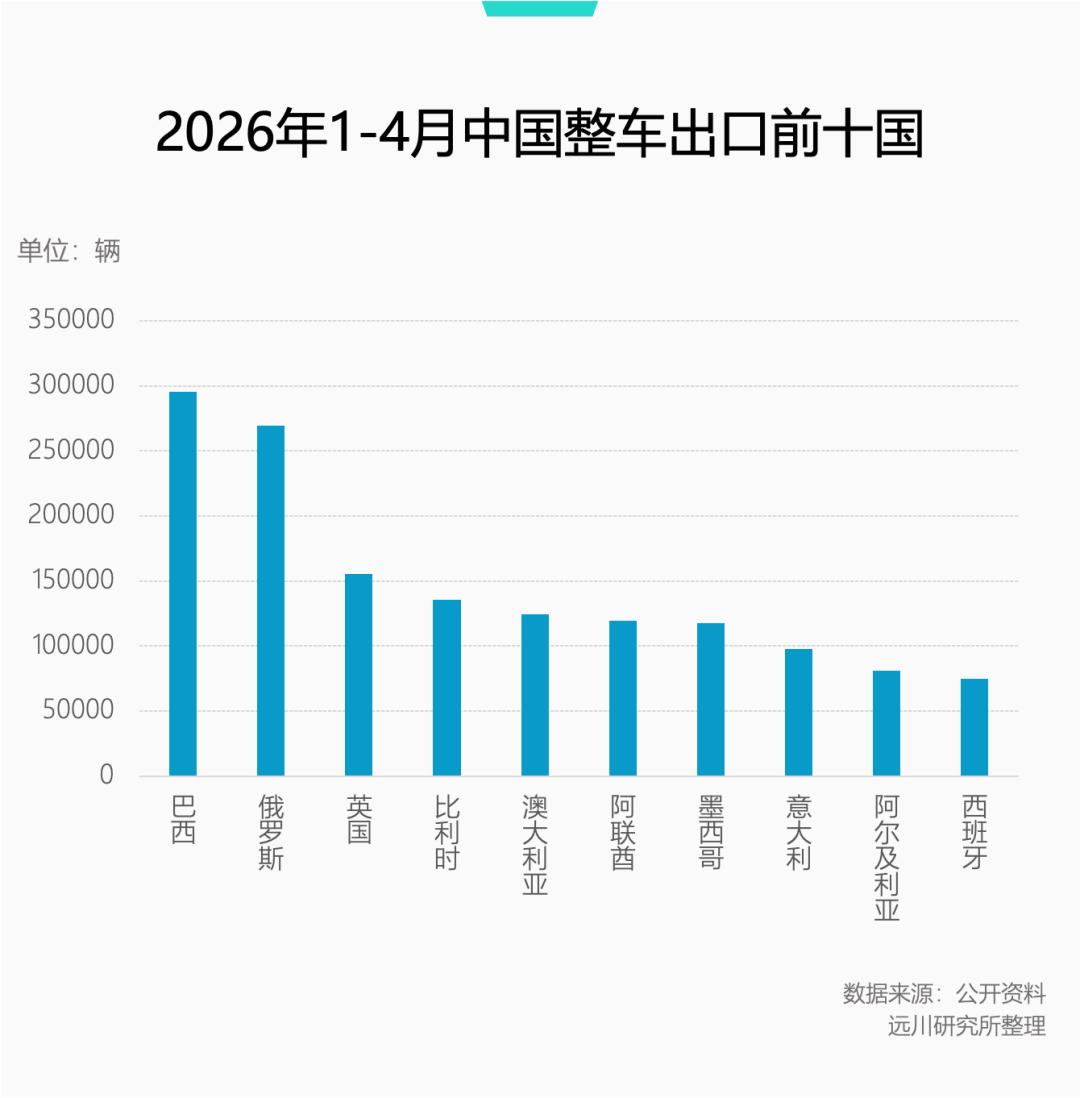
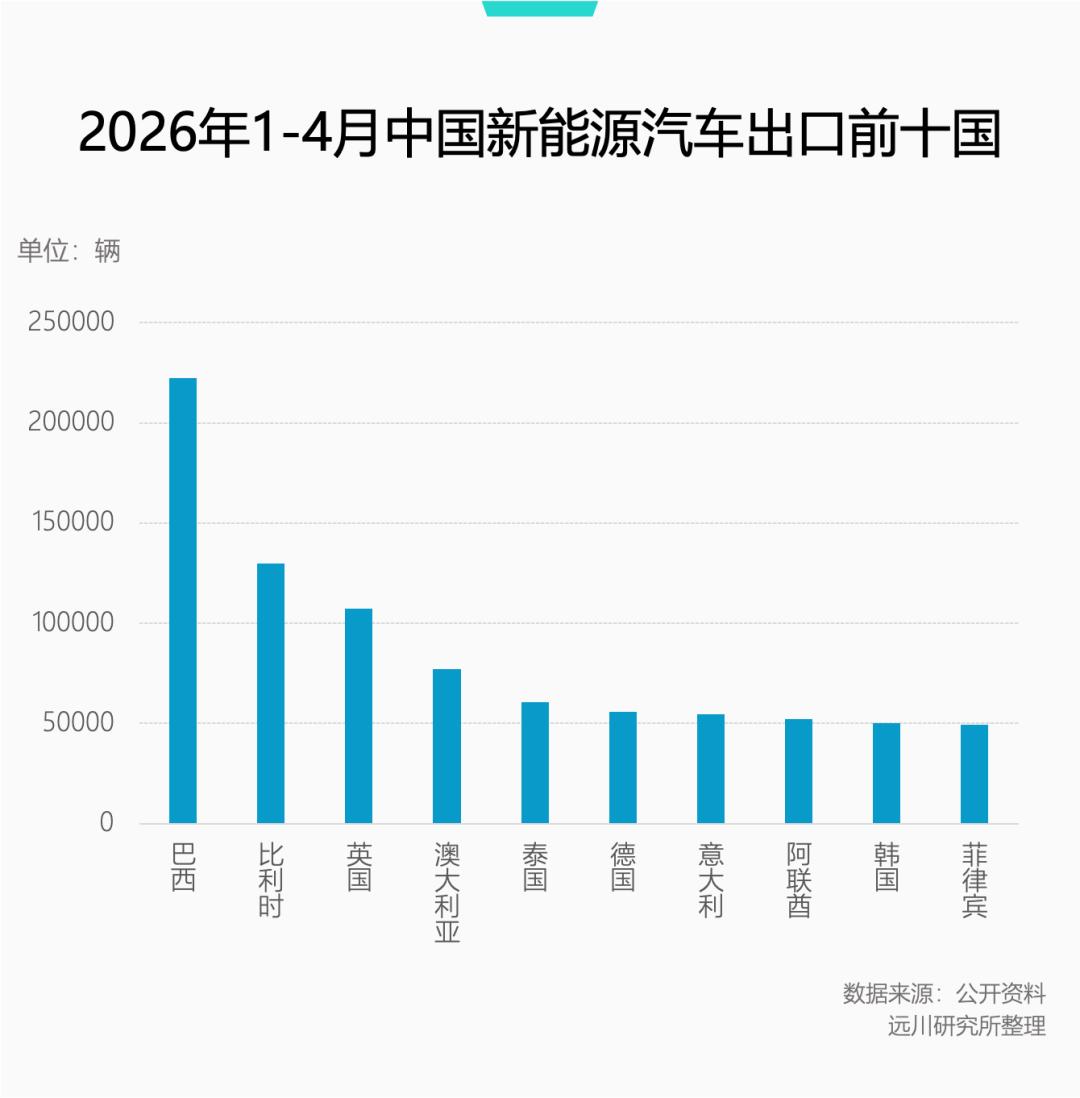
A similar situation is also happening in markets such as Brazil and Australia. The share of electric vehicles in Brazil is not high, only in the single - digit range, but the growth is significant. Chinese automakers send 50,000 electric vehicles to Brazil every month, continuously squeezing the living space of Japanese cars.
In this situation, Japanese automakers have made a consistent choice: to shrink their electric - vehicle business and focus their R & D on fuel - powered and hybrid vehicles. Instead of taking risks by expanding the