The 799-yuan AI Pet Language Translator: Whose Inner Voice Can It Understand?
“Does it meow at the empty food bowl in the early morning because it's hungry or just wants to act coquettishly?” This is the daily confusion of countless pet owners. In an era where pets have become “family members” to urban young people, the communication barrier between humans and pets has always been one of the biggest pain points in the pet - keeping scenario. For a long time, pet owners could only rely on experience to fathom their pets' emotions. This one - way emotional investment has always created a sense of estrangement in the companionship.
Since 2026, an AI pet language translator called PettiChat, priced at $799, has gone viral on social platforms. With the concept of “cross - species communication” and the promotional gimmick of “94.6% accuracy in emotion recognition”, this product, which looks like a collar, quickly became a hit on the Internet. The Hangzhou Mengxiaoyi Technology Co., Ltd. behind it has also frequently appeared on social media thanks to this lightweight intelligent hardware.
Along with the soaring popularity, controversy has also arisen. Is Mengxiaoyi a technological dark horse that has cracked the “human - pet barrier” or a new type of profit - seeker targeting the “pet economy” trend?
In any case, this seemingly imaginative AI pet language translator is pushing a brand - new track born out of artificial intelligence - human - pet AI interaction - to the forefront.
Millions in financing and over ten thousand pre - orders: Black technology or a false proposition?
“Who's the boss in the house?”
“Enough! I'm extremely angry right now. Let me go immediately!”
“I'm not afraid. I'll drive you away right now!”
In the promotional video of PettiChat posted on Xiaohongshu, the “feisty” quarrel lines of two cats were translated into real - time Chinese subtitles. And they were both wearing a special collar around their necks.
Recently, this AI pet language translator and the company behind it have attracted much attention. According to the official promotion, the product relies on Alibaba Cloud's Tongyi Qianwen large - model. It also cooperated with the College of Animal Sciences at Zhejiang University to complete data annotation and scenario training. It has learned over 5 million real vocal samples of cats and dogs, building a dedicated pet emotion recognition database. It can achieve real - time translation of cats' and dogs' emotions and needs, converting vocal signals such as meows, whimpers, and purrs into text - based emotion prompts that humans can understand. In the official introduction of PettiChat, it claims an “accuracy rate of up to 94.6%”.
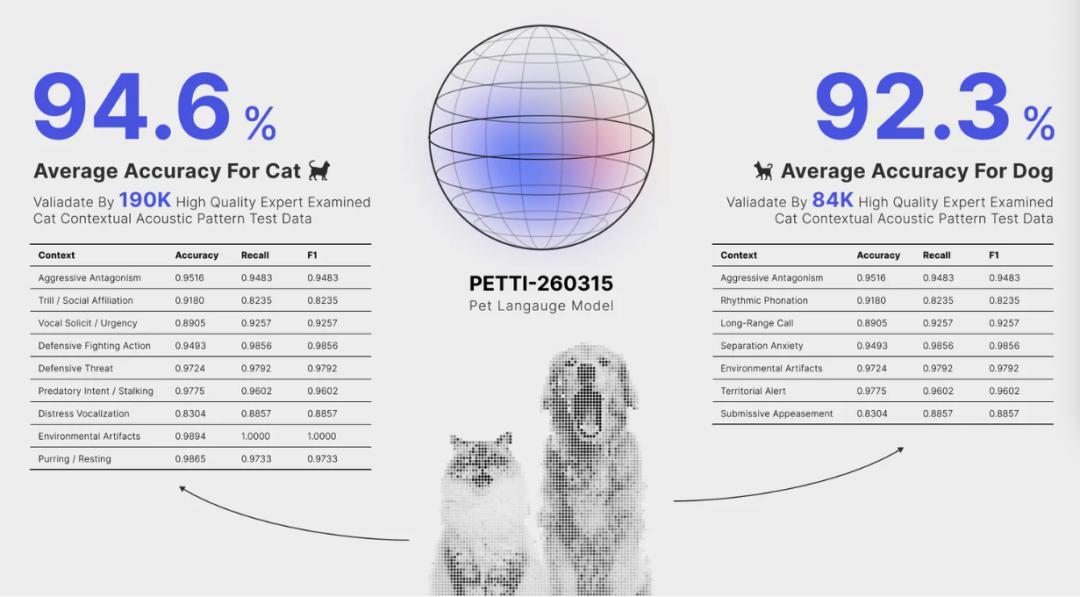
In addition, PettiChat claims to be able to achieve a two - way interaction mode. On the one hand, it can accurately identify more than 20 common core emotions and needs of cats and dogs, covering high - frequency scenarios such as hunger, drowsiness, excitement, anxiety, seeking companionship, and vigilance. On the other hand, it supports converting human voices into pet languages for playback, helping owners actively establish a standardized communication mechanism to correct pet behavior.
It is understood that the device was officially open for pre - orders in early May 2026. As of May 24, 2026, the order volume had exceeded ten thousand units, and it even topped the “Hot - selling List of Social and Entertainment Smart Accessories” on the e - commerce platform for a while.
On platforms such as Xiaohongshu and Douyin, there have also been many reviews and discussions about the product. Zinc Scale noticed that many pet owners are taking a wait - and - see attitude, saying things like “How is the 94.6% accuracy rate calculated?” and “After raising cats or dogs for a long time, you'll know that cats and dogs often express themselves through actions and expressions, not just meows.”
A pet owner who bought the PettiChat pet translator posted her experience on Xiaohongshu, saying, “I feel like a big fool. After using it for a few days, my overall evaluation is just average.” She mentioned that “it's hard to say about the translation accuracy. Based on my understanding of my cat, I'd say it's about 30% - 50% accurate. You still need to figure out what your cat really means on your own.” She also pointed out that “cats that are not used to wearing collars may feel uncomfortable and keep scratching.”
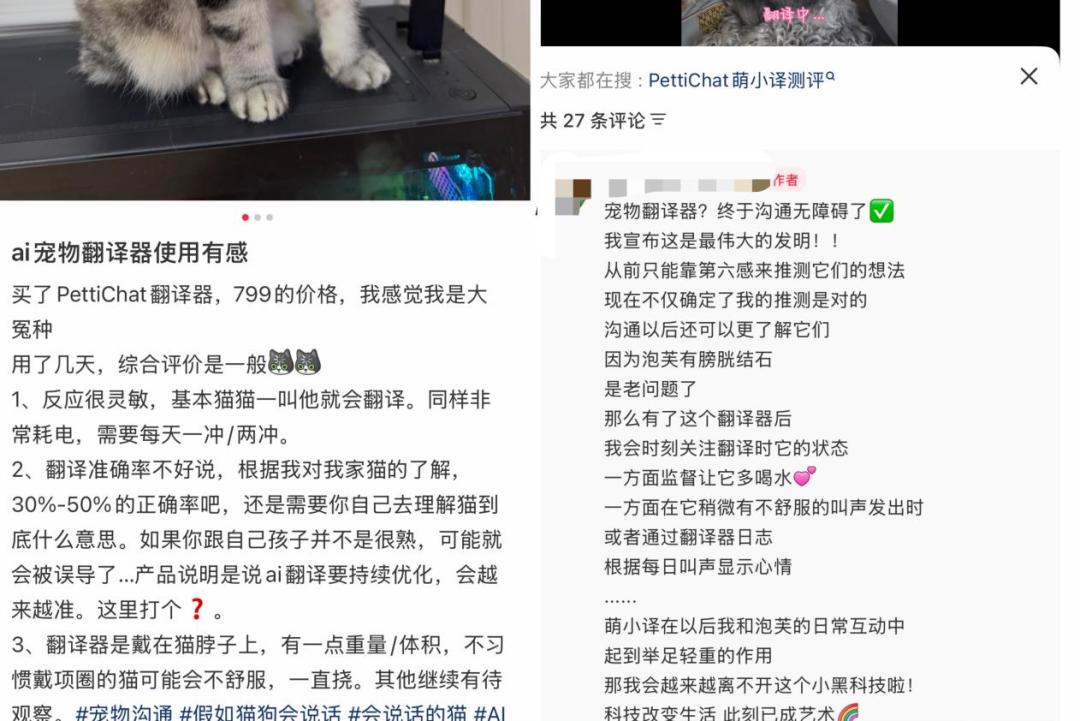
User experience on Xiaohongshu
However, perhaps, rather than saying that such products understand the pets' inner thoughts, it's more accurate to say that they are targeting the pet owners' desire to communicate with their pets. Some bloggers claim that this is “the greatest invention” because “previously, we could only rely on our sixth sense to guess our pets' thoughts. Now, not only can we confirm that our guesses are correct, but we can also understand them better after communicating.”
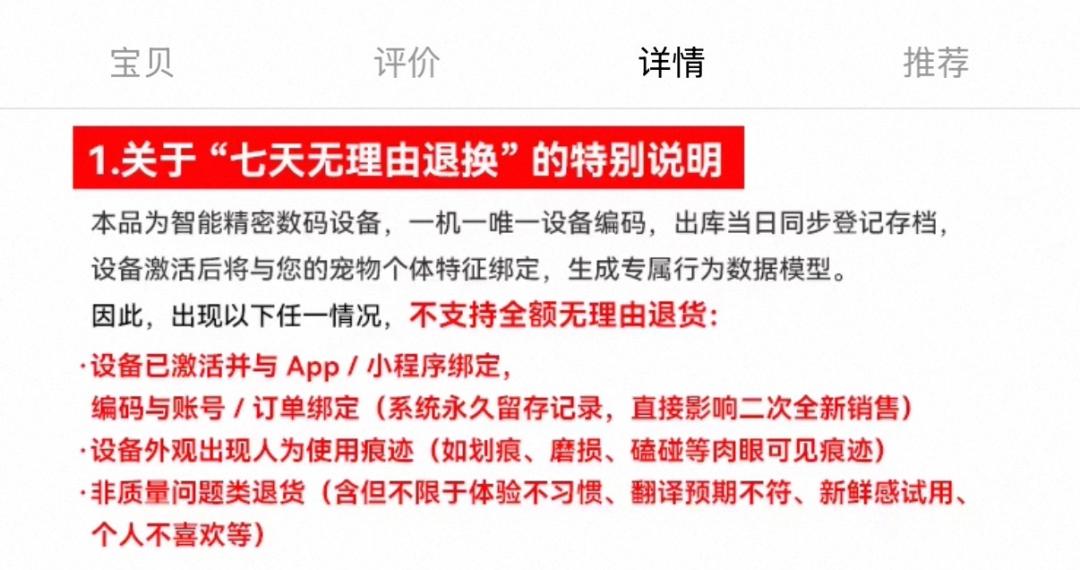
When Zinc Scale asked the customer service of PettiChat on the e - commerce platform “how to ensure the accuracy of the product”, the other party said that “there is no specific guarantee method in the product details.” Regarding the after - sales service, it clearly stated that “full - refund without reason is not supported for returns that are not due to quality issues (including but not limited to discomfort during the experience, inconsistency with translation expectations, etc.).”
In response to the accusation of being a “rip - off”, Mengxiaoyi once told the media that the product is in its early stage of launch, and the algorithm is still being continuously iterated and optimized. In the future, it will continuously improve the recognition accuracy in complex scenarios and perfect the emotion recognition dimensions through OTA upgrades. Subsequently, a relevant person in charge of Mengxiaoyi also said, “It's normal for any new thing to face doubts and disputes. Only by experiencing it yourself can you know that this product is not a rip - off.”
According to Tianyancha information, Hangzhou Mengxiaoyi Technology Co., Ltd. was established in January 2026, with a registered capital of 588,235 yuan. Cai Hongbing, the legal representative, is the actual controller, holding 72.25% of the shares. Although the company has only been registered for four months, the founding team has a very impressive background. According to public information, the core R & D members of the company mainly graduated from universities such as Zhejiang University and the National University of Singapore.
The capital market has also responded quickly. In April this year, Mengxiaoyi completed a seed - round financing of $1 million under the PettiChat brand image, jointly invested by the Zhejiang University Alumni Fund Oufang Angel and Huadan Angel. The financing is mainly used for the research and development of the animal behavior world model, the construction of a high - quality data set, and the market promotion of the first hardware product.
From “human mind - reading” to “AI guessing”
In fact, pet language translation is not a brand - new concept. Around 2020, a niche service of human pet translators emerged in the domestic pet market. The service model was mostly that users uploaded pet videos and audios, and senior pet owners and pet behavior practitioners would manually interpret the pets' emotions and needs based on their years of experience.
But this model has fatal flaws: First, it is extremely inefficient. A single interpretation takes dozens of minutes and cannot achieve real - time interaction. Second, it is highly subjective. There is no unified data standard, and the interpretation results completely depend on the personal experience of the practitioners, resulting in a very high error rate. Third, it is costly. The price of a single service ranges from dozens to hundreds of yuan, making it impossible to be popularized on a large scale. Therefore, human pet language translation has always remained at the level of a trendy and fun experience and has never formed a regular consumer market.
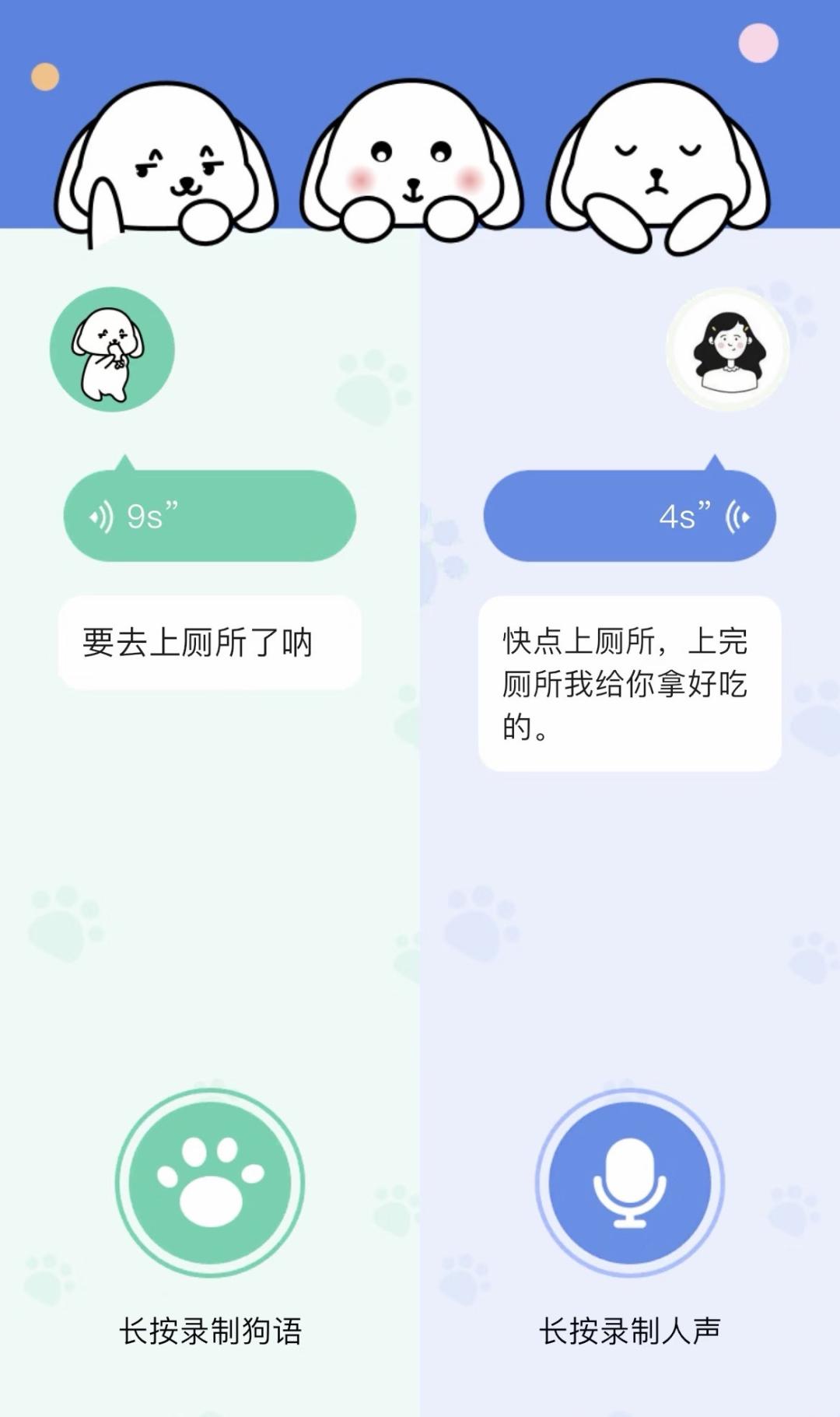
Interface of a pet translation app
After that, a large number of pet translation apps appeared on the market. They would analyze the audio recorded by the mobile phone and output simple text judgments such as “hungry” and “want to play”. However, most of them remained at the entertainment level and were criticized by users as “random guessing”. A reporter from Xinwen Chenbao once tested a cat language translation app and found that although the cat food bowl was still full, the app repeatedly translated the cat's meows as “I'm hungry and need to eat”. The accuracy was hard to verify.
Behind this is a pain point that pet translators can hardly avoid. As an article titled “Pet Translation Technology: A Breakthrough or a False Proposition of Large - models and Voiceprint Data?” published on the Baidu Developer Center wrote, there are two unavoidable technical paradoxes in pet emotion annotation. One is the inaccessibility of Ground Truth. Animal behavior research has confirmed that canine emotion expression has multi - modal characteristics. Inferring emotions only through voiceprint data is like judging specific semantics from the pitch changes in human speech (e.g., being unable to distinguish between “Okay” and “Okay, then”). The other is the cumulative effect of subjective bias. A research team conducted three independent annotations on the same set of recordings and found that the consistency of different annotators' judgments on the “anxiety” emotion was less than 58%. When these annotated data are used for model training, the model will learn human subjective biases rather than objective laws.
However, the emergence of Mengxiaoyi is not accidental but a result of the trend. According to the “2026 China Pet Industry White Paper (Consumption Report)”, in 2025, the consumption market scale of urban pets (cats and dogs) reached 312.6 billion yuan, a 4.1% increase compared to 2024. During the same period, the number of urban cats and dogs exceeded 126 million.
What's more interesting than the numbers is the change in the consumption structure: Pet owners' needs are shifting from “functional consumption” to “emotional companionship consumption”. The vast majority of consumers clearly state that they are willing to pay for the “emotional value” of their pets. The pet technology track is accelerating its growth with this favorable wind. The global pet technology market scale was about $19.98 billion in 2025 and is expected to grow to $147.79 billion by 2034, with an annual compound growth rate of nearly 25%.
When the multi - billion - level market is full of capital and emotional potential, AI suddenly achieved the initial technical link of “understanding pets' needs” at a critical moment. The human - pet AI interaction track has become a must - compete area overnight.

Picture from PurrPurr official flagship store
In December 2025, the Silicon Valley pet emotion AI company Traini announced the completion of a new round of financing of $7.5 million. The funds are mainly invested in the research and development of multi - modal emotion models and the expansion of the overseas market. The domestic startup PurrPurr launched an AI emotional companion collar weighing only 17.9g, specially designed for cats and small dogs. It is equipped with a digital silicon microphone and a six - axis IMU to collect sound and posture data 24/7, writing “AI diaries” for pets from the first - person perspective and forming an MBTI personality profile. The OPC startup OMO TECHNOLOGY LTD, founded by three alumni of China - Europe International Business School, focuses on an AI pet care assistant with active perception and active companionship...
Obviously, judging from the industry situation, “cross - species translation” has become one of the most important narrative threads in the AI pet track.
Back to the core question at the beginning: Is AI pet language translation a rip - off?
Looking rationally at this product priced at $799 and claiming a 94.6% accuracy rate - in the current technical framework, it may be too early for AI to truly achieve “word - for - word accurate” cross - species two - way translation of pets. But we can also make a more open - minded judgment: Rather than saying it is trying to sell “a promise of stable and accurate pet language translation”, it is more about shaping a new way of pet - keeping interaction - based on data tracking and emotional AI, reconstructing the companionship relationship between humans and animals in the context of technology.
Indeed, any emerging track of cross - species communication will be accompanied by a period of ambiguity between truth and falsehood in technology. The real driving force behind the catalysis of this track never comes from the 100% maturity of technology but from the pet owners' emotional desire to “understand their furry friends better”. The stronger this desire is, the broader the depth of the track will be.
This article is from the WeChat official account “Zinc Scale” (ID: znkedu), author: Li Xuanqi. Republished by 36Kr with authorization.