AI "chip grab" impact: Prices of automotive-grade memory chips skyrocket, and the wave of new energy vehicle price hikes spreads
When the fuel - powered vehicle market is having large - scale sales with discounts of over 20%, the automotive industry generally predicts that a new round of price cuts for new energy vehicles will arrive in 2026. However, the current market trend is going in the opposite direction. Although the battery cost has indeed decreased, the terminal vehicle prices are quietly rising. This time, what is driving the price increase is not the battery or steel, but an automotive - grade storage chip that most consumers can't even name.
The latest research report released by UBS clearly points out that the price increase of storage chips has become the biggest cost pressure source in the automotive industry in 2026, and its impact even exceeds the previous price increase of battery raw materials. As of early June, this wave of chip price increases that started in March has spread to the terminal market. More than a dozen domestic new energy vehicle manufacturers have successively raised their prices or tightened purchase discounts. A battle for production capacity triggered by the AI industry is affecting the automotive industry.
Cost pressure transmission from the sky - rocketing chip prices to the terminal market
Since March 2026, the prices of global automotive - grade storage chips have shown a rare upward trend, and the increase and transmission speed have far exceeded industry expectations. Reports from CCTV Finance and Global Times show that in just three months from March to June 2026, the overall price of domestic automotive - grade storage chips has increased by 180%, and the increase of some high - end models is even more astonishing.
This sky - rocketing price has directly translated into an increase in the overall vehicle manufacturing cost. In the era of intelligent connected vehicles, new energy vehicles have evolved from simple means of transportation to "data centers on wheels". The usage and cost proportion of storage chips are both increasing rapidly. High - level autonomous driving needs to process a large amount of data from radars and cameras, and the intelligent cockpit also needs storage for navigation and entertainment. The UBS research report points out that currently, the number of chips used in a high - level intelligent driving vehicle can reach more than 5,000, and the cost of storage chips accounts for 8% to 20% of the vehicle's selling price.
Without automotive - grade storage, many intelligent functions simply cannot run. Traditional fuel - powered vehicles only need a small amount of basic storage to support the operation of the in - vehicle system. However, for high - level new energy models equipped with lidar, high - computing - power intelligent driving platforms, high - definition maps, and multi - screen intelligent cockpits, the usage of storage chips per vehicle is 4 to 8 times that of ordinary entry - level models.
From the perspective of actual cost changes, the storage cost per vehicle for mid - to high - end models has increased from the early $40 - $90 to the current $90 - $220. For top - level intelligent models equipped with urban NOA and edge - side large models, the storage cost per vehicle has even exceeded $500.
According to this calculation, in the first quarter of 2026, only the two most important storage chips, DRAM and NAND Flash, have added a cost of 7,000 to 10,000 yuan to each new energy vehicle. If the simultaneous price increases of other automotive - grade chips such as MCUs and power semiconductors are also taken into account, the total cost of most new energy vehicles has been more than 10,000 yuan higher than that in 2025. For the automotive industry with already thin profit margins, it is almost impossible for vehicle manufacturers to fully absorb such cost pressure internally. Eventually, part of it will be passed on to the terminal market.
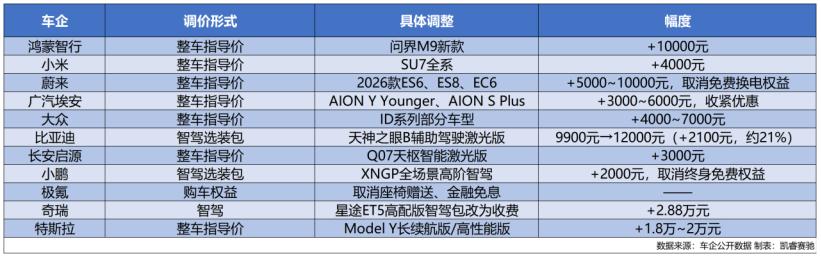
Price adjustment plans of some vehicle manufacturers
As of mid - May 2026, many domestic new energy vehicle manufacturers have completed price adjustments or tightened terminal discounts. The price adjustment range is mainly concentrated between 2,000 yuan and 6,000 yuan, and the increase of high - level intelligent driving optional packages is generally more than 20%. It is worth noting that in this wave of price increases, the higher the level of intelligence of the vehicle, the greater the price increase; while entry - level pure - electric and plug - in hybrid models are relatively less affected. At the same time, the fuel - powered vehicle market shows a completely opposite trend. Most fuel - powered vehicle brands are increasing price - cut promotions, and the terminal price cuts of some models are even approaching 30%.
AI production capacity siphoning becomes the key variable
The key reason for the current price increase of storage chips is the siphoning of global production capacity by AI. Statistical data shows that in the past three years, the usage of HBM in AI clusters has skyrocketed by 1,800 times, the overall HBM usage in AI systems has increased by 65 times, the HBM loading capacity of a single AI chip has increased by 7 times, and the storage usage of a single leading - edge AI training cluster has exceeded the total global HBM production in 2020.
Three global storage giants, Samsung, SK Hynix, and Micron, monopolize more than 90% of the market share. Their production capacity allocation decisions directly determine the price trend of global storage chips. Since the second half of 2025, the global AI server market has witnessed explosive growth, driving the demand for HBM high - bandwidth memory to rise exponentially.
As the core component of AI servers, HBM has a profit margin of 85% to 90%, far higher than that of automotive - grade storage chips. To pursue the super - high profits of HBM, since the second half of 2025, the three major original manufacturers have given priority to allocating 70% to 80% of their advanced wafer production capacity to HBM dedicated to AI servers and high - end DDR5 products. The production capacity of automotive - grade storage chips with thin profits and small demand volume has been continuously compressed, and the industry supply - demand gap has been continuously expanding.
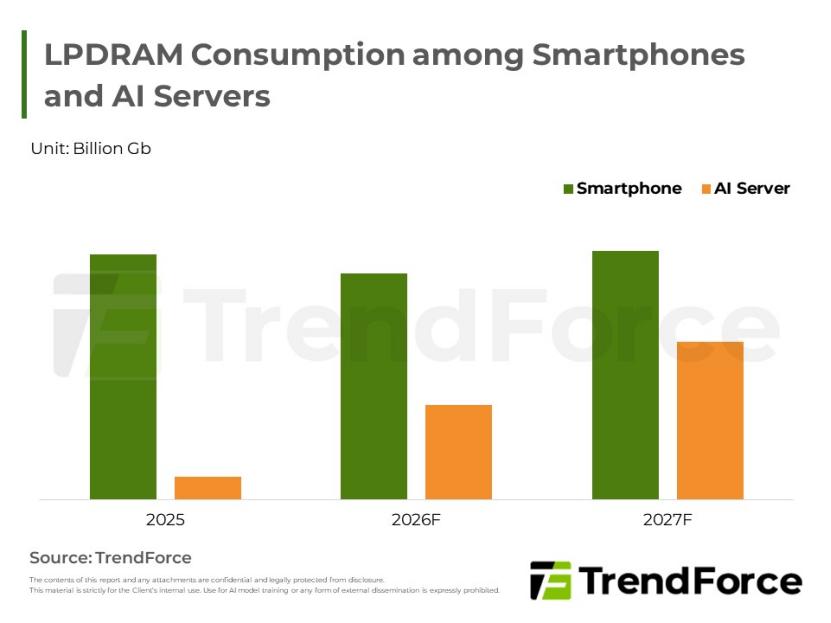
Forecast data from TrendForce shows that in 2028, the demand share of the server side in the global DRAM production capacity will climb to 59%, and the shares of smartphones and PCs will shrink to 19% and 5% respectively. The consumer electronics and automotive industries have become the bottom of the industrial chain and can only purchase high - priced chips through the spot market. Price increases, specification reductions, and declines in shipment volume of terminal products have become an inevitable trend, and the entire industry has entered a new normal of "price increase and volume reduction".
As an industry insider said, "The orders for AI servers are signed for billions of dollars at a time. In the eyes of the three giants, the orders from vehicle manufacturers don't even make the list." The automotive industry has almost no ability to fight back and can only passively accept the reality of price increases and extended delivery cycles. Currently, the delivery cycle of automotive - grade storage chips has been extended from the original 1 to 2 months to 6 to 12 months. The term "chip shortage" has become a frequently mentioned phrase in the industry again after the pandemic.
At the same time, the automotive industry's own demand for storage chips is continuously and rapidly increasing. The rapidly growing intelligent new energy vehicles have further exacerbated the "chip shortage". With the large - scale implementation of 800V high - voltage platforms, the rapid implementation of urban NOA functions, and the standardization of V2X communication modules, the demand for single - vehicle storage capacity is increasing at a rate of more than 30% per year. This serious imbalance between supply and demand determines that the upward trend of storage chip prices is difficult to reverse in the short term.
However, the progress of domestic storage manufacturers has brought a certain substitution window. In recent years, domestic enterprises such as YMTC, GigaDevice, and CXMT have made considerable progress in the field of storage chips, gradually breaking the monopoly of overseas giants. Data shows that as of April 2026, the overall self - sufficiency rate of Chinese automotive chips (including storage, computing, power, etc.) is about 25%, but advanced - process products such as high - end LPDDR5X and UFS4.0 still rely on imports, with an import dependence of over 70%.
Currently, domestic manufacturers are accelerating the R & D and mass - production process of automotive - grade products. As the world's second - largest supplier of automotive - grade NOR Flash, GigaDevice occupies more than 40% of the domestic market share. Its automotive - grade products cover more than 90% of domestic self - owned vehicle manufacturers, including mainstream brands such as BYD, NIO, and XPeng.
As the only domestic enterprise with large - scale DRAM mass production, CXMT's some automotive - grade products have passed the AEC - Q100 certification and successfully entered the supply chains of vehicle manufacturers such as BYD and NIO, and also cover terminal brands such as Lenovo and Xiaomi. YMTC leads in the field of 3D NAND. The fourth - generation TLC 3D NAND based on the Xtacking architecture has excellent storage density and I/O speed, and can be adapted to high - bandwidth demand scenarios such as in - vehicle big data processing, high - definition map loading, and real - time intelligent driving data recording.
Although the domestic substitution process is accelerating, it still cannot fully make up for the supply - demand gap in the short term. Automotive - grade chips have extremely strict certification standards and a long introduction cycle. It usually takes 2 to 3 years for a new product to go from R & D to final mass production and installation in vehicles. The industry predicts that by 2030, the localization rate of Chinese storage chips is expected to reach more than 30%. This means that at least throughout 2026, the domestic automotive industry will still face the pressure of tight supply and rising prices of storage chips.
Judging from the current situation, there is no sign that this wave of new energy vehicle price increases triggered by the price increase of storage chips will end. TrendForce predicts that the price of storage chips will maintain an upward trend throughout 2026, and the supply - demand gap cannot be made up in the short term. May to June each year is a relatively stable price - maintaining window period for the industry, and most brands still maintain the original prices for inventory vehicles.
However, once it enters the second half of the year, as the inventory is digested, a new wave of price adjustments is likely to break out comprehensively, and the scope of price increases will also spread from the current high - level intelligent driving models to more entry - level models. In addition to price increases, some popular models may also fail to be produced and delivered on time due to chip shortages, which will further affect the supply - demand balance in the terminal market.
This article is from the WeChat official account "Insight into the Auto Market", author: Yang Shuo, published by 36Kr with authorization.