A single episode budget of 500,000 yuan, with top players taking 90%: The dilemmas and solutions of podcast commercialization
"The commercial value of podcasts has been seriously underestimated!"
At this year's China Online Audio-Visual Conference in Chengdu, some top podcast creators shouted this on-site, even with a hint of unwillingness and anger. Other creators mentioned that the market ceiling for podcasts at the current stage is clearly visible.
"Podcasts can't be promoted through paid advertising, which actually restricts us quite a lot." Lucy (a pseudonym), a relevant person in charge of a domestic beauty brand, told Spicy that "when collaborating with some high-quality and relatively expensive content on other platforms, we can expand the reach through paid advertising. However, for a lot of podcast content, if it's missed, no one will come to listen. So, we will be relatively stricter in reviewing traffic and costs when collaborating on podcasts."
In fact, the quotes from top podcast creators are not low. According to industry insiders, Yang Tianzhen's quote for a single customized collaboration is around 500,000 yuan. "Some brands are discouraged as soon as they hear this price." There are also some brands that don't understand the podcast ecosystem and immediately want to make their brand podcasts "the next 'Flowers in the Rock'."

One piece of good news is the rise of video podcasts, which not only broadens the podcast audience but also attracts more brands. "Video podcasts don't target the traditional podcast audience. Instead, they attract a lot of video audiences and also give more brand owners the courage to join the podcast field," said Cheng Yanliang, the person in charge of the JustPod label. JustPod is a leading podcast and digital audio company in China, which has previously created many popular podcast programs such as "Flowers in the Rock."
"This industry is still in the initial exploration stage, and the commercialization models and processes haven't been fully established. In addition, whether it's hosts, platforms, or brands, people's understanding of how to commercialize podcasts hasn't been aligned. Many hosts work alone, and the time and energy they invest, their sensitivity to data, and their understanding and judgment of brand owners' needs will all affect the commercialization efficiency," said Yang Qiujie, the person in charge of commercialization at Sound of Zest. Sound of Zest is a model for podcast commercialization, with a separate commercialization team and a professional cooperation SOP. The commercial coverage rate of its 'Sound of Zest Morning Coffee' can reach up to 80%.
Under these contradictions, how to improve the certainty of podcast marketing and how to enhance the efficiency of podcast commercialization have become urgent issues to be solved in the field of podcast marketing.
Video podcasts drive brands to enter the market, but how to calculate the ROI of podcast marketing?
"Brands that are not familiar with podcasts will worry about where the returns of an audio program lie and are unclear about how to calculate the ROI. Once there is video, it's like returning to a comfort zone. The accounts can be clearly calculated, and the video traffic is indeed high. So, Bilibili, Xiaohongshu, and Douyin promoting video podcasts actually help our B2B business a lot," said Cheng Yanliang.
With the familiar model and the algorithm preference of the platforms, many brands have shifted from hesitation to active layout.
For example, Song of mont launched a podcast titled "It's Okay to Have Weaknesses" featuring a conversation between Jiang Sida and Ren Ke, and the related video clips have been continuously spreading on social platforms. Estée Lauder also released a podcast featuring a conversation between Cai Kangyong and Shu Qi. Brands such as Guānxià, Qiu Zhen, and SK-II have also launched video podcasts one after another.
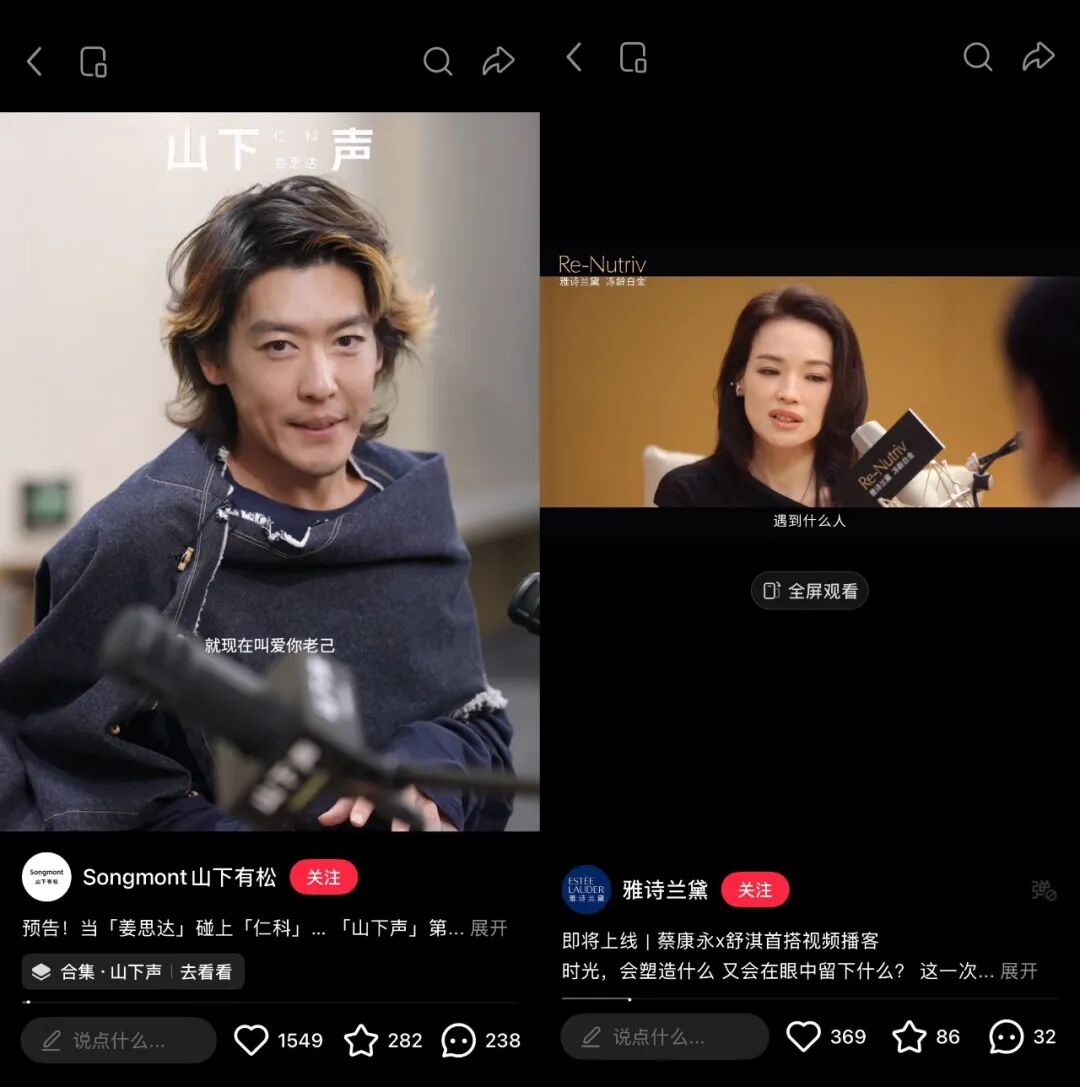
"We are also looking at video podcast collaborations. If the hosts of audio podcasts have package rights on other video platforms, we would also welcome that," Lucy mentioned.
However, video podcasts don't mean that the logic of short videos can be directly reused. Compared with short videos and audio podcasts, the 'celebrity effect' of video podcasts is more concentrated. Because the scenarios are different, audio podcasts make use of a large amount of fragmented time, and celebrities are not a necessary condition for the popularity of a program. However, video podcasts are immersive long - form content consumption, and users tend to watch more exciting, more topical, and more engaging content.

The cost of video podcasts is also higher. If you want to ensure a quality of over 70 points, the investment will be large, and the payback period will be relatively long. Especially for amateur creators, video podcasts bring relatively large income - generating pressure, and when there is no continuous return, their creative motivation will be severely weakened. In addition, the narrative logic of audio and video is completely different. If you want to do this well, you must make upfront investments and build a new team.
For brand owners, what value does podcasting bring from audio to video?
After interviewing many industry practitioners, the unified view is that podcasts are a high - quality medium for shaping and transmitting brand values, which is also a unique value that differentiates podcasts from other content media.
"Podcasts are a very good medium for re - establishing a set of brand narratives," said Cheng Yanliang. The success of "Flowers in the Rock" has largely helped GIADA expand its market awareness in China. "Narrative is the core competitiveness of a brand. All brands ultimately need a strong narrative." After the rise of podcasts, it is actually luxury brands and high - unit - price brands that are the first to be attracted. Prada, LOEWE, LV, Nike, Lululemon, etc. have all launched their own podcasts.
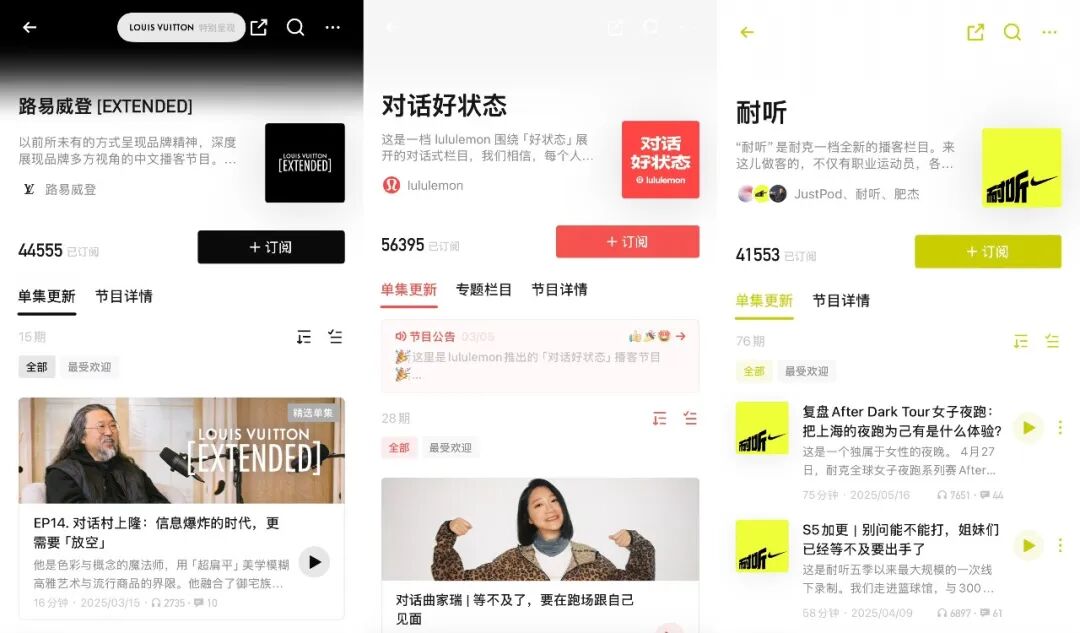
Yang Qiujie also mentioned that "podcasts are one of the few Chinese in - depth long - form content platforms that are still growing." This actually points to track opportunities. When brands have reached the limit in short - video marketing, podcasts have become a medium for brands to leverage new possibilities.
At the same time, at the current stage, podcasts attract many high - net - worth individuals, that is, users living in first - and second - tier cities with relatively high consumption levels, and many of them are female users. This audience profile highly matches the target users of many brands. "Our core requirement is to attract more high - net - worth female podcast listeners. Our main indicator is actually the data on audience recovery, and we will also look at store visits/new customer acquisition/conversion and other KPIs together," Lucy told us.
Lucy added, "Podcasts can indeed effectively improve the quality of the people entering our stores. For our brand, it also helps to convey our brand image to a higher - level audience. In addition to some front - end traffic data, we also look at the audience profile and back - end store visit conversion data."
"The brands we cooperate with, such as Torras and Sony, first of all attach great importance to the growth of the podcast content channel, and second, they value the accurate reach of the audience," said Yang Qiujie.
Some enterprises also use podcasts as functional products for B2B or internal management. Cheng Yanliang mentioned that JustPod has contacted a large number of companies doing B2B business. "Many customers feedback that they have educational needs for the public, for professional circle customers, and for internal employees. Podcasts are a very suitable medium," but at present, this type is not the mainstream in China.
"I think there is only one standard. When a company needs to shape its brand externally or internally and make long - term expressions based on brand shaping, it can consider podcasts," Cheng Yanliang said directly.
Brands are entering the market in batches, but why can't podcast creators make money?
However, many podcast creators are not optimistic about commercialization.
The direct reason is that podcasts currently do not have a strong conversion link and scenario, and most brands at present are very concerned about ROI and expect every marketing budget to bring sales conversion.
But sales conversion is definitely not the strength of podcasts. Podcasts do not have the conditions for immediate conversion. Generally, when listening to podcasts, the screen is off. The link from hearing about a product to actively searching and placing an order is too long, and at each step, 90% of the audience will be lost.
When some brands cooperate, they will give the cooperating hosts the right to "enter a password to get a coupon" to drive conversion. However, compared with the sales efficiency and volume of live - streaming and short - video e - commerce, the conversion brought by this method is at most a minor addition.

This leads many brand owners to be hesitant or control their investment costs. Even if some practitioners are willing to promote it, they may face the situation where the internal report cannot be approved.
"When there is a lot of sales conversion pressure on a large number of enterprises in the overall macro - economy, if the podcast medium cannot provide clear conversion and outstanding ROI, it will naturally become a secondary target for investment. Only when brands have sufficient budgets will they allocate a part of the budget to invest in podcasts," Cheng Yanliang told us.
Yang Qiujie also mentioned that the customers who have settled with "Sound of Zest Morning Coffee" are either podcast listeners themselves and can understand the value that brands can obtain through the podcast channel, or they are industry - leading brands that hope to create something unique and are willing to explore new tracks.
For example, Torras first cooperated with "Sound of Zest Morning Coffee" in 2023 and has continued to invest in podcast content for the next three years. "Most of the brand team are podcast users and can understand the value of long - form content for the brand. They think that doing marketing investment on other channels is spending money, while investing in the podcast channel is like'saving money' for the brand. But there are still many brands that don't understand the podcast content channel and will judge podcasts with the logic of video."

Secondly, the 80/20 rule is more concentrated in the podcast channel. Because podcasts take up a lot of people's time, one may only be able to listen to one podcast episode in an hour. When hundreds of thousands of programs in the market are competing for this one - hour time, the number of winning programs is very limited. So, it may also happen that the top 1% of creators ultimately divide up 90% of the market budget in terms of commercialization.
In addition, currently, the content of brand investment is relatively focused, mainly on topics related to women and lifestyle, and brand owners with budgets are more concerned about top - tier accounts, which leads to the problem of a ceiling on user reach. Lucy reflected, "The repeated reach rate of podcasts is relatively high. The number of top - tier influencers is limited compared to other platforms, and the fan groups are relatively repetitive. As the investment time goes by, the number of new customers will significantly decrease."
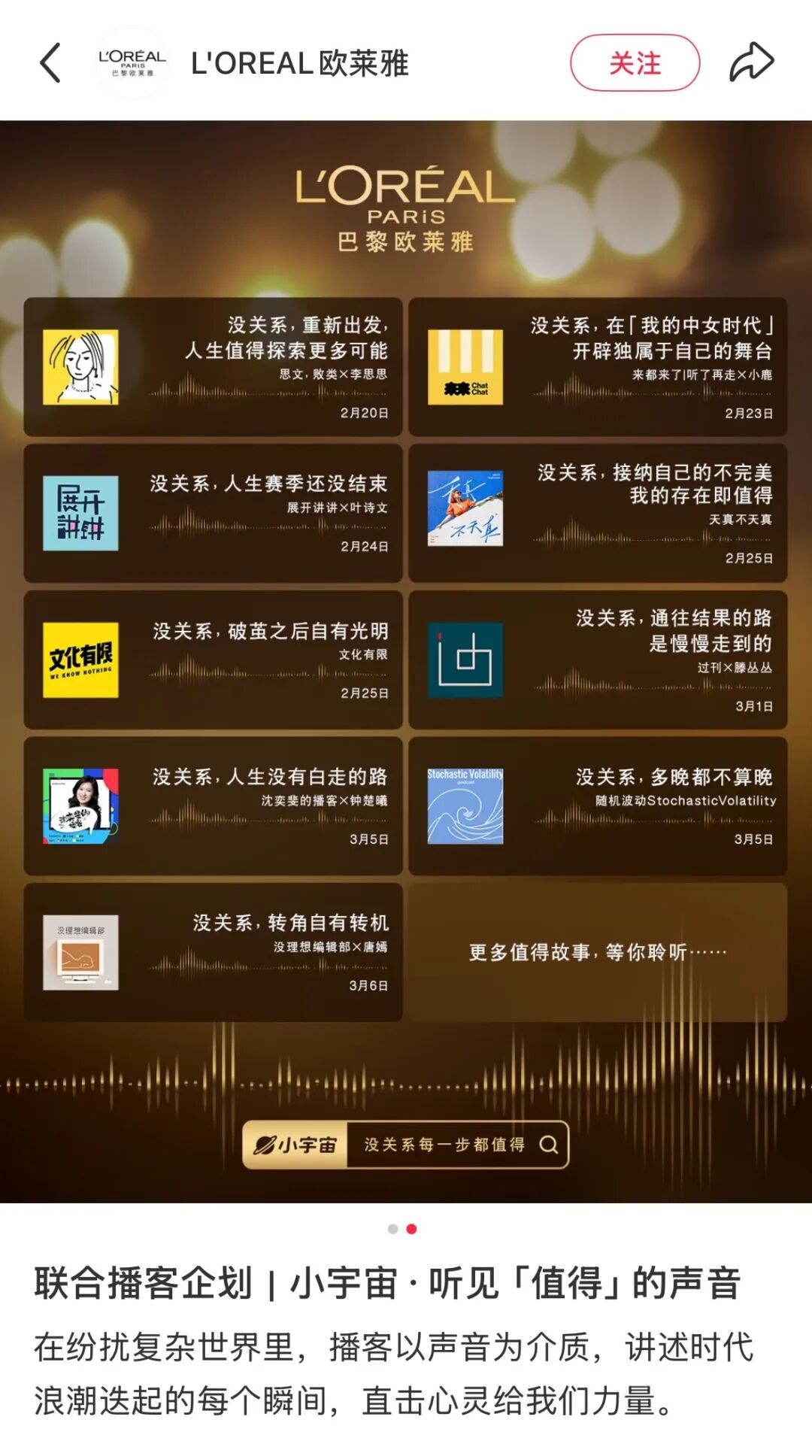
For example, before last year's Women's Day on March 8th, L'Oréal launched a podcast marketing campaign titled "It's Okay, Every Step Counts" and concentrated on investing in top - tier podcasts such as "Tianzhen Is Not Naive," "Let's Talk," and "Si Wen's Miscreants." There is a certain degree of repetition among the audiences of these accounts. "Generally speaking, I really like this campaign, but it also exposes some problems, such as the over - reliance on top - tier hosts and the lack of content innovation. The real value of podcasts lies in enabling brands to break out of the 'advertising bombing' logic and enter a new stage of 'value infiltration'. In the future, the winners will definitely be those who are willing to use the 'distributed touchpoints' of mid - and lower - tier podcasts to cultivate user trust."
Another common problem is the splitting and standardization of commercial rights and responsibilities mentioned earlier.
Currently, most creators work alone or in small teams. They have to both create content and handle commercial cooperation, which makes it difficult to balance the relationship between the two, resulting in low efficiency. If creators are very insistent on content or very eager for commercialization, these two extremes will consume a lot of their energy when communicating with brands about their needs.
For example, some brands have reported that some podcast creators are very assertive during cooperation, only doing hard product placements at the beginning and not doing soft customizations, etc.
The reason why "Sound of Zest Morning Coffee" can achieve a commercial coverage rate of up to 80% is that the content and commercial teams have their own responsibilities and have established a standard commercialization process. Yang Qiujie revealed, "There are two colleagues in the team who are specifically responsible for customer development. The project management staff is responsible for the overall delivery, and there is also a dedicated commercial content planning position." Secondly, specific rights and interests have been broken down. "We make full use of the points where the program group can commercialize for brands and divide the rights and interests into different levels." In addition, this program has more than 1.86 million followers on Xiaoxiao Universe, and the playback of a single episode is basically stable at around 200,000, so the exposure and effects are predictable.

Spicy has learned that the current investments in the Chinese podcast channel are all exclusive. Usually, there