Are gasoline-powered vehicles really no longer selling well?
After the retail penetration rate of new energy vehicles (NEVs) exceeded 60% for the first time in April, an unprecedented scenario appeared on the May vehicle sales list:
There were no fuel-powered vehicles among the top ten best-selling models.
According to the May passenger vehicle retail sales ranking released by Dongchedi, all the top ten models were NEVs. Correspondingly, the retail penetration rate of NEVs in May reached a new high again, rising to 63%.
Looking back at the beginning of the year, fuel-powered vehicles still occupied 7 spots among the top ten best-selling models in January, dropping to 6 in February and further to 5 in March. In just four months, fuel-powered vehicles quickly declined from the market mainstream to the periphery, and the once dominant players became the minority.
If we only look at this list, it seems easy to conclude that "fuel-powered vehicles are not selling well, while NEVs are selling like hotcakes."
However, the reality is still some distance away from the story of "NEVs defeating fuel-powered vehicles."
"No More Familiar Faces"
You might think that "no fuel-powered vehicles among the top ten best-selling passenger vehicles in May" is already bad enough. But in fact, more accurately, there were still no fuel-powered vehicles among the top 16 spots on the sales list.
Let's first take a look at the passenger vehicle retail sales ranking released by Dongchedi:
The "national divine car" Geely Xingyuan took the top spot on the monthly sales list with 38,751 units sold. Tesla Model Y ranked second with 28,911 units sold. Then, Xiaomi SU7, Leapmotor A10, and Li Auto i6 followed closely with 24,023 units, 22,306 units, and 20,878 units respectively, ranking third to fifth.
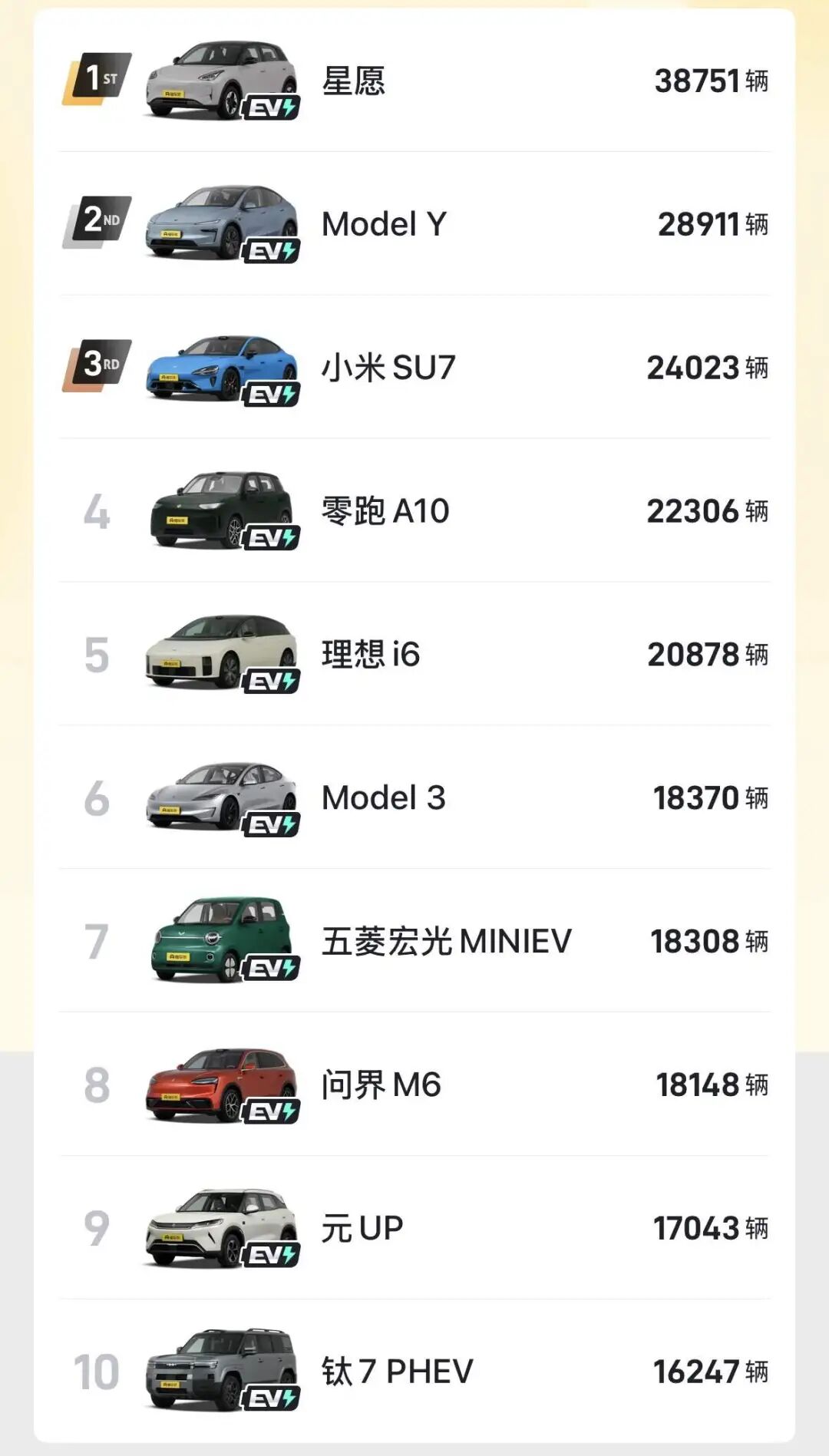
The remaining spots in the top ten list had monthly sales of less than 20,000 units. These included Model 3, Wuling Hongguang, AITO M6, Yuan UP, and Tai 7, all of which were NEV models without exception, and domestic brands accounted for 80%.
The best-selling fuel-powered vehicle in May was Geely Boyue L, which ranked first among fuel-powered vehicles with 13,395 units sold, but ranked 17th on the overall list. If we look at the top 20 best-selling vehicles in May, fuel-powered vehicles still occupied 4 spots, namely Boyue L, Lavida, Sylphy, and Binyue.
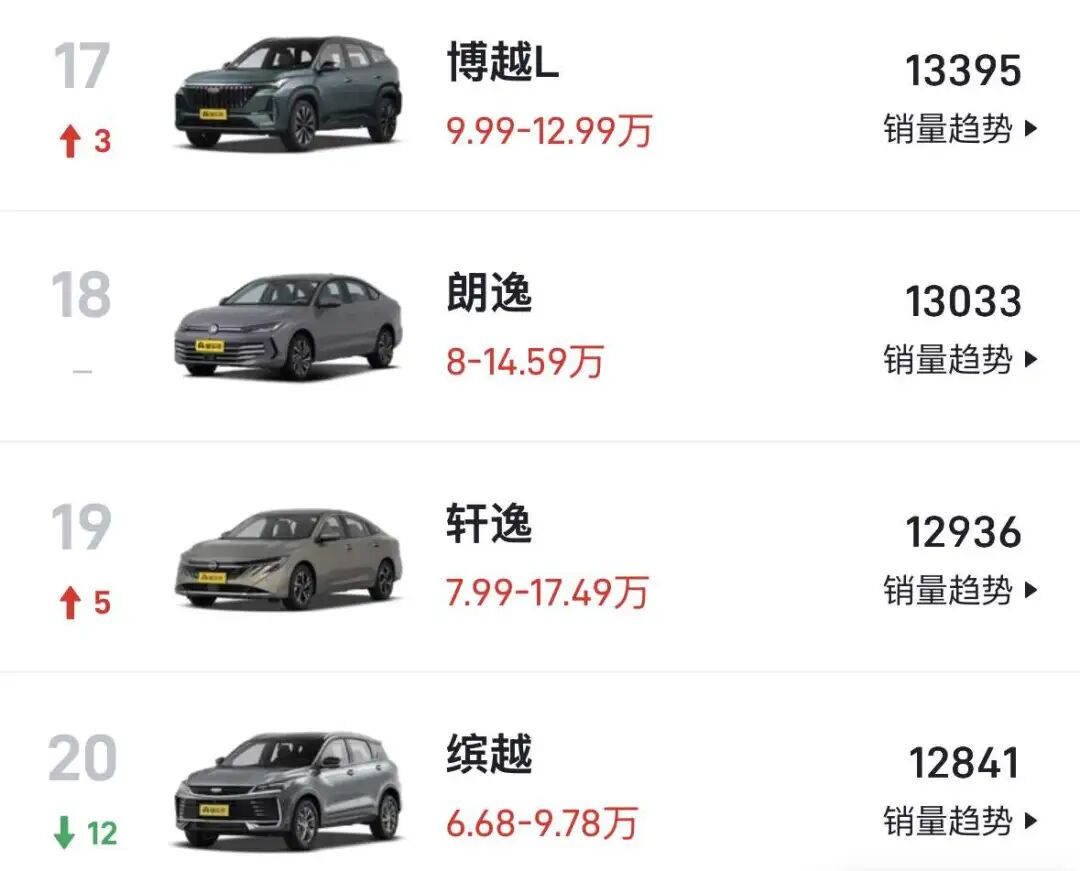
Among them, there were once "divine cars," but now their sales volume has only been maintained between 12,000 and 13,000 units.
Many more "divine cars" have fallen to even more distant positions. For example, the Toyota Corolla, which used to have a stable monthly sales volume of over 30,000 units at its peak, has now seen its latest monthly sales volume drop to more than 3,000 units, ranking outside the top 100.
Joint-venture star models like the Volkswagen Lavida and Toyota RAV4, which used to sell 20,000 to 30,000 units per month, have also fallen outside the top 18. In the separate fuel-powered vehicle list, only the top 13 models had monthly sales of over 10,000 units, and there were no models with monthly sales of over 15,000 units.

Just one month ago, Geely Binyue was the only fuel-powered vehicle remaining among the top ten list, but this month it has dropped to the 20th place. Two months ago, there were still 5 fuel-powered vehicles on the list; in January this year, there were 7 fuel-powered vehicles, and joint-venture models like Lavida and Sylphy still occupied the main positions.
In less than half a year, from occupying a large share of the market to completely disappearing from the top ten, the decline of fuel-powered vehicles has been much faster than expected. At the same time, this objective fact also means that the market share of fuel-powered vehicles is indeed shrinking.
How fast is the decline? According to the latest data released by the China Passenger Car Association (CPCA), the retail sales of fuel-powered passenger vehicles nationwide in May were 560,000 units, a year-on-year plunge of 39%. The market share also dropped to 37.1%.
In sharp contrast, the electrification substitution speed has exceeded expectations. The retail sales of new energy passenger vehicles reached 950,000 units, a year-on-year decrease of 7.5% and a month-on-month increase of 12.4%. The penetration rate further increased to 62.9%, reaching a new high, an increase of 9.9 percentage points compared with the same period last year and 1.6 percentage points month-on-month.
At the same time, the wholesale sales of new energy passenger vehicles reached 1.352 million units, a year-on-year increase of 10.6% and a month-on-month increase of 10.3%. The penetration rate exceeded 60% for the first time.
However, the new high of the NEV penetration rate should be viewed objectively. According to CPCA data, the retail sales of the national passenger vehicle market in May were 1.51 million units, a year-on-year decrease of 22.1%. That is to say, while the NEV penetration rate reached a new high of 62.9%, the overall vehicle market was actually shrinking significantly.
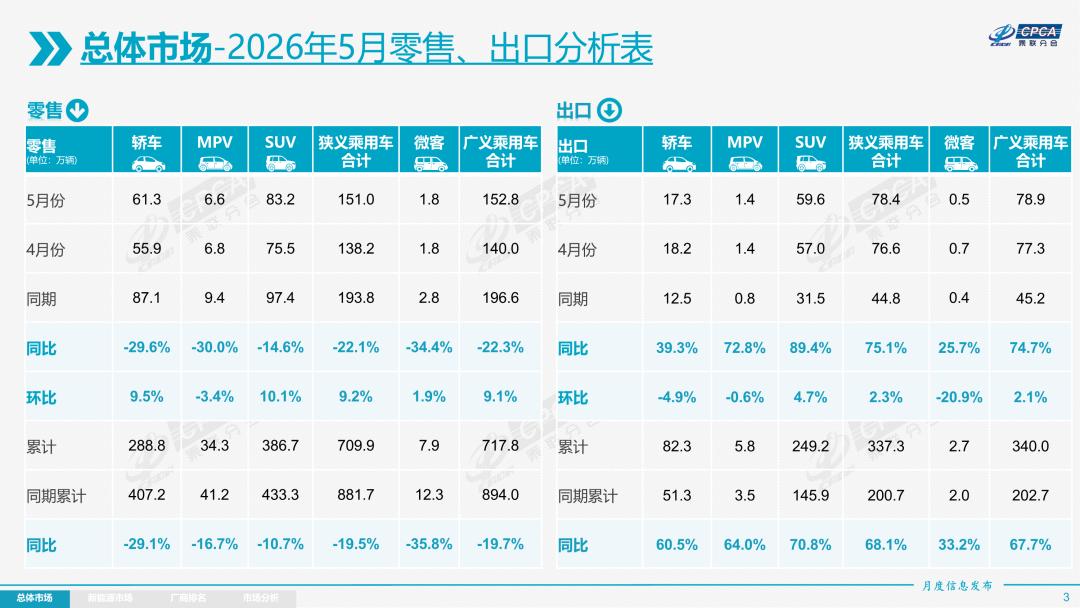
We cannot simply think that it is due to the rapid growth of NEV sales. The sales of NEVs also decreased year-on-year in May, but the decline of fuel-powered vehicles was even faster. The CPCA estimates that fuel-powered vehicles contributed 82% of the year-on-year decline in the passenger vehicle market.
In other words, the 62.9% penetration rate reflects both the competitiveness of NEVs and the rapid contraction of the fuel-powered vehicle market.
According to Cui Dongshu, the secretary-general of the CPCA, the rising oil price is the direct driving force behind this change. The high oil price has increased the usage cost of fuel-powered vehicles and also affected consumers' judgment of future vehicle usage expenses. Since a car is usually used for five to ten years, consumers are not only considering the purchase price but also the monthly usage cost when making a purchase decision.
This is especially true for the mid - to low - end vehicle market, which is more sensitive. For those who drive long distances, the cost advantage of electric vehicles is significant.
However, the oil price can only explain the speed of the decline, not the long - term trend. If fuel-powered vehicles still had obvious competitive advantages, a single increase in oil price would hardly cause them to disappear from the top ten sales list within a few months.
What really changes consumers' choices is that today's NEV models have made up for the gaps in price, range, and product coverage, and have formed advantages in power, intelligent cockpits, and functional experiences. The current increase in oil price has only accelerated the originally slow - occurring changes.
The Internal Combustion Engine Won't Exit the Stage
It can be seen that although the NEV penetration rate has continuously reached new highs in recent months, to a large extent, it is not based on the growing prosperity of the entire automobile consumption market, but on the rapid exit of fuel-powered vehicles, which is a subtraction of the existing market.
So this is not simply a story of "NEVs defeating fuel-powered vehicles." More accurately, against the backdrop of weak consumer confidence and a shrinking vehicle market, the foundation of fuel-powered vehicles has first experienced a cliff - like collapse.
Especially in May, the sales of mainstream joint - venture fuel-powered vehicles dropped by as much as 41%. Facing the shrinking market share, the only option for fuel-powered vehicle manufacturers is almost price cuts.
Cui Dongshu, the secretary - general of the CPCA, said that from January to May 2026, a total of 32 conventional fuel-powered vehicles had price cuts, an increase of 13 compared with the same period last year. From entry - level cars costing a few thousand yuan to luxury cars worth hundreds of thousands of yuan, the price cuts were getting bigger and bigger.
Take the Civic as an example. A few years ago, it cost more than 170,000 yuan to drive it off the lot. Now, the base - model bare - car price is only about 90,000 yuan, and the high - end model is only about 100,000 yuan, according to a salesperson at a Dongfeng Honda 4S store. In addition, there is the Audi A6 with a price cut of 91,000 yuan, the Kia Sportage X with a fixed price of only 109,900 yuan, and some fuel - powered models with a maximum price cut of nearly 30%.
The latest data disclosed by Cui Dongshu shows that in May this year, the average price of new conventional fuel - powered vehicles with price cuts was 166,000 yuan, with an average price cut of 25,000 yuan, and the price cut rate reached 14.9%. In the first five months of this year, the average price of new vehicles with price cuts in the overall passenger vehicle market was 241,000 yuan, with an average price cut of 32,000 yuan, and the price cut rate was 13.1%.
However, the high - discount promotions have not led to a recovery in sales. Instead, the inventory has been piling up.
According to data from the China Automobile Dealers Association, in April 2026, the comprehensive inventory coefficient of automobile dealers reached 1.89, a month - on - month increase of 7.4% and a year - on - year surge of 34%, far exceeding the safety warning line of 1.5. The soaring inventory pressure reflects that the sales speed is far behind the stocking speed of the automakers.
This is because when consumers see the continuously decreasing car prices, it is easy to form a negative cycle. The more frequent the price cuts, the more consumers think they can get a better deal by waiting. So they hold off on purchasing and wait and see.
When price cuts change from a short - term promotional measure to a normal expectation, their ability to stimulate demand rapidly weakens and even begins to undermine consumer confidence.
In addition, in order to clear the inventory, dealers increase discounts and frequently cut prices, which will damage the rights and interests of old car owners and the residual value of second - hand cars. The weakening residual value further reduces consumers' willingness to buy, and dealers will also reduce the exhibition space, sales staff, and marketing resources.
The strategic changes at the manufacturer level are also affecting the mentality of fuel - powered vehicle consumers. Nowadays, more and more automakers are shifting resources from the fuel - powered vehicle segment to new energy. Although traditional giants such as Volkswagen, Toyota, and Honda still sell fuel - powered vehicles, the pace of new product launches has significantly slowed down, and more R & D resources are being tilted towards electrification platforms and intelligent technologies.
For consumers, the signal they perceive is that even automakers themselves are moving towards new energy. How long can the life cycle of fuel - powered vehicles be? So what fuel - powered vehicles are losing is not only sales but also the sense of security formed over the years.
Of course, the "major retreat" of fuel - powered vehicles does not mean that the internal combustion engine will exit the market. In the May sales list, the AITO M6 and Tai 7 PHEV are still equipped with engines. The popularity of extended - range and plug - in hybrid models shows that a considerable number of consumers still need the convenience provided by fuel refueling.
In addition, in the exported vehicles from China in May, NEVs accounted for 54%, and the rest were mainly fuel - powered products. For automakers such as Chery and Geely that are actively expanding overseas, the mature fuel - powered vehicle platforms are still important assets in the global layout.
Cui Dongshu, the secretary - general of the CPCA, also said that in the long run, "fuel - powered vehicles will not completely disappear, but will shrink significantly." In the future, it may present a pattern of "high - end and refined + specialized for specific purposes." For example, there is still a stable demand in the markets of long - distance and high - frequency users, areas with insufficient charging conditions, some hardcore off - road vehicles, and special - purpose vehicles.
Perhaps fuel - powered vehicles will still be on the roads in China, but the era when fuel - powered vehicles were at the center of the automobile industry is coming to an end.
This article is from the WeChat official account "SuperEV - Lab" (ID: SuperEV - Lab), written by Wang Lei, and published by 36Kr with authorization.