1.4 billion Indians, yet not a single Tesla can be retained
"Will Tesla still build a factory in India?" This question has recently stirred up a storm on the Indian Internet.
The cause was a piece of news released by American media. The Indian Minister of Heavy Industries personally confirmed that Tesla had informed the government that it would not build a factory in India.
But before people could digest this news, India's Financial Express and Sunday Guardian quickly came out to refute the rumor. They said the minister's words had been misinterpreted, and there was no evidence to show that the factory plan had been cancelled.
However, the two Indian media outlets themselves admitted that Tesla's intention to manufacture in India had indeed been "put on hold".
Behind this debate, one can't help but wonder why a large market of 1.4 billion people can't make Elon Musk decide to build a factory?
01
Five Years of Tug-of-War: Has the Dream of "Made in India" Shattered?
The story starts in 2021.
That year, Tesla was making great strides in China with its Shanghai Gigafactory. Coincidentally, Prime Minister Modi was advocating the "Make in India" initiative and was in urgent need of a world - class benchmark. The two sides hit it off, and the outside world even began to calculate how many people Tesla would recruit and how large the production capacity would be in India.
In June 2023, Modi met with Elon Musk in the United States. The atmosphere was warm, and Musk promised on the spot to "promote investment in India as soon as possible". Subsequently, the Tesla team visited Mumbai, Bangalore, Delhi, Hyderabad and other places to scout for a location.
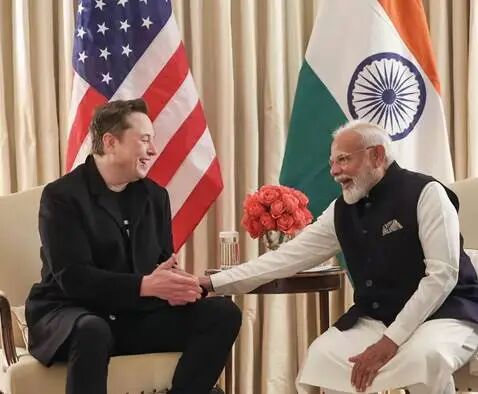
The picture shows the meeting between Modi and Elon Musk in 2023. Source | Internet
In April 2024, Musk originally planned to fly to India to discuss the details of building a factory with Modi. But just before the trip, the itinerary was suddenly cancelled. After more than half a year of silence, the "postponement" turned into "cancellation".
Actually, as early as March 2024, the Indian government had "tailor - made" a new electric vehicle policy for Tesla. The tariff on electric vehicles with an import price of more than $35,000 was reduced from 100% to 15%.
However, the conditions were harsh: first, an investment of at least $500 million was required, with local production to be achieved within 3 years and a localization rate of 50% within 5 years. Tesla did not accept these conditions.
In July 2025, Tesla changed its strategy. Instead of rushing to build a factory, it decided to start selling cars first. Four showrooms in Mumbai, Delhi, Bangalore and Hyderabad opened simultaneously, and the Model Y was officially put on sale.
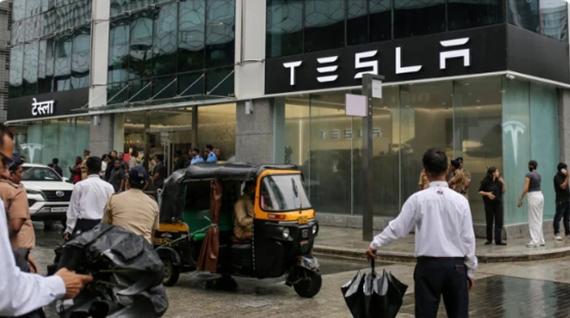
The picture shows a Tesla store in India. Source | Internet
So, what was the result? From July to the end of 2025, only 227 cars were delivered across India.
Less than 10% of the 2,500 - unit import quota given by the Indian government was used. In the first four months of 2026, even with price cuts and promotions, Tesla only sold 383 cars. When the sales data came out, further negotiations became meaningless.
In April 2026, India added another condition, requiring Tesla to produce power batteries locally in India. After that, there was no further progress in the negotiations.
02
Why Can Tesla Build a Factory in China but the Plan Is on Hold in India?
The timing of the foreign media's report that Tesla had confirmed not to build a factory in India was particularly eye - catching.
In May, Musk had just completed his visit to China and was striving for the early implementation of Tesla's FSD (Full Self - Driving) in China.
If we look back at Tesla's cooperation with China, the results are very remarkable.
In July 2018, Tesla signed an agreement with Shanghai. In January 2019, the factory broke ground, and in December of the same year, the first domestically - produced Model 3 rolled off the production line. It only took 358 days from the start of construction to the first delivery.
This is still the fastest record for a large - scale vehicle factory in the global automotive industry history.
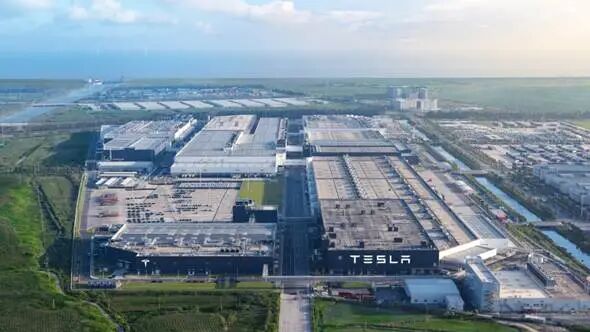
The picture shows Tesla's Shanghai Gigafactory. Source | Internet
Shanghai didn't rely on a miracle but a series of well - organized policy supports.
When Shanghai introduced Tesla, it opened a "green channel" and compressed the original months - long approval process to the extreme.
Tesla smoothly obtained land, loans and qualifications.
Within a 300 - kilometer radius of Shanghai, the most mature automotive parts industrial cluster in China is concentrated. More than 90% of Tesla's parts can be purchased within Shanghai and its surrounding 500 - kilometer area. The decades - long manufacturing accumulation in the Yangtze River Delta cannot be replicated overnight.
The cooperation between the two sides was also more equal and mutually beneficial. Shanghai provided low - interest loans and land at a price far below the market value, and Tesla promised to pay taxes, make investments and achieve localization.
This two - way cooperation allowed Shanghai to exchange its market for an industrial cluster, and Tesla to gain an industry position with its production capacity.
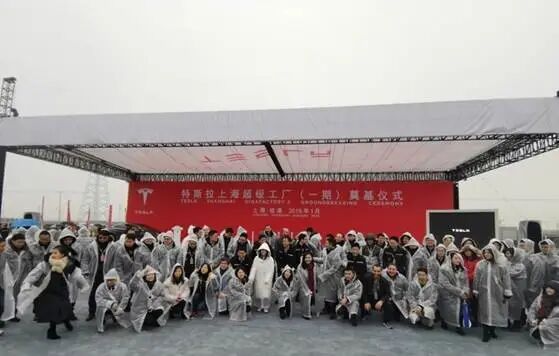
The picture shows the groundbreaking ceremony of Tesla's Shanghai factory (Phase I). Source | Internet
The effects of this cooperation model were soon reflected in Tesla's revenue ledger.
In 2022, Tesla's revenue in the Chinese market was $18.145 billion, accounting for about 23% of its global total revenue. By 2023, this figure soared to $21.745 billion. For the first time, China surpassed the sum of all markets outside the United States and became Tesla's second - largest single market.
Looking at the financial reports of 2024 and 2025, although Tesla's overall revenue scale declined and its performance was under full pressure, the Chinese market did not disappoint. Tesla achieved revenue of over $20 billion for three consecutive years.
In the first quarter of 2026, Tesla's global total revenue was $22.4 billion, and the Shanghai Gigafactory delivered 213,000 vehicles, a year - on - year increase of 23.5%.
During this period, Tesla's revenue in the Chinese market was $4.184 billion. Although there was a decline both year - on - year and quarter - on - quarter, exports increased instead. The Shanghai factory exported more than 100,000 vehicles in the first quarter, a year - on - year surge of 164%. The Shanghai factory has become Tesla's global export hub.
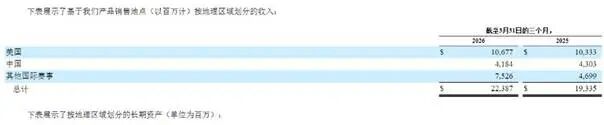
The picture shows Tesla's regional revenue in the first quarter of 2026. Source | Internet
Now look at India. For five years, the two sides have been stuck in a dead - end cycle: Should the tax be reduced first, or should the factory be built first?
India's automobile tariffs are notoriously high globally. Since 1948, India has used high tariffs and import bans to keep foreign cars out of the country, and has forced companies to promise local production in India before entering the market. After the liberalization reform in the 1990s, the tariff once dropped to about 35%, but rebounded to three - digit levels in 2014, reaching a maximum of 125%.
In fact, this strategy has indeed nurtured local giants. In the 2024 - 2025 fiscal year, the vehicle manufacturing sector in India contributed 35% of the manufacturing GDP and 6% of the national GDP. The export volume of various motor vehicles exceeded 5.3 million, ranking third in the world. By 2020, the localization rate of car - making enterprises in India generally exceeded 70%, which also promoted the development of related industrial chains in New Delhi, Maharashtra, Tamil Nadu and other places. Maruti Suzuki, an Indian car company, has a market share of more than 46% in the domestic passenger car market, and Tata has a market share of over 80% in the electric vehicle segment.
Therefore, Modi's logic is very firm. He believes that Tesla currently only ships cars from Shanghai to reap the Indian market and leaves no manufacturing foundation. Tesla must build a factory first to get tariff concessions.
However, Musk's logic is very simple. The per - capita GDP in India is only $2,500, and the price of Tesla models is four times that of local cars. If you don't let me sell a few cars first, how can I dare to invest billions of dollars in building a factory?
More importantly, the Shanghai factory is no longer just a "Chinese production base". It is also the core export hub for Tesla in the Asia - Pacific region. The demand for right - hand - drive cars in the European, Southeast Asian, Japanese and South Korean markets can all be met by Shanghai.
Since the Shanghai factory has already undertaken most of the production capacity in the Asia - Pacific region, why spend $3 billion to build a new production line from scratch in India when a few more right - hand - drive cars can be produced on the Shanghai production line and directly exported to India?
Tesla can calculate this account better than anyone else.
So, this "chicken - and - egg" contradiction remains unsolvable.
Moreover, even if the factory is built, it is questionable whether the supply chain can keep up. This is something that preferential policies cannot make up for.
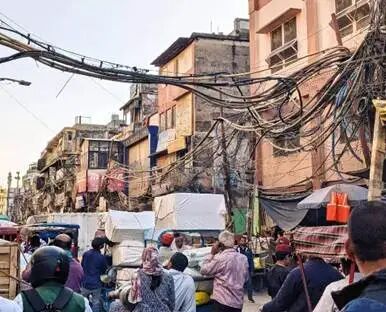
In 2025, India's national import volume of passenger - car batteries reached 7.987 gigawatt - hours, most of which were imported from China. In many places, there are power outages of more than 3 hours per day on average, and the industrial chain is not well - matched. No matter how preferential the policies are, they are just castles in the air.
Source | Internet
Musk didn't refuse to give India a chance. He was willing to bet $3 billion, on the condition that India first reduce the tariff to 15% and let him conduct a trial sales for one year. India refused. By the time India finally relented, Tesla had lost patience.
This exhaustion of patience actually exposes the problems in India's business environment. The policies are fickle, and the conditions are constantly increasing, leaving foreign - funded enterprises at a loss as to what to do next.
03
Unstable Business Environment Scaring Away Foreign Enterprises
The most classic case is Vodafone.

Source | Internet
In 2007, Vodafone acquired Hutchison Whampoa's Indian assets. According to the law at that time, this transaction was not taxable. However, the Indian government later revised the tax law and retroactively levied taxes, with the amount reaching more than $2 billion.
Vodafone took the case to international arbitration and won, but India refused to implement the ruling.
After more than a decade of wrangling, Vodafone finally sold its assets and left.
For Chinese enterprises, Xiaomi has the most say about India's business environment.
In April 2022, India froze 4.8 billion yuan of Xiaomi India's bank assets on the grounds of "suspected illegal remittance". In November 2025, it claimed that Xiaomi evaded tariffs through royalty payments and issued a notice to recover 558 million yuan.
Although the two payments are still in the appeal stage and have not been enforced yet, Xiaomi has significantly reduced its business scale in India, stopped developing exclusive products for the Indian market, and the planned new "Made in India" product categories such as washing machines and refrigerators have also been aborted.
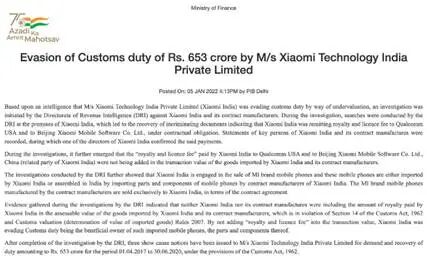
The picture shows a statement issued by the Indian Ministry of Finance regarding Xiaomi's tax evasion. Source | Internet
Apple has also become the latest target.
In April 2026, India passed an amendment to the Competition Act, changing the calculation basis for anti - monopoly fines from "local turnover in India" to "global total turnover". Calculated at 10% of the global revenue, Apple's potential fine could reach as high as $38 billion.
