The cost of forgetting is always higher than the cost of remembering.
Text: Zhu Ning, Distinguished Professor at the Shanghai Advanced Institute of Finance, Shanghai Jiao Tong University
As a fan of the financial-themed TV series Billions, I read 1929 with great interest. Readers familiar with the financial field should not be unfamiliar with the author, Andrew Ross Sorkin. He is not an economist, but undoubtedly a very successful media journalist and cross - border writer. As early as 2001, he launched the very successful subscription email column DealBook, focusing on Wall Street's merger and acquisition transactions. Subsequently, he became a reporter for The New York Times and a host on CNBC. He successfully adapted his book Too Big to Fail, which chronicles the 2008 global economic crisis, into a movie and participated in the creation of the hedge - fund - themed TV series Billions. No wonder I could strongly feel the vivid imagery between the lines when reading this book. To be honest, I wouldn't be surprised at all if this book were adapted into a movie or a TV series one day.
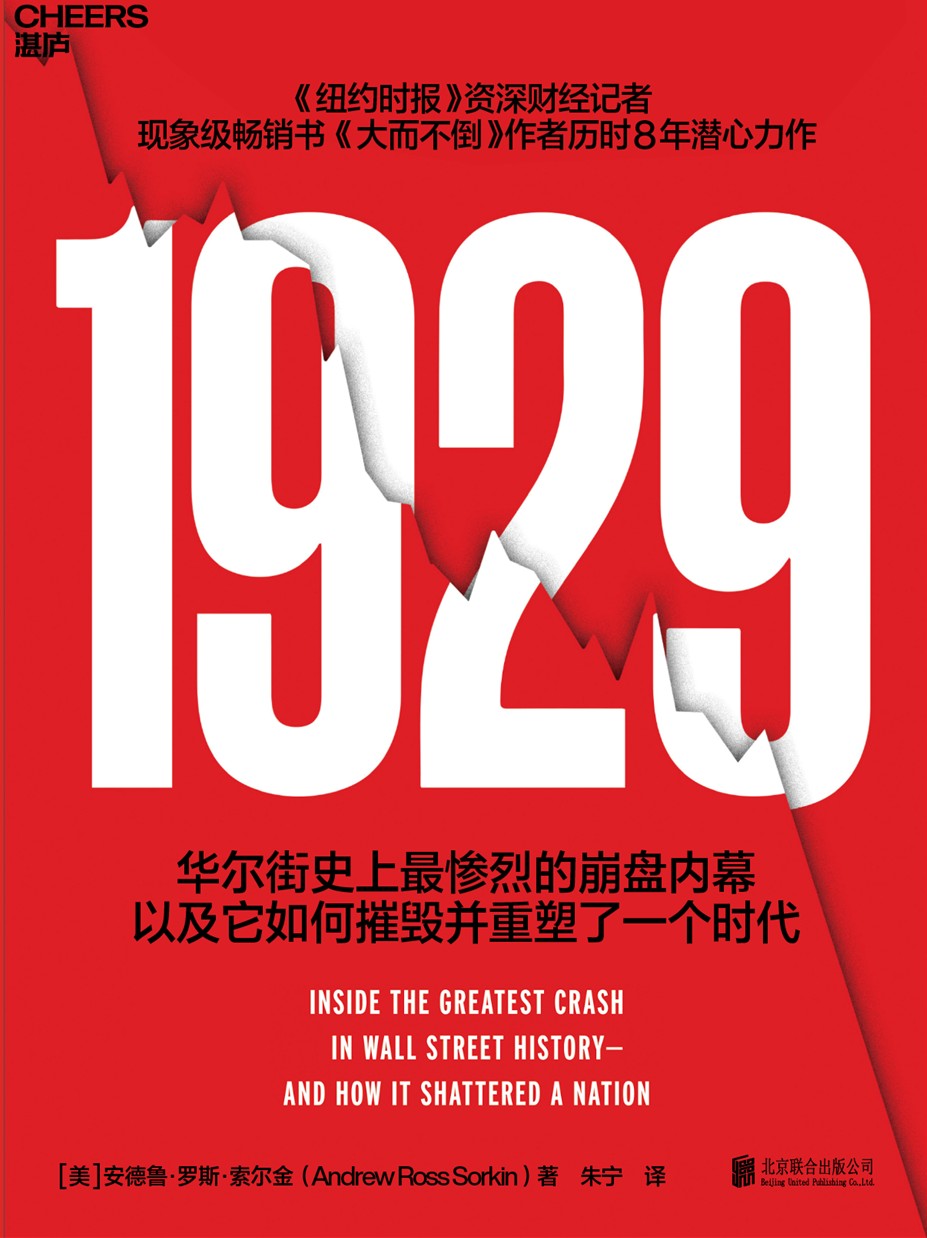
l Author: [USA] Andrew Ross Sorkin
l Translator: Zhu Ning
l Publisher: Cheers Publishing / Beijing United Publishing Co., Ltd.
l Publication Date: June 2026
The Great Depression, the "Holy Grail" of Macroeconomics
This will not be the first book about the 1929 Great Depression, nor will it be the last. From the perspective of financial history, Sorkin appreciates and quotes from John Kenneth Galbraith's classic work The Great Crash 1929, The Day the Bubble Burst by Gordon Thomas and Max Morgan - Witts, and Manias, Panics and Crashes by Charles Kindleberger. From the perspective of macroeconomics, there is Essays on the Great Depression by Nobel laureate and former Federal Reserve Chairman Ben Bernanke, and The Holy Grail of Macroeconomics by Richard Koo, former chief economist of Nomura Securities. Both books specifically point out the significance of studying the 1929 Great Depression and the Japanese recession in the 1990s for macroeconomics.
Bernanke pointed out in Essays on the Great Depression that explaining the Great Depression is the "Holy Grail" of macroeconomics. Despite spending a great deal of time and energy, people have not even touched the edge of the Holy Grail. In his view, the Great Depression was an incredible episode - stock market crashes, widespread famine, begging for alms, bank runs, and crazy currency speculation... Above all this loomed the gathering clouds of war. He admitted that he was obsessed with studying the Great Depression because it was a fascinating event that occurred during a crucial period in modern history. He emphasized that the Great Depression fundamentally improved our understanding of the economy. It not only made macroeconomics an independent research field but also continuously influenced the beliefs, policy recommendations, and research progress of macroeconomists. Putting aside practicality, simply explaining the global economic collapse in the 1930s has always been a fascinating intellectual challenge.
There is a vast amount of research on the causes of the 1929 Great Depression and the corresponding policies. John Maynard Keynes, the giant of the Keynesian school, believed that the lack of effective demand, including household demand and corporate investment demand, was the cause of the economic recession. Irving Fisher, the pioneer of the monetarist school, proposed that "debt - deflation" was the root cause of the Great Depression. In the approximately 10 years before 1929, the hedonistic and extravagant "Roaring Twenties" led businesses and individuals to be infinitely optimistic about the future and willing to take on debt without restraint. When the economy reached a state of "over - indebtedness" at a certain point, especially when asset prices shrank significantly, debtors or creditors, out of caution, would accelerate debt repayment, triggering a series of vicious cycles such as asset sales, corporate asset shrinkage, reduced investment, and consumption.
Bernanke believes that the most important lesson of the Great Depression is that policymakers must be prepared to break out of the established thought pattern and boldly adopt extreme policies aimed at stabilizing the capital market and economic operation when facing special situations like the Great Depression. Bernanke systematically studied President Hoover's approach at the beginning of the Great Depression, which followed traditional economic thinking and regarded free competition, free adjustment, laissez - faire, and financial discipline as the most important principles guiding economic policy. He believed that President Hoover's repeated opposition to large - scale relief measures by the federal government was the most important reason for the intensification of the crisis and the spread of the 1929 stock market crash into the long - lasting Great Depression from 1929 to 1933. Bernanke believes that while the 1929 stock market crash was indeed terrible, a series of subsequent wrong policy responses were the real cause of the Great Depression. Therefore, after the 2008 global financial crisis, governments adopted the opposite, over - corrective, and perhaps excessive radical stimulus policies.
Different from previous economic theories, the author of this book believes that "in the final analysis, the story of 1929 has nothing to do with interest rates or regulations, nor with the shrewdness of short - sellers or the mistakes of bankers. It is about something more eternal: human nature. No matter how many warnings are issued and how many regulations are formulated, people can always find new ways to believe that the good times will never end, and people can always package hope as certainty. And in this collective frenzy, humans will always lose their minds again and again."
Sorkin also quoted the concern of futurist Herbert George Wells in 1920, that is, "human history is increasingly becoming a race between education and disaster," and admitted that "this book does not intend to declare the winner of this race. But by reconstructing the historical picture of 1929, it is hoped that the path forward will be clearer and the alarm bells of the era will be more deafening."
In this sense, the theme of this book is similar to the research of behavioral economics and behavioral finance on bubbles, crashes, and economic crises in the past half - century. A series of studies, including those by 2013 Nobel laureate Professor Robert Shiller, 2017 Nobel laureate Professor Richard Thaler, and my own book Rigid Bubbles, support the author's inference in 1929. Human behavior is far from as rational as assumed by the neoclassical economic paradigm. Instead, it is often driven by greed and fear, promoting the cyclical prosperity and depression of credit scale, asset prices, and the economic operation. Although this may just be the peaks and troughs of a sine curve for the economy itself, for each family, each enterprise, and each economy, it may be a once - in - a - lifetime opportunity to get rich or a once - in - a - lifetime disaster. As Professor Daniel Kahneman pointed out in Thinking, Fast and Slow, due to humans' inborn tendency to avoid losses, the psychological gap caused by crashes and depressions to each individual and the whole society is always much greater than the psychological satisfaction and happiness brought by bubbles and prosperity. This is also one of the reasons why, a hundred years later, we still read 1929, review the Great Depression, and prevent similar history from repeating itself.
Waking up the Memories of a Century Ago with Stories
Expanding economic research is not the purpose of this book. The uniqueness of this book lies in that it finds a new way and successfully achieves the main purpose of Sorkin's writing. He said in the preface of the Chinese version: "I have been writing about financial crises throughout my career. If there is any belief I hold most firmly, it is that the cost of forgetting is always higher than the cost of remembering." The book 1929 successfully achieves this goal, allowing readers to go back a hundred years ago and experience the various historical events before, during, and after the 1929 Great Depression in the United States as if they were on the scene.
In this book, you will see ordinary consumers borrowing to buy cars, refrigerators, and radios, as well as commercial banks actively launching leveraged products to help investors borrow to trade stocks. You will see stock speculators like Jesse Livermore making huge profits through short - selling during the Great Depression, and you will also see the vulnerability of powerful organizations and banks like the Morgan Group and Charles Mitchell in the face of the Great Depression. You will see the delicate relationship between President Hoover and his Treasury Secretary Andrew Mellon and the concerns about not launching fiscal stimulus policies, and you will also see how President Roosevelt "unexpectedly" promoted the recovery of the US economy. You can see the intense debate between grass - roots prosecutors and Wall Street bank executives, and you can also see how Congressman Carter Glass overcame numerous difficulties to introduce the Glass - Steagall Act, which had a significant impact on the entire US banking industry for more than half a century.
1929 reviews the entire history in a very vivid way, including the formation of the 1929 Great Depression, the panic during the Great Depression, and the long - lasting impact of the Great Depression on the entire society and economy. Readers should not underestimate this narrative style of historical events. Professor Shiller spent a large part of his book Narrative Economics discussing that humans are storytelling animals. Humans have difficulty understanding theories, remembering data, and conducting logical inferences, but they are particularly willing to read, listen to, and tell stories. Stories are more touching than theories, so they are also more infectious and have more vitality, even if the stories themselves may not be rigorous or logical.
In this sense, 1929 greatly makes up for the lack of vivid narrative in previous studies, providing ordinary readers with a large number of vivid, real - life stories and scenarios, allowing people to have a more intuitive and distinct impression of the major economic event that changed the fate of the entire world a hundred years ago. This book also wakes up and refreshes the society's memory of that major event a century ago and promotes a deeper understanding and attention to history.
Another attraction of this book is that there are indeed many striking similarities between the current global economy and the global economy in the years before 1929. The 2008 global financial crisis made people think of the 1907 US stock market crash and financial crisis; the 2020 COVID - 19 pandemic made people think of the 1918 global influenza pandemic; the technology stock wave in the past few years made people think of the hedonistic and extravagant "Roaring Twenties"; the tariffs imposed by President Donald Trump on various countries around the world made people think of the beggar - thy - neighbor trade protection policies during the Great Depression; and the recent series of military conflicts around the world have made people alert to the similarities with the global order before World War II in the 1930s, where undercurrents were surging and contradictions were escalating.
If there has been any progress and new normal in the global response to crises in the hundred years after 1929, it is likely that people's experience and response to the 1929 Great Depression gave rise to institutions with memories of the Great Depression, such as the Federal Deposit Insurance Corporation, the Financial Stability Board, and the International Monetary Fund, and policymakers like Bernanke who have studied the Great Depression. After the 2008 global financial crisis, major global economies represented by China and the United States consciously adopted radical stimulus policies to avoid a repeat of the 1929 Great Depression.
However, at the same time, as Shiller pointed out in Irrational Exuberance and I pointed out in Rigid Bubbles, government policies aimed at preventing financial crises will definitely stimulate investors' irrational optimism and speculative willingness of "this time is different," and will also stimulate more intense speculation and leveraging activities, ultimately leading to the occurrence of bubbles and the recurrence of the financial crises that the policies are trying to prevent.
If there are any lessons to be learned from all the events that took place in 1929 recorded in the book 1929, the ups and downs of the global economy in the past century, and the vicissitudes of human history, it is that the truly eternal lesson may not be about how to prevent mania or avoid depression, but rather about how to remain humble, that is, to understand that there are no completely rational humans, no completely efficient markets, no foolproof systems, and no generation can be spared. The higher one climbs, the harder one falls. The more certain one is in advance, the longer and more painful the fall will be. This may be what is called human nature.
From a more positive perspective, 1929 also conveys another important historical - based message. The enduring human optimism, as well as the amazing human and social resilience, enable people to always recover from adversity and come up with ways to avoid repeating the same mistakes. People will always be confident in themselves and ambitious about the future. The belief that the future will be infinitely beautiful has never truly died out; it is just waiting for the next opportunity to push the market to new heights again. This may also be what is called human nature. If 1929 can really help humans understand these things, it would be a great blessing.
This is the preface.