With a cost of over 500 million yuan per kilometer, what benefits can the Pinglu Canal bring to Guangxi?
More than a thousand years after the completion of the Beijing-Hangzhou Grand Canal, another artificial canal is coming to China. In early June this year, the Pinglu Canal fully entered the water debugging stage and is expected to be open to navigation across the entire line in September.
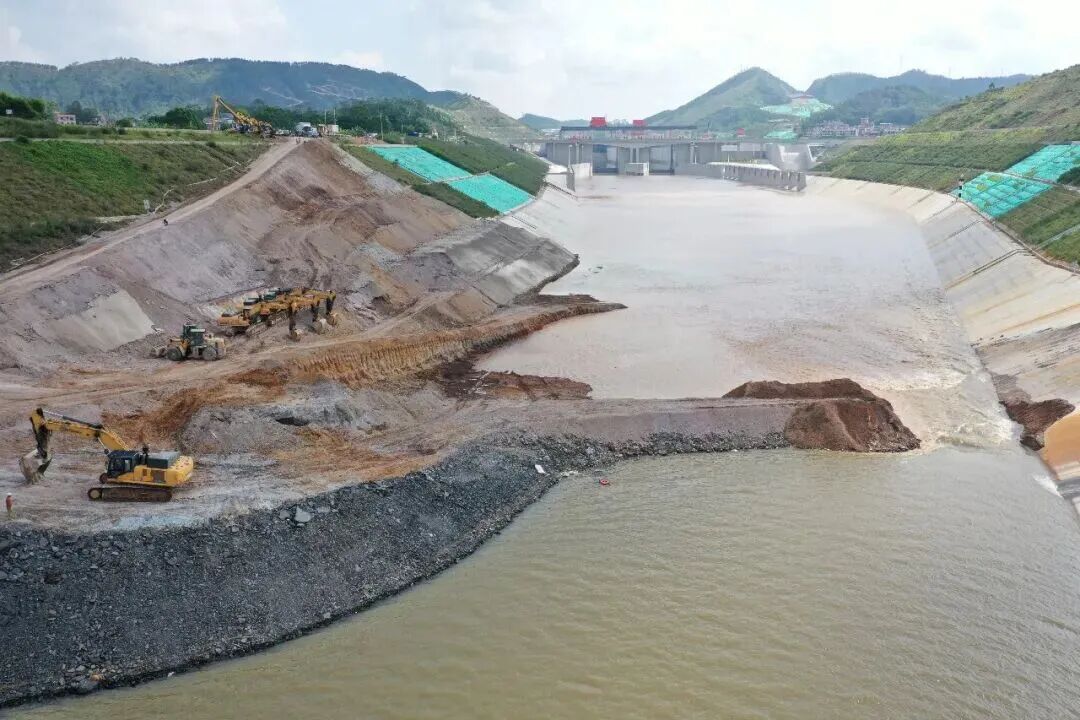
The water filling scene at the Madao Hub of the Pinglu Canal. Image source: The official WeChat account of the Pinglu Canal Group
This canal starts from the Pingtang River Estuary in Hengzhou City, Guangxi in the north, passes through Luwu Town in Lingshan County, and enters the Beibu Gulf along the Qinjiang River. It can accommodate 5,000 - ton ships. The total investment is about 72.7 billion yuan, and the total length is 134.2 kilometers. Calculated, the cost per kilometer exceeds 500 million yuan.
More than a hundred years ago, Dr. Sun Yat - sen pointed out in his "The International Development of China" that Qinzhou is the most convenient sea - going channel for the southwestern region. Choosing this port to go to sea can save 400 miles compared with going through Guangzhou. For southwestern regions such as Guangxi, Sichuan, and Yunnan, the economic benefits are quite considerable.
Now, as the Pinglu Canal is about to be open to navigation, Guangxi's century - old vision of "prospering by the sea" is gradually becoming a reality.
When talking about the impact brought by the opening of the Pinglu Canal, Pan Helin, an economic scholar, said in an interview with a reporter from Time Weekly that theoretically, the Pinglu Canal is expected to reshape the logistics pattern in the western region.
"Since the throughput of land transportation is far less than that of sea transportation, in the past, the economic development of China's western region was restricted by geographical factors, and economically developed regions are often close to the sea." Pan Helin believes that after the completion of the Pinglu Canal, goods from the western region can be transported to the sea more conveniently through the Beibu Gulf, allowing goods from the central and western regions to be shipped to the world through high - throughput sea transportation. For Guangxi, it is expected to join the global industrial division of labor through the Beibu Gulf and strengthen the local manufacturing industry.
Transportation costs will decrease
When it comes to Guangxi, people always think of "the scenery here is the best under heaven". Guangxi has a criss - cross water network, with nearly 16,000 rivers of various sizes, with a total length of about 34,000 kilometers. At the same time, as a coastal province, there are three major ports - Beihai, Qinzhou, and Fangchenggang - distributed along the Beibu Gulf coastline in Guangxi, which is the most convenient sea - going channel for the southwestern region.
However, for a long time, there has been a contradictory problem: Guangxi has rivers and the sea, but there is no waterway that can directly connect the inland rivers with the ocean.
Affected by the terrain, most of the rivers in Guangxi flow from the northwest to the southeast, and finally enter Guangdong through Wuzhou, merge into the Pearl River, and then flow into the South China Sea. This means that although the goods from Guangxi and other southwestern regions such as Yunnan, Guizhou, and Sichuan are closer to the Beibu Gulf ports, they have to detour to the Pearl River Estuary to go to sea. "Being close to the sea but not having direct access to it" has become an important bottleneck restricting the regional development of Guangxi.
Now, the Pinglu Canal, which took four years to build, is expected to be open to navigation across the entire line in September this year. After the canal is opened, Guangxi's dream of "connecting rivers to the sea" will come true.
According to the plan, the Pinglu Canal connects the main stream of the Xijiang River directly with the Beibu Gulf by widening several existing river channels and excavating a new section across the watershed from the Shaping River to the Jiuzhou River. After the completion of the Pinglu Canal, the mileage from Nanning to the sea through the Qinzhou Port via the Pinglu Canal is only 291 kilometers, which is 560 kilometers shorter than the previous route through the Pearl River Delta, greatly reducing the transportation time.
Wan Zhe, the chief expert of the think - tank at the Belt and Road College of Beijing Normal University, once used the export of mandarins as an example to illustrate the value of the Pinglu Canal in an interview. She said that in the past, when exporting fresh agricultural products such as Guangxi mandarins to Southeast Asia, they often had to be transported to Guangzhou Port for transshipment first and then shipped out to sea. The whole journey took about half a month, with not only a long transportation time but also a high loss of fresh products.
For bulk goods such as coal and ore, each additional transshipment means an additional loading, unloading, and waiting process, and the logistics cost and the uncertainty of time also increase accordingly.
After the Pinglu Canal is open to navigation, the water transportation time from Nanning to Qinzhou Port will be compressed to less than one day. Guangxi's agricultural products can reach the main markets in Southeast Asia in about three days at the fastest after being shipped out through the canal, realizing "direct shipping from inland ports to overseas ports", and the logistics efficiency will be significantly improved.
The improvement of transportation efficiency directly leads to a decrease in cost.
According to the calculation, after the Pinglu Canal is open to navigation, the comprehensive logistics cost of goods from the southwestern region going to sea is expected to be reduced by 18% to 30%, and more than 5 billion yuan in social transportation costs can be saved every year. The unit logistics cost of container transportation can be reduced by 18% to 22%.
Can it directly boost Guangxi's development?
Changes in the transportation pattern often lead to adjustments in the industrial pattern. From domestic and international experience, after the completion of a major transportation route, what it attracts is not only goods but also capital, projects, and industries.
During the construction of the Pinglu Canal, this effect has begun to appear.
As an important carrying area for Nanning's development of the marine - oriented economy, the industrial agglomeration in the eastern new city of Nanning has significantly accelerated in recent years.
Locally, focusing on the development opportunities brought by the construction of the Pinglu Canal, it focuses on developing new energy, green chemical industry, high - end papermaking, and port - related industries. In 2025, the industrial output value of enterprises above the designated size in the eastern new city reached 41.7 billion yuan, and the industrial investment reached 9.5 billion yuan. The industrial agglomeration effect is gradually emerging.
Among them, in the new energy field, the eastern new city is led by leading enterprises such as BYD and Do-Fluoride, and the industrial chain is constantly being improved; in the green chemical industry field, a number of major projects and new material projects such as Li'eryan and Maosheng Mining have been successively signed, constructed, and put into production; the high - end papermaking industry relies on the Sun Paper Group, introducing papermaking chemicals upstream and developing deep - processing of paper products downstream, constructing a complete industrial chain of "chemical raw materials - papermaking - paper products".
The changes in the eastern new city of Nanning show that the Pinglu Canal is indeed attracting industries to make early layouts. However, one eastern new city cannot represent the whole of Guangxi.
For Guangxi, the greatest opportunity brought by the Pinglu Canal lies in opening up a more convenient sea - going channel; but whether this channel can ultimately be transformed into industrial agglomeration and economic growth depends on the industrial foundation, business environment, and regional coordination ability.
In fact, many areas in Guangxi still face problems such as a relatively traditional industrial structure and a short industrial chain.
The article "There are no bystanders in the development towards the sea - A research on the development towards the sea of the seven inland cities in Guangxi" published in Guangxi Daily mentioned that the inland cities in Guangxi generally have the problem of a relatively low industrial level. Taking Baise as an example, the local industry is characterized by "aluminum being the dominant industry", with a relatively high proportion of traditional industries and insufficient cultivation of high - end emerging marine - oriented industries. The industrial structure still needs further optimization and upgrading. Similar problems are not an isolated case in some areas of Guangxi.
In this regard, Pan Helin said that the Pinglu Canal has opened up a sea - going channel, creating favorable conditions for Guangxi to undertake industrial transfer and develop the marine - oriented economy. However, the biggest constraint on whether the channel advantage can ultimately be transformed into a development advantage is still the industrial foundation and the business environment.
"At present, Guangxi's industrial foundation is still relatively weak." Pan Helin said that currently, Guangxi needs to cultivate industries by innovating the investment - promotion model. For example, it can learn from the experience of cities like Hefei, make strategic investments in high - end manufacturing enterprises with development potential, and introduce the industrial chain and innovation resources to the local area while helping the enterprises overcome difficulties, gradually strengthening the industrial foundation.
To attract more enterprises to settle, having only a channel and industrial policies is not enough. A good business environment is also indispensable.
Pan Helin believes that in terms of the business environment, the governments at all levels in Guangxi need to further change their governance concepts, focus more on serving enterprises, and focus more on promoting opening - up and attracting foreign investment, providing a more stable, transparent, and efficient development environment for enterprises.
From these aspects, the opening of the Pinglu Canal is just the beginning.
It solves the problem of "how to get the goods out", while what Guangxi needs to answer in the future is "how to keep the industries" and "why enterprises are willing to come".
Only when the channel advantage is truly transformed into an industrial advantage, an opening - up advantage, and a development advantage can this golden waterway connecting the Xijiang River and the Beibu Gulf release greater economic value.
This article is from the WeChat official account "Duchengji Studio". The author is Li Hang. It is published by 36Kr with authorization.