Is AI quietly replacing game writers?
In May 2026, the indie game "History Simulator: Chongzhen" developed by Qinggan Studio was launched on the Steam platform, immediately sparking heated discussions.
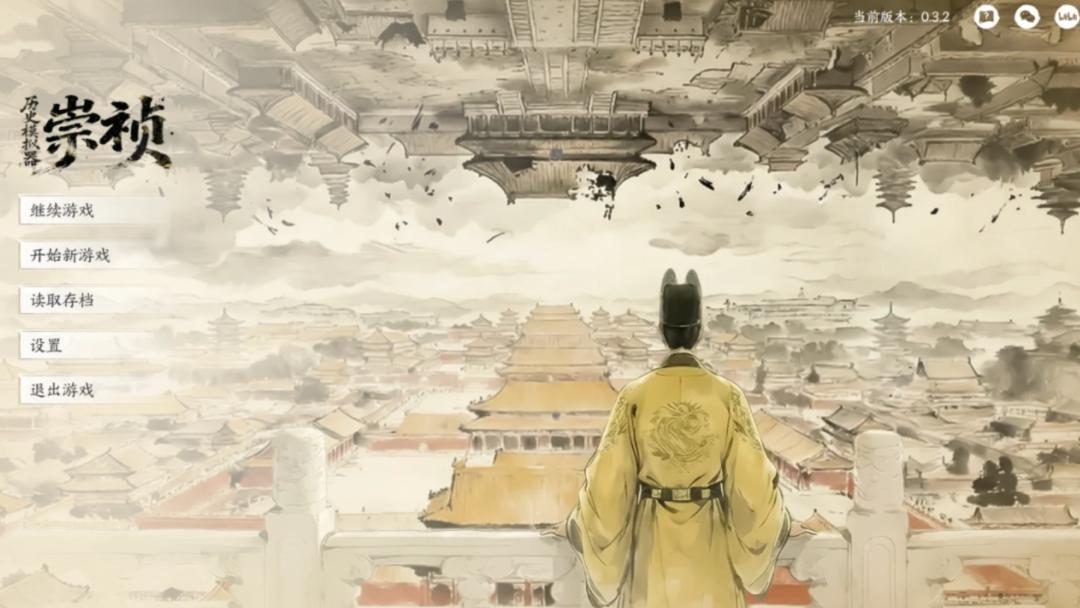
This game, set in the late Ming Dynasty, adopts a rather special mechanism. After players pay 48 yuan to buy the main game, they need to consume Token points each time they have a conversation with AI - driven historical figures. Players input their governance intentions through natural language, and characters such as Chongzhen, Sun Chengzong, and Wei Zhongxian generate real - time responses. The plot development is completely driven by human - computer interaction.
Almost at the same time, the 3D infinite - stream AI companion dating game "Code: Cloud" developed by Zhejiang Tongyuan Intelligent Computing Technology came into the public eye. The game production team publicly stated that in this project, AI is not only responsible for chatting but also permeates every aspect, including character thinking and dialogue, autonomous game behavior, plot interpretation, and intelligent game interaction.

One of these two products is mired in controversy, while the other is full of promise. In the same year, they have brought the same proposition to the forefront. When artificial intelligence starts to drive the narrative and respond to players' free will, the narrative contract between games and players that has been in place for decades is being redrafted.
Looking at both home and abroad, similar explorations have quietly begun in multiple directions, and together they constitute a large - scale experiment on the future of game narrative.
The Ongoing Experiment
Diverse Samples of AI - Driven Narrative Games
The experience provided by "History Simulator: Chongzhen" is both familiar and strange to players accustomed to traditional narratives.
What's familiar is that the game builds a stage with a strong historical flavor. Players wake up as Chongzhen, facing continuous border threats, rampant eunuch cliques, financial collapse, and social unrest. Historical characters such as Yuan Chonghuan, Hong Chengchou, and Li Zicheng have their own agendas, and the picture of a tottering empire unfolds. What's strange is that history enthusiasts have imagined countless times "what if I could rewrite this piece of history", and now they can finally type these ideas into the dialog box and personally deduce another possible development of civilization.
This sense of strangeness points to the long - standing boundary that traditional historical simulation games have difficulty breaking through. A question on Zhihu with over ten million views, "Why can't all historical simulation games simulate the decline of a great power?", has sparked extensive discussions. There are various answers, but one is closest to the essence: the complexity and contingency of reality are almost impossible to truly restore in the era of manually arranged plots.
The value of "Chongzhen" lies precisely in that it allows players to see the initial possibility of breaking through this boundary. Players constantly maneuver between different forces, repeatedly getting into dead - ends and restarting. Each deduction may not necessarily get closer to the historical truth, but it does make the complexity of history tangible. This is why there are widespread complaints like "The position of Chongzhen is really not for humans."
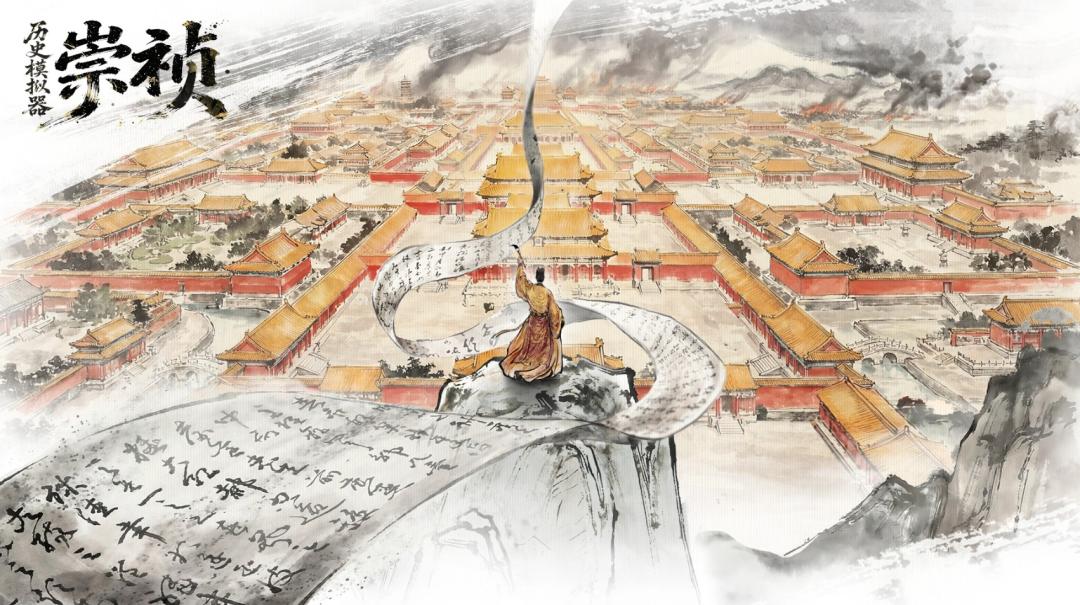
As the first AI - native historical strategy game, "Chongzhen" does have epoch - making significance, but its "imperfections" have also sparked controversy.
Players' negative feedback mainly focuses on two aspects. First, after stripping away the content generated in real - time by AI, the main game is relatively weak in traditional narrative dimensions such as scene description and character portrayal. Second, the combined model of "buy - out plus Token payment" makes some players uncomfortable. In response, the game official announced the opening of a custom API interface and a creative workshop function, trying to find a new balance between cost structure and user experience.
The otome game "Code: Cloud", which entered the public eye almost at the same time as "Chongzhen", has chosen a more radical path. According to the information released by the development team, this game has a built - in AI interaction module. Characters can remember what players have said and the choices they have made, and give relevant responses in subsequent interactions. For example, if a player shows a low mood in a conversation, the character may take the initiative to ask about the player's situation a few days later.

At the same time, each character that can be courted has independent language habits, emotional feedback patterns, and behavioral logic, ensuring that different characters do not give homogeneous responses but show distinct individual personalities. Although "Code: Cloud" has not been released yet, this idea has outlined a possible form of AI - native games, that is, AI is no longer just a simple productivity tool but a new link deeply involved in narrative and interaction.
Expanding the view from domestic to global, there are many similar explorations. "AI Dungeon" developed by Latitude uses large language models to generate infinite possible storylines in real - time. Players can freely explore diverse worlds such as fantasy and mystery by inputting instructions. In the Mod community of the well - known RPG game "The Elder Scrolls V: Skyrim", there were attempts to use AI to give characters independent personalities in 2023. This year, the new version of the Mantella Mod even supports real - time AI dialogue for all NPCs in the world.
Looking at these cases comprehensively, a common feature emerges. They are all trying to shift the production mode of narrative from pre - written to real - time generation, and the delivery mode of narrative from triggering preset content to the emergence of interaction between the system and players. These explorations are still in the early stage, the product quality varies, and the business model is still being explored. But they all point to one direction: game narrative is undergoing a paradigm shift from a "branch tree" to a "generation network".
Boundaries and Breakthroughs
When Narrative Shifts from Preset to Emergent
Before AI intervened in narrative, the game industry had been exploring "letting players influence the story" for decades.
When Quantic Dream launched "Detroit: Become Human" in 2018, the mode of manually creating branched storylines was once pushed to the industrial peak. This game has more than a thousand plot branch nodes. Players' decisions will change the game's plot and ending, and each key choice will have a chain reaction in subsequent chapters. The complexity of the entire script is comparable to that of a multi - season TV series.

Looking back further, the "audio novel" series developed by Japanese company Chunsoft in the 1990s and "Until Dawn" developed by Supermassive Games in 2015 both used the "butterfly effect" system to create non - linear narrative structures.
However, from the perspective of the evolution, manual creation has its limits. Each additional layer of branches leads to a geometric increase in development volume. These works mark the limit of the manual narrative mode and also verify the same law: the consumption speed of content is always faster than the creation speed, and creators cannot predict all of players' free will. Now, the intervention of AI fills the gaps that manual narrative has not fully covered in two dimensions.
The first dimension is the further expansion of narrative possibilities. The core is to use the massive combinations of AI - generated content to respond to the extension of players' free will. "History Simulator: Chongzhen" is a typical example in this direction. In theory, for any instruction input by players, AI can give a relatively reasonable feedback. These feedbacks are continuously superimposed and branched, ultimately generating a unique narrative path.
Of course, this does not mean that players can do whatever they want. AI - native games still have boundaries. For example, "Chongzhen" is still limited within the historical framework of the late Ming Dynasty, and the characters' behavioral logic is restricted by the personality tags set by the developers. But even if the final ending is similar, every court debate, the wording of every imperial edict, and the subtle reactions of every force along the way may vary from person to person. These subtle differences that were impossible to arrange one by one in the manual era are precisely the narrative details that AI can fill.
The second dimension is the structural improvement of interaction depth. For example, "The Elder Scrolls V: Skyrim", NetEase's "Yanyun Sixteen Sounds" and "The Chinese Paladin: Sword and Fairy Online", are all trying to enable NPCs to have real - time conversations with the help of AI. NPCs are no longer just repeaters of fixed lines but can give reciprocal feedback according to players' input. Once this "sense of being alive" is established, players' immersion in the game world will naturally be further enhanced.
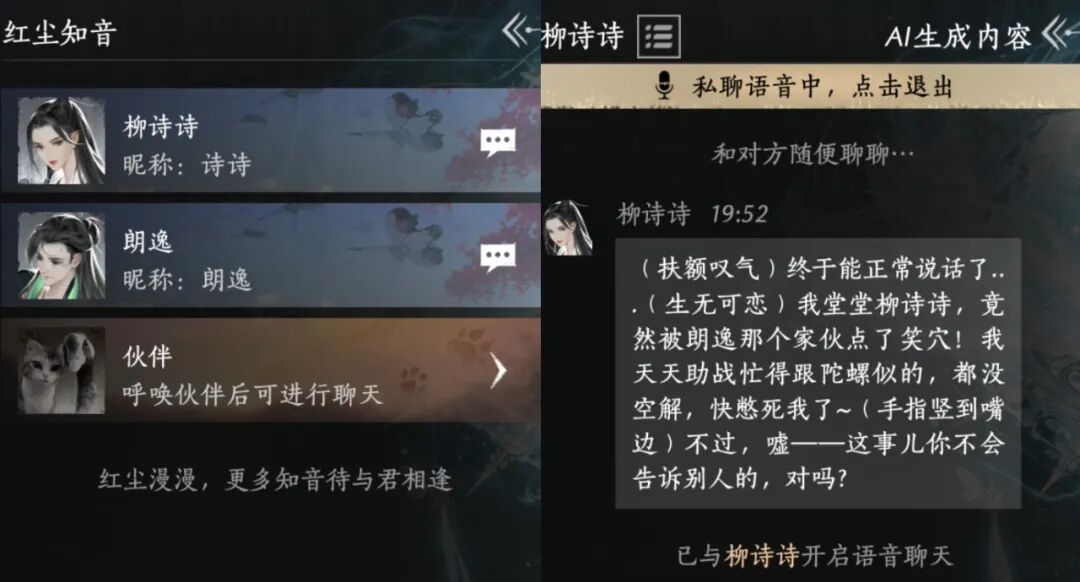
The introduction of AI in otome games follows the same logic. In current leading products such as "Love and Deep Space" and "Light and Night", the interaction between characters and players outside the main plot is still relatively single. A conceivable future is that after AI intervention, players may be able to establish a real - time connection with characters similar to WeChat chats. For example, when sending a message like "So tired" during a late - night overtime, the other party can not only reply instantly but also give comfort with the character's unique personality.
When characters can respond to players' sharing and confessions 24/7, the emotional connection no longer depends on the official's regularly updated plot chapters but grows in the real and trivial companionship of every day. From "watching him love me in the story" to "feeling loved in daily life", this upgrade of the sense of romance is also the direction that players expect otome games to evolve.
The above two dimensions are not mutually exclusive. A mature AI - native game is likely to involve both. They both point to the same paradigm shift. The responsibility of creators shifts from "writing every plot" to "setting the grammar of the world", defining character personality tags, behavioral boundaries, and value orientations, building the basic rules for the world to operate, and then letting the narrative naturally unfold in the system operation.
Beyond enhancing the narrative ceiling, strategic gameplay, and emotional companionship, no one can currently give a complete answer to what other changes AI can bring to games. But it is certain that in the era when AI is transforming various industries, there will probably be more and more AI - driven game works.
Invisible Thresholds
The Triple Dilemmas of Technology, Economy, and Design
Of course, this path is not easy. The controversy surrounding "Chongzhen" is just the tip of the iceberg of the challenges.
The technological threshold is more difficult than what the outside world perceives. At the underlying level, "Chongzhen" has no essential difference from AI interaction platforms such as SillyTavern and MuFy. In all of them, creators set the character framework, and players input actions to drive the plot. Users who have used these platforms intensively have probably experienced moments of being out of the story. Characters suddenly "collapse" in the conversation, forget the previously established plot context, and even say lines that completely violate the character settings. This phenomenon is called OOC (Out - of - Character).
In "Chongzhen", similar problems are not uncommon. For example, NPCs that have been removed from the game inexplicably come back to life in the next round of dialogue, officials who have been clearly promoted do not appear in the minister list, and AI engages in logical sophistry to rationalize the plot. The more interactions there are, the more such bugs there are.
It should be noted that on SillyTavern and MuFy, authors create characters mainly out of love, and players have a relatively high tolerance for OOC. However, games are commercial products. Since players have spent money, they naturally have reason to expect a consistent virtual character. If characters frequently go OOC, the sense of experience collapse will be magnified exponentially. This is also the reason why otome games are generally cautious about introducing AI.
To solve the OOC problem, one relies on model customization, and the other on real money. Manufacturers need to deeply customize the basic model, conduct fine - tuning training with a large amount of dialogue data that fits the character settings, and at the same time build a special filtering mechanism to check the responses in real - time. Without suppressing players' freedom, they can use the characters' own logical reactions to bring the deviated dialogue back on track. There are almost no mature precedents for this technology stack, and the pioneers can only explore on their own.
The cost issue is the second threshold. Real - time invocation of large models is a continuous money - burning process. Each conversation means computing power consumption. For games in operation, this is not a one - time R & D investment but a continuous expense that keeps rising with the user scale and usage time. After "Chongzhen" was questioned for "selling Tokens through the game", it opened the option for players to connect to the API by themselves. This seemingly bypasses the cost problem but actually goes against the future development direction of this category.
The reason is not complicated. The ideal state of AI - driven interaction, including but not limited to smarter responses from characters, longer - term memory, and more stable character performance, all come with a clear price tag on the technology bill. Better memory ability means a longer context window, and smarter dialogue means higher - specification model invocation and more detailed customization investment.
If manufacturers choose to self - develop or deeply customize the model, the game experience can be more controllable, but the sharply increased cost must be digested through a commercialization plan that players are willing to accept. Although opening the self - connected API saves money, it means that manufacturers give up control over the experience quality. Once the model connected by players performs poorly, the experience gap and reputation risk will also backfire on the product. Neither path is easy.
A deeper dilemma lies in the design paradigm. The game industry has accumulated decades of mature design methodologies. How to show character personalities through dialogue, how to control the plot rhythm, and at which node to detonate the emotional climax all have well - verified techniques. However, when generative AI takes over dialogue and plot production, a large part of this methodology is no longer applicable.
In this context, game designers need to transform from content producers to rule - setters. They need to rethink how to define all possible reactions of a character with a set of personality parameters and behavioral rules, and how to create conditions for the emergence of dramatic conflicts without writing specific plots. There are no ready - made answers to these questions either.
This is the real picture of the current stage of AI - native games. The possibilities ahead are clearly visible, but the path underfoot is full of unknowns.
From the controversial exploration of "Chongzhen" to the radical concept of "Code: Cloud", from the trials of