US companies have long suffered from expensive AI? DeepSeek tops the trending list
The cost of AI remains high, and American corporate customers who "can't afford to burn money" are starting to turn their eyes to Chinese large models.
According to the latest report from the American corporate expense management platform Ramp, DeepSeek has topped the "Software Trends List". This list mainly tracks the first-time purchases of enterprises from a certain software provider, which also means that DeepSeek has become one of the fastest-growing software on this platform.
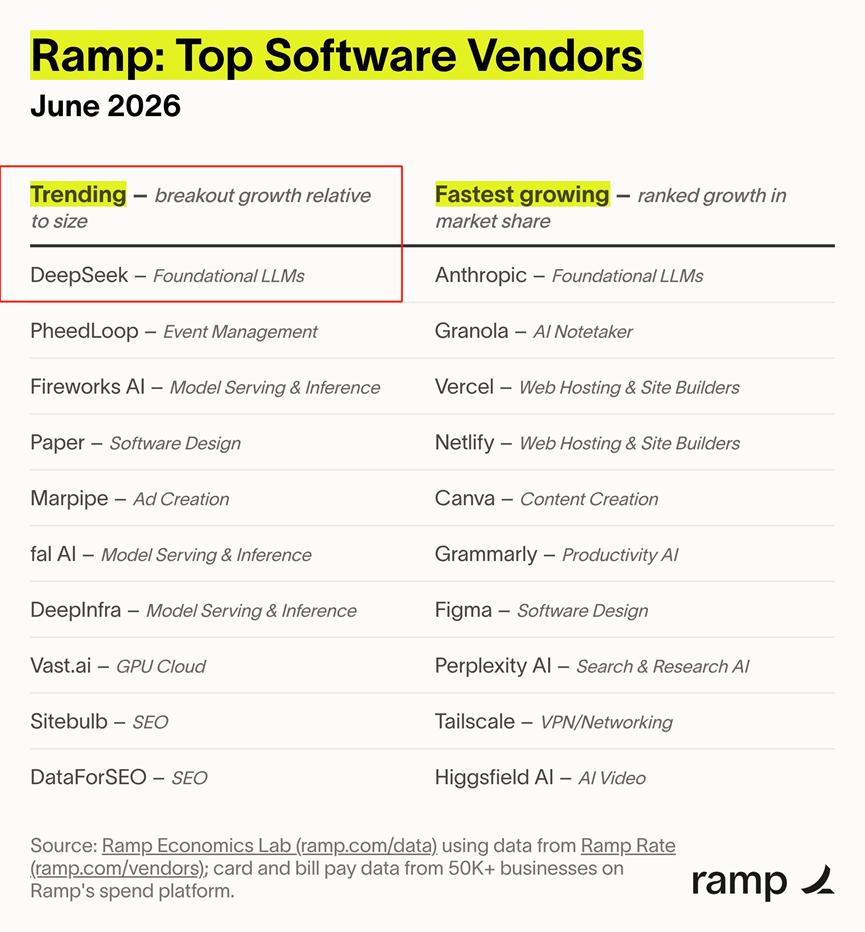
Ara Kharazian, the chief economist of the Ramp Economics Lab, said that this might be the most obvious signal that (American) enterprises are looking for low-cost alternatives to OpenAI and Anthropic, and some companies are willing to adopt Chinese large models with lower prices. According to the data from this platform, these corporate customers pay DeepSeek directly and use the DeepSeek model directly, rather than deploying the DeepSeek open-source model on their own internal servers.
Ramp currently serves about 70,000 corporate customers, a 40% increase from 50,000 at the beginning of the year. Eric Glyman, the CEO of the company, said that a considerable portion of the new customers are from rapidly expanding AI startups, which need to manage the growing model calls, computing power purchases, and related expenses.
Recall that in early 2025, after the debut of DeepSeek R1, global attention soared. Its app not only topped the free list of the Apple App Store in China but also surpassed ChatGPT to claim the top spot in the US list.
The Apple App Store list mainly reflects C-end data, while Ramp data shows that at that time, DeepSeek also had a brief boom in the B-end market. According to Ramp's tracking at that time, the adoption rate of DeepSeek among American enterprises once rose to 0.3% but then quickly dropped back to 0.1% and has remained at this level until April this year. In contrast, the adoption rates of Anthropic and OpenAI among American enterprises are 34.4% and 32.3% respectively. Ramp has not yet disclosed the latest relevant data for May.
"Good but expensive" vs. "Good and inexpensive"
Now, DeepSeek is becoming popular again among American corporate customers, and the direct reason is that "American AI is too expensive". Kharazian pointed out that enterprises are starting to pay more attention to costs in AI spending and will increasingly explore open-source models or model products with lower quotes than OpenAI, Anthropic, and Google.
Not long ago, an AI consultant said that a client company forgot to set a limit on the usage license of Claude for its employees and spent $500 million on it in just one month. Uber revealed that in the first four months of 2026 alone, the company had exhausted its annual "Token budget"; Salesforce said that the company will pay about $300 million to Anthropic this year.
Faced with high AI spending, even technology giants "can't afford to burn money". Amazon has stopped its internal AI usage ranking list to prevent employees from deliberately performing unnecessary tasks to increase the Token consumption in order to improve their rankings. In addition, Microsoft plans to cancel the Claude Code subscriptions of employees in several key product departments and gradually phase them out by the end of June.
The consulting firm Bain recently surveyed 951 global enterprises with annual revenues of over $100 million and released a report, stating bluntly that after enterprises' cumulative AI spending exceeded $1 trillion, the actual cost savings brought by AI are generally far lower than expected; and 44% of large enterprises are using the "unrealized cost savings from the previous round of AI" as the basis for the next round of AI investment - Bain defines this as "a cyclic bet with structural flaws".
From embracing AI at all costs to seeking returns and examining ROI, there has been a shift in the trend among AI enterprise users. Compared with the "good but expensive" American large AI models, the "good and inexpensive" Chinese large models are becoming increasingly popular globally.
It is worth mentioning that in May, DeepSeek announced a permanent 75% price cut for the application programming interface (API) of the DeepSeek V4 Pro model. The input cost per million tokens is as low as $0.025, and the output cost is only $6, setting a new low for the prices of global mainstream large models. Yan Junjie, the founder of MiniMax, which has topped the OpenRouter call volume list multiple times, also revealed earlier that MiniMax is committed to making AI accessible to all and had previously set the goal that the cost of running a complex agent for one hour is $1.
Through innovation in the underlying architecture and technology, combined with energy advantages, cost-effectiveness is becoming the core competitiveness of domestic large models to attract global users.
This article is from the WeChat official account "Caixinlian Press AI Daily", author: Zheng Yuanfang. Republished by 36Kr with permission.