The competition for the central aviation hub sees another city join the fray.
The "air race" in Central China is still intensifying.
Looking at the national air cargo map, the rise of Central China has become the most eye - catching highlight in recent years. In 2025, the cargo throughput of Ezhou Huahu Airport and Zhengzhou Airport both exceeded one million tons for the first time, and they simultaneously joined the global air cargo "one - million - ton club".
In contrast, Hunan, also in Central China, is more like a "latecomer" in this race. A large amount of goods need to "borrow ports to go to sea", resulting in high costs and unstable timeliness. The short - board of the province's international air cargo is obvious.
Recently, a crucial step to rewrite the pattern has arrived in the local area - the full - cargo aircraft at Yueyang Sanhe Airport took off. Local media said bluntly that this is an important breakthrough in the implementation of Hunan's "passenger in the south, cargo in the north" air cargo strategy, and also a far - reaching move to optimize the opening - up pattern and connect with global resources.
What variables will the new pattern of "passenger in the south, cargo in the north" bring to Hunan and even the air map of Central China? Why was Yueyang chosen to break the deadlock with the efforts of the whole province?
New Pattern
Looking back a few years ago, the air logistics pattern in Central China was once in a stable situation of a "tripartite confrontation" among Zhengzhou, Wuhan, and Changsha.
After the operation of Ezhou Huahu Airport, this situation was quickly broken.
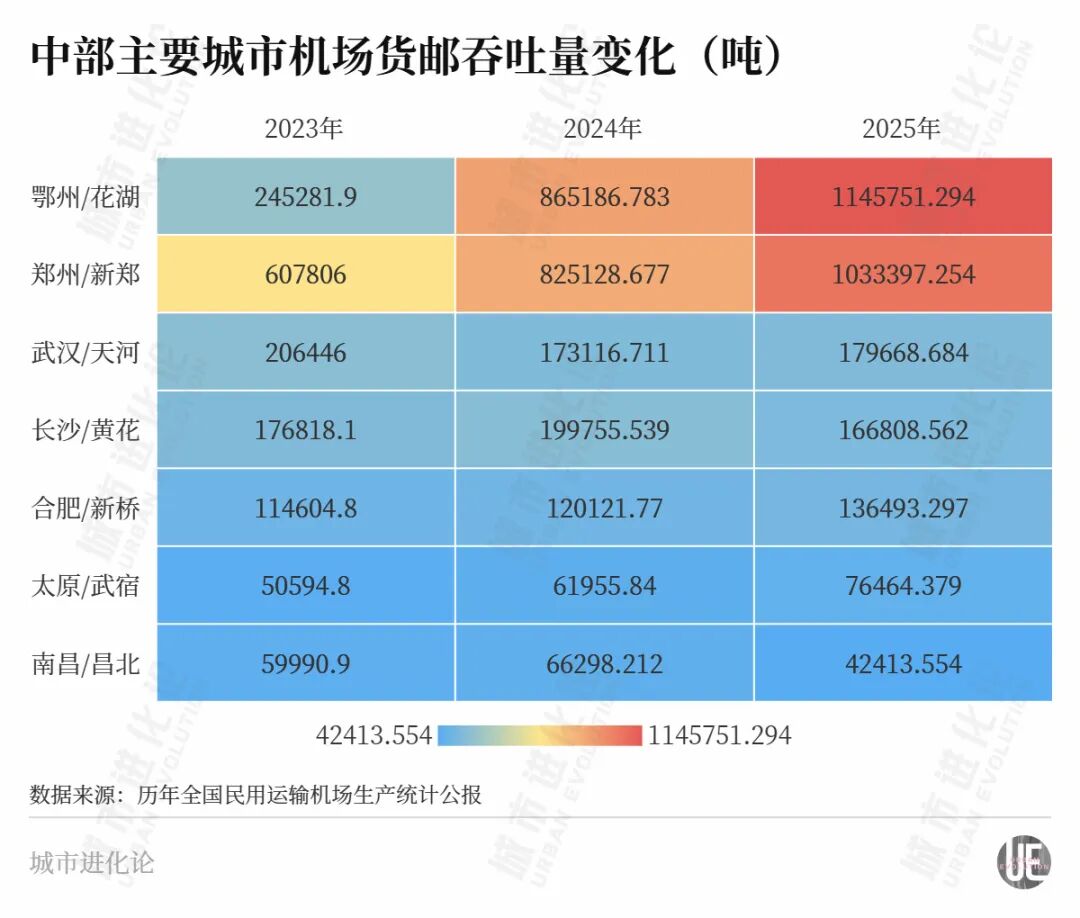
As the first professional cargo hub airport in Asia, the cargo throughput of Huahu Airport has continuously refreshed records since its operation in 2022. It completed a leap - forward counter - attack from 0 to one million tons in less than four years.
In the second year of its operation (2023), the cargo throughput of Huahu Airport exceeded that of Wuhan Tianhe Airport and Changsha Huanghua Airport, rising to the second place in Central China.
In 2024, the cargo throughput of Huahu Airport further surpassed that of Zhengzhou Airport, taking the first place in Central China and becoming the "biggest dark horse" stirring up the air cargo pattern.
In 2025, the air cargo throughput of Huahu Airport reached 1.1457 million tons, ranking fifth among national airports and soaring by 32.4% year - on - year.
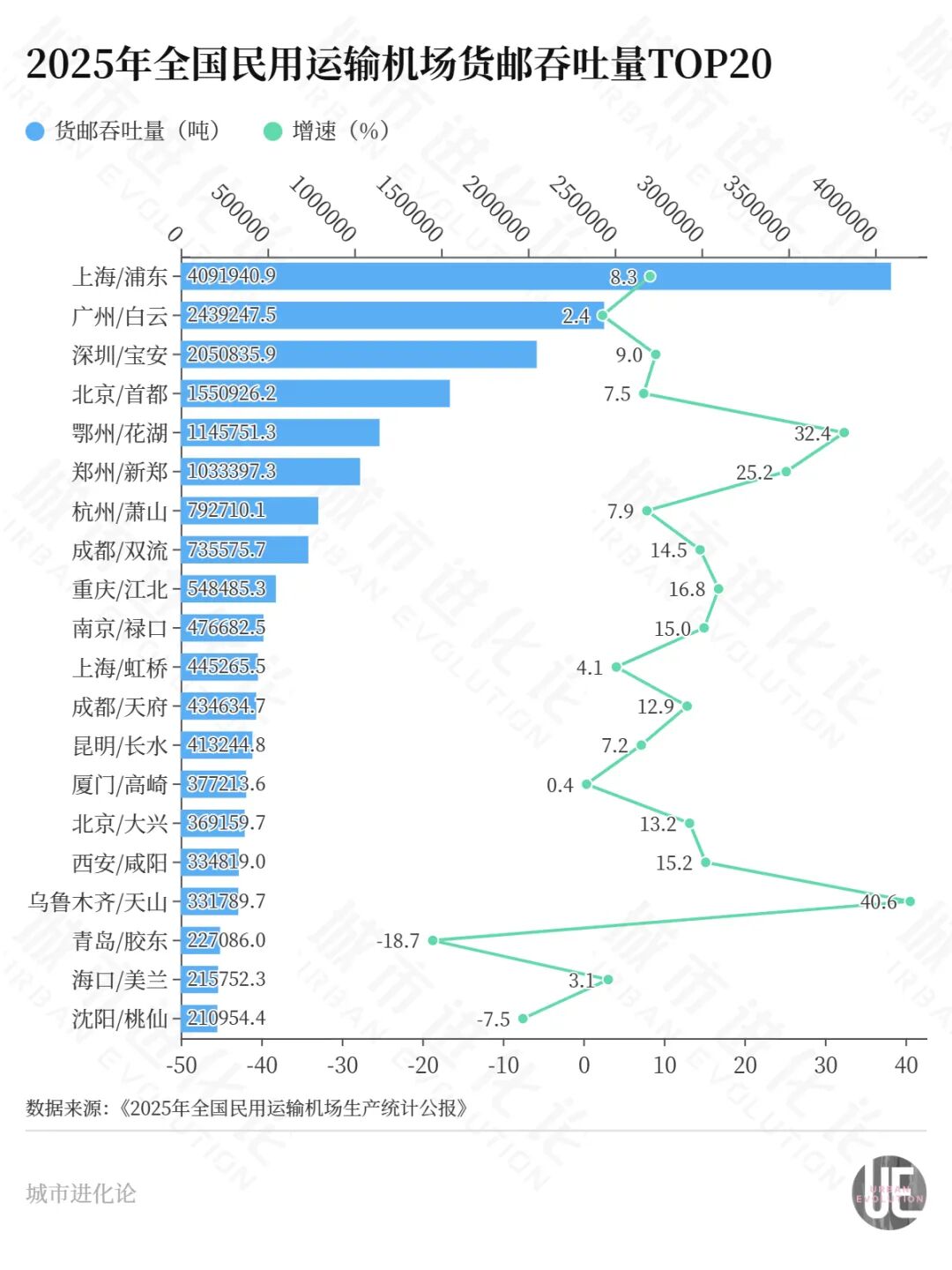
Behind the data is a Central China that is reshaping its coordinates in the national air map.
In the blueprint of the "3 + 7+N" international air hub system of the Civil Aviation Administration, "steadily promoting the construction of professional and comprehensive air cargo hubs" has become a key link in enhancing the development level of hubs.
Among them, Ezhou is clearly defined as a "professional cargo hub", and Zhengzhou and Hefei are respectively positioned as an international logistics center and an international air cargo distribution center, becoming the "pioneers" in expanding inland opening - up.
Facing the accelerating rewritten air logistics pattern, Hunan obviously doesn't want to wait any longer.
On the one hand, there is a shortage of development space. For a long time, Hunan's air passenger and cargo resources have been highly concentrated at Changsha Huanghua Airport. The single - hub bears a large pressure, and the allocation of air resources is unbalanced, which seriously restricts the expansion and upgrading of the province's air logistics industry.
On the other hand, with the rapid rise of time - sensitive industries such as electronic information and biomedicine, the local demand for air logistics is unprecedentedly urgent. However, Changsha Huanghua Airport mainly relies on the belly - hold cargo of passenger planes, and it is difficult to fully meet the large - scale transportation needs of special goods such as bulk goods and cold - chain fresh products. A large amount of goods need to be transshipped through other places, resulting in high costs and unstable timeliness, which hinders the pace of the advantageous industries going global.
In this context, Hunan has made a strategic deployment at the provincial level, strongly supporting the joint creation of an international air logistics hub by Changsha and Yueyang, with the pattern of "passenger in the south, cargo in the north, and coordinated operation of trunk and branch lines", so as to achieve a win - win situation.
Simply put, Changsha focuses on passenger transportation and radiates the national passenger flow, while Yueyang specializes in cargo transportation and connects the global cargo flow, realizing the optimal allocation of air resources and thus reconstructing Hunan's air logistics map.
To this end, Hunan has spared no effort to break the deadlock.
Public reports show that during this year's Two Sessions, the Hunan delegation submitted a proposal (hereinafter referred to as the "Proposal") in the name of the delegation, asking the national level to support relaxing the restrictions on international air rights at Yueyang Airport, optimizing the approval process for cargo routes, expanding the full - cargo aircraft route network, especially strengthening the connections with major domestic hub airports and international air cargo hubs, and providing policy support for the hub construction.
At the same time, the "Proposal" called on the national level to include the construction of Yueyang International Cargo Air Hub in the national plan. Subsequently, the main leaders at the provincial and municipal levels visited the national ministries and commissions several times to coordinate and strive for policy support.
New Hope
Why is the hope of breaking the deadlock in Yueyang?
Looking at the map of Hunan, Yueyang is the only city in Hunan bordering the Yangtze River, with a 163 - kilometer shoreline of the Yangtze River's golden waterway. The Yangtze River and the Beijing - Guangzhou Railway, two major national transportation arteries, meet in Yueyang. This makes Yueyang the only gateway to the sea in Hunan and one of the few in Central China.
Compared with hubs such as Chongqing and Wuhan in the upper reaches of the Yangtze River, Yueyang is closer to the estuary of the Yangtze River Delta, having natural time and cost advantages in undertaking the industrial transfer from the east and connecting with the international market. This also makes Yueyang a key chess piece that cannot be bypassed in Hunan's logistics layout.
For Yueyang, this is also a historical opportunity that it must seize with all its strength. This sub - provincial central city is standing at a delicate crossroads: its GDP ranks second in the province, but it is facing a competitive situation of "the leading cities are getting farther away, and the chasing cities are getting closer" within Hunan and even the entire middle reaches of the Yangtze River.
Within the province, in 2025, Yueyang's GDP was 538.688 billion yuan, and the gap with Changsha (1.573782 trillion yuan) widened to more than one trillion yuan. Behind it, cities such as Changde and Hengyang are only a few billion yuan behind Yueyang in GDP and are working hard to catch up.
Looking outward, Yichang and Wuhu, which were once called the "Four Little Dragons of the Yangtze River" together with Yueyang, the former has risen to become the "first non - provincial - capital city in Central China", and the latter has continuously narrowed the GDP gap with Yueyang in recent years and surpassed Yueyang for the first time in 2025, leaving Yueyang behind.
Behind this, an undeniable reality is that Yueyang, with the geographical advantage of the "golden cross", has not fully released the energy of "connecting to the sea through the river".
Looking at Yueyang's comprehensive logistics system, relying on the water - transport advantages of Chenglingji Port, the transport capacity of the Beijing - Guangzhou Railway trunk line, and the support of the whole - region road network, it has formed a basic pattern of multimodal transport. However, aviation has always been a weak link, and the huge freight potential has not been realized, which largely restricts the improvement of the city's opening - up level.
Especially Yueyang Sanhe Airport, which started operation in 2018, although it has natural endowments for developing air cargo such as loose airspace, low aviation fuel costs, and abundant time resources, it has long faced the bottlenecks of limited route network radiation and an inactive cargo function.
According to the "2025 National Civil Transport Airport Production Statistics Bulletin" released by the Civil Aviation Administration, in 2025, the passenger throughput of Sanhe Airport was 316,600 person - times, a year - on - year decrease of 6%, ranking 174th among 268 civil airports in the country; the cargo throughput was only 6.045 tons, a year - on - year decrease of 86.2%, ranking 227th in the country.
At a critical moment, a turning point appeared.
Public reports show that with the high - level promotion and all - out efforts of the whole province, in less than half a year, important breakthroughs have been made in the approval of the air port of Sanhe Airport. The main construction of three designated supervision sites (incoming fruits, chilled aquatic products, and edible aquatic animals) has been completed, and the reconstruction and expansion of Sanhe Airport have been successfully included in the 15th Five - Year Plan of civil aviation.
On May 12, the National Port Office officially approved the temporary opening of the air port of Yueyang Sanhe Airport. Less than 20 days later, a full - cargo aircraft loaded with 19.2 tons of e - commerce packages, fresh products, electronic accessories and other goods took off from Yueyang Sanhe Airport, transferred through Changsha Huanghua International Airport, and flew to Kuala Lumpur, Malaysia.
This inland city with a dream of connecting to the sea has since opened up the imagination space of an "air sea - outlet", and also brought new variables for Hunan to participate in the competition of air hubs in Central China.
New Challenges
The question is, with the accelerated implementation of Hunan's new pattern of "passenger in the south, cargo in the north", can the air logistics map of Central China be rewritten?
Public information shows that currently, the annual handling capacity of Sanhe Airport Port is 40,000 tons. After it becomes a formally opened port, a 30,000 - to 40,000 - square - meter comprehensive cargo warehouse will be newly built, equipped with three designated supervision sites for incoming fruits, chilled aquatic products, etc.; the cold - chain storage can meet the storage demand of 1,000 tons of imported fresh products, and it has the qualification for all - category imports, making it one of the well - equipped air cargo ports in Central China.
In addition, the cargo storage project at Sanhe Airport is being urgently approved for construction and is planned to be put into use in 2028. It is expected that the cargo throughput capacity will reach 200,000 tons in 2030, with a long - term plan of 600,000 tons. In terms of routes, Yueyang will accelerate the expansion of routes to ASEAN and Japan and South Korea, and open intercontinental long - distance routes in the long - term, speeding up the construction of a regional air logistics hub in Central China.
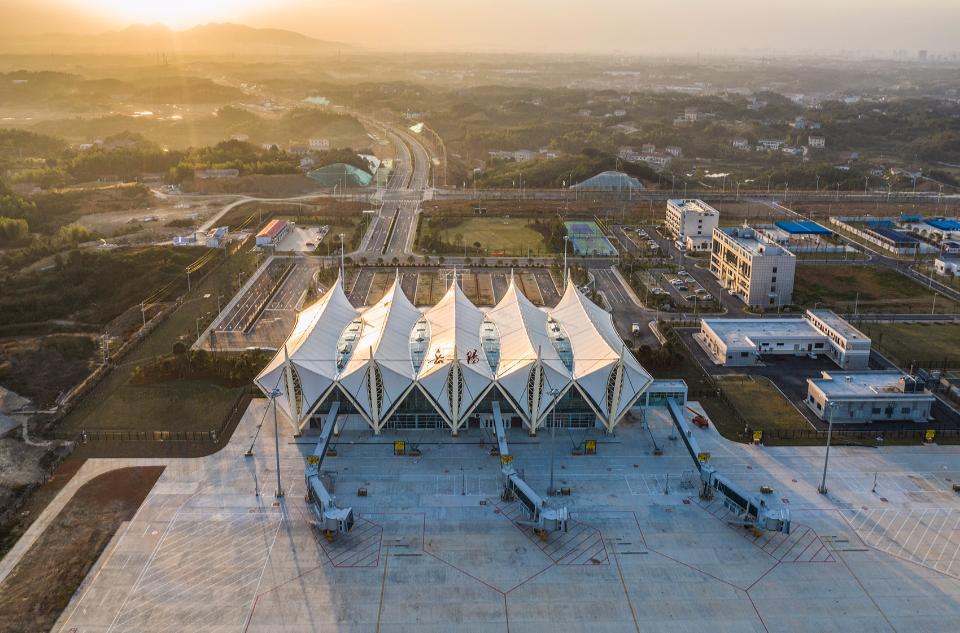
Image source: Yueyang Release
For Yueyang, which is almost starting from scratch, achieving the goal of a cargo throughput capacity of 200,000 tons in 2030 and 600,000 tons in the long - term is not easy.
In the local's vision, the unique advantage of multimodal transport of "water, land, air, and rail" is an important confidence for Yueyang to break the deadlock. As one of the eight excellent ports on the Yangtze River and a port that can accommodate ten - thousand - ton ships all year round, Chenglingji Water Port and Sanhe Airport, as "dual ports and dual hubs", work together. Bulk goods can be transported by water to Chenglingji Port and then seamlessly transferred by air to the world; high - value - added goods transported by air through Sanhe Airport can also be quickly distributed to the water - transport network to radiate the inland hinterland.
However, on the other side of efficient connection, the competition for the hinterland and the siphon effect are also worthy of vigilance.
Lu Yi, the dean and professor of the Institute of Intelligent Transportation and Modern Logistics at Changsha University of Science and Technology, once analyzed that Yueyang is located between Wuhan and Changsha, less than 150 kilometers away from Changsha, and the shipping mileage from Chenglingji Port to Wuhan Port, the Yangtze River shipping center, is only more than 200 kilometers. It is within the radiation hinterland of the influence of Wuhan and Changsha.
In his opinion, the easy siphoning of resources by Wuhan and Changsha and the limited hinterland are the most critical problems affecting the construction and development of Yueyang and its national port - type logistics hub.
At the same time, the reconstruction and expansion project of Changsha Airport has entered the final sprint stage. According to its design goal, the cargo throughput capacity will be expanded to 600,000 tons in 2030.
How the two hubs of Changsha and Yueyang will have a differentiated division of labor and work together in the future not only concerns the future direction of the "Changsha - Yueyang Airport Economic Zone", but also largely determines whether Hunan can catch up from behind in this "air battle" among strong competitors.
This article is from the WeChat official account "Urban Evolution Theory", author: Cheng Xiaoling. Republished by 36Kr with authorization.