Behind Zhang Xiaolong's "loss of control", Fenbi's AI gamble and practical dilemmas
After a series of highly aggressive and controversial remarks, Zhang Xiaolong, the CEO of Fenbi, was caught in an online storm.
On June 3rd, during a speech at the School of Philosophy of Renmin University of China, Zhang Xiaolong, the CEO of Fenbi, made a series of inappropriate remarks. According to media reports, Zhang Xiaolong's original speech topic was about the civil service exam coaching industry. However, before the official start of the lecture, he temporarily changed the topic to "Career Planning in the AI Era".
After the sharing session began, Zhang Xiaolong didn't talk about career planning. Instead, he started discussing stock trading. He claimed that stock trading is the most promising career direction in the future. "It's best to trade technology stocks. Even better, trade US stocks. And it would be even better to trade stocks with your whole family," he said. He also voluntarily revealed that "he invested 80 million yuan in the stock market last month and made a profit of 53 million yuan".
As the students in the audience didn't respond enthusiastically, Zhang Xiaolong gradually lost control of his emotions.
Subsequently, he made remarks like "coming here to show off my wealth" and even insulted the students with swear words. "Don't think you're special just because you're at Renmin University. You have no perception of the changes a new thing brings to society. So it's reasonable that you can't find jobs. Society shouldn't offer you jobs..." Zhang Xiaolong said in the online recording of the scene.
Later, he left after saying, "I'm not going to talk anymore. That's it. My time is very precious. I don't like you. I won't give you time to ask questions. I think you're very bad, extremely bad, xxx."
When the founder of a public company loses control of his emotions in public and makes radical remarks to a group of students who haven't fully entered society, it's not just the students who are shocked.
From yesterday until now, the discussion triggered by Zhang Xiaolong's radical remarks has been heating up. At 10:18 a.m. today, Zhang Xiaolong posted an apology letter through the Weibo account @Fenbi Technology with ID verification. An hour later, he posted the same apology content through Fenbi's official Weibo account @Fenbi Civil Service Exam Education.
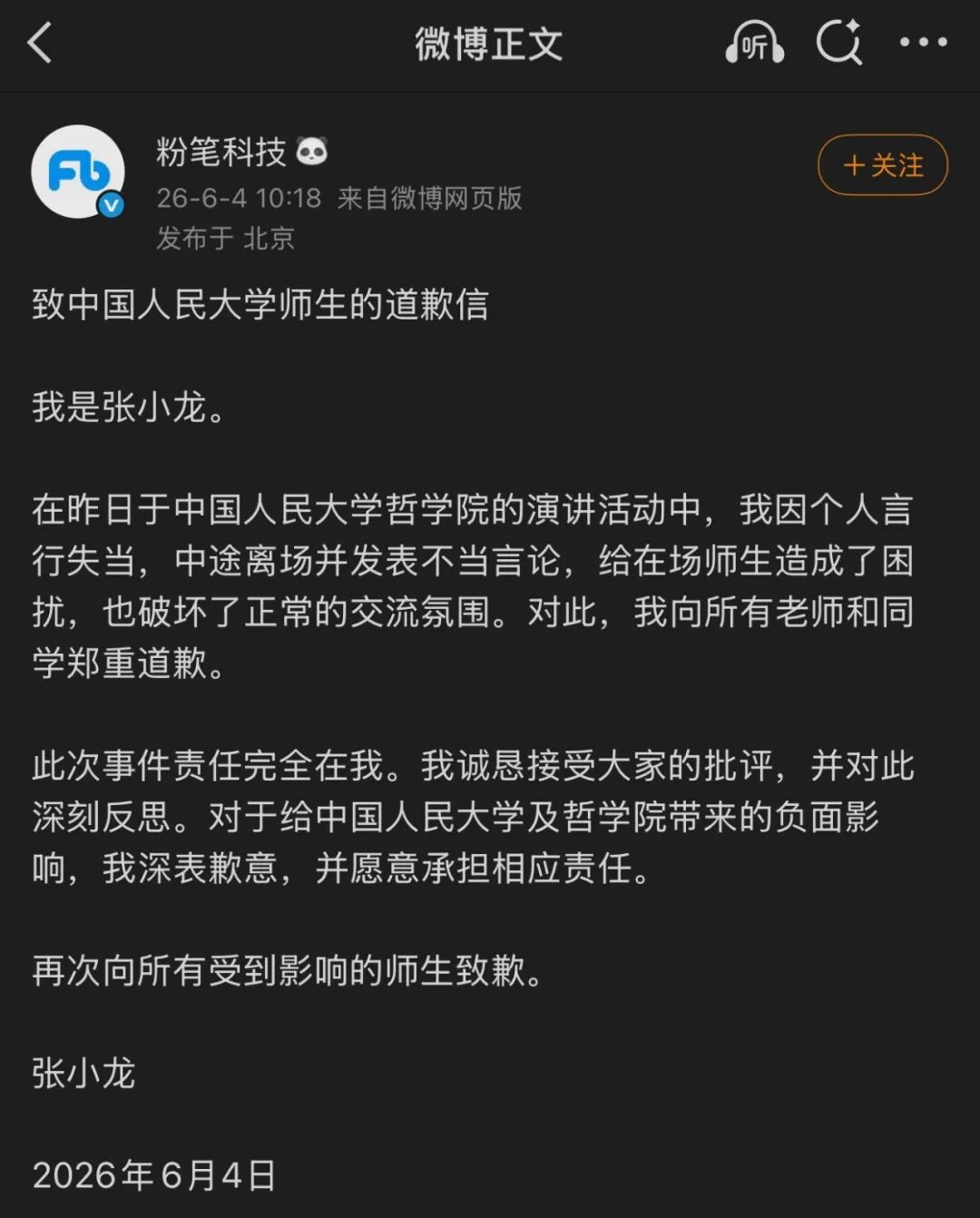
However, Zhang Xiaolong's apology obviously failed to calm down the public's emotions.
"I hate post - event apologies the most", "The boss smashed his own job in public", "A person who makes money from civil service exam candidates insults them, xxxx". You can easily feel the anger of netizens in the comment section of that apology post.
Moreover, angry netizens are already planning to give low ratings to Fenbi's app in major app markets or refund their courses.
Why did Zhang Xiaolong "lose control"?
This is not the first time Zhang Xiaolong has made controversial remarks. His public image has always been distinct, being straightforward, sharp, and emotional. He has never been afraid to express extreme views.

Photo/Fenbi's official Weibo
In the past few years, Zhang Xiaolong has verbally attacked Baidu on Weibo, complained about Beijing's school enrollment system, "criticized" Hunan TV in a video, and dissed Zhang Lei of Hillhouse Capital in his WeChat Moments. Later, his personal Weibo account was once banned.
He has also always been apologizing. In the early years, the most frequent word in his apology reasons was "speaking out of turn after drinking". He also said that he was "hot - tempered and inexperienced", that he shouldn't have used the public platform as a place to vent his emotions, and that his personal remarks didn't represent Fenbi Technology.
From this perspective, Zhang Xiaolong's "loss of control" at the Renmin University lecture hall seems not entirely incomprehensible.
On the afternoon of June 4th, Zhang Xiaolong published another long article, further explaining and apologizing for this incident. In it, he detailed why he lost control of his emotions and what his real intention was.
To put it simply, there are two points:
First, he summarized that the direct reason for his loss of control was that the students at the scene didn't give enough emotional feedback. He felt embarrassed, his self - esteem was hurt, and finally he broke down.
Second, he didn't understand why everyone was indifferent to his content full of valuable information, which was a bit like "hating that iron can't be turned into steel".
"I thought I was doing good for everyone by sharing valuable information. I didn't sell any products. I just said what I thought was good for young people. I thought I, an old man, selflessly shared what I thought was good, but everyone didn't appreciate it. It was all because of my damned self - esteem. At that time, I interrupted the lecture, rushed out of the classroom, and cursed in the corridor, even cursing the school. These were all emotional words and not my real thoughts," Zhang Xiaolong wrote.
Of course, according to Zhang Xiaolong, his emotional outburst was also cumulative.
Based on his long article, here is a simple emotional progression:
Talk about the destructive power of the huge productivity revolution brought by AI - no response from the audience - start giving examples - still no response - give more vivid and stimulating examples, that is, buying technology stocks - still not enough response - give an example of his own stock trading, not to talk about stock trading but mainly to emphasize the effectiveness and importance of AI tools - still no response - emotional outburst.
So far, it's hard to be sure that all of Zhang Xiaolong's radical remarks yesterday were his true thoughts. Perhaps there's no need to discuss his starting point too much. Everyone says angry words when they break down. In fact, his biggest mistakes come from two aspects.
The first aspect is the old - fashioned issue of emotional management; the second aspect is that he not only wanted to teach young people how to do things, but also attacked them when they didn't listen to him. This is not just being "father - like", but more like being "grandfather - like".
To some extent, perhaps Zhang Xiaolong has participated in too few such sharing sessions. In theory, if he had participated in more, he wouldn't have broken down because of the lack of response from the audience.
Of course, after this incident, it's likely that he will have fewer such opportunities.
Behind the CEO's loss of control: Fenbi also faces uncertainties
Let's first look at a set of data. The number of applicants for the 2026 National Civil Service Examination was 3.718 million, and the application - to - admission ratio was 98:1, both setting new historical records.
Against the backdrop of the continuous heating up of the national civil service exam, the pattern of the civil service exam training market is also accelerating its differentiation. Fenbi is facing significant real - world challenges.
According to its 2025 annual report, Fenbi's revenue of 2.677 billion yuan decreased by 4.1% year - on - year. The annual net profit was 198 million yuan, a year - on - year contraction of 17.3%. After adjustment, it was 281 million yuan, and the gross profit margin increased slightly by 1 percentage point to 53.5%, presenting a complex signal of "decreasing revenue, decreasing profit, and increasing gross profit".
A year earlier, Fenbi's revenue also decreased, dropping by 7.7% year - on - year from 2.79 billion yuan in 2023.
Specifically, the online large - class training courses, which Fenbi was once most proud of, are facing more severe challenges.
In 2025, the revenue from this business was 423 million yuan, a year - on - year decrease of 16.7%. In its financial report, it admitted that the main reason for the decline was "small institutions' low - price competition has had a great impact on the industry's price system, diverting a part of the market share. Our overall revenue has still been affected to a certain extent, resulting in a decline in the overall large - class course revenue."
Meanwhile, although Fenbi's offline small - class courses are still the main source of income - contributing 1.738 billion yuan in 2025 - facing the well - established offline channel networks and teaching and research systems of its competitors, Fenbi's offline expansion has not been able to form sufficient barriers.
From the perspective of internal operations, Fenbi is also undergoing a drastic "cost - reduction and efficiency - improvement" process. The number of employees decreased from 10,427 in 2021 to 7,005 in 2025, and the average annual salary per employee decreased from 261,000 yuan in 2021 to 191,000 yuan in 2024, a decrease of about 27%.
In October last year, Zhang Xiaolong also published an article titled "New Journey", in which he wrote:
"In the past two years, affected by various factors, many companies from other industries have entered this relatively small industry, leading to extremely intense competition. Whether online or offline, prices have dropped sharply. In this battle, we didn't follow the trend. We chose to strategically abandon some sinking markets, maintain the quality of our products and services, and keep the original prices. This once put us under great pressure..."
But at that time, he also believed that Fenbi "had ended two years of steady decline and started to rebound in the second half of the year."
Behind this, AI is regarded by Fenbi as a new key variable to break the situation. According to Fenbi's plan, this year is also a year to accelerate the development of online AI - related courses.
In 2025, Fenbi's R & D investment increased by 10.6% year - on - year to 245 million yuan. It launched products such as the AI question - brushing system course and AI interview evaluation, and re - allocated all the unused IPO funds of HK$60.8 million for AI R & D.
However, the current revenue scale of AI courses is still a drop in the bucket - the annual revenue of the AI question - brushing system course was only 38.1 million yuan, showing a huge gap compared with the revenue of traditional small - class courses.
For Fenbi, how to convert more users into paying users of AI courses and fill the gap caused by the decline of large - class courses remains an unsolved problem.
On the other hand, the macro - environment of the industry is also changing.
In recent years, although the scale of civil service recruitment has remained relatively stable, the payment willingness and ability of candidates are differentiating. For example, more and more candidates tend to choose low - cost or even free preparation resources instead of system courses that cost thousands of yuan.
The tightening of policies on vocational education and off - campus training has also added uncertainties to the industry. Fenbi is trying to find a second growth curve by expanding into training for recruitment exams in public institutions, teaching, and medical fields. However, the competition in these niche markets is also fierce, and the teaching and research systems need to be rebuilt, making it difficult to contribute significant growth in the short term.
Overall, Fenbi is currently facing not a single - dimensional dilemma but a combination of multiple pressures such as performance, stock price, business, competition, and internal management.
AI may bring a bright future to Fenbi, but the current problem is that when the company's stock price falls below HK$1 and its market value is only more than one billion Hong Kong dollars, does the capital market still have the patience to wait for an unproven AI narrative?
This article is from the WeChat official account "Listening to the Tide TI", author: Yang Feng, editor: Zhang Xiao. Republished by 36Kr with permission.