ByteDance, Alibaba and Tencent are racing against the time window: the underlying logic of the AI platform war has surfaced
This week, the media reported that Tencent is testing a prototype of an AI agent built into WeChat and plans to start the compliance review this month. As soon as the news came out, Tencent's market value rose by about 360 billion yuan in a single day.
Within the same week, Tongyi Qianwen announced the full opening of brand Agents and Skills to enterprises. Luckin Coffee, KFC, and Mixue Ice Cream & Tea were the first to join. Wang Xing, the CEO of Meituan, announced during an earnings call that Meituan's AI assistant "Xiaomei" has completed the connection with Tencent's Yuanbao. ByteDance's Doubao also confirmed that it will launch a professional version, separating daily services from professional services, with the latter offering some paid services.
Behind these seemingly isolated moves by large tech companies, there is an underlying logic: AI is reshaping the most fundamental industrial architecture of the Internet. Although Doubao and Tongyi Qianwen seem to have taken the lead in seizing the entry point in the AI era, WeChat remains the biggest variable.
01. The Layers Are Splitting
Nine years ago, WeChat launched mini-programs, which changed more than just the way apps are distributed. Before that, the entry point for Meituan was the Meituan app, and the entry point and the service belonged to the same entity. After WeChat launched mini-programs, Meituan could be opened within WeChat, so the entry point (WeChat) and the service (Meituan) belong to two different companies. The industrial structure has an extra layer, but one thing remains unchanged: The user is still the one making the routing decisions.
If a user wants to order a drink from Luckin, they first need to remember Luckin, then open WeChat, find the mini-program, and place an order. Brands are competing for that "actively triggered" position in the user's mind. This is the underlying logic of competition in the mini-program era: Win the user's active choice.
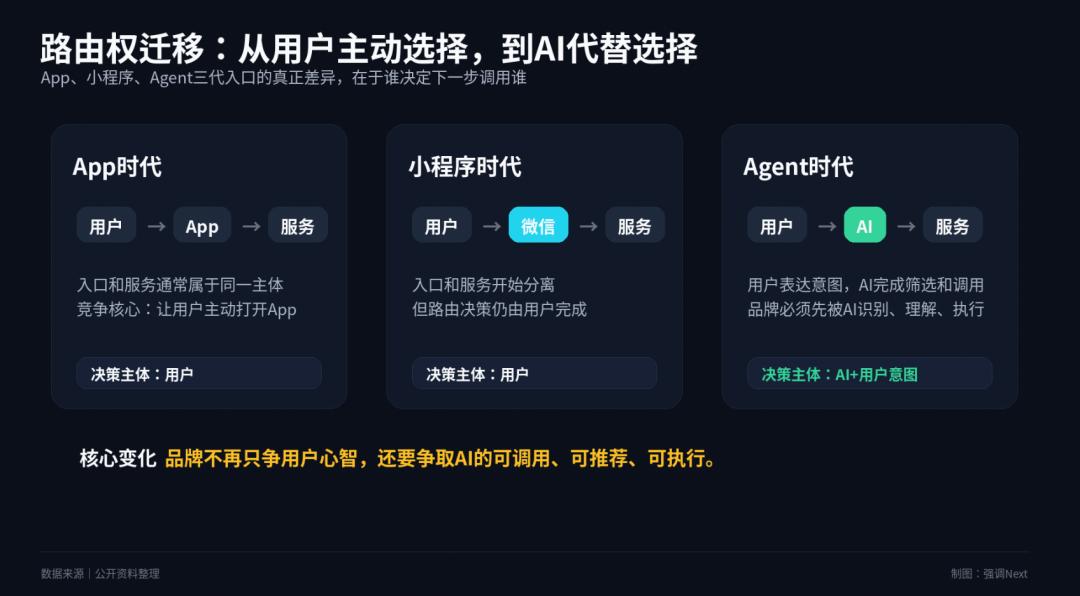
The Agent era is precisely changing this.
When a user says, "Help me order a cup of Luckin latte," in the past, they had to find the Luckin mini-program themselves. Now, they can just tell the AI to do it. Brand loyalty still exists, but it must be "translated" by the AI. If Luckin is not connected to this AI platform, the user's request "Help me order from Luckin" might get a response like "Not supported yet. Here's a recommendation for XX." The user's choice still exists, but the execution path is controlled by the AI.
An even more radical change affects another type of user. These users say, "Help me order a cup of coffee" without specifying a brand preference. In the past, they had to browse and compare prices themselves. Now, this process is taken over by the AI. For these users, brands have never really had their loyalty, but at least in the past, the process had to pass through the user's attention filter. Now, this filtering step is replaced by the AI.
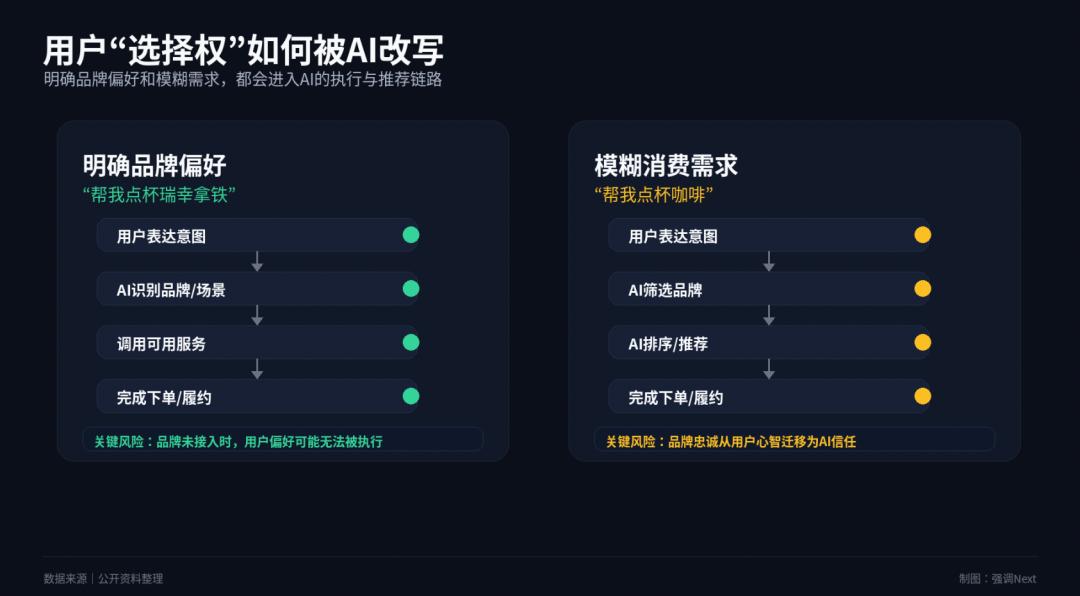
In both cases, the conclusion is the same: The AI itself has become the customer that must be served. This is the essence of ToA (ToAI).
When the AI becomes the routing decision-maker, the vertical integration logic of the mini-program era no longer works. The AI can call execution capabilities across platforms, and brands can connect to any AI entry point. There is now room for independent competition between layers.
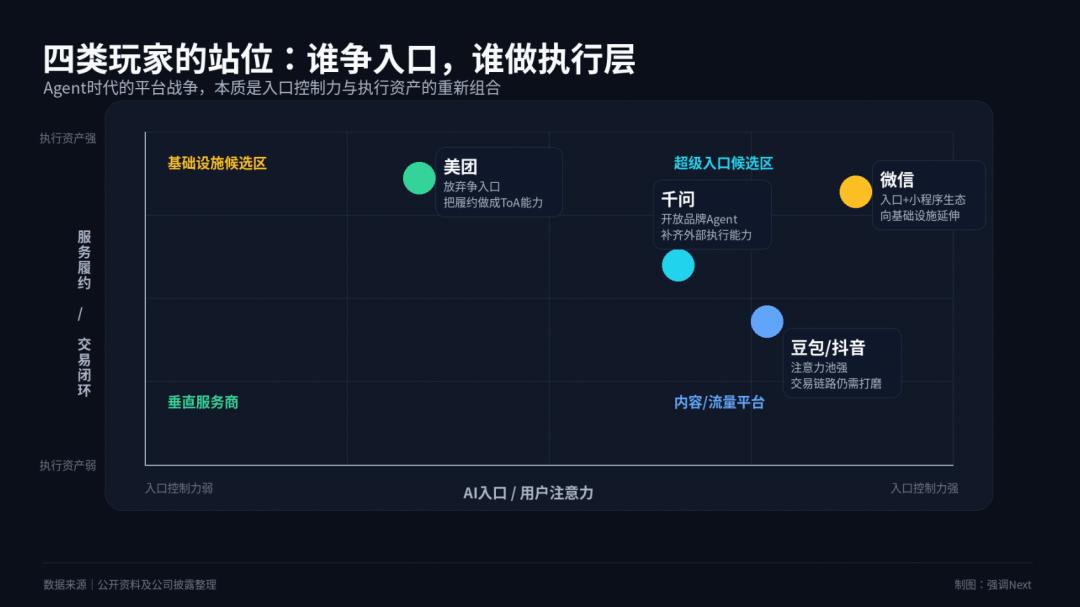
All the actions in this platform war are essentially each player's effort to become the layer that the AI most wants to call.
02. Those Competing for Entry Points Are Making Up for Shortcomings in the Execution Layer
In the past year, AI-native applications like Tongyi Qianwen, Doubao, and Yuanbao have all been striving to become the default AI entry points for users' daily tasks.
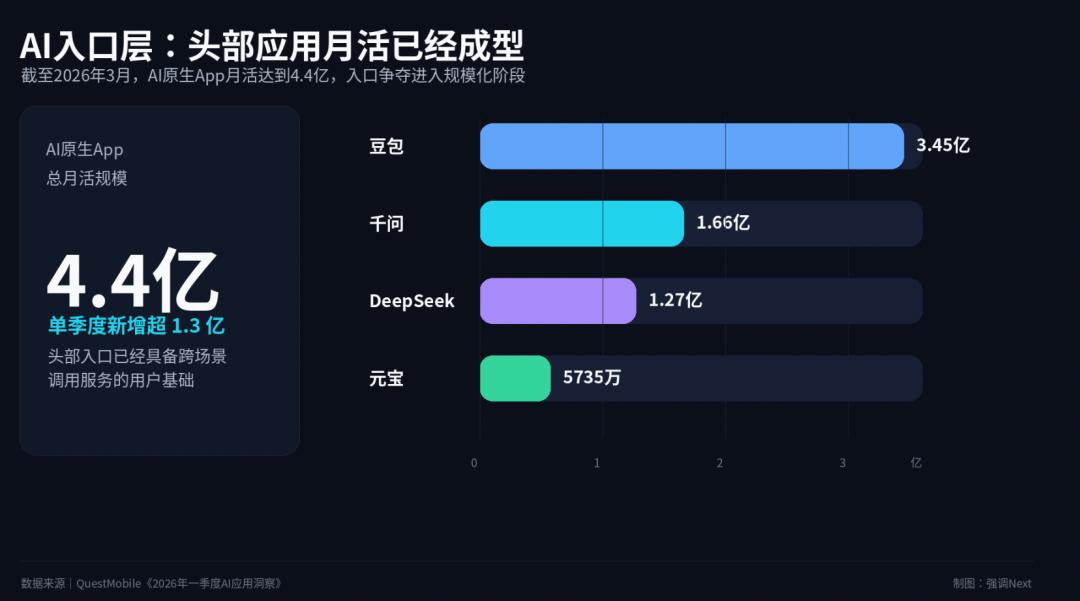
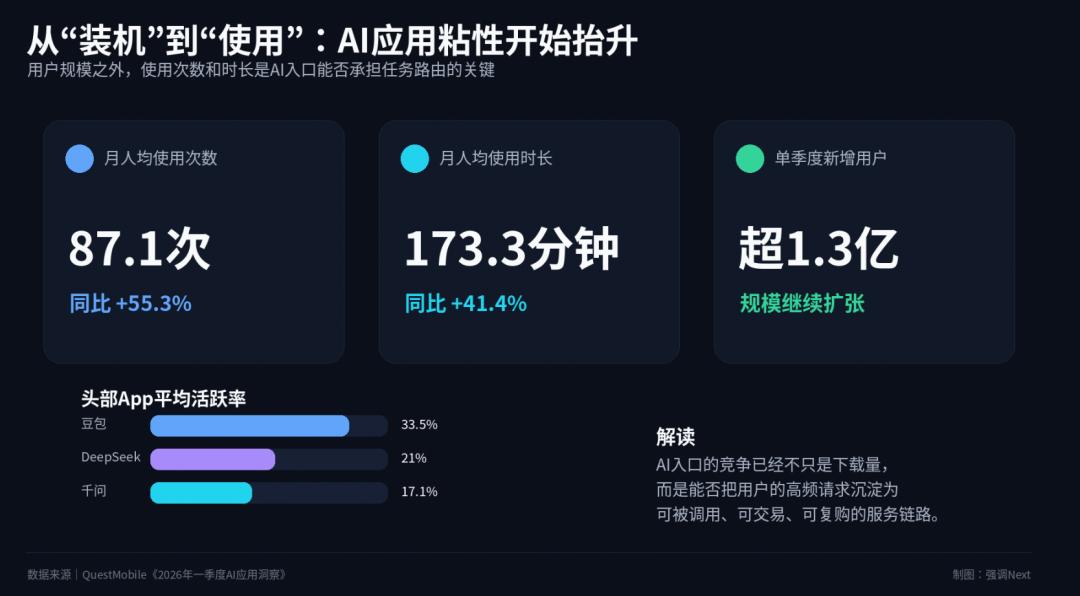
According to QuestMobile data for the first quarter of 2026, the monthly active users of AI-native apps have reached 440 million. Doubao leads with 345 million monthly active users, followed by Tongyi Qianwen with 166 million, DeepSeek with 127 million, and Yuanbao with 57.35 million. However, the value of an entry point depends on what it can call behind it. Therefore, the competition for AI entry points has transformed into each company trying to make up for the shortcomings in the execution layer.
Tongyi Qianwen has opened two forms: Agents and Skills. Skills are the specific callable capabilities provided by brands, while Agents are the autonomous AIs deployed by brands themselves, which can actively reach out to users and manage multi-round conversations. These two reveal the progressive path for brands to enter the execution layer, with the control over user relationships increasing step by step.
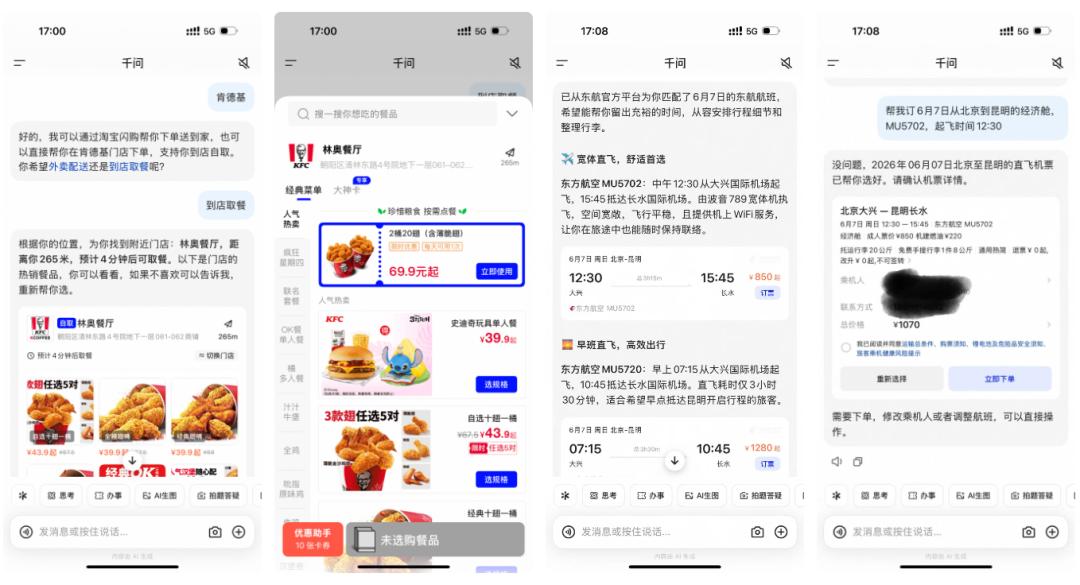
Image | Demonstration of KFC and China Eastern Airlines' Skill functions
This is not just about "having an extra channel" for brands.
Before joining, Tongyi Qianwen could also help users order from Luckin, but through the general interface of "Taobao Flash Sale." Luckin couldn't get any interaction data and didn't even know if the user was a member.
After joining, Luckin's Agent is connected to the membership system. It can actively push notifications when points are about to expire and provide personalized recommendations based on historical orders. The brand has transformed from a line item in the database into an autonomous operating entity. This transformation is similar to when enterprises moved from "having search results on Baidu" to "opening mini-programs on WeChat."
Previously, Tongyi Qianwen had already connected to almost all services within the Alibaba ecosystem. Now, after streamlining the process, it is further expanding its boundaries. Judging from the progress of WeChat's AI agent mentioned at the beginning of this article, the time window for Tongyi Qianwen is limited.
Doubao faces the same problem but takes the opposite approach. Tongyi Qianwen recruits externally, bringing in brands like KFC and Luckin to fill the gaps in the execution layer. Doubao integrates internally, using the Douyin commercial link as the execution layer. The entire process of "seeing content → making a decision → completing a transaction" is closed within the ByteDance ecosystem.
Their business genes are completely different. Tongyi Qianwen is opening up the brand Agent ecosystem, allowing brands to pay for operating rights, which is building a new ecological monetization logic. Doubao is following the traffic model that ByteDance is most familiar with: maintaining scale for free, using scale to support advertising and ecological revenue, and then charging professional version subscription fees for high-value users.
Recently, Doubao's paid plan triggered a strong reaction from users, and ByteDance immediately narrowed the scope, clarifying that basic functions will be free forever. This trade-off shows that the 345 million monthly active users are ByteDance's most important bargaining chip in the AI entry point war. Maintaining the scale takes top priority.
However, apart from the scale, ByteDance still lags behind Alibaba in the maturity of its local life and e-commerce infrastructure. It will take time to reach the end of this path.
03. Meituan Represents the Choice of More Enterprises
Compared with Doubao and Tongyi Qianwen, which are betting on both the entry point and the execution layer, Meituan's choice shows more strategic clarity and represents the majority of service providers.
Wang Xing said during an earnings call, "In the future, in addition to serving consumers (ToC) and merchants (ToB), serving AI Agents (ToA) is becoming increasingly important."
Meituan's judgment is that instead of competing to be an AI entry point, it's better to turn its food delivery fulfillment capabilities into infrastructure that all AI entry points can call.
The connection between Xiaomei and Yuanbao is one of the clearest Agent-to-Agent cases in China at present. It's not the user directly talking to Meituan's AI, but Yuanbao understanding the user's intention and then calling Xiaomei, which completes the actual ordering and delivery.
Yuanbao provides the entry point, and Meituan handles the execution. Each has its own role.
This path choice is based on Meituan's clear understanding of its own barriers.
Meituan's deepest moat is its millions of merchants across the country and its last-mile delivery network, not its AI model capabilities. Opening up this execution infrastructure to connect with various AI entry points is more in line with its long-term interests than spending money to compete for an entry point.
04. Tencent's Ace in the Hole
This week, the news about WeChat's AI agent attracted the most attention.
On the day the news came out, Tencent's market value rose by about 360 billion yuan in a single day. One of the market's judgment logics is that while other players may take several years to build execution infrastructure, WeChat has been nurturing it through mini-programs for nine years. WeChat doesn't need to recruit brands like Tongyi Qianwen, nor does it need to build an entry point and make up for the commercial link at the same time like ByteDance. It just needs to insert the AI layer into the ecosystem that 1.4 billion users are already using.
But WeChat's advantage is not just about "inserting." This week, WeChat also completed the first batch of A2A (Agent-to-Agent) capability connections with Honor, and the connections with Huawei, Xiaomi, OPPO, and vivo are also in progress. This means that when a user says a word to their phone, the phone manufacturer's own AI assistant can directly call WeChat's call and messaging capabilities without the user having to actively open the WeChat app.
Other players are recruiting brand Agents on their own platforms, keeping the traffic and recommendation rights in their own hands. However, WeChat is being integrated into the AI assistants of phone manufacturers, becoming a basic callable capability at the device layer. Doubao and Tongyi Qianwen are integrating internally, while WeChat is extending externally. The former follows the platform logic, and the latter follows the infrastructure logic.
The difference in commercial interests between these two logics is the inherent contradiction in the models of Tongyi Qianwen and Doubao.
When an AI entry point has both recommendation rights and commercial interests, brand exposure is difficult to be neutral. This week, when we evaluated the shopping capabilities of Tongyi Qianwen and Doubao, we also found this problem. The logic behind their product recommendations is not clear. Real tests of Doubao and Tongyi Qianwen's shopping capabilities during the 618 shopping festival: This generation of AI hasn't learned how to sell goods yet.
Moreover, a large number of "GEO optimization" service providers around Doubao have emerged, and the bidding logic of the SEO era is quietly entering the Agent era.
Tencent adheres to the principle of "decentralization and only providing underlying connections," giving a commitment to ecological partners: On WeChat, brands have more complete autonomy, and Tencent won't be the referee holding the recommendation rights.
The strategic value of this positioning is no less than the WeChat AI agent product itself. Back then, WeChat attracted millions of mini-program developers by saying "not being an approver." Today, with the same logic, the goal is also to make brands choose WeChat first.
05. What Comes After Winning?
In every platform war in history, the winner has ultimately become a "toll booth": the App Store takes a 30% cut, search engines sell paid search rankings, and food delivery platforms charge commissions. Ma Huateng's statement of "only providing underlying connections" continues WeChat's consistent positioning and is an active abandonment of this logic.
However, abandonment doesn't mean weakness. If WeChat truly becomes the underlying connection for all AI executions, not charging rent, not controlling recommendations, and only providing the link, what will it become? Not a toll booth, but the road itself.
This is why the actions of other players have been so frequent this week: Before the WeChat AI layer is inserted and the reshuffle window closes, they must first occupy a position in users' habits.
But there is a more fundamental question: When AI becomes the main interface between brands and users, to whom will users' loyalty ultimately belong?
In the app era, users loved Luckin because they remembered it and actively opened the Luckin app. In the Agent era, users may only remember "let the AI help me order coffee." Where that cup of coffee comes from is recommended by the AI, not actively chosen by the user. Brand loyalty may quietly shift from "users' recognition of the brand" to "users' trust in that AI."
Brands are rushing to join the Agent ecosystems of various platforms without necessarily realizing that they are participating in a deeper game: After AI intervention, who does the relationship between them and users really belong to?
This article is from the WeChat official account "Emphasize Next" (ID: leo89203898). Author: Yixiu, Editor: Xiaobai. Republished by 36Kr with permission.