Top 10 by Market Cap in China and the US: An Uneven Ranking
Every once in a while, a chart comparing the top ten companies by market value in China and the United States circulates on social media, accompanied by a striking conclusion: The United States no longer has traditional companies, while traditional industries still dominate in China. Following this line of thought, it's easy to conclude that "the United States has entered the post - industrial era, while China is still in the industrial stage." This judgment is widely spread, but it oversimplifies the issue, and the chart on which it is based uses two different yardsticks.
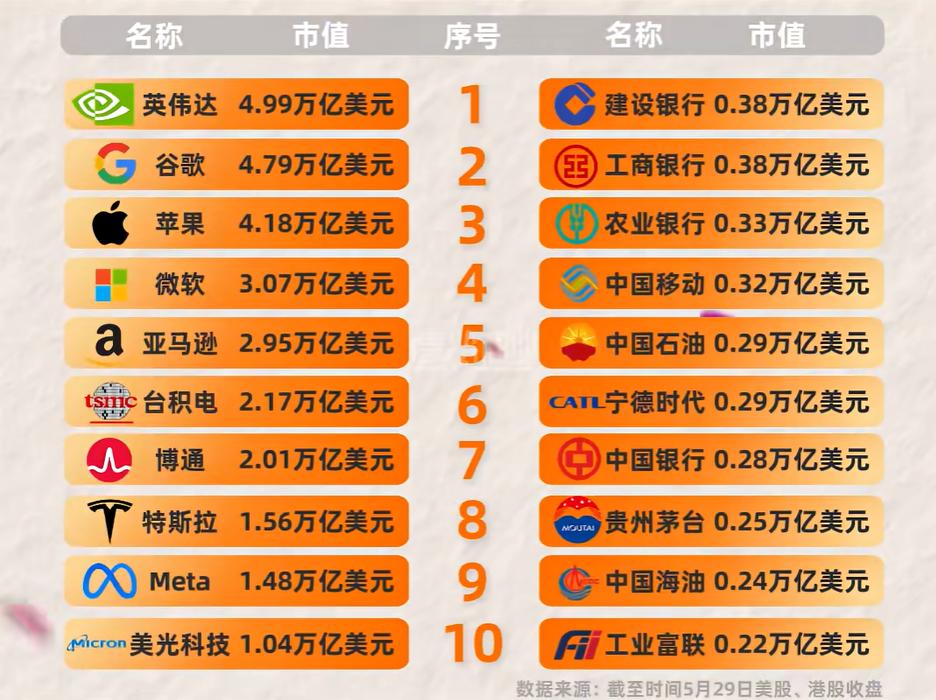
"Comparison of the top ten companies by market value in China and the United States"
Two Different Yardsticks
First, look at the U.S. column. Its scope is actually "companies listed on U.S. stock exchanges." As a result, TSMC, whose headquarters and registration are both in Taiwan, China, is counted as an "American" company. If TSMC is excluded, among the top - ten U.S. domestic companies, the retailer Walmart will appear. Its market value is about $1.05 trillion. Berkshire Hathaway, which focuses on insurance and real - estate, is worth about $1.02 trillion, and JPMorgan Chase is worth about $838.1 billion. They are also ranked behind.
Walmart and Berkshire Hathaway are the most typical traditional industries. Regarding those well - recognized technology giants, Apple is essentially a hardware manufacturer, and Amazon's foundation lies in retail and logistics, so they can't be said to be detached from the real economy. Therefore, the statement "The United States no longer has traditional companies" may not hold true even at the factual level.
The scope issue in the Chinese column is even more serious. The chart claims that the data is taken from the closing prices of U.S. and Hong Kong stocks, but Tencent, the Chinese company with the highest market value in the Hong Kong stock market, is not in the Chinese column. The reason is that it narrows the scope of Chinese companies to "companies listed on the A - share market." As a result, Chinese companies such as Tencent, Alibaba, Meituan, Xiaomi, and Pinduoduo, which are only listed in Hong Kong or the United States, are not included.
On September 20, 2014, Alibaba was listed on the New York Stock Exchange in the United States.
Just Tencent alone, with a market value of about $550 billion, already exceeds the approximately $380 billion of China Construction Bank, the top - ranked Chinese company in the chart; Alibaba, worth about $315 billion, can also rank among the top. If ranked by the company's place of origin rather than the place of listing, the company with the highest market value in China is not a bank, but an Internet platform company like Tencent. Counting a Taiwanese company as American while excluding Tencent and Alibaba from China, the two scopes are inconsistent, and the comparability of the comparison is thus reduced.
More notably, the companies cut out by this yardstick are precisely the most active Chinese companies in this wave of AI. Alibaba's stock price doubled in 2025, and its market value in the Hong Kong stock market reached HK$3.32 trillion in September. The cumulative downloads of its Tongyi Qianwen Qwen series exceeded 700 million times, making it the most - downloaded open - source model family on Hugging Face.
Even within the A - share list, the trace of AI is clearly visible: Foxconn Industrial Internet, ranked tenth, saw its market value increase by about 188% in a year, thanks to the demand for AI servers; Cambricon, a domestic AI chip company, saw its stock price soar by more than 110% in August 2025 alone.
Of course, this doesn't mean that Chinese technology companies have caught up with U.S. companies in terms of scale. The leading U.S. AI companies are worth trillions of dollars, while Tencent and Alibaba are only worth hundreds of billions. The real gap is on an order - of - magnitude level. However, the conclusion that "traditional industries dominate in China" is largely drawn after screening out China's new - economy companies based on the place of listing.
Not about New vs. Old, nor Light vs. Heavy
After correcting the scope, we'll find that "traditional vs. technology" is not the real dividing line. In fact, there are names of traditional industries on both lists. So, what about the other common explanation, which says that U.S. giants rely on intellectual property and network effects for "light - asset" operations?
This statement is now outdated. Google raised its capital expenditure guidance for 2026 to between $180 billion and $190 billion, almost twice that of 2025, and clearly stated that it will significantly increase in 2027. Even though its operating cash flow in the past twelve months was as high as $174 billion, it still announced a refinancing of about $80 billion, including a private placement of $10 billion to Berkshire Hathaway. The fact that a company with such abundant cash flow still needs to refinance shows that the "light - asset" narrative is no longer applicable.
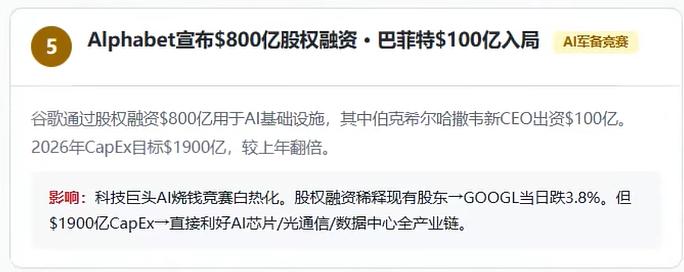
Google made a major move, raising a record - high $80 billion for AI, but its stock price plummeted.
Neither the newness or oldness of the industry nor the lightness or heaviness of capital is the answer. The real dividing lines lie in three aspects.
First is the structure of the financial system. China has a bank - dominated indirect financing system. Social savings are mainly allocated through the balance sheets of banks. Therefore, banks are the central nodes of the financial system, with extremely large assets and equity. Even with a relatively low valuation, their absolute market values rank among the top. The United States has a securities - market - dominated direct financing system. Funds flow directly to enterprises through the stock and bond markets. Banks don't need to use their own balance sheets to absorb social savings. So, the companies at the top of the market - value list are real - economy enterprises directly priced by the market, rather than banks acting as intermediaries.
Second is the geographical scope of revenue. Most U.S. companies target the global market, with high profit margins and capital returns, and can be replicated on a large scale. Chinese banks, oil companies, and telecommunications companies earn most of their revenue from the domestic market, and their ceiling is the domestic market.
Third is the cost of capital. Google chose to issue additional shares despite having hundreds of billions in cash flow because after the stock price soared, equity financing became the cheapest form of capital: high valuation brings cheap equity, and cheap equity supports heavy capital investment. The investment then consolidates advantages and supports high valuation. However, it's difficult for a state - owned large - scale bank with a price - to - book ratio of less than 0.7 times for a long time to replicate this path. Issuing shares below the net asset value means diluting shareholders' value.
Why the Best Companies Don't List in Their Home Markets
Among the three points, the first one is worth further exploration because it leads to an interesting phenomenon: Most of the Chinese companies with the highest market values are listed overseas. This is a reflection of the institutional design of the A - share market. Companies like Tencent, Alibaba, Meituan, Xiaomi, and Pinduoduo almost all chose Hong Kong or the United States back then. The reasons are cumulative:
Firstly, they received U.S. dollar venture capital and adopted offshore VIE structures, which cannot be listed on the A - share market. Secondly, most of them were still burning money at the time of listing, and the approval system of the A - share market back then required consecutive profitability, which blocked them out. Thirdly, the different - voting - rights shares that the founders wanted were only available in the U.S. stock market and the Hong Kong stock market after 2018.
Therefore, what determines where they list is mainly the financing structure at their birth and the access rules of the A - share market at that time. This leads to a profound but often overlooked result: It is mainly overseas venture capital and offshore public markets, rather than the domestic stock market, that provide risk capital for these most dynamic Chinese companies and ultimately share in their equity appreciation.
However, this pattern is changing, and the way of change is quite revealing. On the one hand, the institutional supply has improved. In 2019, the Science and Technology Innovation Board was launched, allowing unprofitable companies and companies with different - voting - rights shares to list. Subsequently, the full - fledged registration - based IPO system was implemented. On the other hand, the external environment has forced many Chinese concept stocks back to Hong Kong for secondary listings due to U.S. audit and delisting pressures.
As a result, most of the older - generation platform companies remain overseas, while the new companies in this wave of AI and hard - technology are more likely to return to the domestic market. Cambricon, which produces AI chips, was listed on the Science and Technology Innovation Board in 2020 with consecutive years of losses and only achieved full - year profitability for the first time in 2025. This is exactly the type of company that the A - share market couldn't accommodate back then but the Science and Technology Innovation Board can now. More recent and younger AI chip companies such as Moore Threads, Muxi, and Biren have also mostly chosen to list in the domestic market. That's why the significance of the Science and Technology Innovation Board and the registration - based IPO reform lies in gradually bringing back this part of the function to the domestic market.
How to Understand the High Market Values of the Big Four Banks?
Back to the Big Four Banks, which are often mentioned in relation to the chart, how should we understand their high market values?
Two facts need to be pointed out. Firstly, the equity is highly concentrated. According to the data of the top ten shareholders at the end of the first quarter of 2026, Just Central Huijin and the Ministry of Finance together hold about 75% of Agricultural Bank of China, 67% of Bank of China, 66% of Industrial and Commercial Bank of China, and 59% of China Construction Bank. None of them is less than half, and Huijin alone holds more than 50% of China Construction Bank and Bank of China. If we also consider Central Huijin Asset Management, China Securities Finance, and the National Social Security Fund, which are also state - owned investment entities, the proportion of state - owned and quasi - state - owned shares will be even higher. As for the part available for public trading in the A - share market, the proportion is self - evident.
Secondly, the arrangement to maintain market stability has been institutionalized. Central Huijin is clearly positioned as a "quasi - stabilization fund," holding large - scale banks for a long time and playing the role of a "stabilizer" in the market. At the end of the first half of 2025, the scale of stock ETFs it held was about 1.29 trillion yuan, nearly nine times that at the end of 2023. The A - share ETFs held by long - term funds represented by it account for more than 40% of the entire market.
It should be noted that the arrangement to maintain market stability and the small tradable shares explain the level of bank valuations, not the fact that they rank among the top ten. Even in the years when the Big Four Banks' share prices were below the net asset value, their market values still ranked among the top due to their huge assets and equity. Ranking among the top ten is determined by scale and is not sensitive to the level of valuation. The fact that the banks' share prices have been below the net asset value for more than a decade shows that a small tradable share doesn't naturally drive up the price. Its real effect is that the purchase of a small amount of long - term funds can strongly support the price, and this supported price is then multiplied by a nearly fixed large - scale base. As for the extent to which such purchases affect the valuation, it's difficult to quantify due to the lack of public breakdown.
The Truth Behind the Conclusions Determined by the Scope
Combining these two points, we can get a more notable methodological hint than "new vs. old industries": The market values of the top ten companies in China and the United States are not entirely comparable in terms of scope.
For U.S. companies, whether they are technology giants or companies like Walmart and Berkshire Hathaway, the tradable shares are large, and the prices are fully traded and repeatedly discovered by global capital. However, the freely tradable shares of the Big Four Banks are relatively small, and their total market values more reflect the scale in the accounting sense, which is different from the market value that can be immediately realized.
More importantly, as mentioned before: A considerable part of China's large - cap stocks that are fully priced by the market and have the best liquidity are not on its own main board but in Hong Kong and New York. When directly comparing the market values of the two sides as if they were comparable, we need to take these scope differences into account.
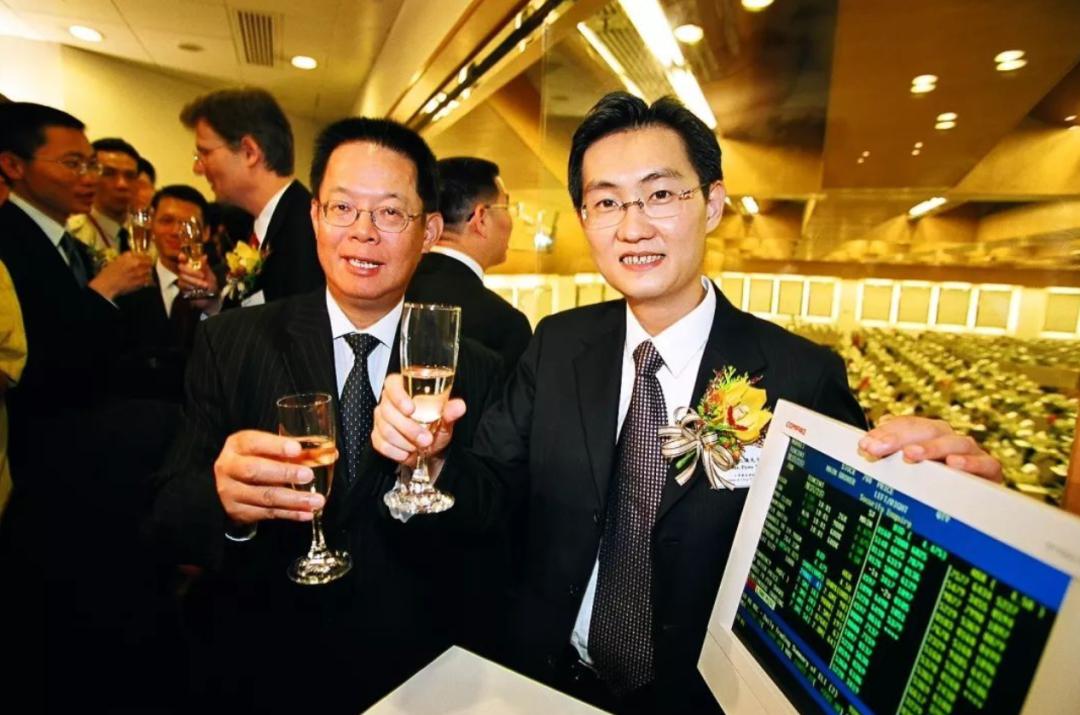
BAT (Baidu, Alibaba, Tencent) are all listed in Hong Kong. In addition to BAT, companies such as Country Garden, Industrial and Commercial Bank of China, and Sinopec have also chosen to list in Hong Kong.
Therefore, the list of the top ten companies by market value is more like a cross - section than a mirror reflecting the advancement of industries. There are names of traditional industries on both lists. The real difference lies not in new or old, but in what lies behind the numbers.
How the two countries organize capital, who provides funds for high - risk growth, and what functions their respective stock markets undertake. Those who only focus on "whether there are banks" or "whether it's technology" will miss what's really written behind the numbers.
This article is from the WeChat official account "Saige Avenue" (ID: saigedashu), written by Fu Weigang, and is published by 36Kr with authorization.