The Resurgence of Keynesianism: The Destiny of the Silicon-Based Era
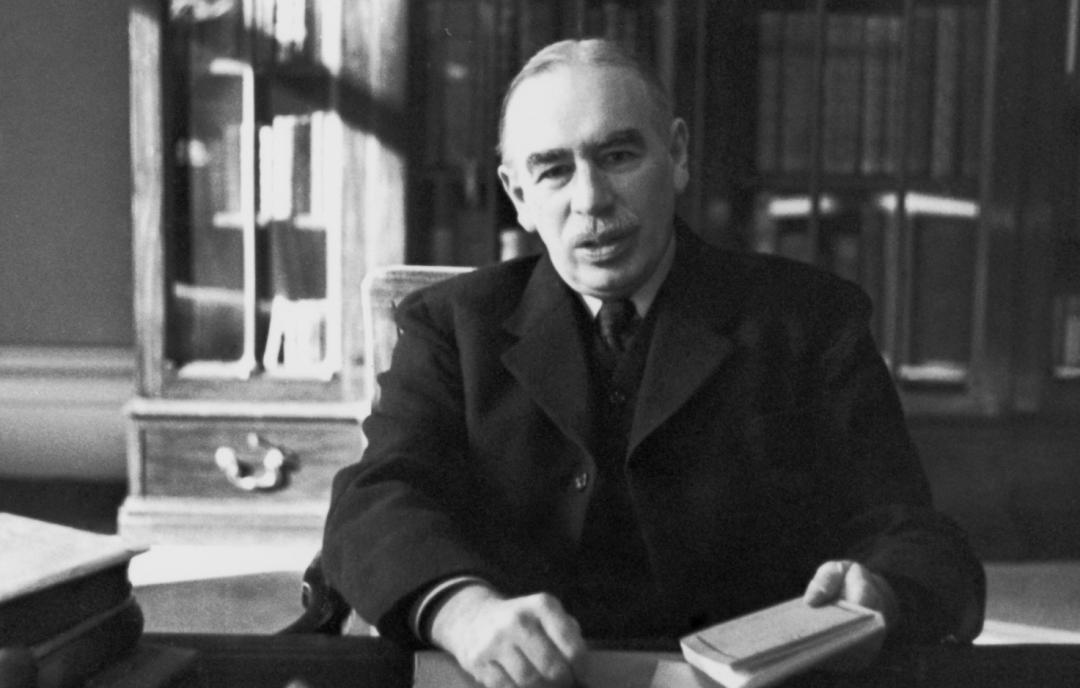
Image: John Maynard Keynes
In 1936, John Maynard Keynes wrote a well - known and easily misinterpreted solution, which might seem like black humor, in his epoch - making book The General Theory of Employment, Interest and Money:
“If the Treasury were to fill old bottles with banknotes, bury them at suitable depths in disused coal mines which are then filled up to the surface with town rubbish, and leave it to private enterprise on well - tried principles of laissez - faire to dig the notes up again (the right to do so being obtained, of course, by tendering for leases of the note - bearing territory), there need be no more unemployment.”
This passage is the most popular and extreme interpretation of Keynesian theory.
Its core insight is that when “effective demand” is completely exhausted and the economy is in a downward spiral, any action that can create jobs and inject purchasing power back into the pockets of the public, even if it is physically meaningless, is a lifesaver to keep the system afloat. This is Keynes' algorithm, a macro - economic operating system centered on people and aiming at demand redistribution.
Nearly ninety years later, in May 2026, another person stood at a developer conference in San Francisco and announced the amazing success of a completely different algorithm. Dario Amodei, the CEO of Anthropic, announced that the company's annualized revenue had exceeded $44 billion, and the gross margin of inference for its core product, the AI programming tool Claude Code, had exceeded 70%.
On GitHub, the world's largest code hosting platform, 7 out of every 100 lines of publicly submitted code are now written by this invisible algorithm. It is replacing the mental work that used to belong to knowledge workers at an unimaginable speed.
From Keynes to Amodei, these two men are separated by ninety years. Keynes tried to fill the demand gap with government spending, while Amodei uses machine intelligence to break through the efficiency limit. These are two opposing algorithms: one provides “off - algorithm” shelter for those who cannot survive in the market logic, while the other, with unparalleled efficiency, pushes more and more people to the cliff of being “off - algorithm”.
And history is approaching a critical juncture: when Amodei's algorithm devours carbon - based jobs at an unprecedented speed, Keynes' algorithm will have to make a comeback in an unprecedented form in the silicon - based era.
01 Echoes of the Great Depression: When Machines Outpace Demand
To understand today's fears, we must return to Keynes' world.
The stock market crash in 1929 was not the only cause of the Great Depression. Keynes saw a deeper problem: a society with an extreme imbalance between technology and distribution.
In the United States in the 1920s, the productivity of the manufacturing industry soared at an average annual rate of over 5%. With the popularization of electricity and the internal combustion engine, factory output doubled in a decade, and agricultural mechanization turned millions of farmers into job - seekers flocking to cities. However, between 1923 and 1929, while the output value of the US manufacturing industry increased by about 30%, workers' wages remained almost stagnant.
Wealth was concentrated upwards at an unprecedented speed. In 1929, the wealthiest 1% of the population held nearly 40% of the country's wealth, and the wealthiest 10% accounted for about 50% of the national income. Meanwhile, the bottom 70% of the population lived from hand to mouth, relying on odd jobs to make a living.
As a result, factories were filled with goods, but most people couldn't afford them. The stock market crash in October 1929 was just the last straw that broke the back of this distorted structure. When the rich stopped consuming and businesses stopped investing, the blood circulation of the entire economy came to a halt.
Keynes coined a term in The General Theory to summarize all this - “insufficient effective demand”. Thus, his “fill - the - ditch - dig - the - ditch - fill - it - again” solution emerged.
It is not an investment theory about infrastructure but an algorithm about “people”. When the wealth distribution algorithm fails and directs 90% of social resources into the hands of 10% of the people, the government, as the “system administrator”, must intervene. In a seemingly absurd way, it reconnects the 70% of the “off - algorithm” population to the economic cycle. This is not a moral choice but the only mathematical solution for the system to maintain its existence.
This algorithm dominated the golden thirty years of post - war capitalism. From 1945 to 1973, the real GDP of the United States grew at an average annual rate of nearly 4%, and the share of national income of the top 10% income group decreased from 45% to 33%. A large middle class was created out of thin air. The success of Keynesianism lies not in the government's ability to spend money but in its successful demand - side management: it forced the redistribution of a part of social wealth to maintain the balance of total demand in the entire system.
However, the “stagflation” in the 1970s dealt a heavy blow to this algorithm. Milton Friedman's monetarism rose to prominence, bringing about the Reagan and Thatcher revolutions. In the following forty years, “the government is the problem, not the solution” became the creed. Tax cuts, deregulation, and privatization reshaped the underlying logic of the global economy. Free - market capitalism advanced by leaps and bounds, and wealth began to concentrate again at an accelerated pace, as if the Great Depression was just a distant nightmare.
It is not until today, when the scythe of AI swings towards the “middle class” of the information age, that the old question resurfaces: what should people do when technology outpaces them?
02 This Time, Machines Aim at the Brain
In previous industrial revolutions, machines replaced our hands and muscles; in this AI revolution, machines target our brains and our cognition.
In the past sixty years, the semiconductor revolution has created a brand - new social division of labor system. Information processing - from programmers, accountants, legal assistants to graphic designers - has become the means of livelihood for hundreds of millions of middle - class people. They don't farm or turn screws. Their work is to read, analyze, organize, write, and code. They form the main body of the consumer society, accounting for 20% to 60% of the population in Keynes' stratification.
AI is mercilessly redrawing this boundary.
Programmers are the most obvious example at present. One senior engineer with Claude Code can do the work of a former team. The global scale of programmers and related technical positions is about 30 million, and the total number of developers on GitHub has exceeded 150 million.
This is just the tip of the iceberg. Legal document review, medical image diagnosis, financial statement preparation, customer service Q&A, translation... Every profession with “input information, process information, output information” as the basic actions has come within the replacement range of AI.
McKinsey disclosed at the 2026 CES that there were already 25,000 AI agents working in collaboration with 40,000 employees within the company, and the back - office positions were shrinking systematically. IBM announced that it would replace more than 30,000 back - office positions with AI within five years, mainly in finance, human resources, and compliance.
The calculations of Goldman Sachs economists are even more shocking: in the past year, the replacement effect of AI wiped out about 25,000 US jobs per month, while the enhancement effect only created about 9,000 new jobs, resulting in a net loss of about 16,000 jobs per month. Replacement means one - time, large - scale, and cliff - like layoff announcements, while enhancement means slow, scattered, and lagging incremental recruitment. The rhythms of the two are completely out of sync.
This is not the fear of the Luddites in the 19th century towards steam engines, but the fear of knowledge workers in the 21st century towards algorithms.
The experience of the industrial revolution shows that the enhancement effect of new technologies will create new jobs in the long run. But this time, we have placed too much emphasis on the “long run”. Keynes' misinterpreted famous quote - “In the long run, we are all dead” - does not mean giving up long - term thinking. Instead, it warns us: don't use the illusory long - term promise to avoid the immediate and urgent systemic crisis.
03 Amodei's Miracle, Keynes' Return
Dario Amodei is undoubtedly honest. He said at the developer conference, “I hope the 80 - fold growth won't continue. It's too crazy and too hard to handle.” He is well aware that the success of Anthropic is precisely the convergence point of social pain. The gross margin of inference for Claude Code has soared from 38% to over 70%. Every percentage point increase in the gross margin means less computing power consumption, less human participation, and a higher automation rate.
This is a miracle for corporate profits but a deficit for social employment, and it is also the return of Keynes.
This is not Amodei's fault. He is creating a new mode of production. The problem is that this new mode of production naturally and gravitationally tends to concentrate wealth in the hands of a small number of people who own the machines.
Claude Code is not a means of production shared by one million programmers. It is owned by Anthropic and rented by thousands of corporate customers. The $44 billion annualized revenue it creates goes into Anthropic's account, not the salary cards of the programmers it replaces. A part of this huge amount of revenue becomes the compensation for Anthropic's employees and the return for its shareholders, and the other part flows back to the cloud bills of Amazon and Google as computing power costs. Almost none of it trickles down to the replaced social strata.
This is exactly the algorithm failure that Keynes fought against all his life. He doesn't care who is more efficient. He cares about whether the system can operate stably. In a society, if only 10% of the people can benefit from the AI productivity revolution and the other 90% are marginalized, then its consumption foundation will surely collapse. And on the day when the consumption foundation collapses, all the trillion - dollar valuations based on the expectation of “infinite future demand” will be buried in the soil.
One statistic is enough to show how close the crisis is. By the 2020s, the wealthiest 10% of American households held nearly 70% of stocks and mutual funds. The capital appreciation brought by AI will almost all flow into these already wealthy households, rather than to the replaced working - class.
The more concentrated the wealth, the less effective consumption. AI can design the most sophisticated advertising algorithms, but if it faces a public with exhausted purchasing power, it can only sell nothing. The huge machine of the modern economy cannot run for a single day without consumption as fuel.
04 Neo - Keynesianism: From “Digging Ditches” to “Cutting”
The neo - Keynesianism called for in the AI era will not appear in the rough form of road - building and ditch - digging in the 1930s, but it will follow exactly the same underlying logic.
AI companies are creating astronomical profits. A large part of these profits does not come from the creation of new value but corresponds to the cost of human labor that has been replaced. In the past, this labor cost was paid in the form of wages and flowed back into the economic system through consumption, forming the cornerstone of total demand. Now, this money has disappeared and become the profits of AI companies and the capital gains of shareholders.
This process is essentially the “savings” of costs from the pockets of the vast working - class, which are transferred to the books of a small number of capital owners.
The core proposition of neo - Keynesianism is therefore extremely clear: The government must represent the majority marginalized by the algorithm and, as the guardian of system stability, cut a large enough piece from the excess profits of the AI industry and, through some form of redistribution, inject purchasing power back into the pockets of the public. This is not moral Robin Hoodism but a negative feedback mechanism to maintain the system's steady state.
We (Jinduan Research Institute) predict that the specific paths may unfold simultaneously in several aspects:
Excess profit tax on AI: Levy a special tax on the part of profits that exceed the industry average due to AI's replacement of human labor. The tax rate can be anchored to the replacement rate of the industry and the historical average wage to socialize part of the wealth created by machines.
Universal Basic Income (UBI) pilot: In areas with the highest AI penetration, such as California, use AI tax revenue as a source of funds to conduct a pilot of unconditional monthly cash payments. This is not relief but provides a basic and predictable consumer identity for the population outside the algorithm to maintain the bottom line of social total demand.
Shorten the legal workweek: When AI can complete the work that used to take 40 hours, the socially necessary labor time should be reduced from 40 hours to 32 hours or even less. By redistributing the remaining working hours, the number of social employment can be maintained, and the productivity dividend can be shared.
Public AI sovereign fund: The government can invest in AI giants by providing public infrastructure such as computing power, data, or power grids and direct the future dividend distributions to the people in the affected industries, making every citizen a “shareholder” of AI infrastructure.
Behind these options, there is a common and earth - shattering truth: The economic efficiency of a society should not be determined by its productivity but by its ability to maintain system stability. If a society cannot redistribute wealth to maintain consumption, the products produced will eventually rot in the warehouses. On the day when the warehouses are full, the trillion - dollar valuations of AI companies are just a piece of scrap iron written in the cloud.
05 Conclusion: Who Will Complete the Closed - Loop?
Keynes used a clever metaphor to dispel the obsession with “long - term solutions”. In the AI era, this warning still rings in our ears. AI is one side of productivity, the most powerful production tool created by humans so far. It can develop drugs, write code, and design proteins at an unprecedented speed. Its production potential exceeds the wildest imagination of anyone in Keynes' era.
However, the gap between productivity and consumption will not heal automatically. When 90% of information work is taken over by machines and less than 10% of people own and operate the machines, a fundamental rift appears: Who will buy the products produced by AI? Who will pay for the drugs developed by AI? Who will subscribe to the thousands of lines of code generated by AI?
Machines can create everything, but they cannot be “consumers”. Only people with purchasing power and desires can complete the final closed - loop from production to consumption. Once this closed - loop is broken, no matter how smart the algorithm is, it has nowhere to sell, and no matter how high the efficiency is, it is equal to zero.
Filling ditches, digging ditches, and filling them again is no longer a satire today. It symbolizes a necessary algorithm beyond market logic to maintain the existence of the system. In the AI era, the form of this algorithm will change from shovels in the physical world to computing power tax and basic income in the digital world, but its underlying logic remains the same: A system that cannot allow most of its members to share the dividends, no matter how efficient it is, is an active volcano that is accumulating energy.
Dario Amodei's algorithm represents the future, while Keynes' algorithm guards the bottom line that allows the future to come. We don't need to choose between the two but use the sobriety of the latter to control the wild gallop of the former. Otherwise, when the lava finally erupts, what will be buried is not only the ruins of the old era but also all those arrogant fantasies about wisdom.
This article is written based on publicly available information and is only for information exchange purposes and does not constitute