China's Internet Connects to the World: The Eve of Giant Emergence, 1994-1999
When talking about the Internet, there is a starting point that cannot be bypassed.
China connected to the Internet in 1994, becoming the 77th country in the world to do so.
However, many people don't know that China's first email was sent earlier, in 1987. There is an unclear story behind this, and today I'd like to start from here.
From 1994 to 1999, it was a few years of accessing, building, and weaving the network. The network was connected, the bridges were built, and then those well - known names began to appear one by one. At that time, most of them were still lying low.
1 Accessing the Network
China's connection to the Internet was an unexpected process, but also quite reasonable.
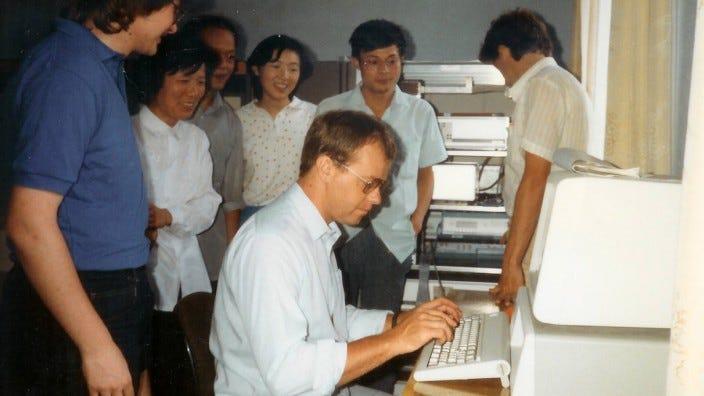
Back in 1987, Stone was booming in making typewriters in Zhongguancun. On September 14th, near Chedaogou in Zhongguancun, at the China Ordnance Industry Computer Application Research Institute, a group of people gathered around a Siemens 7760 mainframe, studying how to send out information.
The person in charge was Professor Wang Yunfeng. He was not in the field of computers; he had been engaged in military weapons all his life. After the founding of the People's Republic of China, he responded to Zhou Enlai's call and returned to China from Germany, devoting himself to the tank industry and participating in the improvement and research of the Type 59 tank. Later, he was known as the father of Chinese tanks. During the Cultural Revolution, he was regarded as a German spy and sent for labor reform. In 1975, he returned to his post and turned to computer technology, so he came into contact with foreign network technology early on. When communicating in Germany, he met Professor Zorn from the University of Karlsruhe, who was also the director of the German Information Computer Center.
Professor Zorn helped to contact Siemens for sponsorship, which was the computer. At that time, the United States had an embargo on China, but Siemens was not on the list. He also contacted the governor of Baden - Württemberg for sponsorship, getting marks worth 287,000 RMB at that time. He also sent his technical staff to China for support.
The person typing on the keyboard is Professor Zorn.
There was no Internet at that time. In the early days, many people used different protocols to communicate online (strictly speaking, the Internet we use today is also a complex and comprehensive protocol). There was no unified protocol, and email was the earliest and most common means of communication.
Sending this email was not easy. China had not joined the international computer data communication network yet, so the information had to be relayed through the University of Karlsruhe to connect to the international network. Specifically, it had to go through the node of the Italian public packet network set up in Beijing to connect with the University of Karlsruhe, with an initial rate of 300 bps.
Amid the ticking sound, everyone stared and pressed the send button. After waiting for a long time, there was no response, and it failed. After a week of repeated inspections and tests, it was found that there might be a protocol vulnerability. After consulting the US National Science Council, they confirmed the problem. Finally, with the efforts of an assistant left by Zorn, the line was finally connected.
On September 20th, 1987, the send button was pressed again. The signal from China traveled across half of the globe and reached Germany.
The title read:
first email from china to germany
The text later became a classic:
across the Great Wall we can reach every corner in the world
Crossing the Great Wall, we step towards the world.
It still sounds powerful today.
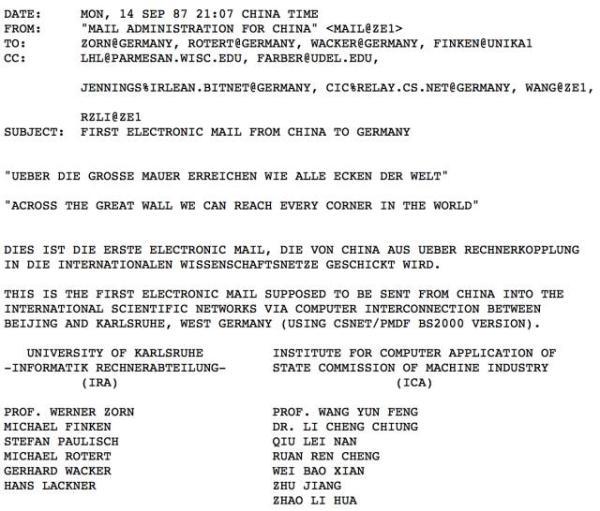
There are 6 Germans on the left and 7 Chinese on the right at the end of the email screenshot. Is this the first connection to the world with the help of German friends...?
2 Another Email
"Crossing the Great Wall and stepping towards the world" is very well - known. However, in 2006, the Science Times of the Chinese Academy of Sciences published an article with the title asking: Who exactly sent China's first email?
It said that the previous one was not the earliest, and the Chinese Academy of Sciences sent one earlier.
In 1979, Professor Li Zhengdao came to China to give lectures on "Particle Physics and Field Theory" and "Statistical Mechanics" for seven weeks. He also facilitated the cooperation between the Institute of High - Energy Physics of the Chinese Academy of Sciences and the European Organization for Nuclear Research (CERN). CERN had access to the network early on, and the WWW protocol was invented here. Before its invention, it also had its own computer communication system.
Wu Weimin from the Institute of High - Energy Physics was the leader of the cooperation group and started to promote a communication project with the goal of direct communication.
The difficulty was quite high, involving several links. In Beijing, it had to go through the satellite interface of the 710 Institute. In Switzerland, it had to go through the PTT of the telecommunications bureau and be relayed by the Vienna Radio Station. In addition, there were equipment coordination and protocol debugging.
After several months of hard work, Wu Weimin successfully sent an email to Professor Jack Steinberger in Geneva, Switzerland. Steinberger was Wu Weimin's teacher and the winner of the 1988 Nobel Prize in Physics.
The content of the email was as follows:
Dear Jack, I'm very glad to send you this letter through computer networking. I believe this is the first successful computer communication between CERN and China. I'd like to thank you again for your recent visit to Beijing, which led to the success of this valuable computer communication experiment. I think now every member of the cooperation group is connected through the computer network, which is very important. But most importantly, we have started. Currently, I'm using the IBM - PC of the 710 Institute to contact you. We will connect the computer microwave communication currently used for the M160H directly with you from the Institute of High - Energy Physics. Please give my regards to your colleagues. I wish you, Cynthia, and your whole family happiness. By the way, how is the carpet you bought in Shanghai? Weimin
The time was fixed on August 25th, 1986, more than a year earlier than the previous one.
This event is also recorded in the publications of the Institute of High - Energy Physics of the Chinese Academy of Sciences.
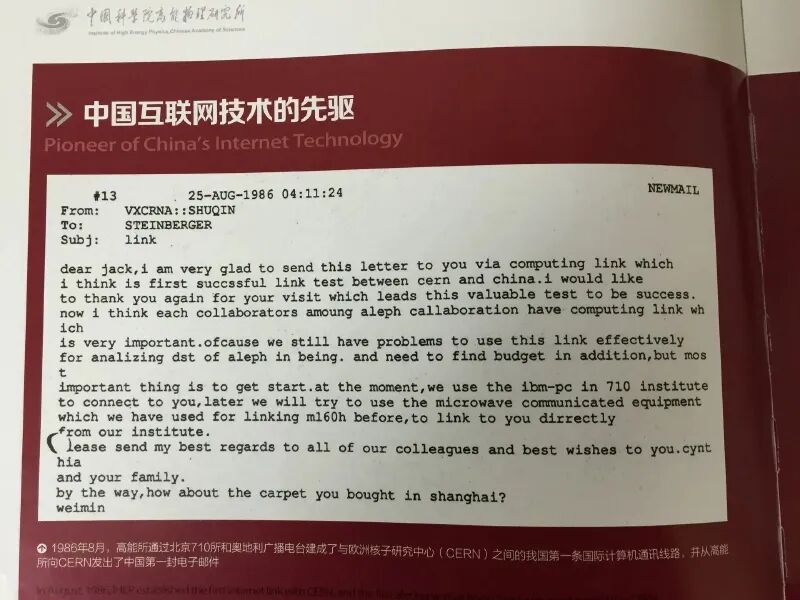
The author of this article is Wu Weimin, and he was specially invited to write it. The Chinese Academy of Sciences wanted to compete for this title.
Wu Weimin also mentioned at the end that many people were not in China at that time. He was in the United States, some professors went to France, some passed away, and some left the Institute of High - Energy Physics. The information was incomplete, and even their application for the Internet Science and Technology Progress Award came to nothing.
More interestingly, in 2008, the Jinghua Times published an article titled "The Story of Sending the First Email", written by Li Chengjiong, the former director of the Ordnance Industry Computer Research Institute.
In the previous email about crossing the Great Wall, he was the second among the Chinese people.
The article finally said:
In the past two years, we've heard some people say that they sent China's first email. There's not much point in arguing about this, and we don't want to say much. But from a technical perspective, those "emails" are similar to faxes, lacking postal functions and unable to store or forward. They are far from a real email system. A real email system should be like a "communication port".
Although they said they didn't want to argue, they actually did.
What exactly is going on?
Here, we need to clarify a bit.
There is some truth from a technical perspective. Wu Weimin's email was sent through remote login using Telnet, and the email gateway node was not in China.
The email in 1987 used an email protocol that met the RFC standard and was sent in a data exchange packet mode. Technically, it is the same as today's emails.
Establishing communication is indeed difficult, but there is a difference between sending an email from a Chinese node and sending an email by remotely logging in to someone else's computer from China. It's a bit like sending a letter to a German post office in a private way and sending it from a Chinese post office. There is naturally a difference.
Putting aside the technical perspective, the reason why the email "Crossing the Great Wall and stepping towards the world" is well - known is also closely related to Wang Yunfeng because he did another thing.
3 Domain Name
In 1990, Qian Hualin, a researcher at the Institute of Computing Technology of the Chinese Academy of Sciences, had his eyes on the Internet. He found that with the Internet, foreign research institutions directly posted their research results online and no longer sent pre - prints. By the time domestic researchers saw them, they were already old papers that had been published in magazines for more than half a year.
He knew about domain names early on and wanted to register the .cn domain during a trip to the United States for a conference at the end of 1990. However, he found that it had been registered two months ago.
Looking at the person in charge, his surname was Qian. Who was so kind as to register it for me? Looking closely, it wasn't himself, but Qian Tianbai from the Ordnance Industry Computer Application Research Institute - a colleague of Wang Yunfeng.
What happened? After Wang Yunfeng promoted the connection of the email server, he found it too expensive. The international email channel was very costly. How much was an email? Hundreds or even thousands. Both China and Germany had to pay a monthly maintenance fee of 2,000 to 5,000 US dollars. The core reason was the high forwarding cost. After 1990, for countries not connected to the Internet backbone network, the cost per 1K of traffic exceeded 6 yuan, while for countries connected to the backbone network, the cost of sending and receiving 1K of email was only a few cents. As mentioned before, China's information had to be relayed through the special line in Germany.
Wang Yunfeng entrusted Zorn to apply for it. The name .cn was his suggestion, an abbreviation of China. In the earliest contact information of .cn, the technical contact was the University of Karlsruhe, and the administrative contact was Qian Tianbai. Professor Zorn really went all the way to help.
Since the end of 1990, .cn has been operated by the University of Karlsruhe because there were no conditions in China at that time. On May 21st, 1994, the Computer Network Information Center of the Chinese Academy of Sciences completed the server configuration, and the domain name finally returned to China. The technical person in charge was transferred to Qian Hualin. In 1997, the State Council arranged for the Chinese Academy of Sciences to establish the China Internet Network Information Center (CNNIC), and the domain name and domestic domain name services were all under this institution.
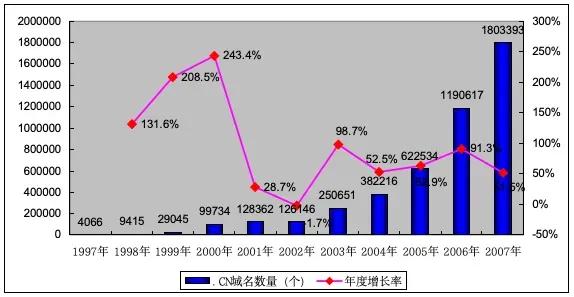
The .cn domain name was not easy to operate. It was not naturally user - friendly. In 2002, although the Internet was developing rapidly, the registration volume of .cn decreased instead of increasing because people preferred .com. Whether a domain name is recognized is a big deal. It took a lot of effort in market - oriented operation to resume growth.
4 Networking
The domain name is equivalent to having an official address on the Internet, registering a file, and no longer being an unregistered user. Networking itself is a technical matter, and it has a lot to do with Qian Hualin.
At the end of 1988, Professor Hu Daoyuan from Tsinghua University met a World Bank delegation on a train during a business trip. They were going to jointly implement a loan project with the State Planning Commission (the predecessor of the National Development and Reform Commission) to support the construction of high - tech laboratories in China, with a loan of 200 million US dollars.
Hu Daoyuan said, "Let's take a stroll in Tsinghua Garden." After the visit, the experts found that Tsinghua had built its own campus network, which impressed them deeply. Hu Daoyuan took the opportunity, and the State Planning Commission specially allocated 4.2 million US dollars from the loan for network construction. The goal was clear: use optical fibers, with a rate of no less than 10 megabits per second, and a unified network protocol. Simply put, it was a Chinese - made Internet.
4.2 million US dollars was a huge sum at that time. The State Planning Commission arranged a tender, and the eligible ones were Tsinghua, Peking University, and the Chinese Academy of Sciences near Zhongguancun. Finally, the Chinese Academy of Sciences won the bid, and the project was named NCFC (National Computing and Networking Facility of China).
The primary task was to build three campus networks and then a backbone network, which was equivalent to China's own wide - area network, using the TCP/IP protocol. In 1993, the three - party network was completed, which was the predecessor of the Chinese Internet, also known as the Zhongguancun Demonstration Network. The person in charge of the project on the Chinese Academy of Sciences side was Vice - President Hu Qiheng, and the technical person in charge was, coincidentally, Qian Hualin again.
After the first step was completed, it was natural to connect to the larger network. It's like when the village roads are all built, opening an entrance to the highway can lead to the world.
However, it turned out to be not that simple.
The goal of NCFC was not international networking, and the country had no motivation to network for the time being. It didn't oppose it, but the 4.2 million US dollars couldn't be used. The international expert group only came to accept the goal of NCFC and had no interest in networking. They just wanted to close the case quickly. Hu Qiheng recalled that when they were doing international networking, the expert group always had critical comments every time they came for an inspection. They had no choice but to accept the criticism and not correct it for the time being.
There was also the issue of fees. When pulling telephone lines, the Ministry of Posts and Telecommunications charged very high fees. It wasn't twice the price for two lines; sometimes it was even higher. The networking cost was simply unaffordable, and it was very difficult to negotiate.
All these difficulties were gradually solved. The state provided financial support, the Ministry of Posts and Telecommunications loosened its restrictions, and they got the approval of the State Council. Zou Jiahua, Song Jian, Li Lanqing, and Luo Gan all signed.
There were also technical challenges. Cisco routers were on the embargo list, and they couldn't be bought, just like today. Smuggling was impossible, so they had to do it themselves. Qian Hualin obtained an open - source routing protocol software shared by the University of California, Berkeley,