With the world's largest port, why does it turn its eyes to inland rivers?
According to a message from "Shanghai Release", on June 1st, the executive meeting of the Shanghai Municipal Government deployed the construction of a pilot zone for high - quality development of the Yangtze River Delta's inland waterway shipping and implemented the project to connect the inland water transport system.
The meeting agreed in principle to the "Implementation Plan for Shanghai to Build a Pilot Zone for High - quality Development of the Yangtze River Delta's Inland Waterway Shipping and the Project to Connect the Inland Water Transport System (2026 - 2030)". It pointed out that efforts should be made to speed up the dredging of the "capillaries" of inland waterway shipping, achieve efficient connection and coordinated development with the "aorta" of sea shipping, and truly form an integrated river - sea - ocean intermodal transportation network.
The meeting emphasized that major projects should be used as the driving force. Focus on improving and connecting the waterway network to promote waterway construction, and focus on improving quality and efficiency to promote port construction. Build an inland water transport system that "connects provincial boundaries and reaches seaports". Driven by green and intelligent development, adhere to green and low - carbon development, explore the pilot application of clean energy technologies, strengthen the empowerment of digital technologies, achieve "one - time declaration and smooth passage across the region", and reshape the new advantages of the industry's development.
The meeting also pointed out that with the concept of a people - centered city as the background, efforts should be made to speed up the improvement of waterways and the upgrading of riverbanks, coordinate and optimize shipping and leisure functions, actively cultivate new water - based cultural and tourism formats such as cruise ships and yachts, and strive to turn inland rivers into a comfortable and attractive place for citizens' leisure and tourism.
In the national comprehensive transportation system, inland waterway shipping, with its comparative advantages such as large transport capacity, low cost, and green and low - carbon features, is playing an increasingly prominent role in smoothing the domestic economic cycle and reducing the overall social logistics cost. A new round of regional competition around inland waterway shipping is also quietly heating up.
As an international shipping hub, according to the Xinhua - Baltic International Shipping Center Development Index, Shanghai International Shipping Center ranks third globally. In 2025, the container throughput of Shanghai Port exceeded 55.06 million TEUs, a year - on - year increase of 6.9%, ranking first among global ports for 16 consecutive years.
So, why does Shanghai attach so much importance to inland waterway shipping?
The key lies in the fact that as the world's largest container port, the collection and distribution system of Shanghai Port is crucial for supporting the main port area.
In 2025, the Ministry of Transport, together with the governments of Shanghai and the three provinces in the Yangtze River Delta, issued the "Action Plan for Building a Pilot Zone for High - quality Development of the Yangtze River Delta's Inland Waterway Shipping (2025 - 2027)", which clearly stated that a pilot zone for high - quality development of the Yangtze River Delta's inland waterway shipping should be built to better serve the strategies of building a transportation - strong country and promoting the integrated development of the Yangtze River Delta, and play a leading role in the high - quality development of the country's inland waterway shipping.
In the previously released draft for public comments of the "Territorial Spatial Planning of the Shanghai Metropolitan Area (2025 - 2035)", the waterway network is listed alongside the railway network and the highway network as the three pillars of the regional transportation system.
However, there are still many bottlenecks in Shanghai's current inland waterway shipping. In February this year, the "15th Five - Year Plan for Accelerating the Construction of Shanghai International Shipping Center (Draft for Public Comments)" was open for public feedback. It frankly pointed out that the construction and operation of the hub port are restricted by resource bottlenecks, and the overall efficiency of the collection and distribution network still needs to be improved. Specifically, it includes issues such as "the Yangtze Estuary waterway system has not been fully completed, there are few inland container transport channels, and the long - term capacity of the sea - rail intermodal transport channels needs to be improved".
Currently, Shanghai is making efforts to promote direct river - sea transportation, unleash the potential of inland rivers, and build an integrated river - sea - ocean intermodal transportation network.
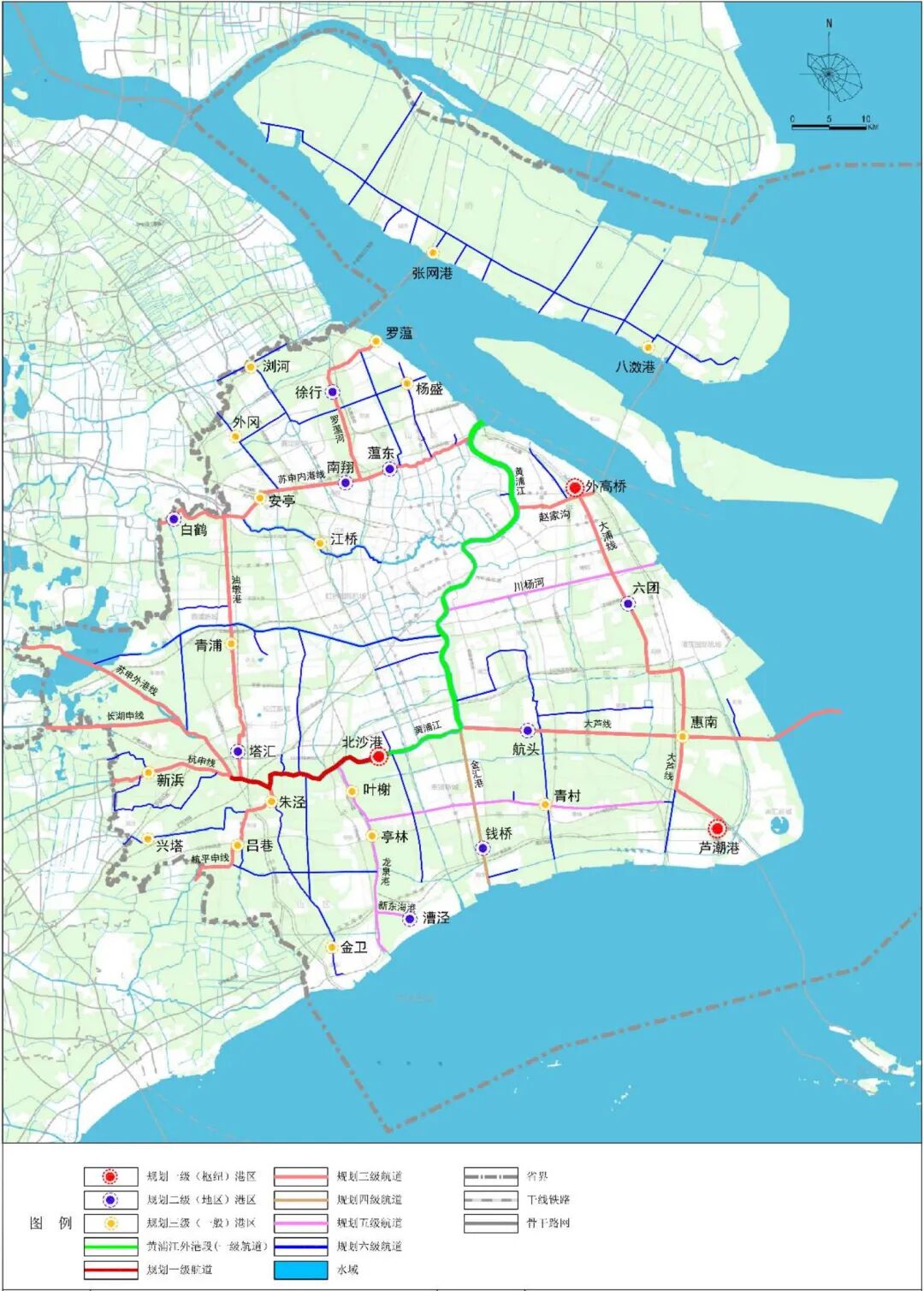
Layout plan of Shanghai's inland port areas. Image source: "Layout Plan of Shanghai's Inland Port Areas (2025 - 2035)"
Recently, the largest inland waterway shipping hub in Shanghai, the Eastern Extension Shipping Hub of the Dalu Line, is under accelerated construction. Located in Pudong New Area and Lingang New Area of Shanghai, after its completion, 1000 - ton container ships can navigate in both directions. Inland ships can reach Yangshan Port directly via the Dalu Line waterway, shortening the voyage by about 70 kilometers.
Meanwhile, the Wusong River Project (Shanghai section), which has been in the works for decades, has also entered a critical stage. With an investment of over 55 billion yuan, this project will create a super waterway that is 69 kilometers long and about 100 meters wide. The entire project is expected to be fully completed by 2030.
According to local media, this is not only a "high - speed road" for flood discharge and drainage but also a "new waterway" for river - sea - ocean intermodal transportation. Through waterway transfer, the Wusong River can realize river - sea - ocean intermodal transportation with Yangshan Port, further reducing the transportation costs of enterprises and strengthening the support for seaports.
This article is from the WeChat official account "Urban Evolution Theory". Author: Liu Yanmei. Republished by 36Kr with permission.