At this year's Computex, semiconductor manufacturers are all revolving around Jensen Huang.
There's no need to elaborate on how popular AI has become. Currently, almost all enterprises around the world are continuously making inroads in the three major systems of Cloud AI, Edge AI, and Physical AI. Moreover, Lobster has further popularized AI Agents, and discussions about intelligent agents are everywhere.
The popularity of AI is mirrored by that of Computex. On June 1st, which is also Children's Day, it was the moment when Jensen Huang "ignited" Computex 2026. At the GTC during Computex, NVIDIA sent out the strongest signal: from data centers to PCs, cars, and robots, Jensen Huang has achieved a full - stack closed - loop.
NVIDIA is a lucrative target, and everyone wants to be its customer. This year, we've witnessed a remarkable scene. Whether it's the 800V power supply architecture for servers, optical interconnection, or EDA, semiconductor manufacturers are all revolving around Jensen Huang. EEWorld will now take stock of the notable points at Computex.
These manufacturers are circling around Jensen Huang
Optical communication has been extremely popular recently, and Marvell is a company highly regarded by NVIDIA. Previously, NVIDIA made a strategic investment of $2 billion in Marvell, and their cooperation is expanding in multiple dimensions such as optical communication, silicon photonics, and NV Link Fusion.
At this year's Computex, Jensen Huang also gave Marvell "face." Matt Murphy, the Chairman and CEO of Marvell, a leader in AI custom chips, optical communication, and data center interconnection, delivered a keynote speech. Jensen Huang, the CEO of NVIDIA, made a surprise appearance as a special guest and had a dialogue on stage.
They stated that the next bottleneck in AI is not computing power or memory, but connectivity. As AI enters the "intelligent agent" era, the demand for computing power has skyrocketed, and system performance will be determined by connectivity capabilities. Regarding the transition time from copper cables to optical fibers, they proposed the strategy of "use copper if possible, use optical fibers only when necessary": copper cables are suitable for short - distance and low - cost scenarios, while optical fibers are used for larger - scale expansion.
Marvell is deploying optical communication technologies such as CPO and is building a heterogeneous and open AI data center ecosystem with NVIDIA through NV Link Fusion. Affected by this, Marvell's stock price soared by more than 16% in after - hours trading.
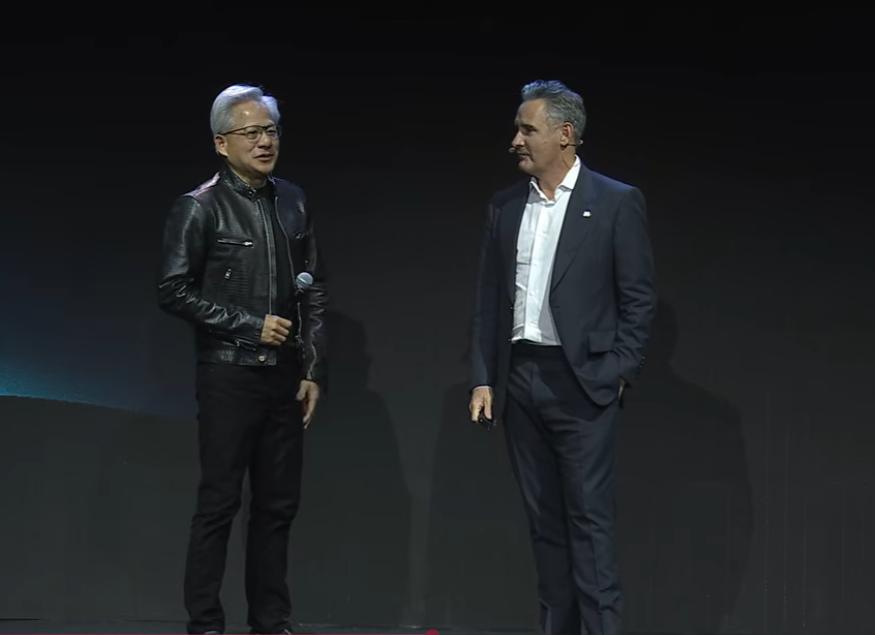
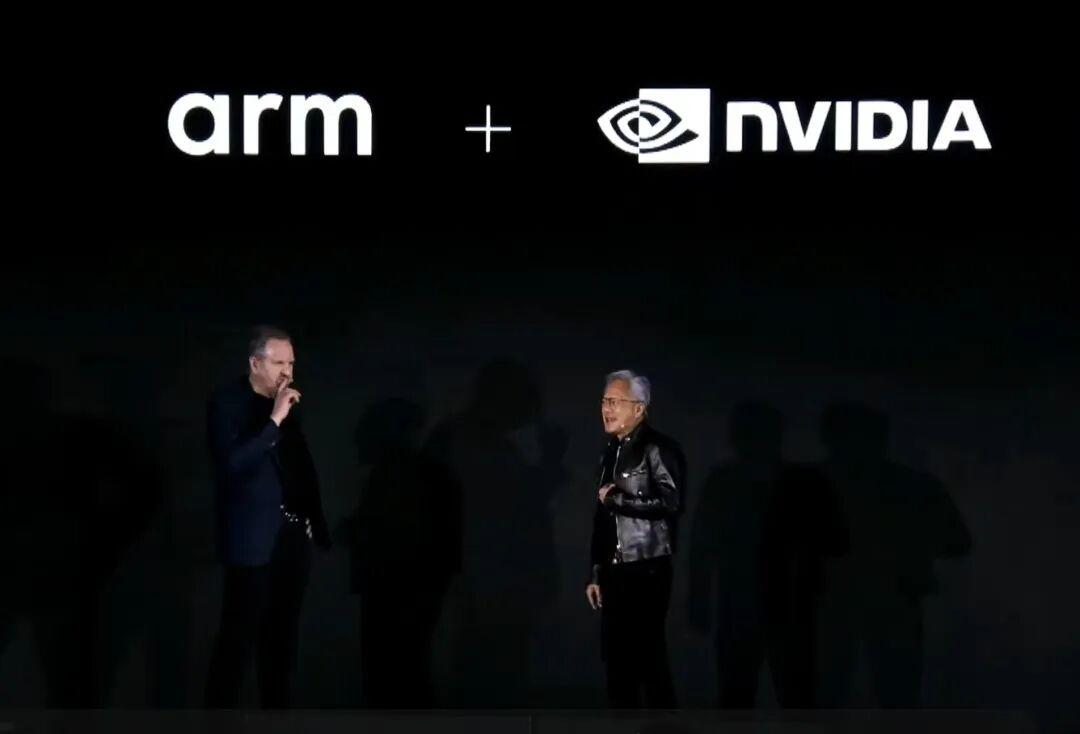
NVIDIA's entry into the PC market has attracted a great deal of attention. Notably, NVIDIA RTX Spark is based on the Arm architecture. Arm has been promoting Windows on Arm for a long time. NVIDIA's strong support this time is undoubtedly a shot in the arm for Arm. Arm is also very optimistic about this opportunity, and Jensen Huang also "gave his all" to support Arm, having a dialogue with Arm CEO Rene Haas at Computex.
The two pointed out that with the explosion of intelligent agent applications, the demand for CPUs is growing at a faster - than - expected rate, and the Arm architecture has obvious advantages in terms of energy efficiency and TCO. They believe that intelligent agents will not "kill" software or replace operating systems; instead, they will make tools and systems more crucial. NVIDIA released the PC chip RTX Spark based on the Arm architecture, promoting PCs to become intelligent agent terminals for local operation. Jensen Huang predicts that in the future, intelligent agents, robots, and autonomous driving will drive the computing industry to expand tenfold.
Power supply technology is another area of concern. Previously, NVIDIA officially finalized and promoted the 800V HVDC high - voltage direct - current architecture on a large scale and also disclosed a group of partners. Currently, all power supply manufacturers are continuing to increase their investment in 800V HVDC.
Power Integrations (PI) announced the launch of a space - saving and ultra - thin auxiliary power supply reference design for NVIDIA Kyber 800 VDC AI data centers.
Texas Instruments (TI) also presented multiple 800V demos at this year's Computex, including an 800V high - power - density AI server power supply, an 800V capacitor energy storage unit (CBU), an 800V to 6V DC/DC power distribution board, an 800V hot - swap solution, and an 800V 12V DC/DC power distribution board. Many of these solutions involve GaN (gallium nitride), indicating TI's determination regarding GaN.
Wolfspeed, a silicon carbide technology company, announced that it will expand its business in the rapidly growing data center market by establishing a dedicated data center solutions team and a regional office in the San Francisco Bay Area. Wolfspeed's newly established data center solutions team aims to cooperate more closely with leading hyperscale data center operators, original design manufacturers (ODM), and the entire ecosystem to create differentiated products and solutions for artificial intelligence and other data center applications.
In terms of power supply technology, MGX is becoming another focus for manufacturers. NVIDIA's MGX modular building - block architecture enables original equipment manufacturers (OEMs) and system builders to more quickly configure, deploy, and expand AI infrastructure, while reducing development complexity and accelerating time to market.
onsemi announced that it is expanding its role in the NVIDIA MGX ecosystem. onsemi's extensive product portfolio covering the "power link" enables it to support the "flexible mix - and - match" feature at the core of the MGX ecosystem. Currently, onsemi's relevant technologies have been applied in existing MGX systems, and there are growing opportunities in areas such as power field - effect transistors (FETs), multi - phase power supply solutions, SiC JFETs, and GaN technologies. The cooperation between the two parties will also expand to the emerging 800V direct - current (800 VDC) power supply architecture to support AI application environments with increasing computing density.
Infineon also announced its participation in NVIDIA's MGX program. The AI factory ecosystem will revolutionize the power delivery architecture to meet the needs of next - generation AI server racks. As a member of NVIDIA's MGX AI factory ecosystem, Infineon supports the complete power conversion process from 800 VDC all the way down to the intermediate bus voltage and processor core voltage in NVIDIA MGX - based systems, helping to reduce the number of conversion stages and bring the DC power supply point closer to the rack. This helps to improve power efficiency, simplify infrastructure, and support higher - density AI deployments.
Hardware determines the upper limit, and software determines the lower limit. EEWorld has noticed that EDA manufacturers are also continuously making arrangements around NVIDIA.
Cadence launched the industry's first fully autonomous virtual engineer powered by NVIDIA at Computex, specifically for the chip design field. In December last year, NVIDIA invested $2 billion in Synopsys and reached a strategic cooperation, highlighting the importance of EDA at present.
These manufacturers are also empowering AI
At Computex, NVIDIA is undoubtedly the focus of everyone's attention, but Intel is also quietly making efforts and not willing to be outdone.
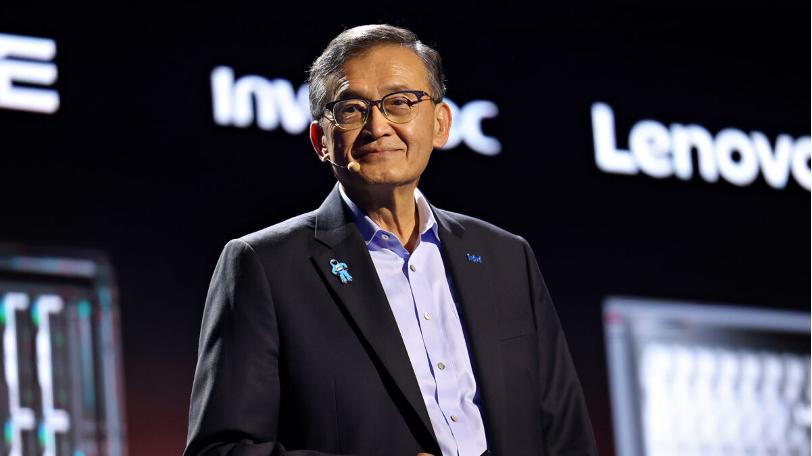
June 2nd was the first time since his appointment that Intel CEO Pat Gelsinger delivered a speech at COMPUTEX. Intel positioned this speech as a vision for the next era of AI - driven computing, covering areas such as AI PCs, the edge, and data centers. In the increasingly crowded situation of Arm architecture competitors, Pat Gelsinger's appearance was a crucial moment for Intel to showcase the impetus of its chip and software roadmaps.
Pat Gelsinger said that the company is using silicon as the cornerstone to drive an intelligent future. The third - generation Core Ultra processors based on the Intel 18A process have been applied in more than 325 PC designs, and the Arc G3 series optimized for handheld consoles has been launched. In the field of edge computing, Intel 18A has obtained more than 130 design cooperation projects. For AI data centers, Intel released the Xeon 6+ processor (288 cores) and pointed out that Agentic AI is driving the CPU - to - GPU ratio to change from 1:8 to 1:1. Intel is shifting to rack - level systems and cooperating with Foxconn, SambaNova, etc. to optimize inference energy efficiency. At the same time, the company provides custom chips for Google, Ericsson, etc., and promotes vertical industry solutions in fields such as energy and medicine.
The Arm ecosystem is also not to be outdone, and Arm's focus is on the direction of AI intelligent agents. At the Arm Everywhere event held on March 24th, Arm pointed out that intelligent agent AI will significantly increase the demand for CPUs in data centers. Just two months later, the market development speed has exceeded Arm's expectations.
At the COMPUTEX event, Arm announced that Oracle Cloud Infrastructure (OCI) has officially joined the Arm AGI CPU ecosystem. OCI's participation will further continue and expand the strong development momentum previously achieved by Arm at the Arm Everywhere event with customers such as Cerebras, Cloudflare, F5, Meta, OpenAI, Positron, Rebellions, SAP, SK Telecom, and Verda.
According to Arm, the Arm AGI CPU is specifically designed for the intelligent agent AI era, and its single - rack - level performance can be more than twice that of traditional x86 CPUs, enabling cloud service providers and AI infrastructure operators to significantly increase computing density within power consumption and heat dissipation constraints.
Qualcomm CEO Cristiano Amon's focus is also on AI. His speech focused on Qualcomm's agent - based AI strategy and its continuously expanding computing platform. Qualcomm detailed its next - generation Snapdragon X series platform, continuing to drive development in the Windows - on - Arm AI PC field.
These manufacturers are optimistic about data centers
How hot is the market? You can tell by looking at the increase in memory prices. During Computex, many manufacturers also successively released their latest forecasts, which undoubtedly provided strong evidence for the market's heat.
Microchip provided more information about its data center solutions business unit. Microchip President and CEO Steve Sanghi said: "Our extensive data center and computing end - market covers our product catalog, including MCUs, analog circuits, power management, timing, memory, and security products, as well as our client PC revenue. These product catalogs are all general - purpose products suitable for many end - markets, and the data center market is just one of them. Our data center and computing end - market accounts for about 18% of our total revenue. In this extensive end - market, we have a data center solutions business unit dedicated to producing products for data centers."
Steve Sanghi introduced that the data center solutions business unit has three major product lines: storage controllers/expanders/accelerators, PCIe and CXL memory controllers, and Switchtec PCIe switches and retimer business. These product lines cover multiple generations, including the recently launched industry's first 3nm Gen6 PCIe switch and a new G6 retimer product line with backward compatibility. The data center solutions business unit generated revenue of $302.7 million in the 2025 calendar year and is expected to continue growing in the next few years. It is expected that by 2026, with the continuous accelerated growth of the business unit's revenue, the revenue will increase by about 65% to approximately $500 million. In the first quarter of 2026, the revenue of the data center solutions business unit increased by 62.9% compared to the same period last year.
In view of the continuously strong demand for artificial intelligence infrastructure and the recent progress in capacity improvement, STMicroelectronics, a global semiconductor leader serving customers in the electronic application field, has raised its revenue target for the data center business. It is currently expected that by 2026, the data center revenue will reach approximately $1 billion (previously expected to be "well over $500 million"). Assuming the current growth momentum continues and the ongoing projects are advanced, the revenue may double by 2027 (previously expected to be "well over $1 billion").
Conclusion
As Jensen Huang's figure in a leather jacket shuttles between various exhibition halls and stages at Computex, a clear industrial picture has emerged: AI is no longer a one - man show but a collaborative evolution of the entire industrial chain. From Marvell's optical interconnection to Arm's CPU architecture, from the power supply solutions of TI, onsemi, and Infineon to the EDA tools of Cadence and Synopsys, the entire semiconductor ecosystem is accelerating its reconstruction with NVIDIA at the core. We can also see a change in the industry: the competition in AI is shifting from the chips themselves to the competition of system - level capabilities.
This article is from the WeChat official account "EEWorld" (ID: EEWorldbbs), author: Fu Bin, published by 36Kr with authorization.