Sanofi and Novo Nordisk Make Moves: Can This Biotech Win the Race in the Weight Loss Market with a 1.333 Billion Yuan Financing?
The weight loss track has entered the deep - water zone. It is no longer an era where wild growth can be achieved by relying on a single target, a single sequence, or a single round of financing.
Recently, Alveus Therapeutics, a U.S. clinical - stage biopharmaceutical company (hereinafter referred to as Alveus), officially entered the global spotlight with an over - subscribed Series A financing of up to $197 million (approximately 1.333 billion RMB) in two tranches.
The first tranche of $159.8 million was co - led by New Rhein Healthcare Investors, Andera Partners, and Omega Funds, with a group of industrial VCs such as Sanofi Ventures following. The second tranche received support from Jeito Capital and Novo Holdings, further strengthening the capital lineup and making it one of the most notable early - stage financings in the global weight loss drug field in recent years.
This money will be invested in the clinical advancement of the core pipeline and the IND application for the early - stage pipeline. How can a newly launched Biotech secure high - value early - stage funds, attract many top - tier industrial capitals, and quickly push its pipeline into the clinical stage?
Antagonist + Agonist Combination Mechanism Specializes in Weight Maintenance
While Novo Nordisk and Eli Lilly have built a complete barrier covering basic research, clinical development, and commercialization, many startups are still struggling to survive in a crowded and uncertain environment: either competing on price and speed in the me - too involution, or repeatedly making mistakes in unproven new mechanisms, with a very low survival rate.
The difference lies in whether it's a giant or a stone being groped for while crossing the river.
In contrast, Alveus is undoubtedly lucky. It was born with a silver spoon in its mouth, never lacking a course, crew, or supplies. Alveus was not naturally spawned from laboratory molecules, nor did it start from scratch in the ordinary sense. Instead, it is a project carefully planned and directionally incubated by New Rhein Healthcare Investors.
As an institution deeply involved in the life - science field in Europe and the United States and conducting early - stage investments with a private - equity mindset, New Rhein is good at inferring product value from the perspective of strategic buyers. It doesn't bet on unproven cutting - edge mechanisms. Instead, it first locks in the track, then builds a team, and finally matches assets, using mature industrial logic to reduce the uncertainty of early - stage R & D.
Therefore, entering the field of obesity and metabolic diseases at this time is not accidental. As the global obesity drug market approaches the scale of tens of billions of dollars, there are still clear unmet clinical needs: Although existing therapies can achieve short - term weight loss, they are difficult to support patients in maintaining their weight in the long term, and there is still room for optimization in terms of tolerance and convenience of administration.
To make this path work, New Rhein assembled a luxurious team for Alveus: CEO Raj Kannan has more than thirty years of experience in global biopharmaceutical operations. He has served as the CEO of three companies, Tianjin Biopharmaceuticals, Aerie Pharmaceuticals, and Chiasma, leading product commercialization, mergers and acquisitions, and corporate transformation. He is good at converting R & D pipelines into commercial value.
Chief Scientific Officer Dr. Jacob Jeppesen comes from the core management of Novo Nordisk. He served as the vice - president of research on type 2 diabetes and cardiovascular diseases and the head of the therapeutic area, deeply involved in the clinical transformation of core weight - loss pathways such as GLP - 1 and GIPR. He has first - line practical experience in the full - process R & D of metabolic diseases from early discovery to clinical candidate drugs.
Chief Commercial and Strategy Officer Dr. Brian Bloomquist worked at Eli Lilly for nearly twenty years, serving as the vice - president of external innovation for diabetes, obesity, and complications. He has led many major collaborations and project introductions, is familiar with the pipeline layout, transaction logic, and strategies of giants in the global weight - loss track, and is a key figure connecting technology and business.
Chief Technology Officer Dr. Xiaoping Dai has more than twenty years of experience in biopharmaceutical development and production. He has served as the CTO of IVERIC and the chief technology expert of WuXi Advanced Therapies, and has held important positions at Celgene and Bristol - Myers Squibb. He was deeply involved in the CMC development and commercialization of products such as Opdivo and Yervoy, ensuring the stable and feasible transition of candidate drugs from the laboratory to industrialization.
This team is not a simple collection of talents but covers the entire chain of R & D, clinical, business, and production. Each core member has successful experience from molecule to market, compressing the common trial - and - error costs and time cycles of startups from the source.
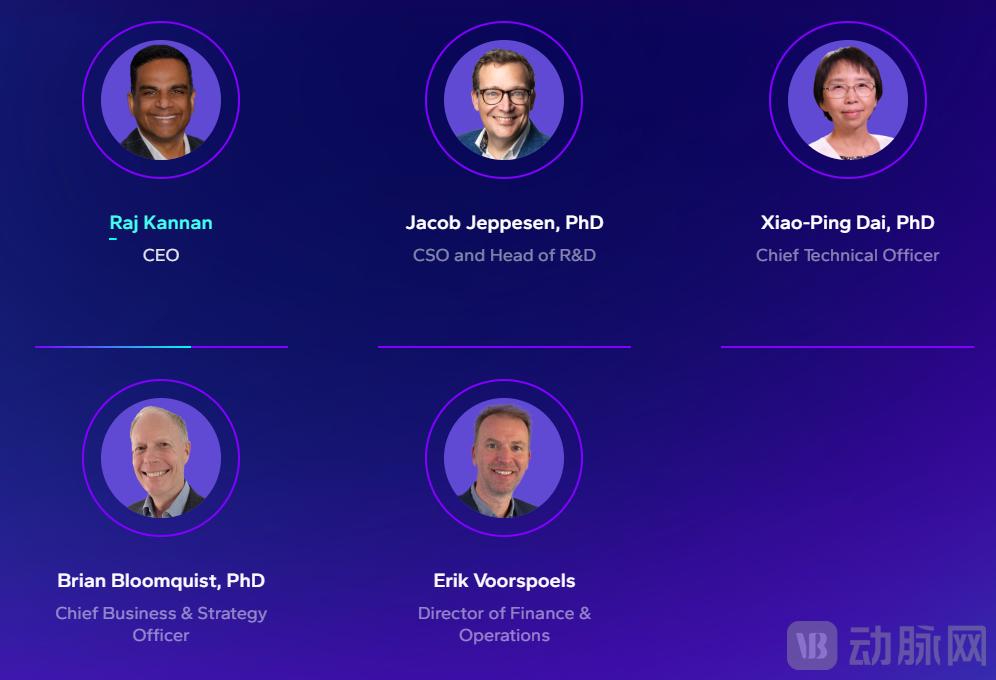
Alveus team (Image source: Alveus official website)
License - in Chinese Pipeline and Independent R & D Go Hand in Hand
After clarifying the track and the team, Alveus quickly established its R & D positioning: not engaging in homogeneous competition, relying on mechanisms fully verified by human genetics and clinical practice, and taking a differentiated innovation route. Alveus avoids high - risk new targets and focuses on mature pathways such as GLP - 1R, GIPR, and amylin receptor, concentrating its R & D on long - term weight maintenance, improvement of treatment tolerance, and improvement of body composition, trying to solve problems commonly existing in current weight - loss drugs, such as weight rebound, obvious side effects, and poor long - term compliance.
In terms of pipeline layout, Alveus adopts a dual - drive model of "license - in + independent development". Its core asset, ALV - 100, is licensed from Hongyun Huaning, a clinical - stage pharmaceutical company in Hangzhou, China. In 2024, Alveus reached a cooperation with Hongyun Huaning and obtained the global development and commercialization rights of ALV - 100 outside the Greater China region. As a fusion protein of a recombinant humanized GIPR antagonist IgG4 antibody and a GLP - 1R agonist polypeptide, ALV - 100 clearly differentiates itself from the mainstream products in the current weight - loss track at the mechanism level.
Among the two weight - loss drugs with the leading global market share, Novo Nordisk's semaglutide is a single - target GLP - 1R agonist, and Eli Lilly's tirzepatide adopts the R & D concept of a GIPR/GLP - 1R dual agonist. Both are mainstream and mature solutions fully verified in clinical practice. The "receptor antagonist + agonist" combined mechanism selected by ALV - 100 is also supported by human genetic evidence: Population studies show that loss - of - function mutations in GIPR can effectively reduce an individual's BMI level and improve overall cardiometabolic indicators.
ALV - 100, independently developed by Hongyun Huaning, achieves a longer half - life and lower dosing frequency through an antibody - polypeptide fusion structure. Pre - clinical research data show that ALV - 100 performs excellently in the pharmacological activity in an obese non - human primate model. While achieving efficient fat and weight loss, it can effectively preserve the body's lean body mass. The preliminary results of the Phase I clinical trial further verify its core value in weight loss and long - term weight maintenance. In January 2026, ALV - 100 received FDA IND approval and started the Phase 1b trial, and is expected to enter Phase III clinical trials in 2027.
After quickly supplementing its clinical - stage assets with ALV - 100, Alveus built a hierarchical early - stage pipeline around the amylin pathway to further build a differentiated competitive barrier. Currently, most amylin analogs under research globally are amylin - calcitonin receptor (CTR) dual agonists, and gastrointestinal adverse reactions have always been the core bottleneck restricting their clinical tolerance and patient compliance. Alveus' R & D team clarified through mechanism analysis that the core metabolic benefits (including lean body mass maintenance) brought by amylin are mainly mediated by the AMYR3 receptor, while gastrointestinal side effects such as nausea and vomiting are mainly due to the activation of the CTR receptor.
The highly selective AMYR3 peptide agonist ALV - 200 developed based on this mechanism discovery has been proven in pre - clinical models to fully retain the weight - loss and feeding - inhibition effects while having high selectivity for CTR. Its pharmacokinetic characteristics support once - a - week dosing, and it has now entered the preparation stage for IND application. In addition, Alveus has simultaneously laid out an oral amylin pipeline and plans to start the first - in - human clinical study within 18 months.
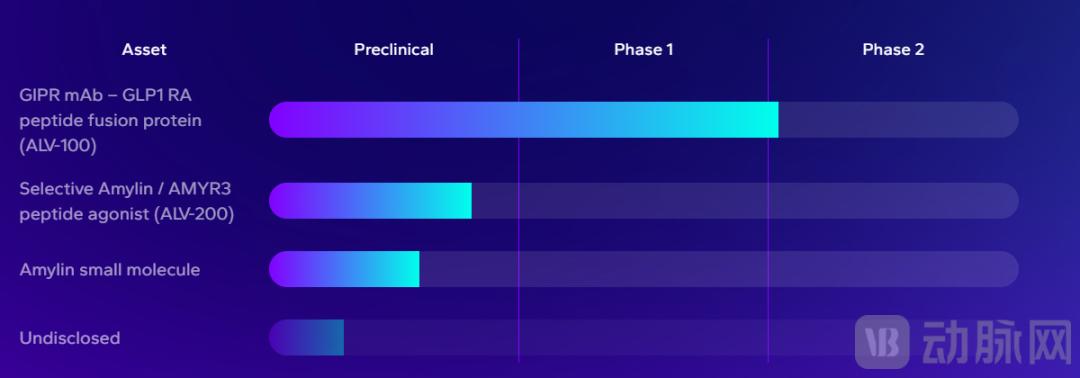
Alveus' existing pipeline (Image source: Alveus official website)
On the Eve of Commercialization
The establishment of Alveus is essentially a typical operation by an investment institution to predict the gap from an industrial perspective and then fill it with capital and resources. This incubation logic is not an isolated case. When the two oligarchs completely opened up the multibillion - dollar metabolic disease market with GLP - 1 drugs, global medical investment institutions are using this mature industrial incubation paradigm to try to seize opportunities in the gaps left by the giants.
A typical example is Metsera, jointly incubated and established in 2022 by ARCH Venture Partners, a top - tier global medical venture - capital institution, and Population Health Partners. Its R & D layout is centered around three verified and mature pathways: GLP - 1, GIP, and GCGR. After its establishment, Metsera acquired Zihipp, a UK peptide technology company, obtaining its molecular library containing 20,000 proprietary nutrient - stimulated hormone (NuSH) peptides and peptide/antibody conjugates, as well as an injectable product pipeline. At the same time, it reached a licensing cooperation agreement with South Korean biotech company D & D Pharmatech, obtaining the global exclusive development rights to its peptide drug oral delivery platform.
Metsera deeply integrated the acquired and self - developed technologies, targeting a differentiated R & D direction of long - acting administration and lower gastrointestinal side effects, and focusing on the development of long - acting monthly metabolic formulations. The core pipeline, MET - 097i, completed the Phase 2b clinical study. Clinical data showed that the 1.2mg dose group achieved an average weight loss of 11.3% after placebo correction on the 85th day, and the weight loss further climbed to 15% on the 115th day; the product has built significant differentiated advantages in terms of long - acting administration potential, safety, and tolerance.
Metsera listed on the NASDAQ in January 2025, and in November of the same year, it was fully acquired by Pfizer at a total transaction consideration of approximately $10 billion. From its establishment to being acquired by a giant, Metsera only took three years, becoming an example of institutional incubation, pipeline supplementation through mergers and acquisitions, and takeover by a pharmaceutical giant in the biopharmaceutical field.
Another company, Versanis Bio, also replicated this mature industrial closed - loop model. Versanis was initiated and incubated in 2021 by Aditum Bio, a life - science incubation institution co - founded by former Novartis CEO Joe Jimenez, and co - invested by top - tier global medical funds such as Atlas Venture and Medicxi, deeply deploying in the field of obesity and metabolic diseases. After its establishment, Versanis Bio obtained the global exclusive development rights to the core antibody asset Bimagrumab from the incubator Aditum Bio. This asset was originally developed by Novartis and then its rights were transferred to Aditum Bio.
Bimagrumab targets the ActRII (activin type II receptor) target. Versanis focuses on promoting its Phase IIb BELIEVE clinical study of using Bimagrumab alone or in combination with semaglutide to treat adult obese and overweight patients, evaluating the clinical efficacy of monotherapy and combination therapy, highlighting the differentiated value of weight loss while preserving muscle, and filling the clinical application gap of single GLP - 1 preparations. In August 2023, Eli Lilly completed the acquisition of Versanis, with a maximum transaction consideration of $1.925 billion. Eli Lilly plans to combine incretin - based drugs with Bimagrumab to achieve both weight loss and muscle preservation, further consolidating its industry barrier in the metabolic weight - loss field. This acquisition also makes Versanis another classic example of incubation, asset revaluation, and integration and acquisition by giants in the metabolic track.
These cases, together with Alveus, outline this incubation scenario: It subverts the traditional growth path of Biotech, which is "scientists come out with technological achievements to raise funds, then build a team, and gradually verify drugability". Through industrial prediction and resource integration, it pre - positions, disperses, or even avoids risks in advance. The reason why this model can be quickly replicated and widely adopted in the weight - loss track is essentially determined by the industrial characteristics of this field.
On the one hand, the weight - loss drug market has achieved a breakthrough from 0 to 1. Semaglutide and tirzepatide have verified the commercial ceiling and payment willingness of this track with annual sales of over billions of dollars. Capital no longer needs to bear the risk of market education, but only needs to find assets that can fill the differentiated gaps in the product matrix of giants. On the other hand, the core biological mechanisms of the weight - loss track have been fully verified by human genetics and clinical practice. The drugability of the targets has been repeatedly proven. There is no need to bet on the conversion success rate of basic research. Only by optimizing the mechanism design, molecular structure, and administration method to solve the pain points of existing therapies can clear clinical and commercial values be formed.
More importantly, the arms race of global pharmaceutical giants in the weight - loss track has reached a white - hot stage. Companies such as Novo Nordisk, Eli Lilly, Sanofi, AstraZeneca, and Roche are all quickly completing their pipeline layouts through mergers and acquisitions. Differentiated assets targeting the pain points of existing therapies can always get high - premium acquisition offers from giants, providing a clear and stable exit path for incubation projects. This is also the core underlying logic for top - tier institutions to continuously invest heavily in this incubation model.
For Alveus, this mature model undoubtedly paves a relatively smooth starting path, but it doesn't mean it can win this competition without suspense. The current weight - loss market has entered an era of all - around involution. Eli Lilly's oral GLP - 1 weight - loss drug Orforglipron was approved for marketing in the United States in April this year, and Novo Nordisk's high - dose Phase III study of its next - generation weight - loss product CagriSema is scheduled to start in the second half of this year.
There are also several me - better products with the same targets and mechanisms being advanced simultaneously globally. Whether the differentiated advantages of ALV - 100 can be fully verified in clinical practice and whether it can gain sufficient market share in a market surrounded by giants still have considerable uncertainties. And its self - developed amylin pipeline also faces direct competition from products with the same targets from companies such as Roche and Pfizer.
This article is from the WeChat official account "Arterial Network" (ID: vcbeat), author: Miaoxin Yu. It is published by 36Kr with authorization.