Seven billionaires worth 50 billion yuan each are born, aiming for an IPO worth 1 trillion yuan.
A new super IPO is emerging in the AI industry.
On June 1st, according to multiple media reports, Anthropic has officially submitted a confidential IPO application to the US SEC.
Just three days ago, the company completed a $65 billion Series H financing round, with a post - investment valuation reaching $965 billion (approximately 6.9 trillion RMB). This figure has exceeded OpenAI for the first time.
As a result, Anthropic has become the world's most highly valued AI company. If the IPO proceeds smoothly, it may become one of the largest technology IPOs globally in recent years.
What's even more astonishing is that this company has only been established for five years, and its founding team consists of only seven people, all of whom come from OpenAI.
Based on the current valuation, the net worth of the seven co - founders is also astonishing. However, due to the relatively low actual shareholding ratio (generally less than 1%), the calculation methods of different institutions vary.
Bloomberg estimated based on the internal equity structure that each person holds approximately 0.83% of the shares, with a net worth of about $8 billion (approximately 57 billion RMB). The total net worth of the seven people is about $56 billion (380 billion RMB).
Creating seven billionaires in a single day is the highest record set by a single company since the establishment of the Bloomberg Billionaires Index.
Perhaps the most astonishing aspect of Anthropic is not its valuation, but rather that it is enabling the entire AI industry to truly witness for the first time that AI has begun to take over the high - paying labor market.
$965 billion, approaching a "national - level company"
Many people have no concept of $965 billion. To put it another way, Anthropic's current valuation has exceeded that of AMD, Intel, Uber, Salesforce, and Qualcomm, and is approaching the total value of some technology companies in the German DAX index. And Anthropic has only been established for five years.
What's even more terrifying is its growth rate. In September 2025, Anthropic's valuation was only $183 billion, and now it's $965 billion, a nearly five - fold increase in eight months. If we look back further, at the beginning of 2024, Anthropic's valuation was only about $6 billion, more than a 150 - fold increase in just over a year. This may be one of the fastest valuation growth records in the history of large - scale global technology companies.
On average, Anthropic theoretically adds about $2 billion in valuation per day, equivalent to creating a unicorn every day.
Why does the capital market dare to offer such a crazy price? There's only one answer: revenue.
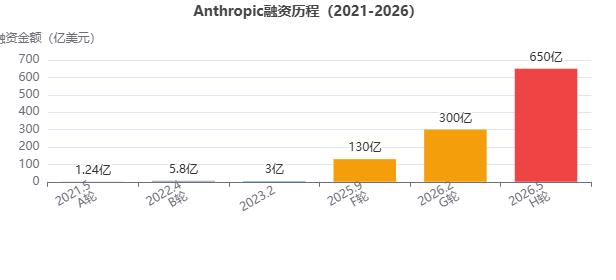
Anthropic's financing history (2021 - 2026); Data source: Crunchbase / Caijing Magazine
A 5400 - fold increase in revenue in 27 months
What truly supports Anthropic's $965 billion valuation is not just a concept, but its almost out - of - control revenue growth.
According to CEO Dario Amodei, since Anthropic received its first revenue, it has been growing at a rate of about ten times per year.
Public data shows that the ARR in 2022 was about $10 million, in 2023 it was about $100 million, at the end of 2024 it was about $1 billion, in September 2025 it was about $7 billion, in December 2025 it was about $9 billion, in February 2026 it was about $14 billion, in April 2026 it was about $30 billion, and in May 2026 it had exceeded $44 billion.
What does this mean? In 27 months, from $87 million to $44 billion, a growth of about 5400 times. This growth rate far exceeds that of the traditional SaaS era and even surpasses the growth records of many Internet companies.
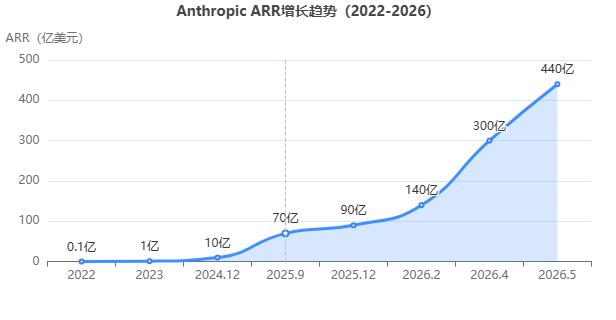
Anthropic's ARR growth trend (2022 - 2026); Data source: Disclosed by CEO Dario Amodei / China Fund News
The core growth engine of Anthropic is not the chatbot, but Claude Code. This is an AI programming product launched by Anthropic. In just half a year since its launch, its ARR has exceeded $1 billion. In contrast, most SaaS companies in history have taken more than ten years to reach an ARR of $1 billion. Claude Code achieved this in just half a year.
Even more astonishing is that currently, about 4% of the open - source code on GitHub has been generated with the participation of Claude. One out of every 25 newly added lines of code globally comes from Anthropic.
In the SWE - bench Verified evaluation, Claude Code scored 93.9%, far exceeding OpenAI Codex's 80.8%. What the capital market is really betting on is not the chatbot, but the fact that AI is starting to take over programmers.
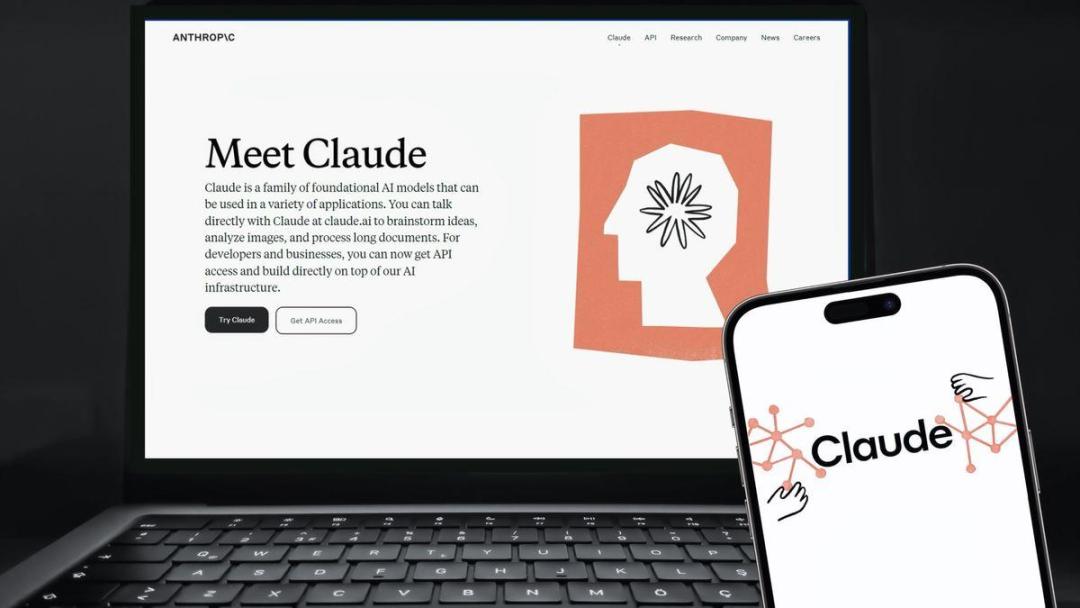
Anthropic Claude product interface; Image source: Anthropic official website
1000 companies pay it $1 million annually
The truly terrifying aspect of Anthropic is not the consumer (C - end) market, but the business (B - end) market, that is, the enterprise market.
Public data shows that there are more than 1000 enterprise customers of Anthropic who pay more than $1 million annually. If simply calculated, the theoretical annual revenue from these customers alone has exceeded $1 billion.
More importantly, these are not ordinary companies, but Cursor, Notion, Zoom, Slack, financial institutions, and global software companies. In the past year, Anthropic's market share in the enterprise market has increased from about 10% to over 65%.
A major change is occurring in the AI industry: it's not ordinary people spending money on AI, but enterprises starting to allocate budgets of millions or even tens of millions of dollars to purchase AI labor.
Liu Run, the founder of Runmi Consulting, summarized it straightforwardly: OpenAI sells emotional value, while Anthropic sells productivity.
OpenAI enables people to chat, draw pictures, and create videos, while Anthropic enables enterprises to automatically write code, conduct automatic approvals, perform automatic analysis, migrate systems automatically, and carry out risk control automatically. And the money in the B - end market is far greater than that in the C - end market.
OpenAI nurtured its biggest rival with its own hands
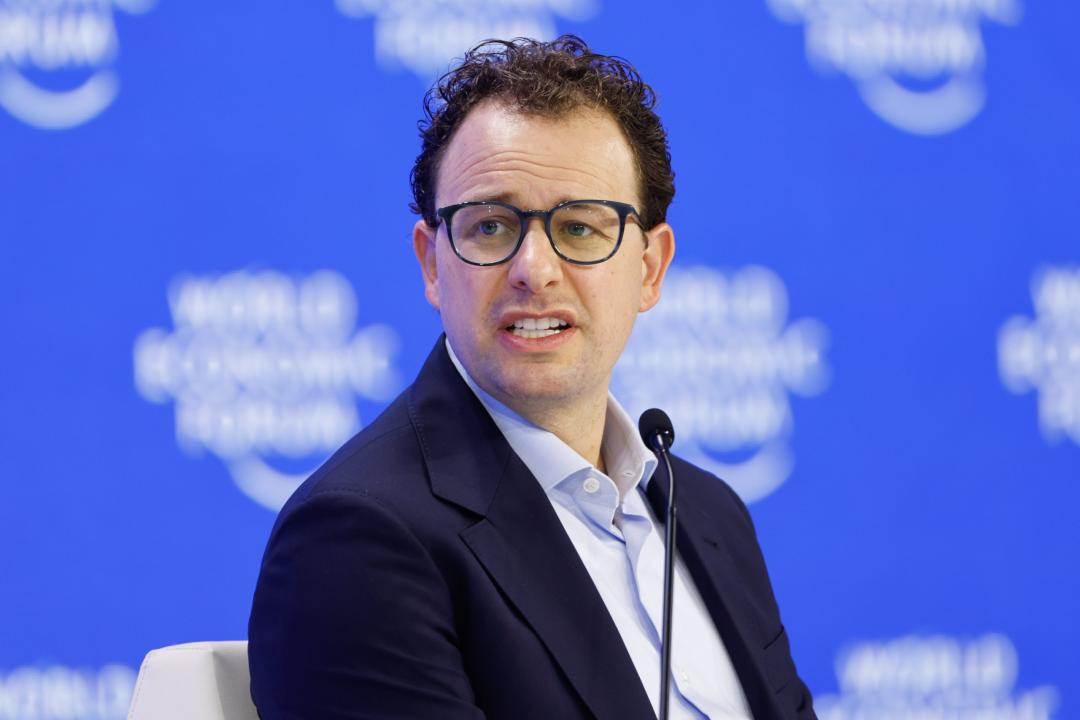
Dario Amodei (Anthropic CEO); Image source: World Economic Forum / TechCrunch
The story of Anthropic is essentially an "internal split" of OpenAI.
Back in 2020, when GPT - 3 was just released, OpenAI was at the height of its popularity. At that time, Dario Amodei, the founder of Anthropic, was still the vice - president of research at OpenAI, in charge of the core R & D of GPT - 2 and GPT - 3.
OpenAI once allocated 50% - 60% of its total computing power to him. It can be said that Dario was one of the most core figures in the development of GPT - 3.
However, as OpenAI became more and more commercialized, internal routes began to split. According to multiple media reports, OpenAI once discussed whether it was possible to sell AGI capabilities to global nuclear - powered countries in the future, which Dario could not accept at all. In his view, AGI should not be a tool for unlimited profit - seeking.
Finally, at the end of 2020, Dario decided to leave OpenAI. Moreover, he didn't leave alone. He directly took five core researchers from OpenAI with him: Tom Brown, the core author of GPT - 3; Jared Kaplan, the author of the Scaling Laws paper; Chris Olah, an expert in AI interpretability research; Jack Clark, the head of OpenAI's policy; and Sam McCandlish, an OpenAI researcher. Together with his sister Daniela Amodei, there were a total of seven people.
In 2021, Anthropic was established. The company name "Anthropic" means "related to humans". No one expected that five years later, the company's valuation would reach $965 billion.
And OpenAI has truly encountered its most dangerous rival for the first time.
Why can seven people get rich together?
The most counter - intuitive thing about Anthropic is: equal rights for equal shares. The seven founders hold almost exactly the same amount of shares (currently less than 1%).
Many people thought this design would fail back then because the Silicon Valley startup logic has always been that there must be an absolute core founder. But Dario believes that Anthropic is not built around an individual, but around a mission. As a result, this "seemingly stupid" decision has instead become Anthropic's strongest stabilizer.
Most of the 11 core founding members of OpenAI have left, while all seven co - founders of Anthropic are still there after five years.
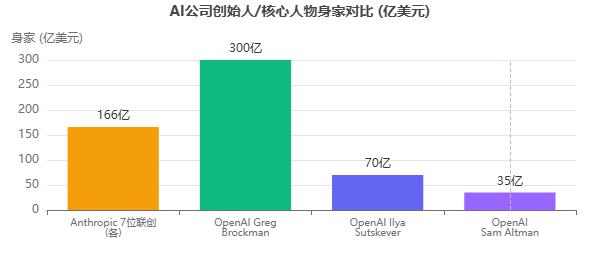
Comparison of the net worth of AI company founders/core figures; Data source: Forbes / Bloomberg Billionaires Index
According to public data, Anthropic's two - year talent retention rate is about 80%, higher than OpenAI's 67%. There has even been a rare situation where many CTOs of star companies are willing to take a demotion and join Anthropic as ordinary engineers. Because in the current AI industry, what's most valuable is not the position, but the equity.
Who else is making huge profits?
There is a long list of winners behind Anthropic's latest financing round.
The most astonishing one is Google. In 2023, Google only spent $300 million to acquire about 10% of Anthropic's shares. Based on the $965 billion valuation, this part of the equity is worth about $96.5 billion, a more than 300 - fold increase in three years.
Amazon has also made huge bets, with cumulative investments exceeding $13 billion. The reason is simple: Anthropic needs computing power, and Amazon needs AI traffic, and the two sides have been deeply bound.
Even more surprisingly, Anthropic currently pays about $1.25 billion in computing power fees to SpaceX every month, with a three - year contract worth nearly $45 billion.
In other words, Anthropic is not only creating AI billionaires, but also feeding GPU manufacturers, cloud service providers, storage providers, data centers, power companies, and even the entire AI industry chain. The AI industry has entered a real "arms race".
The fastest wealth - creation in AI history has just begun
However, problems are starting to emerge.
First, most of Anthropic's current wealth is only on paper. The company has not officially gone public yet, and many shares cannot be cashed out.
Second, AI is extremely capital - intensive. Public data shows that Anthropic's annual computing power cost is about $15 billion, and the computing power cost still accounts for more than 50% of its revenue.
Third, the $965 billion valuation is approaching the "perfect expectation", which means that as long as the growth slows down slightly, the valuation pressure will be extremely high.
However, even so, the capital market is still making crazy bets. Because everyone has begun to realize that the truly profitable stage of the AI industry may have just begun.
In the past, the Internet made money from advertising, and the mobile Internet made money from traffic. What AI really wants to make is the money from human labor. Code writing, customer service, analysis, research, operation, sales... More and more jobs that used to require "people" are being taken over by large models.
Five years ago, the seven founders of Anthropic chose to leave OpenAI collectively because they were dissatisfied with its increasingly radical commercialization route. Five years later, the company they founded has a higher valuation than OpenAI.
Perhaps the most terrifying thing about Anthropic is not its $965 billion valuation, but that it has enabled the whole world to truly witness for the first time that AI has begun to take over the high - paying labor market.
This article is from the WeChat official account “Pencil News” (ID: pencilnews), author: Honest One. Republished by 36Kr with authorization.